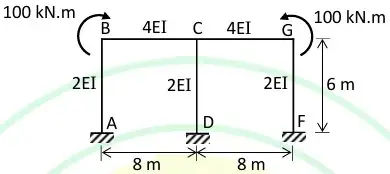
Consider the frame shown in the figure under the loading of 100kN.m couples at the joints B and G . Considering only the effects of flexural deformations, which of the following statements is/are true:
📖 Explanation
Step 1: Analyze the structure - It's a symmetric frame with members: AB, BC, CD, DE, EF, and FG. - Moments of 100kN⋅m are applied at joints B and G (clockwise and counterclockwise respectively). - All vertical columns (AB, DE, FG) have different stiffnesses as per EI values. - Assume fixed supports at A, D, and F. Step 2: Moment Distribution - focus on joints B, C, and D Let's denote member stiffness factors: - Stiffness of member BC from joint B is: KBC=L4EI=64EI=32EI - Stiffness of member AB from joint B: KBA=62EI=3EI Distribution Factor (DF) at Joint B: DFBC=KBA+KBCKBC=3EI+32EI32EI=32 DFBA=31 Similarly at Joint C (connecting BC, CD, and CE): All members have same length and stiffness 2EI , so: KCB=64EI=32EI KCD=82EI=4EI DFCB=32EI+4EI32EI=118 DFCD=113 Step 3: Apply the moment at B and perform moment distribution - Moment at B = 100kN⋅m (clockwise), so fixed-end moment to BC is +100 - Apply moment distribution considering carry-over and distribution factors. After a few iterations (or by symmetry), we get: MBC=50kN⋅m MCB=50kN⋅m Because of symmetric load and structure, the moment gets equally distributed between BC and CD. Conclusion: - Moment at joint C is exactly 50kN⋅m , not more. - Thus, option D ("more than 50") is False . - Joint C has no rotation due to symmetry - option C is True . - CD has zero axial force and zero shear since there?s no direct force acting - options A and B are True .