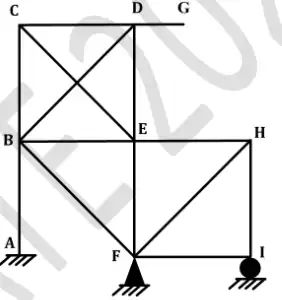
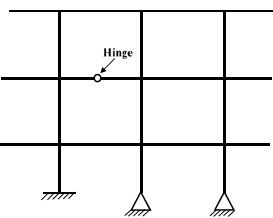
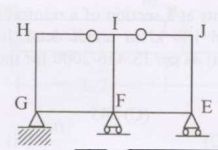
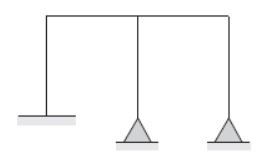
From inextensibility of BF and BA, ΔBx=0ΔBy=0 From inextensibility of BE and EF , ΔEx=0ΔEy=0 From inextensibility of CE and BC ΔCx=0ΔCy=0 From inextensibility of BD and CD , ΔDx=0ΔDy=0 From inextensibility of DG, ΔGX=0 From inextensibility of EH and HF , ΔHx=0ΔHy=0 From inextensibility FI , Δlx=0 ⇒ If at joint (F),FB,FE,FH,FI are rigidly connected then possible displacements at F=θF . If at joint I, FI and IH are rigidly connected, possible displacements at I=θI . Hence unknown joint displacements are θB,θC,θD,θE,θF,θG,ΔGy,θH,θI ⇒Dk=9 Note: However, if somebody assumes all members at joint (F) to be connected with pin then at (F) we have unknown joint displacements as θFB,θFE,θFH,θFl . Similarly, if at joint I if somebody assumes FI and HI to be pin connected then unknown joint displacements at I are θIF,θIH . Hence, Dk will increase by 4 . ⇒Dk=9+4=13