GATE CE · Geotechnical Engineering
Generate GATE-level questions on Stress Distribution In The Soil in Geotechnical Engineering. Focus on core concepts, previous year patterns, and numerical problem-solving techniques.
16 questions · 16 PYQs · 0 AI practice · GATE CE 2027
🎯 These are sample questions
Just sign in to unlock everything. Free for all students.
Which of the following statements is/are INCORRECT ?
An unconfined compression strength test was conducted on a cohesive soil. The test specimen failed at an axial stress of . The undrained cohesion (in , in integer) of the soil is ___
Consider that a force is acting on the surface of a half-space (Boussingesq's problem). The expression for the vertical stress at any point with the half-space is given as, where, is the radial distance, and is the depth with downward direction taken as positive. At any given , there is a variation of along , and at a specific , the value of will be maximum. What is the locus of the maximum ?
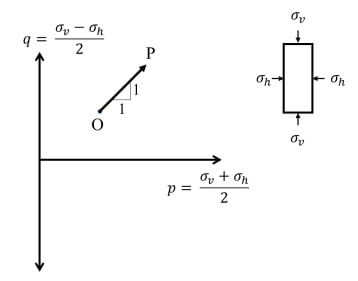
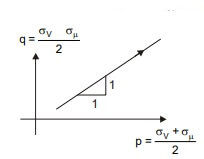
In the given figure, Point indicates the stress point of a soil element at initial non-hydrostatic stress condition. For the stress path (OP), which of the following loading conditions is correct ?

A concentrically loaded isolated square footing of size 2 m x 2 m carries a concentrated vertical load of 1000 kN. Considering Boussinesq's theory of stress distribution, the maximum depth (in m) of the pressure bulb corresponding to 10% of the vertical load intensity will be ________. (round off to two decimal places)
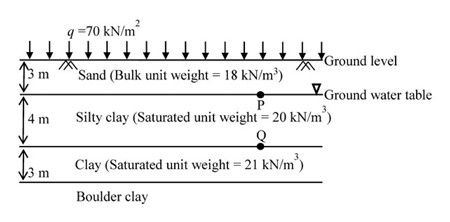
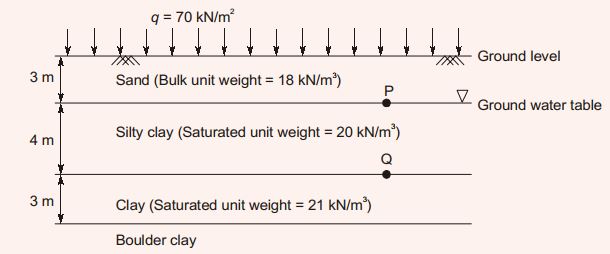
The soil profile at a site up to a depth of 10 m is shown in the figure (not drawn to the scale). The soil is preloaded with a uniform surcharge (q) of 70 at the ground level. The water table is at a depth of 3 m below ground level. The soil unit weight of the respective layers is shown in the figure. Consider unit weight of water as 9.81 and assume that the surcharge (q) is applied instantaneously. Immediately after preloading, the effective stresses (in kPa) at points P and Q respectively, are

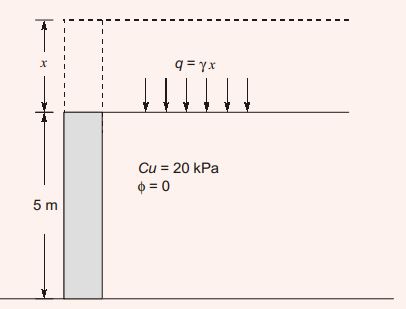
A 5 m high vertical wall has a saturated clay backfill. The saturation unit weight and cohesion of clay are and 20 kPa, respectively. The angle of internal friction of clay is zero. In order to prevent development of tension zone, the height of the wall is required to be increased. Dry sand is used as backfill above the clay for the increased portion of the wall. The unit weight and angle of internal friction of sand are and , respectively. Assume that the back of the wall is smooth and top of the backfill is horizontal. To prevent the development of tension zone, the minimum height (in m, round off to one decimal place) by which the wall has to be raised, is __________.
Which one of the following statements is NOT correct?
A concentrated load of 500 kN is applied on an elastic half space. The ratio of the increase in vertical normal stress at depths of 2m and 4m along the point of the loading, as per Boussinesq's theory, would be ___
A 2mx 4m rectangular footing has to carry a uniformly distributed load of 120 kPa. As per the 2:1 dispersion method of stress distribution, the increment in vertical stress (in kPa) at a depth of 2m below the footing is ________
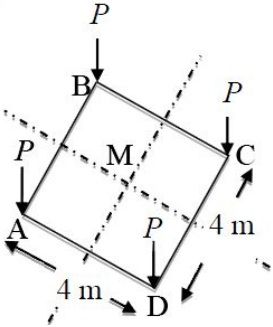
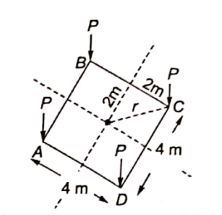
Consider a square-shaped area ABCD on the ground with its Centre at M as shown in the figure. Four concentrated vertical load of P=5000 kN are applied on this area, at each corner. The vertical stress increment (in kPa, up to one decimal place) due to these loads according to the Boussinesq's equation, at a point 5 m right below M, is_____

A uniformly distributed line load of 500 kN/m is acting on the ground surface. Based on Boussinesq's theory, the ratio of vertical stress at a depth 2 m to that at 4 m, right below the line of loading, is
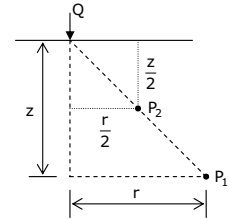
The vertical stress at point P1 due to the point load Q on the ground surface as shown in figure is . According to Boussinesq's equation, the vertical stress at point P2 shown in figure will be

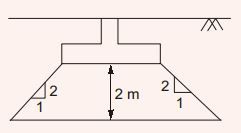
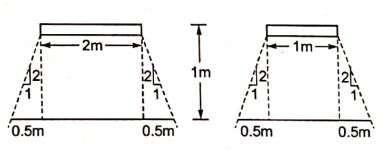
A footing exerts a uniform pressure of 150 kN/ on the soil. Assuming a load dispersion of 2 vertical to 1 horizontal, the average vertical stress (kN/ ) at 1.0 m below the footing is
The vertical stress at some depth below the corner of a 2m x 3m rectangular footing due to a certain load intensity is 100 kN/ . What will be the vertical stress in kN/ below the centre of a 4m x 6m rectangular footing at the same depth and same load intensity ?
A 25 kN point load acts on the surface of an infinite elastic medium. The vertical pressure intensity in at a point 6.0 m below and 4.0 m away from the load will be
Want unlimited AI-generated Stress Distribution In The Soil questions?
Sign up free and practice with adaptive difficulty — Easy, Medium, Hard. New questions every session.
Start practising for free →