GATE CE · Geotechnical Engineering
Generate GATE-level questions on Shallow Foundation And Bearing Capacity in Geotechnical Engineering. Focus on core concepts, previous year patterns, and numerical problem-solving techniques.
49 questions · 20 PYQs · 0 AI practice · GATE CE 2027
🎯 These are sample questions
Just sign in to unlock everything. Free for all students.
A designer used plate load test to obtain the value of the bearing capacity factor . A circular plate of diameter was placed on the surface of a dry sand layer extending very deep beneath the ground. The unit weight of the sand is . The plate is loaded to failure at a pressure of . Considering Terzaghi's bearing capacity theory, the bearing capacity factor is ______ (round off to the nearest integer).
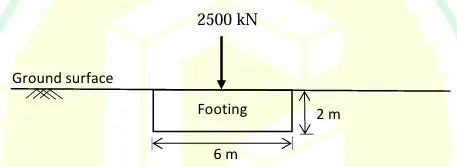
A square footing constructed in clay is subjected to a vertical load of 2500 kN at its centre. The base of the footing is 2 m below the ground surface, as shown in the figure. The footing is made of 2 m thick concrete. The ground water table is at a great depth. Considering Terzaghi's bearing capacity theory, the factor of safety of footing against the bearing capacity failure is _________ (rounded off to 2 decimal places). Note: Unit of concrete Properties of clay: , and For

A wide strip footing is founded at a depth of below the ground level in a homey, pure clay bed. The clay bed has unit cohesion . Due to seasonal fluctuations of water table from peak summer to peak monsoon period, the net ultimate bearing capacity of the footing as per Terzaghi's theory
The in-situ percentage of voids of a sand deposit is . The maximum and minimum densities of sand determined from the laboratory tests are and , respectively. Assume the specific gravity of sand as 2.7 . The relative density index of the in-situ sand is ______ (rounded off to 2 decimal places)
A square footing of size is placed below the ground surface on a cohesionless homogeneous soil stratum. Considering that the groundwater table is located at the base of the footing, the unit weights of soil above and below the groundwater table are and , respectively, and the bearing capacity factor is 58 , the net ultimate baring capacity of the soil is estimated as (unit weight of water ). Earlier, a plate load test was carried out with a circular place of diameter in the same foundation pit during a dry season, when the water table was located beyond the plate influence zone. Using Terzaghi's bearing capacity formulation, what is the ultimate bearing capacity (in of the plate ?
A square footing is to be designed to carry a column load of which is resting on a soil stratum having the following average properties: bulk unit weight ; angle of internal friction , and cohesion . Considering the depth of the footing as and adopting Meyerhof's bearing capacity theory with a factor of safety of 3 , the width of the footing (in ) is ____ (round off to one decimal place) [Assume the applicable shape and depth factor values as unity; ground water level at greater depth.]
The reason(s) of the nonuniform elastic settlement profile below a flexible footing, resting on a cohesionless soil while subjected to uniform loading, is/are:
A square concrete pile of 10 m length is driven into a deep layer of uniform homogeneous clay. Average unconfined compressive strength of the clay, determined through laboratory tests on undisturbed samples extracted from the clay layer, is 100 kPa. If the ultimate compressive load capacity of the driven pile is 632 kN, the required width of the pile is _______ mm. (in integer) (Bearing capacity factor ; adhesion factor )
Read the following statements: (P) While designing a shallow footing in sandy soil, monsoon season is considered for critical design in terms of bearing capacity. (Q) For slope stability of an earthen dam, sudden drawdown is never a critical condition. (R) In a sandy sea beach, quicksand condition can arise only if the critical hydraulic gradient exceeds the existing hydraulic gradient. (S) The active earth thrust on a rigid retaining wall supporting homogeneous cohesionless backfill will reduce with the lowering of water table in the backfill. Which one of the following combinations is correct?
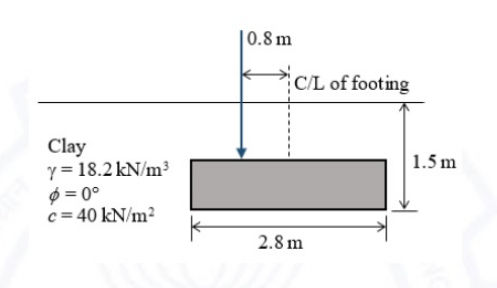
A rectangular footing of size 2.8m x 3.5m is embedded in a clay layer and a vertical load is placed with an eccentricity of 0.8 m as shown in the figure (not to scale). Take Bearing capacity factors: , , and ; Shape factors: , and ; Depth factors: , and ; and Inclination factors: and and . Using Meyerhoff's method, the load (in kN, round off to two decimal places) that can be applied on the footing with a factor of safety of 2.5 is _________________

The cohesion (c), angle of internal friction and unit weight of a soil are and , respectively. The maximum depth of unsupported excavation in the soil (in m, round off to two decimal places) is __________
A square footing of 4 m side is placed at 1 m depth in a sand deposit. The dry unit weight ( ) of sand is 15 . This footing has an ultimate bearing capacity of 600 kPa. Consider the depth factors: and the bearing capacity factor: . This footing is placed at a depth of 2m in the same soil deposit. For a factor of safety of 3.0 as per Terzaghi's theory, the safe bearing capacity (in kPa) of this footing would be _______
A square footing of 2 m sides rests on the surface of a homogeneous soil bed having the properties: cohesion c=24 kPa, angle of internal friction , and unit weight . Terzaghi's bearing capacity factors for are , , and . The ultimate bearing capacity of the foundation (in kPa, round off to 2 decimal places) is _______
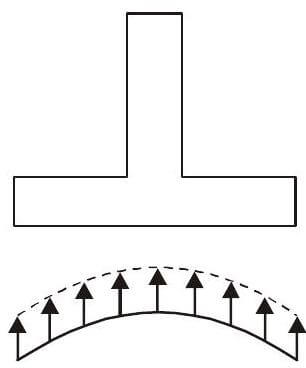
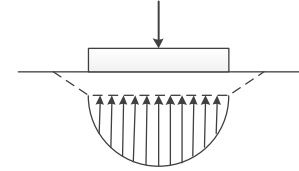
The contact pressure and settlement distribution for a footing are shown in the figure. The figure corresponds to a

The percent reduction in the bearing capacity of a strip footing resting on sand under flooding condition (water level at the base of the footing) when compared to the situation where the water level is at a depth much greater than the width of footing, is approximately
The width of a square footing and the diameter of a circular footing are equal. If both the footings are placed on the surface of sandy soil, the ratio of the ultimate bearing capacity of circular footing to that of square footing will be
The plate load test was conducted on clayey strata by using a plate of 0.3mx0.3 m dimensions, and the ultimate load per unit area for the plate was found to be 180 kPa. The ultimate bearing capacity (in kPa) of a 2 m wide square footing would be
A strip footing is resting on the ground surface of a pure clay bed having an undrainedcohesion . The ultimate bearing capacity of the footing is equal to
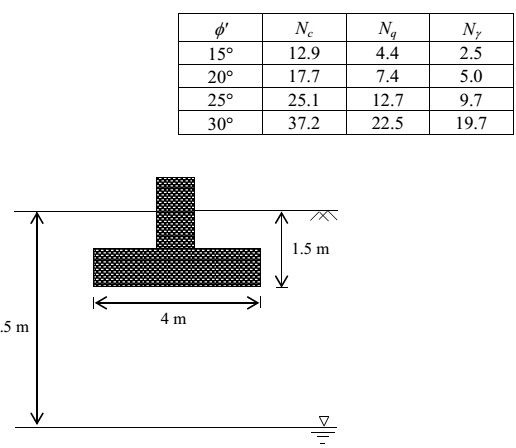
A 4 m wide strip footing is founded at a depth of 1.5 m below the ground surface in a soil as shown in the figure. The water table is at a depth of 5.5 m below ground surface. The soil properties are: and . The values of bearing capacity factors for different are given below. Using Terzaghi's bearing capacity equation and a factor of safety , the net safe bearing capacity (expressed in ) for local shear failure of the soil is ________.

A strip footing is resting on the surface of a purely clayey soil deposit. If the width of the footing is doubled, the ultimate bearing capacity of the soil
Want unlimited AI-generated Shallow Foundation And Bearing Capacity questions?
Sign up free and practice with adaptive difficulty — Easy, Medium, Hard. New questions every session.
Start practising for free →