Generate GATE-level questions on Retaining Wall Earth Pressure Theories in Geotechnical Engineering. Focus on core concepts, previous year patterns, and numerical problem-solving techniques.
30 questions · 20 PYQs · 0 AI practice · GATE CE 2027
🎯 These are sample questions
Get the full Retaining Wall Earth Pressure Theories experience — 100% free
✓ Attempt tracking & analytics
✓ Timer & exam-mode simulation
✓ Adaptive difficulty (Easy → Hard)
✓ Bookmarks, notes & mistake review
Just sign in to unlock everything. Free for all students.
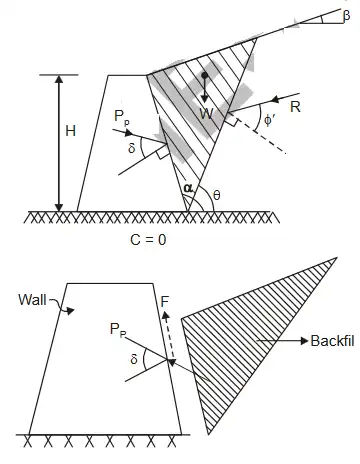
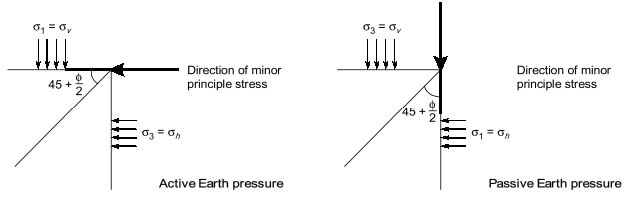
Consider the statements P and Q related to the analysis/design of retaining walls. P: When a rough retaining wall moves toward the backfill, the wall friction force/resistance mobilizes in upward direction along the wall. Q: Most of the earth pressure theories calculate the earth pressure due to surcharge by neglecting the actual distribution of stresses due to surcharge. Which of the following options is CORRECT?
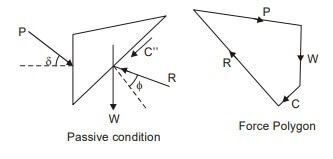
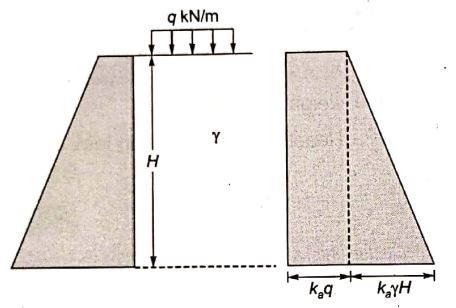
When rough retaining wall moves toward the back fill passive earth pressure (PP) condition will develop which can be represented with the help of diagram shown below. Hence wall friction force/resistance (F) mobilizes in upward direction along the wall. Earth pressure due to surcharge is assumed to be constant along the depth of retaining wall and actual variation of stress due to surcharge is neglected.
Q2GATE 2024MCQ
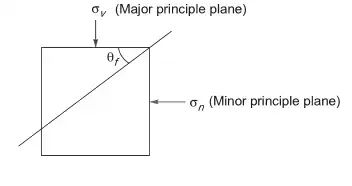
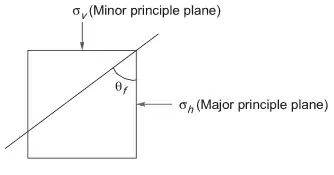
A vertical smooth rigid retaining wall is supporting horizontal ground with dry cohesionless backfill having a friction angle of 30∘ . The inclinations of failure planes with respect to the major principal plane for Rankine's active and passive earth pressure condition, respectively are
For Rankine's active pressure condition where, θf=45∘+2ϕ=45∘+230∘=60∘ For Rankine's passive pressure condition where, θf=45∘+2ϕ=45∘+230∘=60∘
Q3GATE 2023MCQ
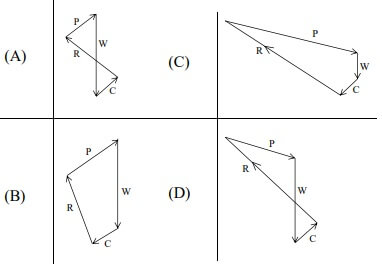
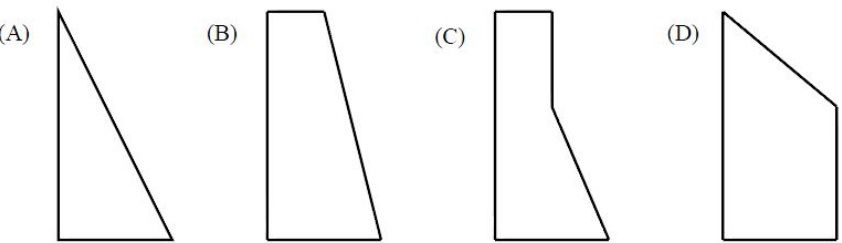
The figure shows a vertical retaining wall with backfill consisting of cohesive-frictional soil and a failure plane developed due to passive earth pressure. The forces acting on the failure wedge are: P as the reaction force between the wall and the soil, R as the reaction force on the failure plane, C as the cohesive force along the failure plane and W as the weight of the failure wedge. Assuming that there is no adhesion between the wall and the wedge, identify the most appropriate force polygon for the wedge.
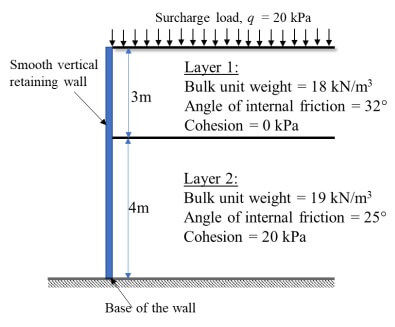
A smooth vertical retaining wall supporting layered soils is shown in figure. According to Rankine's earth pressure theory, the lateral active earth pressure acting at the base of the wall is ____ kPa (round off to one decimal place)
A vertical sheet pile wall is installed in an anisotropic soil having coefficient of horizontal permeability, kH and coefficient of vertical permeability, kV . In order to draw the flow net for the isotropic condition, the embedment depth of the wall should be scaled by a factor of _____, without changing the horizontal scale.
We know that, for 2D flow. K=Kxdx∂2h+Kzdz∂2h=0 When K1=Khorizontal and K2=Kvertical as shown in figure. KxKz∂x2∂2h+∂z2∂2h=0 From the above equation we can note that, when soil is anisotropic with respect to permeability i.e. kx=kz , the flow and equipotential line are not necessarily to be orthogonal as because KxKz=1 , and we cannot get the actual form of Laplace equation which is ∂x2∂2h+∂z2∂2h=0 . But if we replace xt=xKxKz Then, ∂xt2=∂x2KxKz∂xt2∂2h+∂z2∂2h=0 Thus, new flow line and equipotential lines are drawn on transformed section with x -distance changed to xKxKz while keeping the vertical dimension constant. If we scale up the depth by keeping the horizontal distance same the depth will be scaled by factor Kx/Kz .
Q6GATE 2022NAT
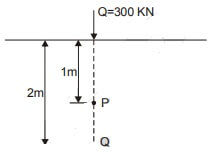
A concentrated vertical load of 3000 kN is applied on a horizontal ground surface. Points P and Q are at depths 1 m and 2 m below the ground, respectively, along the line of application of the load. Considering the ground to be a linearly elastic, isotropic, semi-infinite medium, the ratio of the increase in vertical stress at P to the increase in vertical stress at Q is ________. (in integer)
Let σv′ and σh′ denote the effective vertical stress and effective horizontal stress, respectively. Which one of the following conditions must be satisfied for a soil element to reach the failure state under Rankine?s passive earth pressure condition?
As per Rankine's theory of earth pressure, the inclination of failure planes is (45+2ϕ)∘ with respect to the direction of the minor principal stress. The above statement is correct for which one of the following options?
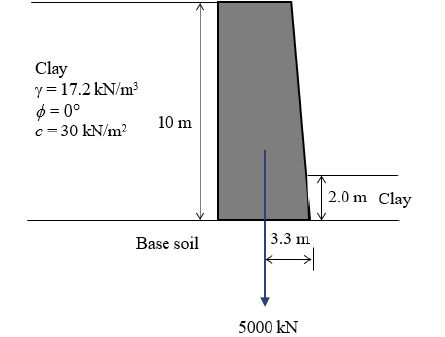
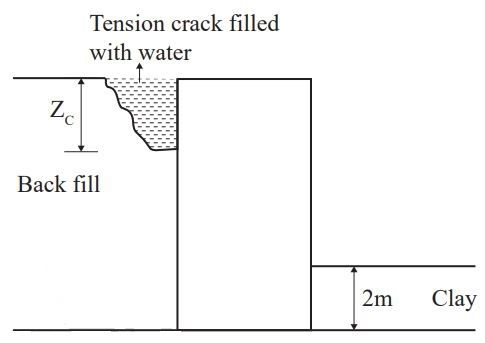
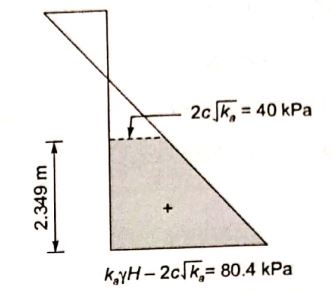
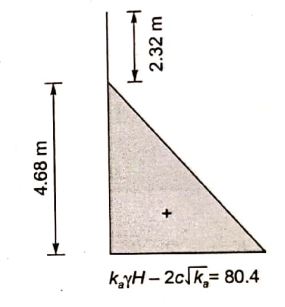
A retaining wall of height 10 m with clay backfill is shown in the figure (not to scale). Weight of the retaining wall is 5000 kN per m acting at 3.3 m from the toe of the retaining wall. The interface friction angle between base of the retaining wall and the base soil is 20∘ . The depth of clay in front of the retaining wall is 2.0 m. The properties of the clay backfill and the clay placed in front of the retaining wall are the same. Assume that the tension crack is filled with water. Use Rankine's earth pressure theory. Take unit weight of water, γw=9.81kN/m3 . The factor of safety (round off to two decimal places) against sliding failure of the retaining wall after ignoring the passive earth pressure will be ________________
Tension crack develops only in the back fill (clay) The tension crack will not develop in the clay which is infront of the wall. The total active thrust on the wall, due to the backfill, and the water in the tension crack Fa=ka⋅2γH2−2Cka⋅H+γ2C2+2γwzc2ka=1 since ϕ=0Fa=1×217.2×102−2×301×10+17.22×302+29.81×3.4882=424.326kN Factor of safety against sliding neglecting passive earth pressure on front side, FsFs=Faμ⋅Wμ= coefficient of friction at base =tanδFs=Fatanδ⋅W=424.326tan20∘×5000=4.2888≈4.29
Q10GATE 2020NAT
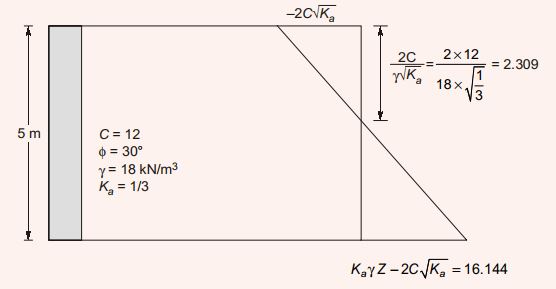
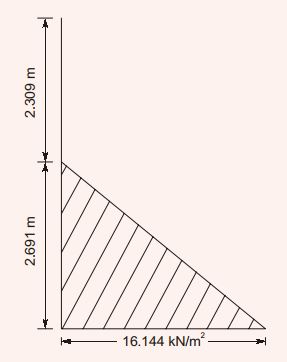
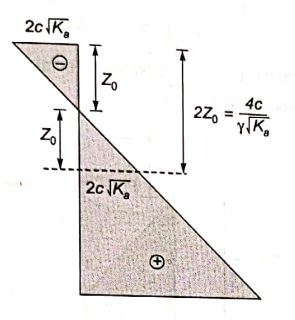
A vertical retaining wall of 5 m height has to support soil having unit weight of 18 kN/m3 , effective cohesion of 12 kN/m2 , and effective friction angle of 30∘ . As per Rankine's earth pressure theory and assuming that a tension crack has occurred, the lateral active thrust on the wall per meter length (in kN/m, round off to two decimal places), is ______.
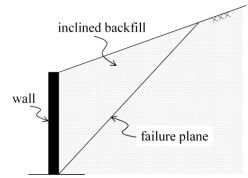
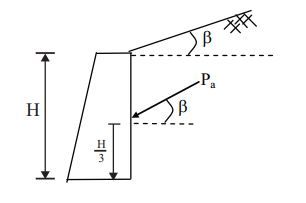
A retaining wall of height H with smooth vertical backface supports a backfill inclined at an angle β with the horizontal. The backfill consists of cohesionless soil having angle of internal friction ϕ . If the active lateral thrust acting on the wall is Pa , which one of the following statements is TRUE?
An earthen dam of height H is made of cohesive soil whose cohesion and unit weight are c and γ , respectively. If the factor of safety against cohesionis Fc , the Taylor's stability number ( Sn ) is
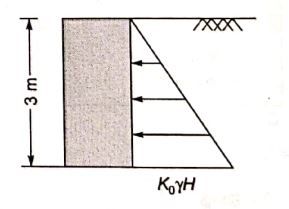
A 3 m high vertical earth retaining wall retains a dry granular backfill with angle of internal friction of 30∘ and unit weight of 20 kN/m3 . If the wall is prevented from yielding (no movement), the total horizontal thrust (in kN per unit length) on the wall is
Soil is dry sand ∴K0=1−sinϕ=1−sin30∘=0.5 Total horizontal thrust
P0=21K0γH⋅H=21×21×20×32=45kN/m
Q14GATE 2018NAT
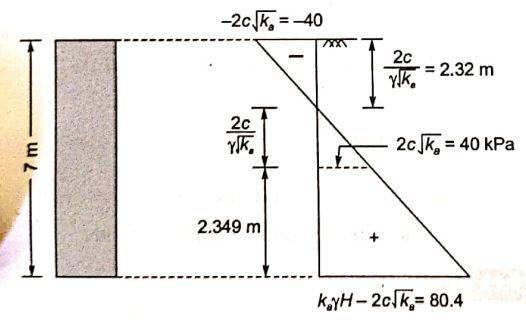
A rigid smooth retaining wall of height 7 m with vertical backface retains saturated clay as backfill. The saturated unit weight and undrained cohesion of the backfill are 17.2 kN/ m3 and 20 kPa, respectively. The difference in the active lateral forces on the wall (in kN per meter length of wall, up to two decimal places), before and after the occurrence of tension cracks is ______
Consider a rigid retaining wall with partially submerged cohesionless backfill with a surcharge. Which one of the following diagrams closely represents the Rankine's active earth pressure distribution against this wall?
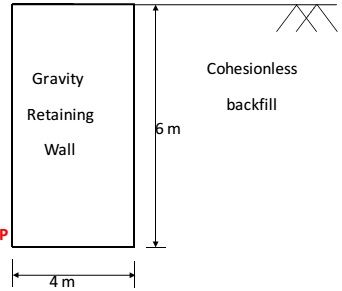
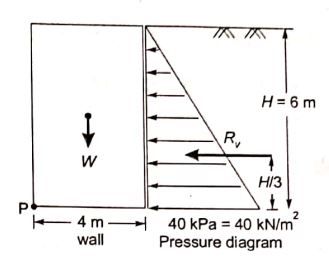
A homogeneous gravity retaining wall supporting a cohesionless backfill is shown in the figure. The lateral active earth pressure at the bottom of the wall is 40 kPa. The minimum weight of the wall (expressed in kN per m length) required to prevent it from overturning about its toe (Point P) is
W = weight of wall Rv= Reaction from cohesion less backfill
=21×40×H=21×40×6=120kN
To prevent overturning about point P.
M0Rv×3H120×36⇒W≤MR≤W×2≤W×2≥120kN
∴ Minimum weight of wall =120kN
Q17GATE 2016MCQ
A vertical cut is to be made in a soil mass having cohesion c, angle of internal friction ϕ , and unit weight γ . Considering Ka and Kp as the coefficients of active and passive earth pressures, respectively, the maximum depth of unsupported excavation is
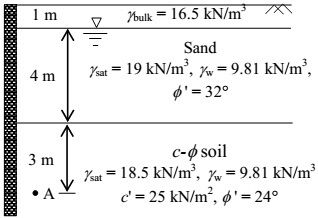
The soil profile at a site consists of a 5 m thick sand layer underlain by a c−ϕ soil as shown in figure. The water table is found 1 m below the ground level. The entire soil mass is retained by a concrete retaining wall and is in the active state. The back of the wall is smooth and vertical. The total active earth pressure (expressed in kN/m2 ) at point A as per Rankine's theory is _________.
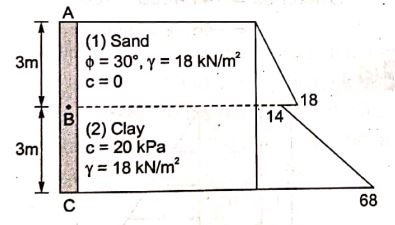
A 6 m high retaining wall having a smooth vertical back face retains a layered horizontal backfill. Top 3 m thick layer of the backfill is sand having an angle of internal friction, ϕ=30∘ while the bottom layer is 3 m thick clay with cohesion, c = 20 kPa. Assume unit weight for both sand and clay as 18 kN/ m3 . The totalactive earth pressure per unit length of the wall (in kN/m) is: