Q1GATE 2025MCQ
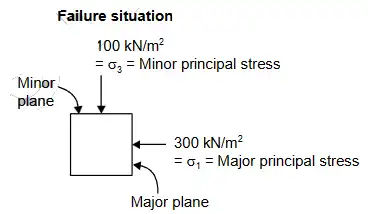
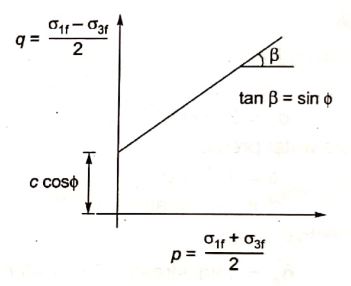
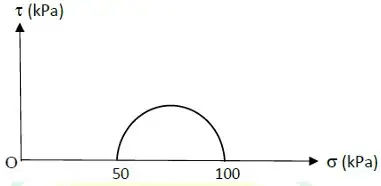
The results of a consolidated drained triaxial test on a normally consolidated clay are shown in the figure. The angle of internal friction is
GATE CE · Geotechnical Engineering
Generate GATE-level questions on Shear Strength Of Soil in Geotechnical Engineering. Focus on core concepts, previous year patterns, and numerical problem-solving techniques.
33 questions · 20 PYQs · 0 AI practice · GATE CE 2027
🎯 These are sample questions
Just sign in to unlock everything. Free for all students.
The results of a consolidated drained triaxial test on a normally consolidated clay are shown in the figure. The angle of internal friction is
In the context of shear strength of soil, which of the following statements is/are CORRECT?
A drained triaxial test was conducted on a saturated sand specimen using a stress-path triaxial testing system. The specimen failed when the axial stress reached a value of from an initial confining pressure of . The angle of shearing plane (in degrees) with respect to horizontal is _____ (rounded off to the nearest integer).
A drained direct shear test was carried out on a sandy soil. Under a normal stress of , the test specimen field at shear stress of . The angle of internal friction of the sample is ______ degree (round off to the nearest integer).
A consolidated drained (CD) triaxial test was carried out on a sand sample with the known effective shear strength parameters, and . In the test, prior to the failure, when the sample was undergoing axial compression under constant cell pressure, the drainage valve was accidentally closed. At the failure, deviatoric stress was recorded along with pore water pressure. If the test is repeated without such error, and no back pressure is applied in either of the tests, what is the deviatoric stress (in , in integer) at the failure? _____
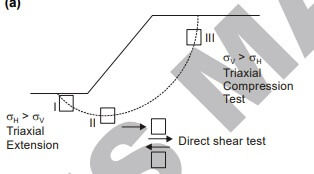
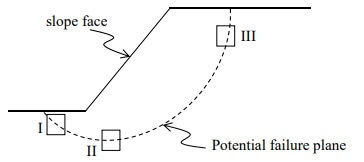
A possible slope failure is shown in the figure. Three soil samples are taken from different locations (I, II and III) of the potential failure plane. Which is the most appropriate shear strength test for each of the sample to identify the failure mechanism? Identify the correct combination from the following options: P: Triaxial compression test Q: Triaxial extension test R: Direct shear or shear box test S: Vane shear test
Match the following in Column X with Column Y:
Which one of the following combinations is correct?
The most appropriate triaxial test to assess the long-term stability of an excavated clay slope is
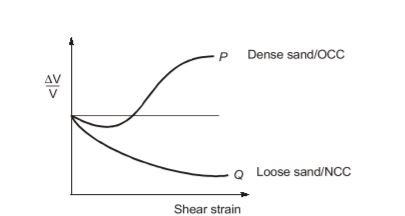
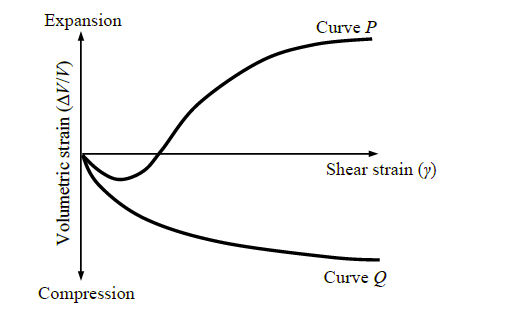
Based on drained triaxial shear tests on sands and clays, the representative variations of volumetric strain with the shear strain is shown in the figure. Choose the CORRECT option regarding the representative behaviour exhibited by Curve P and Curve Q.
In a drained tri-axial compression test, a sample of sand fails at deviator stress of 150 kPa under confining pressure of 50 kPa. The angle of internal friction (in degree, round off to the nearest integer) of the sample, is ________
A conventional drained triaxial compression test was conducted on a normally consolidated clay sample under an effective confining pressure of 200 kPa. The deviator stress at failure was found to be 400 kPa. An identical specimen of the same clay sample is isotropically consolidated to a confining pressure of 200 kPa and subjected to standard undrained triaxial compression test. If the deviator stress at failure is 150 kPa, the pore pressure developed (in kPa, up to one decimal place) is ______
The total horizontal and vertical stresses at a point X in a saturated sandy medium are 170 kPa and 300 kPa, respectively. The static pore-water pressure is 30 kPa. At failure, the excess pore-water pressure is measured to be 94.50 kPa, and the shear stresses on the vertical and horizontal planes passing through the point X are zero. Effective cohesion is 0 kPa and effective angle of internal friction is . The shear strength (in kPa, up to two decimal places) at point X is ______
A consolidated undrained triaxial compression test is conducted on a normally consolidated clay at a confining pressure of 100 kPa. The deviator stress at failure is 80 kPa, and the pore-water pressure measured at failure is 50 kPa. The effective angle of internalfriction (in degrees, up to one decimal place) of the soil is _________
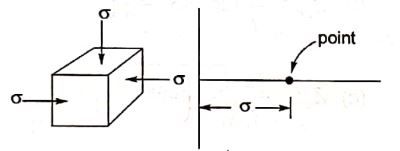
A soil sample is subjected to a hydrostatic pressure, . The Mohr circle for any point in the soil sample would be
Following are the statements related to the stress paths in a triaxial testing of soils: P. If , the stress point lies at the origin of the p-q plot. Q. If, the stress point lies on the p-axis of the p-q plot. R. If , both the stress points p and q are positive. For the above statements, the correct combination is
In the consolidated undrained triaxial test on a saturated soil sample, the pore water pressure is zero
A drained triaxial compression test on a saturated clay yielded the effective shear strength parameters as Consolidated Undrained triaxial test on an identical sample of this clay at a cell pressure of 200 kPa developed a pore water pressure of 150kPa at failure. The deviator stress (expressed in kPa) at failure is _________ .
In an unconsolidated undrained triaxial test, it is observed that an increase in cell pressure from 150 kPas to 250 kPa leads to a pore pressure increase of 80 kPa. It is further observed that, an increase of 50 kPa in deviatoric stress result in an increase of 25 kPa in the pore pressure. The value of Skempton's pore pressure parameter B is:
Which of the following statement is NOT correct?
Stress path equation for tri-axial test upon application of deviatoric stress is, . The respective values of cohesion, c (in kPa) and angle of internal friction, are:
Want unlimited AI-generated Shear Strength Of Soil questions?
Sign up free and practice with adaptive difficulty — Easy, Medium, Hard. New questions every session.
Start practising for free →