Q1GATE 2025MCQ
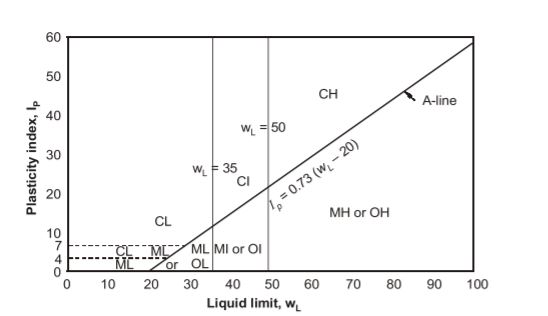
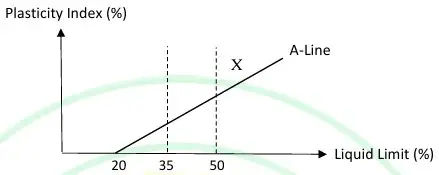
The standard plasticity chart for the classification of a fine-grained soil is shown in the figure. As per the Indian standard soil classification system, X represents
GATE CE · Geotechnical Engineering
Generate GATE-level questions on Classification Of Soils And Clay Minerals in Geotechnical Engineering. Focus on core concepts, previous year patterns, and numerical problem-solving techniques.
20 questions · 20 PYQs · 0 AI practice · GATE CE 2027
🎯 These are sample questions
Just sign in to unlock everything. Free for all students.
The standard plasticity chart for the classification of a fine-grained soil is shown in the figure. As per the Indian standard soil classification system, X represents
Consider the statements P and Q. P : Soil particles formed by mechanical weathering, and close to their origin are generally subrounded. Q: Activity of the clay physically signifies its swell potential. Which one of the following options is CORRECT?
The correct match between the physical states of the soils given in Group I andthe governing conditions given in Group II is
Four different soils are classified as CH, ML, SP, and SW, as per the Unified Soil Classification System. Which one of the following options correctly represents their arrangement in the decreasing order of hydraulic conductivity?
From laboratory investigations, the liquid limit, plastic limit, natural moisture content and flow index of a soil specimen are obtained as 60%, 27%, 32% and 27%, respectively. The corresponding toughness index and liquidity index of the soil specimen, respectively, are
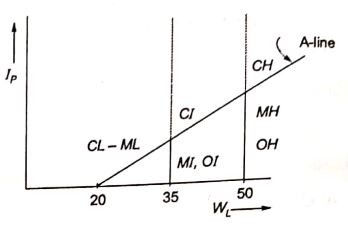
As per the Unified Soil Classification System (USCS), the type of soil represented by 'MH' is
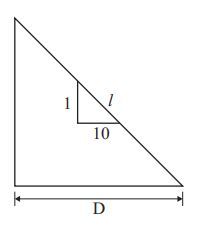
A survey line was measured to be 285.5 m with a tape having a nominal length of 30 m. On checking, the true length of the tape was found to be 0.05 m too short. If the line lay on a slope of 1 in 10, the reduced length (horizontal length) of the line for plotting of survey work would be
A fine grained soil is found to be plastic in the water content range of 26-48%. As per Indian Standard Classification System, the soil is classified as
As per Indian Standard Soil Classification System (IS: 1498-1970), an expression for A-line is
The clay mineral primarily governing the swelling behavior of Black Cotton soil is
As per the Indian Standard soil classification system, a sample of silty clay with liquid limit of 40% and plasticity index of 28% is classified as
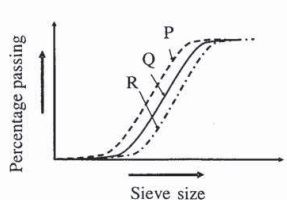
The results for sieve analysis carried out for three types of sand, P, Q and R, are given in the figure. If the fineness modulus values of the three sands are given as FMP, FMQ and FMR, it can be stated that
A fine grained soil has liquid limit of 60 and plastic limit of 20. As per the plasticity chart, according to IS classification, the soil is represented by the letter symbols
The laboratory test results of a soil sample are given below : Percentage finer than 4.75 mm= 60 Percentage finer than 0.075 mm= 30 Liquid Limit= 35% Plastic Limit27% The soil classification is
Group Symbols assigned to silty sand and clayey sand are respectively
Sieve analysis on a dry soil sample of mass 1000 g showed that 980 g and 270 g of soil pass through 4.75 mm and 0.075 mm sieve, respectively. The liquid limit and plastic limits of the soil fraction passing through 425 sieves are 40% and 18%, respectively. The soil may be classified as
Laboratory sieve analysis was carried out on a soil sample using a complete set of standard IS sieves. Out of 500g of soil used in the test, 200g was retained on sieve, 250g was retained on sieve and the remaining 50g was retained on sieve. The classification of the soil is
A soil mass contains 40% gravel, 50% sand and 10% silt. This soil can be classified as
Data from a sieve analysis conducted on a given sample of soil showed that 67% of the particles passed through 75 micron IS sieve. The liquid limit and plastic limit of the finer fraction was found to be 45 and 33 percents respectively. The group symbol of the given soil as per IS:1498-1970 is
The following two statments are made with respect to different sand samples having the same relative density. Identify if they are TRUE or FALSE. I. Poorly graded sands will have lower friction angle than the well graded sands. II. The particle size has no influence on the friction angle of sand.
Want unlimited AI-generated Classification Of Soils And Clay Minerals questions?
Sign up free and practice with adaptive difficulty — Easy, Medium, Hard. New questions every session.
Start practising for free →