Q1GATE 2023MCQ
A jet of water having a velocity of strikes a series of plats fixed radially on a wheel revolving in the same direction a the jet at . What is the percentage efficiency of the plates ? (round off to one decimal place).
GATE CE · Fluid Mechanics And Hydraulics
Generate GATE-level questions on Impact Of Jets And Turbines in Fluid Mechanics And Hydraulics. Focus on core concepts, previous year patterns, and numerical problem-solving techniques.
9 questions · 9 PYQs · 0 AI practice · GATE CE 2027
🎯 These are sample questions
Just sign in to unlock everything. Free for all students.
A jet of water having a velocity of strikes a series of plats fixed radially on a wheel revolving in the same direction a the jet at . What is the percentage efficiency of the plates ? (round off to one decimal place).
Consider the reactor shown in the figure. The flow rate through the reactor is . The concentrations (in mg/L) of a compound in the influent and effluent are and C, respectively. The compound is degraded in the reactor following the first order reaction. The mixing condition of the reactor can be varied such that the reactor becomes either a completely mixed flow reactor (CMFR) or a plug-flow reactor (PFR). The length of the reactor can be adjusted in these two mixing conditions to and while keeping the cross-section of the reactor constant. Assuming steady stateand for , the value of (round off to 2 decimal places) is _______

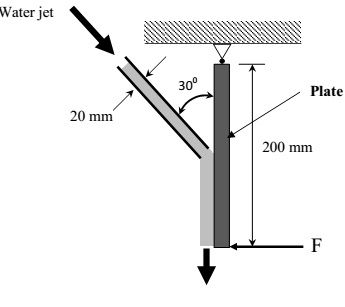
A square plate is suspended vertically from one of its edges using a hinge support as shown in figure. A water jet of 20 mm diameter having a velocity of 10 m/s strikes the plate at its mid-point, at an angle of with the vertical. Consider g as and neglect the self-weight of the plate. The force F (expressed in N) required to keep the plate in its vertical position is _______________
A penstock of 1 m diameter and 5 km length is used to supply water from a reservoir to an impulse turbine. A nozzle of 15 cm diameter is fixed at the end of the penstock. The elevation difference between the turbine and water level in the reservoir is 500 m. Consider the head loss due to friction as 5% of the velocity head available at the jet. Assume unit weight of water = and acceleration due to gravity (g)= . If the overall efficiency 80%, power generated (expressed in kW and rounded to nearest integer) is ___________
A horizontal nozzle of 30 mm diameter discharges a steady jet of water into the atmosphere at a rate of 15 liters per second. The diameter of inlet to the nozzle is 100 mm. The jet Impinges normal to a flat stationary plate held close to the nozzle end. Neglecting air friction and considering the density of water as 1000 kg/ , force exerted by the jet (in N) on the plate is _______
A horizontal jet of water with its cross-sectional area of 0.0028 hits a fixed vertical plate with a velocity of 5 m/s. After impact the jet splits symmetrically in a plane parallel to the plane of the plate. The force of impact (in N) of the jet on the plate is
A horizontal water jet with a velocity of 10 m/s and cross sectional area of 10 strikes a flat plate held normal to the flow direction. The density of water is 1000 kg/ . The total force on the plate due to the jet is
A tank and a deflector are placed on a frictionless trolley. The tank issues water jet (mass density of water = 1000 kg/ ), which strikes the deflector and turns by 45 . If the velocity of jet leaving the deflector is 4 m/s and discharge is 0.1 /s, the force recorded by the spring will be

A horizontal jet strikes a frictionless vertical plate (the plan view is shown in the figure). It is then divided into two parts, as shown in the figure. If the impact loss is neglected, what is the value of ?

Want unlimited AI-generated Impact Of Jets And Turbines questions?
Sign up free and practice with adaptive difficulty — Easy, Medium, Hard. New questions every session.
Start practising for free →

