GATE CE · Fluid Mechanics And Hydraulics
Generate GATE-level questions on Flow Through Pipes in Fluid Mechanics And Hydraulics. Focus on core concepts, previous year patterns, and numerical problem-solving techniques.
28 questions · 20 PYQs · 0 AI practice · GATE CE 2027
🎯 These are sample questions
Just sign in to unlock everything. Free for all students.
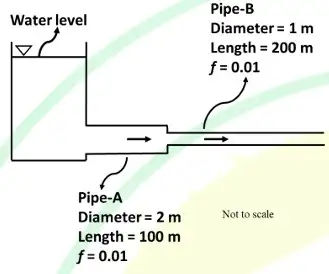
Consider steady flow of water in the series pipe system shown below, with specified discharge. The diameters of Pipes A and B are 2 m and 1 m, respectively. The lengths of Pipes A and B are 100 m and 200 m, respectively. Assume the Darcy-Weisbach friction coefficient, as 0.01 for both the pipes. The ratio of head loss in Pipe-B to the head loss in Pipe-A is ______ (round off to the nearest integer).

A tank of height is provided with a diameter orifice at the center of its base. The orifice is plugged and the tank is filled up to height. Consider the average value of discharge coefficient as 0.6 and acceleration due to gravity (g) as . After unplugging the orifice, the time (in seconds) taken for the water level to drop from to under free discharge condition is _____ (rounded off to 2 decimal places).
With respect to fluid flow, match the following in Column X with Column Y:
Which one of the following combinations is correct?
A fire hose nozzle directs a steady stream of water of velocity 50 m/s at an angle of above the horizontal. The stream rises initially but then eventually falls to the ground. Assume water as incompressible and inviscid. Consider the density of air and the air friction as negligible, and assume the acceleration due to gravity as . The maximum height (in m,round off to two decimal places) reached by the stream above the hose nozzle will then be _________
A fluid flowing steadily in a circular pipe of radius R has a velocity that is everywhere parallel to the axis (centerline) of the pipe. The velocity distribution along the radial direction is , where is the radial distance as measured from the pipe axis and is the maximum velocity at . The average velocity of the fluid in the pipe is
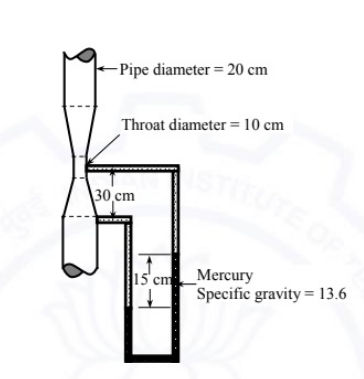
A venturimeter as shown in the figure (not to scale) is connected to measure the flow of water in a vertical pipe of 20 cm diameter. Assume . When the deflection in the mercury manometer is 15 cm, the flow rate (in lps, round off to two decimal places) considering no loss in the venturimeter is ___________

A cast iron pipe of diameter 600 mm and length 400 m carries water from a tank and discharges freely into air at a point 4.5 m below the water surface in the tank. The friction factor of the pipe is 0.018. Consider acceleration due to gravity as 9.81 . The velocity of the flow in pipe (in m/s, round off to two decimal places) is __________.
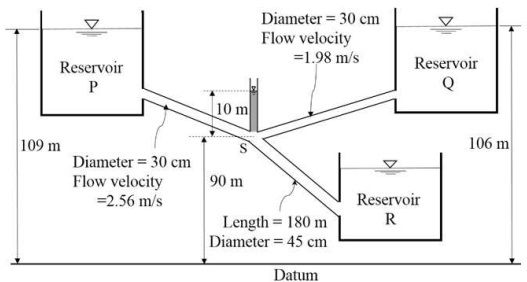
Three reservoir P, Q and R are interconnected by pipes as shown in the figure (not drawn to the scale). Piezometric head at the junction S of the pipes is 100 m. Assume acceleration due to gravity as 9.81 m/ and density of water as 1000 . The length of the pipe from junction S to the inlet of reservoir R is 180 m. Considering head loss only due to friction (with friction factor of 0.03 for all the pipes), the height of water level in the lowermost reservoir R (in m, round off to one decimal places) with respect to the datum, is ________.

Two identically sized primary settling tanks receive water for Type-I settling (discrete particles in dilute suspension) under laminar flow conditions. The surface overflow rate (SOR) maintained in the two tanks are 30 and 15 . The lowest diameters of the particles, which shall be settled out completely under SORs of 30 and 15 are designated as and respectively. The ratio (round off to two decimal places), is __________.
A circular water tank of 2 m diameter has a circular orifice of diameter 0.1 m at the bottom. Water enters the tank steadily at a flow rate of 20 litre/s and escapes through the orifice. The coefficient of discharge of the orifice is 0.8. Consider the acceleration due to gravity as 9.81 and neglect frictional loses. The height of the water level (in m, round off to two decimal places) in the tank at the steady state, is ______.
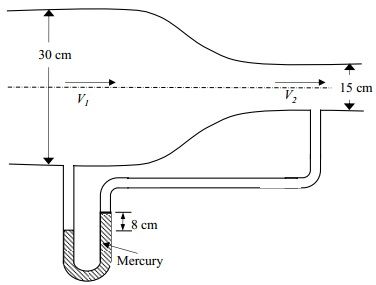
A circular duct carrying water gradually contracts from a diameter of 30 cm to 15 cm. The figure shows the arrangement of differential manometer attached to the duct When the water flows, the differential manometer shows a deflection of 8 cm of mercury (Hg). The values of specific gravity of mercury and water are 13.6 and 1.0, respectively. Consider the acceleration due to gravity, . Assuming frictionless flow, the flow rate (in , round off to 3 decimal places) through the duct is ____

Two identical pipes (i.e., having the same length, same diameter, and same roughness) are used to withdraw water from a reservoir. In the first case, they are attached in series and discharge freely into the atmosphere. In the second case, they are attached in parallel and also discharge freely into the atmosphere. Neglecting all minor losses, and assuming that the friction factor is same in both the cases, the ratio of the discharge in the parallel arrangement to that in the series arrangement (round off to 2 decimal places) is ______
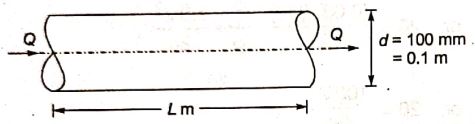
Water is pumped at a steady uniform flow rate of 0.01 through a horizontal smooth circular pipe of 100 mm diameter. Given that the Reynolds number is 800 and g is 9.81 , the head loss (in meters, up to one decimal place) per km length due to friction would be_____
A triangular pipe network is shown in the figure. The head loss in each pipe is given by with the variables expressed in a consistent set of units. The value of r for the pipe AB is 1 and for the pipe BC is 2. If the discharge supplied at the point A (i.e., 100) is equally divided between the pipes AB and AC, the value of r (up to two decimal places) for the pipe AC should be ____________

A pipe of 0.7 m diameter has a length of 6 km and connects two reservoirs A and B. The water level in reservoir A is at an elevation 30 m above the water level in reservoir B. Halfway along the pipe line, there is a branch through which water can be supplied to a third reservoir C. The friction factor of the pipe is 0.024. The quantity of water discharged into reservoir C is 0.15 /s. Considering the acceleration due to gravity as 9.81 and neglecting minor losses, the discharge (in ) into the reservoir B is __________.
For steady incompressible flow through a closed- conduit of uniform cross-section, the direction of flow will always be :
A circular pipe has a diameter of 1m, bed slope of 1 in 1000, and Manning's roughness coefficient equal to 0.01. It may be treated as an open channel flow when it is flowing just full, i.e., the water level just touches the crest. The discharge in this condition is denoted by . Similarly, the discharge when the pipe is flowing half-full i.e., with a flow depth of 0.5m, is denoted by . The ratio is:
Two reservoirs are connected through a 930 m long, 0.3 m diameter pipe, which has a gate valve. The pipe entrance is sharp (loss coefficient = 0.5) and the valve is half-open (loss coefficient = 5.5). The head difference between the two reservoirs is 20 m. Assume the friction factor for the pipe as 0.03 and g = 10 . The discharge in the pipe accounting for all minor and major losses is _________ .
A straight 100 m long raw water gravity main is to carry water from an intake structure to the jack well of a water treatment plant. The required flow through this water main is . Allowable velocity through the main is 0.75 m/s. Assume f = 0.01, g=9.81 . The minimum gradient (in cm/100 m length) to be given to this gravity main so that the required amount of water flows without any difficulty is ___________
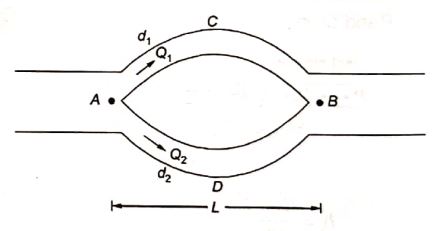
An incompressible fluid is flowing at a steady rate in a horizontal pipe. From a section, the pipe divides into two horizontal parallel pipes of diameters and (where ) that run for a distance of L each and then again join back to a pipe of the original size. For both the parallel pipes, assume the head loss due to friction only and the Darcy-Weisbach friction factor to be the same. The velocity ratio between the bigger and the smaller branched pipes is
Want unlimited AI-generated Flow Through Pipes questions?
Sign up free and practice with adaptive difficulty — Easy, Medium, Hard. New questions every session.
Start practising for free →