GATE CE · Fluid Mechanics And Hydraulics
Generate GATE-level questions on Fluid Dynamics And Flow Measurements in Fluid Mechanics And Hydraulics. Focus on core concepts, previous year patterns, and numerical problem-solving techniques.
13 questions · 13 PYQs · 0 AI practice · GATE CE 2027
🎯 These are sample questions
Just sign in to unlock everything. Free for all students.
A long water distribution pipeline with diameter , is used to convey of flow. A new pipeline , with the same length and flow rate, is to replace . The friction factors for and are 0.04 and 0.01 , respectively. The diameter of the pipeline (in meters) is _____(rounded off to 2 decimal places)
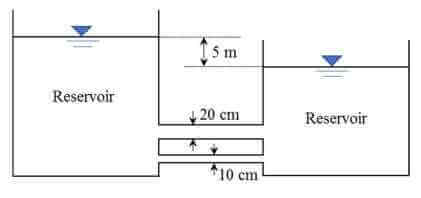
Two reservoirs are connected by two parallel pipes of equal length and of diameters 20 cm and 10 cm, as shown in the figure (not drawn to scale). When the difference in the water levels of the reservoirs is 5 m, the ratio of discharge in the larger diameter pipe to the discharge in the smaller diameter pipe is ____________. (round off to two decimal places) (Consider only loss due to friction and neglect all other losses. Assume the friction factor to be the same for both the pipes)

Match Column X with Column Y:
Which one of the following combinations is correct?
The ratio of the momentum correction factor to the energy correction factor for a laminar flow in a pipe is
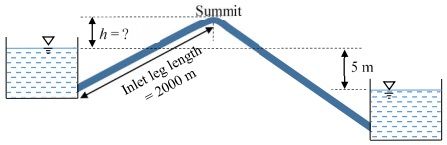
Two water reservoirs are connected by a siphon (running full) of total length 5000 m and diameter of 0.10m, as shown below The inlet leg length of the siphon to its summit is 2000m. The difference in the water surface levels of the two reservoirs is 5 m. Assume the permissible minimum absolute pressure at the summit of siphon to be 2.5 m of water when running full. Given: friction factor f=0.02 throughout, atmospheric pressure= 10.3 m of water, and acceleration due to gravity g= 9.81 . Considering only major loss using Darcy-Weisbach equation, the maximum height of the summit of siphon from the water level of upper reservoir,h (in m, round off to 1 decimal place)is _____
At two point 1 and 2 in a pipeline the velocities are V and 2V, respectively. Both the points are at the same elevation. The fluid density is . The flow can be assumed to be incompressible, inviscid, steady and irrotational. The difference in pressures and at point 1 and 2 is
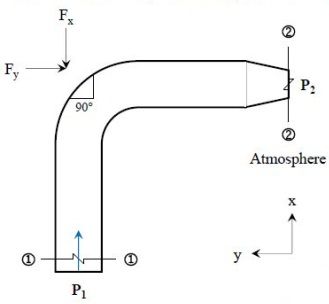
Water flows through a 90 bend in a horizontal plane as depicted in the figure. A pressure of 140 kPa is measured at section 1-1. The inlet diameter marked at section 1-1 is , while the nozzle diameter marked at section 2-2 is . Assume the following: (i) Acceleration due to gravity = 10 (ii) Weights of both the bent pipe segment as well as water are negligible. (iii) Friction across the bend is negligible. The magnitude of the force (in kN, up to two decimal places) that would be required to hold the pipe section is ______

Group I lists a few devices while Group II provides information about their uses. Match the devices with their corresponding use.

A venturimeter, having a diameter of 7.5 cm at the throat and 15 cm at the enlarged end, is installed in a horizontal pipeline of 15 cm diameter. The pipe carries an incompressible fluid at a steady rate of 30 litres per second. The difference of pressure head measured in terms of the moving fluid in between the enlarged and the throat of the venturimeter is observed to be 2.45 m. Taking the acceleration due to gravity as 9.81 , the coefficient of discharge of the venturimeter (correct up to two places of decimal) is___
A venturimeter having a throat diameter of 0.1 m is used to estimate the flow rate of a horizontal pipe having a diameter of 0.2 m. For an observed pressure difference of 2 m of water head and coefficient of discharge equal to unity, assuming that the energy losses are negligible, the flow rate (in /s) through the pipe is approximately equal to
Group I gives a list of devices and Group II gives the list of uses The correct match of Group I with Group II is

The reading of differential manometer of a Venturimeter, placed at 45 to the horizontal is 11 cm. If the Venturimeter is turned to horizontal position, the manometer reading will be
A frictionless fluid of density r flow through a bent pipe as shown below. If A is the cross sectional area and V is the velocity of flow, the forces exerted on segment 1-2 of the pipe in the x and y direction are, respectively,

Want unlimited AI-generated Fluid Dynamics And Flow Measurements questions?
Sign up free and practice with adaptive difficulty — Easy, Medium, Hard. New questions every session.
Start practising for free →