GATE CE · Fluid Mechanics And Hydraulics
Generate GATE-level questions on Boundary Layer Theory Drag And Lift in Fluid Mechanics And Hydraulics. Focus on core concepts, previous year patterns, and numerical problem-solving techniques.
11 questions · 11 PYQs · 0 AI practice · GATE CE 2027
🎯 These are sample questions
Just sign in to unlock everything. Free for all students.
Which of the following statements is/are TRUE?
Two discrete spherical particles (P and Q) of equal mass density are independently released in water. Particle P and particle Q have diameters of 0.5 mm and 1.0 mm, respectively. Assume Stokes' law is valid. The drag force on particle Q will be________ times the drag force on particle P. (round off to the nearest integer)
Velocity distribution in a boundary layer is given by , where is the velocity at vertical coordinate is the free stream velocity and is the boundary layer thickness. The values of and are 0.3 m/s and 1.0 m, respectively. The velocity gradient (in , round off to two decimal places) at y= 0, is ________.
Consider a laminar flow in the x-direction between two infinite parallel plates (Couette flow). The lower plate is stationary and the upper plate is moving with a velocity of 1 cm/s in the x-direction. The distance between the plates is 5 mm and the dynamic viscosity of the fluid is 0.01 . If the shear stress on the lower plate is zero, the pressure gradient, , (in per m,round off to 1 decimal place)is _______
An automobile with projected area 2.6 is running on a road with a speed of 120 km per hour. The mass density and the kinematic viscosity of air are 1.2 and , respectively. The drag coefficient is 0.30. The metric horse power required to overcome the drag force is
The thickness of the laminar boundary layer on a flat plate at a point A is 2 cm and at a point B, 1 m downstream of A, is 3 cm. What is the distance of A from the leading edge of the plate ?
An aircraft is flying in level flight at a speed of 200 km/hr through air (density, , and viscosity ). The lift coefficient at this speed is 0.4 and the drag coefficient is 0.0065. The mass of the aircraft is 800 kg. The effective lift area of the aircraft is
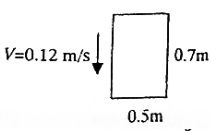
A thin flat plate in size settles in a large tank of water with a terminal velocity of 0.12 m/s. The coefficients of drag for a laminar boundary layer and for a turbulent boundary layer, where is the plate Reynolds number. Assume and The submerged weight of the plate is

A solid sphere (diameter 6 mm) is rising through oil (mass density 900 , dynamic viscosity 0.7 kg/ms) at a constant velocity of 1 cm/s. What is the specific weight of the material form which the sphere is made ? (Take g = 9.81 )
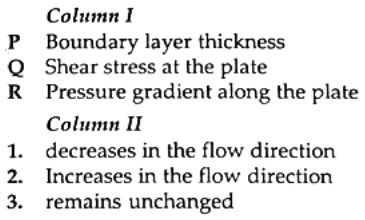
A flat plate is kept in an infinite fluid medium. The fluid has a uniform free-stream velocity parallel to the plate. For the laminar boundary layer formed on the plate, pick the correct option matching Columns I and II.

Velocity distribution in a boundary layer flow over a plate is given by where, ; y is the distance measured normal to the plate; is the boundary layer thickness; and is the maximum velocity at . If the shear stress , acting on the plate is given by where, is the dynamic viscosity of the fluid, K takes the value of
Want unlimited AI-generated Boundary Layer Theory Drag And Lift questions?
Sign up free and practice with adaptive difficulty — Easy, Medium, Hard. New questions every session.
Start practising for free →