GATE CE · Environmental Engineering
Generate GATE-level questions on Treatment Of Waste Water in Environmental Engineering. Focus on core concepts, previous year patterns, and numerical problem-solving techniques.
43 questions · 20 PYQs · 0 AI practice · GATE CE 2027
🎯 These are sample questions
Just sign in to unlock everything. Free for all students.
A compound has a general formula and molecular weight 187. A 935 mg/l solution of the compound is prepared in distilled deionized water. The Total Organic Carbon (TOC) is measured as 360 mg/l (as C). The Chemical Oxygen Demand (COD) and the Total Kjeldahl Nitrogen (TKN) are determined as 600 mg/l (as ) and 140 mg/l (as N), respectively (as per the chemical equation given below). Which of the following options is/are CORRECT? Atomic weight: C(12), H(1), O(16), N(14)
A facultative pond system is employed for wastewater treatment. Which of the following statements is/are true:
Aeration is employed as a treatment option for the removal of several pollutants from contaminated water. Identify the pollutant(s), where aeration is employed as a part of their removal:
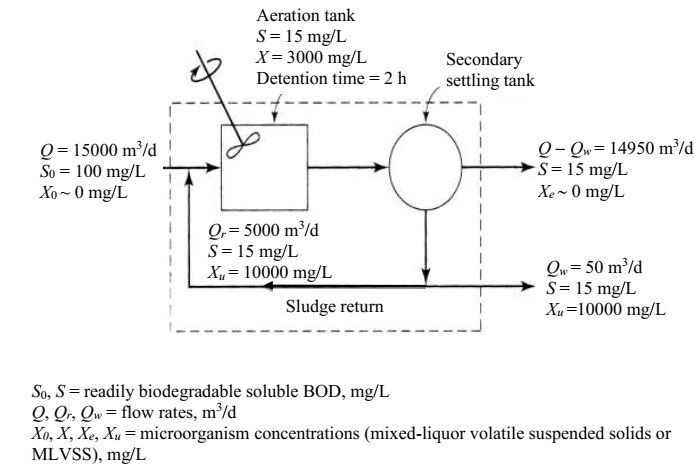
A community generates 1 million litres/day (MLD) of wastewater. This wastewater is treated using an activated sludge process (ASP). The working volume of the aeration tank of the ASP is , and the biomass concentration in the tank is . Analysis results showed that a biomass concentration of is present in the treated effluent from the secondary sedimentation tank of the ASP. Sludge wastage from the system is at a rate of with a biomass concentration of . The system is in steady-state condition. The biological sludge residence time (BSRT) of the system (in days) is ______ (round off to one decimal place).
A circular settling tank is to be designed for primary treatment of sewage of a flow rate of 10 million liters/day. Assume a detention period of 2.0 hours and surface loading rate of 40000 liters day. The height (in meters) of the water column in the tank is _____ (rounded off to 2 decimal places)
Activated carbon is used to remove a pollution from wastewater in a mixed batch reactor, which follows first-order reaction kinetics. At a reaction rate of 0.38 /day, the time (in days) required to remove the pollutant by is ______ (rounded off to 1 decimal place).
Identify the waterborne diseases caused by viral pathogens:
In the context of water and wastewater treatments, the correct statements are:
The wastewater inflow to an activated sludge plant is , and the plant is to be operated with a food to microorganism ratio of . The concentration of influent biodegradable organic matter of the wastewater to the plant (after primary settling) is , and the mixed liquor volatile suspended solids concentration to be maintained in the plant is . Assuming that complete removal of biodegradable organic matter in the tank, the volume of aeration tank (in , in integer) required for the plant is _____.
A 2% sewage sample (in distilled water) was incubated for 3 days at temperature. After incubation, a dissolved oxygen depletion of 10 mg/L was recorded. The biochemical oxygen demand (BOD) rate constant at was found to be (at base e). The ultimate BOD (in mg/L) of the sewage will be_____________. (round off to the nearest integer)
A grit chamber of rectangular cross-section is to be designed to remove particles with diameter of 0.25 mm and specific gravity of 2.70. The terminal settling velocity of the particles is estimated as 2.5 cm/s. The chamber is having a width of 0.50 m and has to carry a peak wastewater flow of giving the depth of flow as 0.75 m. If a flow-through velocity of 0.3 m/s has to be maintained using a proportional weir at the outlet end of the chamber, the minimum length of the chamber (in m,in integer) to remove 0.25 mm particles completely is _________
A secondary clarifier handles a total flow of from the aeration tank of a conventional activated-sludge treatment system. The concentration of solids in the flow from the aeration tank is 3000 mg/L. The clarifier is required to thicken the solids to 12000 mg/L, and hence it is to be designed for a solid flux of . The surface area of the designed clarifier for thickening (in , in integer) is _________________
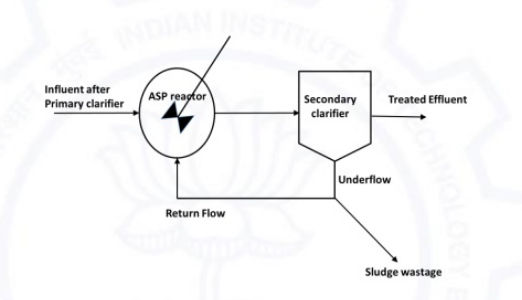
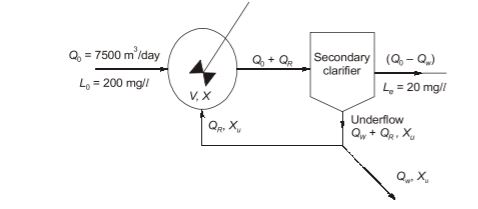
An activated sludge process (ASP) is designed for secondary treatment of of municipal wastewater. After primary clarifier, the ultimate BOD of the influent, which enters into ASP reactor is 200 mg/L. Treated effluent after secondary clarifier is required to have an ultimate BOD of 20 mg/L. Mix liquor volatile suspended solids (MLVSS) concentration in the reactor and the underflow is maintained as 3000 mg/L and 12000 mg/L, respectively. The hydraulic retention time and mean cell residence time are 0.2 day and 10 days, respectively. A representative flow diagram of the ASP is shown below. The underflow volume (in , round off to one decimal place) of sludge wastage is _________

A wastewater is to be disinfected with 35 mg/Lof chlorine to obtain 99% kill of micro-organisms. The number of micro-organisms remaining alive ( ) at time t, is modelled by , where is number of micro-organisms at t= 0, and k is the rate of kill. The wastewater flow rate is 36 , and k= 0.23 . If the depth and width of the chlorination tank are 1.5 m and 1.0 m, respectively, the length of the tank (in m, round off to 2 decimal places) is ________
At a small water treatment plant which has 4 filters, the rates of filtration and backwashing are 200 and 1000 , respectively. Backwashing is done for 15 min per day. The maturation, which occurs initially as the filter is put back into service after cleaning, takes 30 min. It is proposed to recover the water being wasted during backwashing and maturation. The percentage increase in the filtered water produced (up to two decimal places) would be ______
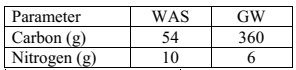
A waste activated sludge (WAS) is to be blended with green waste (GW). The carbon (C) and nitrogen (N) contents, per kg of WAS and GW, on dry basis are given in the table. The ratio of WAS to GW required (up to two decimal places) to achieve a blended C:N ratio of 20:1 on dry basis is ______

A schematic flow diagram of a completely mixed biological reactor with provision for recycling of solids is shown in the figure. The mean cell residence time (in days, up to one decimal place) is ______

The most important type of species involved in the degradation of organic matter in the case of activated sludge process is
The wastewater having an organic concentration of 54 mg/l is flowing at a steady rate of 0.8 through a detention tank of dimensions . If the contents of the tankare well mixed and the decay constant is 0.1 per day, the outlet concentration (in mg/l, up to one decimal place) is ______
Match the items in Group-I with those in Group-II and choose the right combination.

Want unlimited AI-generated Treatment Of Waste Water questions?
Sign up free and practice with adaptive difficulty — Easy, Medium, Hard. New questions every session.
Start practising for free →