Q1GATE 2025MCQ
Identify the treatment technology/technologies NOT recommended for highly biodegradable organic solid wastes.
GATE CE · Environmental Engineering
Generate GATE-level questions on Municipal Solid Waste Management in Environmental Engineering. Focus on core concepts, previous year patterns, and numerical problem-solving techniques.
22 questions · 20 PYQs · 0 AI practice · GATE CE 2027
🎯 These are sample questions
Just sign in to unlock everything. Free for all students.
Identify the treatment technology/technologies NOT recommended for highly biodegradable organic solid wastes.
Organic fraction of municipal solid waste (OFMSW) with bulk density of and water content of is mixed with municipal sludge of bulk density and water content of , such that the water content of the mixture is . The amount (in kg ) of sludge to be mixed per kg of OFMSW (rounded off to 2 decimal places) and the density of the mixture (in ) (rounded off to the nearest integer) are calculated. Which of the following options is/are true:
The following table gives various components of Municipal Solid Waste (MSW) and a list of treatment/separation techniques.
The CORRECT match is
An organic waste is represented as (Atomic weights: S-32, H-1, C-12, O-16, N-14) Assume complete conversion of to while burning. generated (in grams) per of this waste is _____ (rounded off to 1 decimal place).
The composition and energy content of a representative solid waste sample are given in the table. If the moisture content of the waste is , the energy content of the solid waste on dry-weight basis is _____ (round off to one decimal place).
Which of the following statements is/are TRUE for the Refuse-Derived Fuel (RDF) in the context of Municipal Solid Waste (MSW) management?
In the context of Municipal Solid Waste Management, 'Haul' in 'Hauled Container System operated in conventional mode' includes the ____
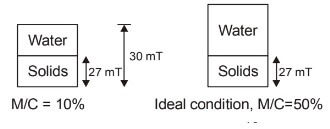
At a municipal waste handling facility, 30 metric ton mixture of food waste, yard waste, and paper waste was available. The moisture content of this mixture was found to be 10%. The ideal moisture content for composting this mixture is 50%. The amount of water to be added to this mixture to bring its moisture content to the ideal condition is _______metric ton. (in integer)
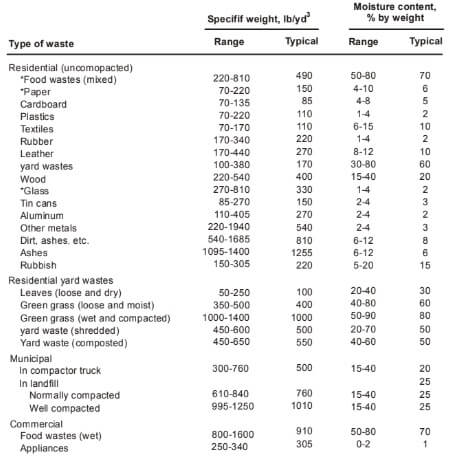
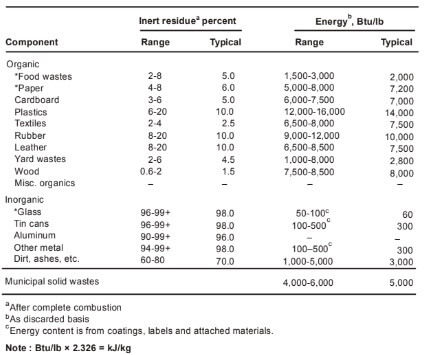
In a solid waste handling facility, the moisture contents ( ) of food waste, paper waste, and glass waste were found to be , , and , respectively. Similarly, the energy contents ( ) of plastic waste, food waste, and glass waste were found to be , , and , respectively. Which of the following statement(s) is/are correct?
In a city, the chemical formula of biodegradable fraction of municipal solid waste (MSW) is . The waste has to be treated by forced-aeration composting process for which air requirement has to be estimated. Assume oxygen in air (by weight) = 23 %, and density of air = 1.3 .Atomic mass: C = 12, H = 1, O = 16, N = 14. C and H are oxidized completely whereas N is converted only into during oxidation. For oxidative degradation of 1 tonne of the waste, the required theoretical volume of air (in ) will be (round off to the nearest integer)
To design an optimum municipal solid waste collection route, which of thefollowing is/are NOT desired:
Determine the correctness or otherwise of the following Assertion [a] and the Reason [r]. Assertion [a]: One of the best ways to reduce the amount of solid wastes is to reduce the consumption of raw materials. Reason [r]: Solid wastes are seldom generated when raw materials are converted to goods for consumption.
Raw municipal solid waste (MSW) collected from a city contains 70% decomposable material that can be converted to methane. The water content of the decomposable material is 35%. An elemental analysis of the decomposable material yields the following mass percent. C : H : O : N : other = 44 : 6 : 43 : 0.8 : 6.2 The methane production of the decomposable material is governed by the following stoichiometric relation Given atomic weights: C=12, H=1, O=16, N=14. The mass of methane produced (in grams, round off to 1 decimal place) per kg of raw MSW will be ______
There are 20,000 vehicles operating in a city with an average annual travel of 12,000 km per vehicle. The emission rate is 2.0 g/km per vehicle. The total annual release of will be
A coal containing 2% sulfur is burned completely to ash in a brick kiln at a rate of 30 kg/min. The sulfur content in the ash was found to be 6% of the initial amount of sulfur present in the coal fed to the brick kiln. The molecular weights of S, H and O are 32, 1 and 16 g/mole, respectively. The annual rate of sulfur dioxide ( ) emission from the kiln (in tonnes/year, up to two decimal places) is ______
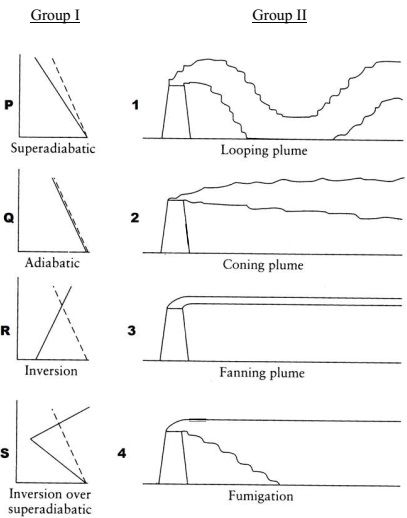
In the figures, Group I represents the atmospheric temperature profiles (P, Q, R and S) and Group II represents dispersion of pollutants from a smoke stack (1, 2, 3 and 4). In the figures of Group I, the dashed line represents the dry adiabatic lapse rate, whereas the horizontal axis represents temperature and the vertical axis represents the altitude. The correct match is
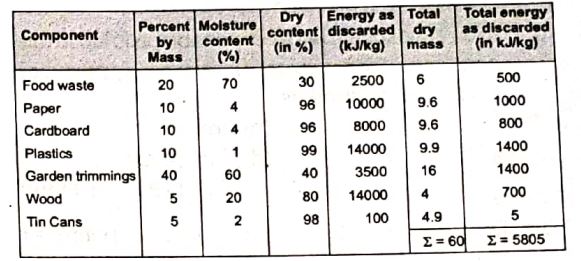
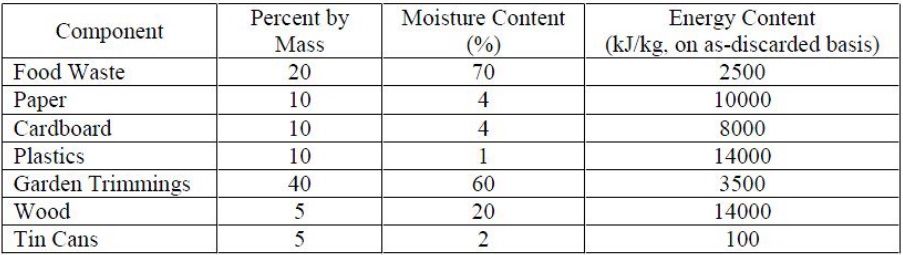
The composition of a municipal solid waste sample is given below: The difference between the energy content of the waste sample calculated on dry basis and asdiscarded basis (in kJ/kg) would be
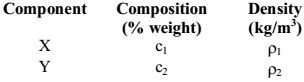
Solid waste generated from an industry contains only two components, X and Y as shown in the table below Assuming ( )=100, the composite density of the solid waste is given by :
A landfill is to be designed to serve a population of 200000 for a period of 25 years. The solid waste (SW) generation is 2 kg/person/day. The density of the un-compacted SW is 100 kg/ and a compaction ratio of 4 is suggested. The ratio of compacted fill (i.e. SW + cover) to compacted SW is 1.5. The landfill volume (in million ) required is _______.
A coastal city produces municipal solid waste (MSW) with high moisture content, high organic materials, low calorific value and low inorganic materials. The most effective and sustainable option for MSW management in that city is
Want unlimited AI-generated Municipal Solid Waste Management questions?
Sign up free and practice with adaptive difficulty — Easy, Medium, Hard. New questions every session.
Start practising for free →