GATE CE · Environmental Engineering
Generate GATE-level questions on Quality And Characteristics Of Waste Water in Environmental Engineering. Focus on core concepts, previous year patterns, and numerical problem-solving techniques.
24 questions · 20 PYQs · 0 AI practice · GATE CE 2027
🎯 These are sample questions
Just sign in to unlock everything. Free for all students.
A wastewater sample contains two nitrogen species, namely ammonia and nitrate. Consider the atomic weight of N, H, and O as 14 g/mol, 1 g/mol, and 16 g/mol, respectively. In this wastewater, the concentration of ammonia is 34 mg and that of nitrate is 6.2 mg . The total nitrogenconcentration in this wastewater is _______ milligram nitrogen per liter. (round off to one decimal place)
The total hardness in raw water is 500 milligram per liter as . The total hardness of this raw water, expressed in milligram equivalent per liter, is (Consider the atomic weights of Ca, C, and O as 40 g/mol, 12 g/mol, and 16 g/mol, respectively.)
A 50 mL sample of industrial wastewater is taken into a silica crucible. The empty weight of the crucible is 54.352 g. The crucible with the sample is dried in a hot air oven at 104 till a constant weight of 55.129 g. Thereafter, the crucible with the dried sample is fired at 600 for 1 h in a muffle furnace, and the weight of the crucible along with residue is determined as 54.783 g. The concentration of total volatile solids is
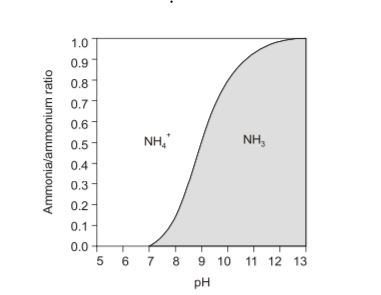
Ammonia nitrogen is present in a given wastewater sample as the ammonium ion and ammonia . If pH is the only deciding factor for the proportion of these two constituents, which of the following is a correct statement?
A completely mixed dilute suspension of sand particles having diameters 0.25, 0.35, 0.40, 0.45 and 0.50 mm are filled in a transparent glass column of diameter 10 cm and height 2.50 m. The suspension is allowed to settle without any disturbance. It is observed that all particles of diameter 0.35 mm settle to the bottom of the column in 30 s. For the same period of 30 s, the percentage removal (round off to integer value) of particles of diameters 0.45 and 0.50 mm from the suspension is ____
The ultimate BOD ( ) of a wastewater sample is estimated as 87% of COD. The COD of this wastewater is 300 mg/L. Considering first order BOD reaction rate constant k (use natural log) = 0.23 per day and temperature coefficient = 1.047, the BOD value (in mg/L, up to one decimal place) after three days of incubation at C for this wastewater will be______
For a given water sample, the ratio between and the ultimate BOD is 0.68. The value of the reaction rate constant k (on base e) (in up to two decimal places) is_____
Two wastewater streams A and B, having an identical ultimate BOD are getting mixed to form the stream C. The temperature of the stream A is 20 C and the temperature of the stream C is 10 C. It is given that The 5-day BOD of the stream A measured at 20 C=50 mg/l BOD rate constant (base 10) at 20 C=0.115 per day Temperature coefficient = 1.135 The 5-day BOD (in mg/l, up to one decimal place)of stream C, calculated at 10 C, is ______
The 2-day and 4-day BOD values of a sewage sample are 100 mg/L and 155 mg/L, respectively. The value of BOD rate constant (expressed in per day) is ___________
For a wastewater sample, the three-day biochemical oxygen demand at incubation temperature of , is estimated as 200 mg/L. Taking the value of the first order BOD reaction rate constant as , the five-day BOD (expressed in mg/L) of the wastewater at incubation temperature of would be ___________
Ultimate BOD of a river water sample is 20 mg/L. BOD rate constant (natural log) is 0.15 . The respective values of BOD (in %) exerted and remaining after 7 days are:
A student began experiment for determination of 5-day, 20 C BOD on Monday. Since the day fell on Saturday, the final DO readings were taken on next Monday. On calculation, BOD (i.e. 7 day, 20 C) was found to be 150 mg/L. What would be the 5-day, 20 C BOD (in mg/L)? Assume value of BOD rate constant (k) at standard temperature of 20 C as 0.23/day (base e). __________
Some of the water quality parameters are measured by titrating a water sample with a titrant. Group-I gives a list of parameters and Group-II gives the list of titrants. The correct match of water quality parameters in Group-I with titrants in Group-II is:

If the of a wastewater sample is 75mg/L and reaction rate constant k (base e) is 0.345 per day, the amount of BOD remaining in the given sample after 10 days is
The 5-day BOD of a wastewater sample is obtained as 190 mg/l (with k = 0.01 ). The ultimate oxygen demand (mg/l) of the sample will be
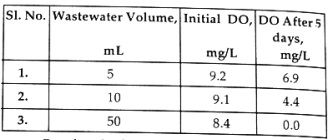
To determine the of a waste water sample, 5, 10 and 50 mL aliquots of the waste water were dilute to 300 mL and incubated at 20 C in BOD bottles for 5 days. The results were as follows Based on the data, the average of the waste water is equal to

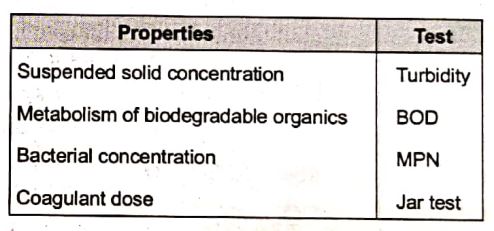
Group-1 contains some properties of water/wastewater and Group-2 contains list of some tests on water/wastewater. Match the property with corresponding test.

Total Kjeldahl nitrogen is a measure of
A portion of waste water sample was subjected to standard BOD test (5 days, 20 C), yielding a value of 180 mg/L. The reaction rate constant (to the base'e') at 20 C was taken as 0.18 per day. The reaction rate constant at other temperature may be estimated by . The temperature at which the other portion of the sample shoudl be tested, to exert the same BOD in 2.5 days, is
Water samples (X and Y) from two different source were brought ot the laboratory for the measurement of dissolved oxygen (DO) using modified Winkler method. Samples were transferred to 300 ml BOD bottles. 2 ml of solution and 2 mL of alkaliodide-azide reagent were added to the bottles and mixed. Samples X developed a brown precipitate, whereas sample Y developed a white precipitate. In reference to these observations, the correct statement is
Want unlimited AI-generated Quality And Characteristics Of Waste Water questions?
Sign up free and practice with adaptive difficulty — Easy, Medium, Hard. New questions every session.
Start practising for free →