Q1GATE 2025MCQ
The bacteria mainly responsible for crown corrosion in a sewer is ______.
GATE CE · Environmental Engineering
Generate GATE-level questions on Disposal Of Sewage Effluents in Environmental Engineering. Focus on core concepts, previous year patterns, and numerical problem-solving techniques.
9 questions · 9 PYQs · 0 AI practice · GATE CE 2027
🎯 These are sample questions
Just sign in to unlock everything. Free for all students.
The bacteria mainly responsible for crown corrosion in a sewer is ______.
Which one of the following products is NOT obtained in anaerobic decomposition of glucose?
Which one of the following statements is TRUE for Greenhouse Gas (CHG) in the atmosphere?
Which of the following statements is/are TRUE for the aerobic composting of sewage sludge?
A sewage treatment plant receives sewage at a flow rate of 5000 . The total suspended solids (TSS) concentration in the sewage at the inlet of primary clarifier is 200 mg/L. After the primary treatment, the TSS concentration in sewage is reduced by 60%. The sludge from the primary clarifier contains 2% solids concentration. Subsequently, the sludge is subjected to gravity thickening process to achieve a solids concentration of 6%. Assume that the density of sludge, before and after thickening, is 1000 . The daily volume of the thickened sludge (in ) will be_________.(round off to the nearest integer)
A city generates kg of municipal solid waste (MSW) per year, out of which only 10% is recovered/recycled and the rest goes to landfill. The landfill has a single lift of 3 m height and is compacted to a density of . If 80% of the landfill is assumed to be MSW, the landfill area (in , up to one decimal place) required would be ______
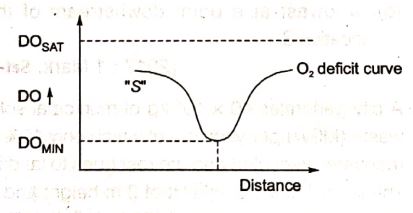
The wastewater form a city, containing a high concentration of biodegradable organics, is beingsteadily discharged into a flowing river at a location S. If the rate of aeration of the river water islower than the rate of degradation of the organics, then the dissolved oxygen of the river water
In a certain situation, waste water discharged into a river mixer with the river water instantaneously and completely. Following is the data available : Waste water: DO = 2.00 mg/L Discharge rate = 1.10 /s River water: DO = 8.3 mg/L Flow rate = 8.70 /s Temperature = 20 C Initial amount of DO in the mixture of waste and river shall be
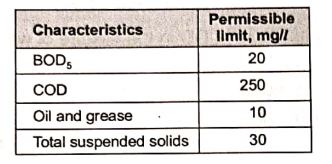
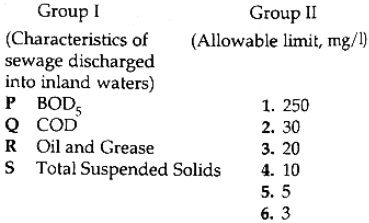
Match Group-I (Characteristics of sewage discharged into inland waters ) with Group-II (Allowable limit, mg/L).
Want unlimited AI-generated Disposal Of Sewage Effluents questions?
Sign up free and practice with adaptive difficulty — Easy, Medium, Hard. New questions every session.
Start practising for free →