A block of mass 5 kg is moving on an inclined plane which makes an angle of 30∘ with the horizontal. Friction coefficient between the block and inclined plane surface is 3/2. The force to be applied on the block so that the block will move down without acceleration is ____ N. (g=10m/s2)
To find the applied force required for the block to move down without acceleration, we analyze the forces acting parallel to the inclined plane.
The normal force is N=mgcos30∘=5×10×23=253N.
The kinetic friction force opposing motion is f=μN=23×253=37.5N.
The component of gravity acting down the plane is mgsin30∘=5×10×0.5=25N.
For constant velocity (zero acceleration), the net force along the plane must be zero: Fapplied+mgsin30∘=f.
Solving for Fapplied, we get Fapplied=37.5−25=12.5N.
Q2JEE Main 2026MCQ
A block is sliding down on an inclined plane of slope θ and at an instant t=0 this block is given an upward momentum so that it starts moving up on the inclined surface with velocity u. The distance (S) travelled by the block before its velocity become zero, is ____ . (g = gravitational acceleration)
When the block moves up the inclined plane, the component of gravity acting downwards along the plane is mgsinθ. Since this force acts opposite to the direction of motion, the retardation is a=gsinθ. Using the kinematic equation v2=u2+2aS, where v=0 at maximum distance S: 02=u2−2(gsinθ)S u2=2gsinθS S=2gsinθu2
Q3JEE Main 2026MCQ
A particle of mass m falls from rest through a resistive medium having resistive force, F=−kv, where v is the velocity of the particle and k is a constant. Which of the following graphs represents velocity (v) versus time (t) ?
The forces acting on the particle are gravity mg downwards and drag kv upwards. Applying Newton's second law: mdtdv=mg−kv.
Separating variables and integrating with initial condition v(0)=0: ∫0vmg−kvdv=∫0tmdt⟹−k1ln(mgmg−kv)=mt
Solving for velocity gives: v(t)=kmg(1−e−mkt).
As t→0, v→0, and as t→∞, v→kmg (terminal velocity).
The graph starts at the origin, increases with a decreasing slope, and asymptotically approaches the horizontal line v=kmg, matching option D.
Q4JEE Main 2026NAT
In the given figure the blocks A,B and C weigh 4kg,6kg and 8 kg respectively. The co-efficient of sliding friction between any two surfaces is 0.5 . The force F required to slide the block C with constant speed is ____ N . (Use g=10m/s2 )
To find the force F required to slide block C, we calculate the normal and frictional forces acting on the system:
Normal Forces:
Between A and B: N1=mAg=4×10=40 N.
Between B and C: N2=(mA+mB)g=(4+6)×10=100 N.
Between C and ground: N3=(mA+mB+mC)g=(4+6+8)×10=180 N.
Frictional Forces (μ=0.5):
f1=μN1=0.5×40=20 N.
f2=μN2=0.5×100=50 N.
f3=μN3=0.5×180=90 N.
Total Force Calculation:
Since block B is connected to the wall, the tension T in the rope balances the friction forces on B (from A and C), so T=f1+f2=20+50=70 N. The force F required to slide block C must overcome the friction from the ground (f3), the friction from block B (f2), and the tension transferred through the system (T): F=f3+f2+T=90+50+70=210 N
[CORRECT_OPTION: N/A]
Q5JEE Main 2026MCQ
A flexible chain of mass m hangs between two fixed points at the same level. The inclination of the chain with the horizontal at the two points of support is 30∘. Considering the equilibrium of each half of the chain, the tension of the chain at the lowest point is ____
Considering the equilibrium of one half of the chain (mass 2m), the vertical forces must balance: Tsupportsin(30∘)=2mg, where Tsupport is the tension at the support.
The horizontal forces must also balance, giving the tension at the lowest point as T0=Tsupportcos(30∘).
From the vertical equilibrium, Tsupport=sin(30∘)mg/2=1/2mg/2=mg.
Substituting this into the horizontal equilibrium equation yields T0=mgcos(30∘)=mg(23)=23mg.
Q6JEE Main 2026MCQ
A small block of mass m slides down from the top of a frictionless inclined surface, while the inclined plane is moving towards left with constant acceleration a0. The angle between the inclined plane and ground is θ and its base length is L. Assuming that initially the small block is at the top of the inclined plane, the time it takes to reach the lowest point of the inclined plane is ____ .
In the non-inertial reference frame of the inclined plane, a pseudo-force Fp=ma0 acts on the block towards the right. The components of acceleration along the incline (downwards) are gsinθ due to gravity and −a0cosθ due to the pseudo-force. Thus, the net acceleration is a=gsinθ−a0cosθ.
The length of the inclined surface is s=cosθL. Using the kinematic equation s=21at2, we have: t=a2s=gsinθ−a0cosθ2(L/cosθ)=gsinθcosθ−a0cos2θ2L
To match the given options, multiply the numerator and denominator by 2: t=2gsinθcosθ−2a0cos2θ4L
Using the trigonometric identities 2sinθcosθ=sin2θ and 2cos2θ=1+cos2θ: t=gsin2θ−a0(1+cos2θ)4L
Q7JEE Main 2026MCQ
A 4 kg mass moves under the influence of a force F=(4t3ı^−3tȷ^)N where t is the time in second. If mass starts from origin at t=0, the velocity and position after t=2s will be:
Given the mass m=4 kg and force F=(4t3i^−3tj^) N, the acceleration is a=mF=(t3i^−43tj^) m/s2.
Integrating acceleration with respect to time, v(t)=∫adt=(4t4i^−83t2j^) m/s, as v(0)=0.
At t=2 s, the velocity is v(2)=424i^−83(22)j^=4i^−812j^=4i^−23j^ m/s.
Integrating velocity, r(t)=∫vdt=(20t5i^−8t3j^) m, as r(0)=0.
At t=2 s, the position is r(2)=2025i^−823j^=2032i^−88j^=58i^−j^ m.
Q8JEE Main 2025MCQ
A body of mass m is suspended by two strings making angles θ1 and θ2 with the horizontal ceiling with tensions T1 and T2 simultaneously. T1 and T2 are related by T1=3T2, the angles θ1 and θ2 are
The equilibrium conditions for the mass m are given by resolving forces horizontally (T1cosθ1=T2cosθ2) and vertically (T1sinθ1+T2sinθ2=mg). Given T1=3T2, the horizontal equation becomes 3cosθ1=cosθ2. Testing Option C where θ1=60∘ and θ2=30∘, we find 3cos60∘=3×21=23=cos30∘, which is satisfied. Substituting these into the vertical equation gives T2(3sin60∘+sin30∘)=mg, which simplifies to T2(3⋅23+21)=T2(23+21)=2T2=mg. Thus, T2=2mg.
Q9JEE Main 2025MCQ
A block of mass 1 kg , moving along x with speed vi=10m/s enters a rough region ranging from x=0.1m to x=1.9m. The retarding force acting on the block in this range is Fr=−kxN, with k=10N/m. Then the final speed of the block as it crosses rough region is.
W=Δk so ∣Wf∣= loss \inKE21k((1.9)2−(0.1)2)=21×1{102−v2}10×1.8×2=100−v2v2=64v=8m/s
Q10JEE Main 2025MCQ
A body of mass 2 kg moving with velocity of v=3i^+4j^ ms−1 enters into a constant force field of 6 N directed along positive z-axis. If the body remains in the field for a period of 35 seconds, then velocity of the body when it emerges from force field is :
A balloon and its content having mass M is moving up with an acceleration ' a '. The mass that must be released from the content so that the ballon starts moving up with an acceleration ' 3 a ' will be (Take ' g ' as acceleration due to gravity)
Let us assure buoyancy force on balloon be B.B−Mg=MaB−(M−m)g=(M−m)3aSubtracting (ii) from (i)(B−Mg)−(B−(M−m)g)=Ma−3(M−m)a−mg=(3m−2M)aor m=3a+g2Ma
Q14JEE Main 2025MCQ
A body of mass 1 kg is suspended with the help of two strings making angles as shown in figure. Magnitudes of tensions T1 and T2, respectively, are (in N )(Take acceleration due to gravity 10m/s2 )
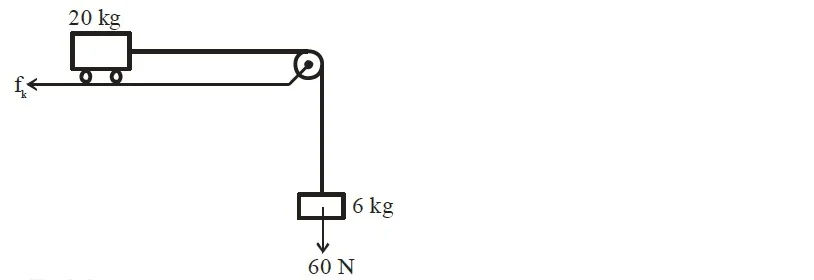
Consider a block and trolley system as shown in figure. If the coefficient of kinetic friction between the trolley and the surface is 0.04 , the acceleration of the system in ms−2 is :(Consider that the string is massless and unstretchable and the pulley is also massless and frictionless) : [1-Feb-2024 Shift 1]
A light string passing over a smooth light fixed pulley connects two blocks of masses m1 and m2. If the acceleration of the system is g/8, then the ratio of masses is [31-Jan-2024 Shift 2]
A light string passing over a smooth light pulley connects two blocks of masses m1 and m2 (where m2>m1 ). If the acceleration of the system is g/2, then the ratio of the masses m1/m2 is :
A player caught a cricket ball of mass 150g moving at a speed of 20m/s. If the catching process is completed in 0.1s, the magnitude of force exerted by the ball on the hand of the player is:
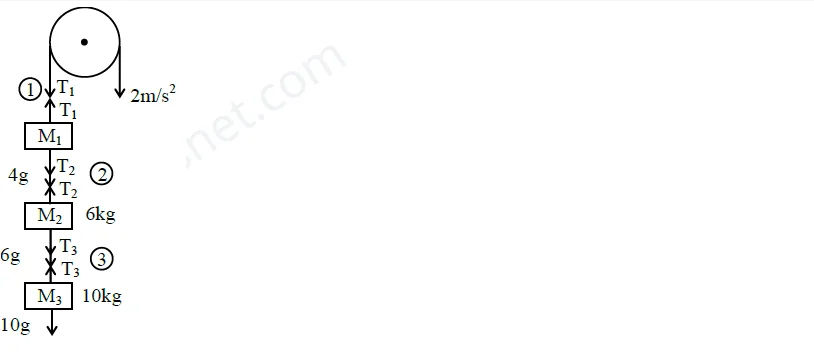
Three blocks M1,M2,M3 having masses 4kg,6kg and 10kg respectively are hanging from a smooth pully using rope 1,2 and 3 as shown in figure. The tension in the rope 1,T1 when they are moving upward with acceleration of 2ms−2 is ............... N (if g=10m/s2 )