Two charged conducting spheres S1 and S2 of radii 8 cm and 18 cm are connected to each other by a wire. After equilibrium is established, the ratio of electric fields on S1 and S2 spheres are ES1 and ES2 respectively. The value of ES1/ES2 is ________.[JEE Main 2 apr 2026 Shift 1]
Three small identical bubbles of water having same charge on each coalesce to form a bigger bubble. Then the ratio of the potentials on one initial bubble and that on the resultant bigger bubble is :
Let r,q, and Vs=rkq be the radius, charge, and potential of one small bubble.
When three identical bubbles coalesce, volume conservation implies 34πR3=3×(34πr3), which yields R=31/3r.
The total charge of the resultant bigger bubble is Q=3q, so its potential is Vb=RkQ=31/3rk(3q)=31−1/3(rkq)=32/3Vs.
The ratio of the potential of one initial bubble to that of the resultant bigger bubble is VbVs=32/3VsVs=32/31.
Thus, the required ratio is 1:32/3.
Q3JEE Main 2026NAT
A point charge q=1μC is located at a distance 2 cm from one end of a thin insulating wire of length 10 cm having a charge Q=24μC, distributed uniformly along its length, as shown in figure. Force between q and wire is ____ N. (Use : 4πE01=9×10⁹N⋅m2/C2 )
Given d=0.02m, L=0.1m, q=10−6C, Q=24×10−6C, and k=4πϵ01=9×10⁹N⋅m2/C2.
The linear charge density is λ=LQ. The differential force on q due to a charge element dq=λdx at distance x is dF=x2kqλdx.
Integrating over the wire from x=d to x=d+L: F=∫dd+Lx2kqλdx=kqλ[−x1]dd+L=kqλ(d1−d+L1).
Simplifying with λ=LQ, we get F=d(d+L)kqλL=d(d+L)kqQ.
Substituting the values: F=(0.02)(0.12)(9×10⁹)(10−6)(24×10−6)=0.00240.216=90N.
Q4JEE Main 2026MCQ
Three charges +2q,+3q and −4q are situated at (0,−3a),(2a,0) and (−2a,0) respectively in the xy plane. The resultant dipole moment about origin is ____ .
The resultant dipole moment p for a system of point charges is defined as p=∑qiri. Given the charges q1=+2q at r1=−3aj^, q2=+3q at r2=2ai^, and q3=−4q at r3=−2ai^, we calculate the vector sum: p=(2q)(−3aj^)+(3q)(2ai^)+(−4q)(−2ai^)
Expanding this expression gives: p=−6qaj^+6qai^+8qai^
Grouping the components yields: p=(6+8)qai^−6qaj^=14qai^−6qaj^
Factoring out 2qa, we obtain the resultant dipole moment: p=2qa(7i^−3j^)
Q5JEE Main 2026MCQ
Given below are two statements: one is labelled as Assertion A and the other is labelled as Reason RAssertion A : In electrostatics, a conductor does not store any net charge inside.Reason R : Inside the capacitor (with no dielectric medium), the free charge carriers, if placed between the plates of capacitor, experience force and drift.Choose the correct answer from the options given below.[JEE Main 4 Apr 2026 Shift 2]
Assertion ⟶ True : (in electrostatics, conductor can have charge only on its surface)Reason ⟶ True : [inside capacitor, electric field exists therefore charges can improve force] But reason is not correct explanation of assertion
Q6JEE Main 2026MCQ
Electric field in a region is given by E=Axi∧+Byj∧, where A=10V/m2 and B=5V/m2. If the electric potential at a point (10,20) is 500 V , then the electric potential at origin is ____ V.
The relationship between the electric field E and potential V is given by dV=−E⋅dr=−(Axdx+Bydy).
Integrating from the origin (0,0) to a point (x,y), we obtain V(x,y)−V(0,0)=−∫0xAxdx−∫0yBydy=−2Ax2−2By2.
Rearranging for the potential at the origin, we have V(0,0)=V(x,y)+2Ax2+2By2.
Substituting the given values V(10,20)=500V, x=10, y=20, A=10V/m2, and B=5V/m2: V(0,0)=500+210(10)2+25(20)2=500+500+1000=2000V.
Q7JEE Main 2026MCQ
A simple pendulum has a bob with mass m and charge q. The pendulum string has negligible mass. When a uniform and horizontal electric field E is applied, the tension in the string changes. The final tension in the string, when pendulum attains an equilibrium position is ____ .
At equilibrium, the forces acting on the bob are gravity mg (downward), the electric force qE (horizontal), and the tension T directed along the string.
Resolving the tension into perpendicular components, we balance the forces as Tcosθ=mg and Tsinθ=qE, where θ is the angle the string makes with the vertical.
Squaring both equations gives T2cos2θ=m2g2 and T2sin2θ=q2E2.
Adding these equations yields T2(cos2θ+sin2θ)=m2g2+q2E2.
Applying the identity sin2θ+cos2θ=1, we get T2=m2g2+q2E2.
Solving for T, we find the final tension to be T=m2g2+q2E2.
Q8JEE Main 2026MCQ
Identify the correct statements: A. Electrostatic field lines form closed loops. B. The electric field lines point radially outward when charge is greater than zero. C. The Gauss - Law is valid only for inverse-square force. D. The work done in moving a charged particle in a static electric field around a closed path is zero. E. The motion of a particle under Coulomb's force must take place in a plane. Choose the correct answer from the options given below :
A is incorrect because electrostatic field lines originate from positive charges and terminate on negative ones, unlike magnetic field lines which form closed loops. B is correct because the electric field for a charge q>0 is directed radially outward. C is correct because Gauss's Law, ∮E⋅dA=q/ϵ0, relies fundamentally on the inverse-square nature of the Coulomb force. D is correct because static electric fields are conservative, meaning ∮E⋅dl=0, so the work done over a closed path is zero. E is correct because Coulomb's force is a central force (F∥r), which conserves angular momentum L=r×p, thereby restricting motion to a single plane.
Q9JEE Main 2026MCQ
Two metal plates (A,B) are kept horizontally with separation of (π12) cm, with plate A on the top. An atomizer jet sprays oil (density 1.5g/cm3 ) droplets of radius 1mm horizontally. All oil droplets carry a charge 5 nC. The potentials VA and VB are required on plates A and B respectively in order to ensure the droplets do not descend. The values of VA and VB are _______.(Neglect the air resistance to the droplets and take g=10m/s2)[JEE Main 2 apr 2026 Shift 2]
ΔV/(12/π)×10−2×5×10−9=34π(r3)ρ(g)ΔV×5×10−7=16(r3)ρ(g)ΔV=480,VA<VBPlate A will be lower potential
Q10JEE Main 2026MCQ
The electrostatic potential in a charged spherical region of radius r varies as V=ar3+b, where a and b are constants. The total charge in the sphere of unit radius is α×πa∈0. The value of α is ____ . (permittivity of vacuum is E0 )
The Poisson equation relates the electrostatic potential V to the volume charge density ρ as ρ=−ϵ0∇2V. For spherical symmetry, ∇2V=r21drd(r2drdV).
Given V=ar3+b, we have drdV=3ar2, so ∇2V=r21drd(3ar4)=12ar.
Thus, the charge density is ρ=−12arϵ0. The total charge Q within radius r=1 is calculated as Q=∫01ρ(4πr2)dr.
Substituting ρ, Q=∫01(−12arϵ0)(4πr2)dr=−48πaϵ0∫01r3dr.
Evaluating the integral, Q=−48πaϵ0[4r4]01=−12πaϵ0.
Comparing this with the given expression Q=απaϵ0, we find α=−12.
Q11JEE Main 2026MCQ
There are three co-centric conducting spherical shells A,B and C of radii a,b and c respectively ( c>b>a ) and they are charged with charge q1,q2 and q3 respectively. The potentials of the spheres A,B and C respectively, are :
The potential at a distance r from a conducting spherical shell of radius R with charge Q is 4πϵ01rQ for r≥R and 4πϵ01RQ for r<R.
For shell A (r=a), the potential is the sum of contributions from all three shells: VA=4πϵ01(aq1+bq2+cq3).
For shell B (r=b), since a<b<c, q1 acts as if it is at its surface, q2 is at its surface, and q3 is outside: VB=4πϵ01(bq1+bq2+cq3)=4πϵ01(bq1+q2+cq3).
For shell C (r=c), all charges are effectively at or inside the surface r=c: VC=4πϵ01(cq1+cq2+cq3)=4πϵ01(cq1+q2+q3).
These expressions match the formulas provided in option D.
Q12JEE Main 2026MCQ
The electric potential as a function of x, y is given by V=5(x2−y2)V. The electric field at a point (2, 3) m is ______ V/m.[JEE Main 6 Apr 2026 shift 2]
A point charge of 10−8C is placed at origin. The work done in moving a point charge 2μC from point A(4,4,2)m to B(2,2,1)m is ____ J. (4πEo1=9×10⁹. in Sl units)
The distance of points A and B from the origin are rA=42+42+22=6m and rB=22+22+12=3m.
The work done W is given by W=q(VB−VA)=kQq(rB1−rA1).
Substituting the given values, we have W=(9×10⁹)(10−8)(2×10⁻⁶)(31−61).
Simplifying the expression, W=(18×10−5)(61)=3×10⁻⁵J.
Converting to the required units, W=30×10−6J.
Q14JEE Main 2026MCQ
Two charges 7μC and −2μC are placed at (−9,0,0)cm and (9,0,0)cm respectively in an external field E=r2Ar^, where A=9×10⁵N/C.m2. Considering the potential at infinity is 0 , the electrostatic energy of the configuration is ____ J.
The electrostatic potential due to the external field E=r2Ar^ is V(r)=∫r∞E⋅dr=rA=r9×105V.
The potential energy due to the external field is Uext=q1V(r1)+q2V(r2): Uext=(7×10⁻⁶C)(0.09m9×105)+(−2×10⁻⁶C)(0.09m9×105)=70J−20J=50J
The interaction energy between the charges is U∫=dkq1q2, where d=0.18m: U∫=0.18(9×10⁹)(7×10⁻⁶)(−2×10⁻⁶)=0.18−126×10−3=−0.7J
The total electrostatic energy of the configuration is U=Uext+U∫=50J−0.7J=49.3J.
Q15JEE Main 2026MCQ
Two shorts dipoles (A,B),A having charges ±2μC and length 1 cm and B having charges ±4μC and length 1 cm are placed with their centres 80 cm apart as shown in the figure. The electric field at a point P, equi-distant from the centres of both dipoles is ____ N/C.
Distance from each dipole center to P: r=40 cm=0.4m Dipole moments: pA=(2×10⁻⁶)(10−2)=2×10⁻⁸pB=(4×10⁻⁶)(10−2)=4×10⁻⁸ For dipole A (axial point), EA=4πϵ01r32pA=9×109⋅(0.4)32(2×10⁻⁸) =5625 For dipole B (equatorial point), EB=4πϵ01r3pB=9×109⋅(0.4)34×10−8 =5625 So magnitudes are equal. Directions: EA is horizontal EB is vertical They are perpendicular. Hence resultant: E=EA2+EB2=56252=169×1042
Q16JEE Main 2026MCQ
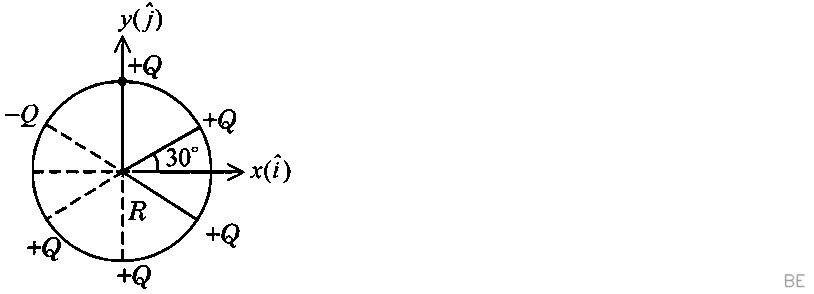
Six point charges are kept 60∘ apart from each other on the circumference of a circle of radius R as shown in figure. The net electric field at the center of the circle is ____ . ( E0 is permittivity of free space)
The charges are located at 30∘,90∘,150∘,210∘,270∘,and 330∘ on the circle. Pairs at (30∘,210∘) with charges (+Q,+Q) and (90∘,270∘) with charges (+Q,+Q) create electric fields that cancel out due to symmetry and equal magnitudes. The remaining pair consists of a −Q charge at 150∘ and a +Q charge at 330∘. The field from the +Q charge at 330∘ points away from it (towards 150∘), and the field from the −Q charge at 150∘ points towards it (towards 150∘), so they add constructively. The resultant field is E=2×(4πϵ01R2Q)r^150∘, where r^150∘=cos(150∘)i^+sin(150∘)j^=−23i^+21j^. Thus, E=4πϵ0R22Q(−23i^+21j^)=−4πϵ0R2Q(3i^−j^).
Q17JEE Main 2026MCQ
Two point charges of 1 nC and 2 nC are placed at the two corners of equilateral triangle of side 3 cm . The work done in bringing a charge of 3 nC from infinity to the third corner of the triangle is ____μJ. 4πE01=9×10⁹N⋅m2/C2
The potential V at the third corner of the equilateral triangle due to charges q1 and q2 is: V=4πϵ01(rq1+rq2)=rk(q1+q2)
The work done W to bring charge q3 from infinity to that point is W=q3×V=rkq3(q1+q2).
Given k=9×10⁹N⋅m2/C2, q1=1nC, q2=2nC, q3=3nC, and r=3cm=0.03m: W=0.03(9×109)×(3×10−9)×(1×10−9+2×10⁻⁹) W=0.039×109×3×10−9×3×10−9=0.0381×10−9=2700×10−9J W=2.7×10⁻⁶J=2.7μJ
Q18JEE Main 2026MCQ
A thin half ring of radius 35 cm is uniformly charged with a total charge of Q coulomb. If the magnitude of the electric field at centre of the half ring is 100 V/m, then the value of Q is ______ nC.(E0=8.85×10⁻¹²C2/Nm2andπ=3.14)[JEE Main 6 Apr 2026 shift 1]
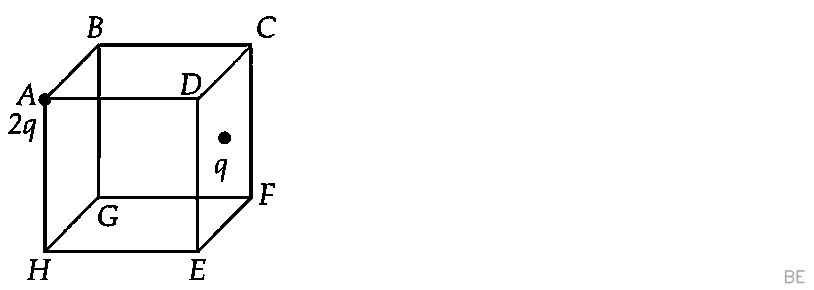
Two point charges 2q and q are placed at vertex A and centre of face CDEF of the cube as shown in figure. The electric flux passing through the cube is:
By Gauss's Law, the total electric flux Φ through the cube is ϵ0Qenclosed.
The charge 2q is placed at a vertex, which is shared by 8 such cubes; therefore, the contribution to the enclosed flux is Φ1=8ϵ02q=4ϵ0q.
The charge q is placed at the center of a face, which is shared by 2 such cubes; therefore, the contribution to the enclosed flux is Φ2=2ϵ0q=4ϵ02q.
The total flux passing through the cube is the sum of these contributions: Φ=Φ1+Φ2=4ϵ0q+4ϵ02q=4ϵ03q.
Q20JEE Main 2026MCQ
Two short electric dipoles A and B having dipole moment p1 and p2 respectively are placed with their axis mutually perpendicular as shown in the figure. The resultant electric field at a point x is making an angle of 60° with the line joining points O and x. The ratio of the dipole moments p2/p1 is _______.[JEE Main 2 apr 2026 Shift 1]