📖 Explanation
Faraday's law of electromagnetic induction dictates that the generated emf is equal to the negative rate of change of magnetic flux enclosed by a loop, expressed as e=−dtdΦ. Magnetic flux is determined by the product of the magnetic field and the cross-sectional area where that field genuinely exists.
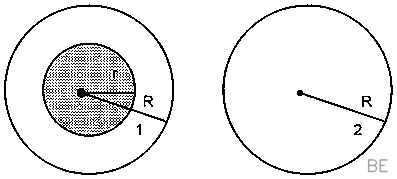
Because loop 1 encompasses the entire region of radius r where the magnetic field is restricted, its magnetic flux is given by Bπr2, which differentiates with respect to time to produce an emf of −dtdBπr2. Conversely, loop 2 sits completely outside the restricted magnetic field zone, meaning no magnetic flux threads through its surface at any point, resulting in an induced emf of zero.