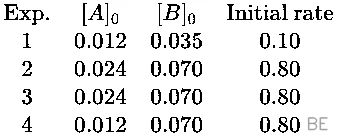
The data for the reaction A+B→C, is
Exp.1234[A]00.0120.0240.0240.012[B]00.0350.0700.0700.070Initial rate0.100.800.800.80The rate law corresponds to the above data is(1994)
📖 Explanation
The rate law for a general reaction can be expressed as rate=k[A]x[B]y, where x and y represent the orders with respect to reactants A and B. Comparing the data from experiment 2 and experiment 3, where the concentration of A is held constant at 0.024 and the concentration of B is doubled from 0.035 to 0.070, the initial rate increases from 0.10 to 0.80, which is an eightfold increase. Setting up the ratio 0.100.80=(0.0350.070)y yields 2y=8, demonstrating that the reaction is third order with respect to B, so y=3. Next, comparing experiment 3 and experiment 1, where the concentration of B remains constant at 0.035 while the concentration of A is doubled from 0.012 to 0.024, the initial rate stays unchanged at 0.10. Evaluating the ratio 0.100.10=(0.0120.024)x results in 2x=1, revealing that the reaction order with respect to A is zero, meaning x=0. Combining these findings yields the final rate law expression rate=k[B]3.