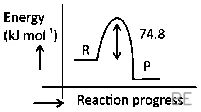
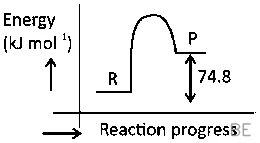
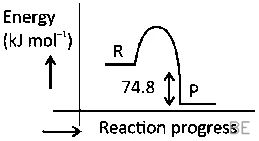
Consider the following reaction :2A(g)+B(g)→2D(g) ΔU⊖=−10 kJ mol−1 and ΔS⊖=−44 JK−1 at 298 K.Identify the correct option with ΔG⊖ for the reaction and spontaneity of the reaction at 298 K .(Given : R=8.31J mol−1K−1 )
📖 Explanation
The feasibility of a chemical process at constant temperature and pressure depends on the Gibbs free energy change, determined by the relation ΔG⊖=ΔH⊖−TΔS⊖. Before calculating this, the enthalpy change must be determined from the internal energy change using the formula ΔH⊖=ΔU⊖+ΔngRT, where Δng is the difference in stoichiometric coefficients between gaseous products and gaseous reactants. In this reaction, Δng is calculated as 2−(2+1), which equals −1. Using the provided values, the enthalpy change is ΔH⊖=−10 kJ mol−1+(−1)(8.31 J K−1 mol−1)(298 K)×10−3 kJ J−1, simplifying to −10−2.47638, or −12.47638 kJ mol−1.
The entropic component, TΔS⊖, is found by multiplying 298 K by −44 J K−1 mol−1, yielding −13112 J mol−1, which is equivalent to −13.112 kJ mol−1. Substituting these values back into the Gibbs equation gives ΔG⊖=−12.47638 kJ mol−1−(−13.112 kJ mol−1), resulting in +0.63562 kJ mol−1, which is approximately +0.63568 kJ mol−1. Since the resulting Gibbs free energy change is positive, the reaction is non-spontaneous at 298 K.