Q1NEET UG 2026MCQ
The oxidation of glucose is one of the most important reactions in a living cell. What is the number of ATP molecules generated in cells from one molecule of glucose? (1995)
NEET UG · Chemistry
Generate NEET level questions on Biomolecules. Focus on NCERT concepts.
79 questions · 20 PYQs · 0 AI practice · NEET UG 2027
🎯 These are sample questions
Just sign in to unlock everything. Free for all students.
The oxidation of glucose is one of the most important reactions in a living cell. What is the number of ATP molecules generated in cells from one molecule of glucose? (1995)
The amino acid that gives a red-blood colour on treating its sodium fusion extract with sodium nitroprusside is[NEET 2026 Re-exam]
An example of biopolymer is (1994)
Haemoglobin is (1997)
Glucose molecule reacts with number of molecules of phenyl hydrazine to yield osazone. The value of is (1998)
The correct statement with regard to the secondary structure of DNA/RNA is
Chemically considering digestion is basically (1994)
Which of the following statements about enzymes are true? (1995)
The secondary structure of a protein refers to (1995)
The function of enzymes in the living system is to (1997)
Enzymes take part in a reaction and (1993)
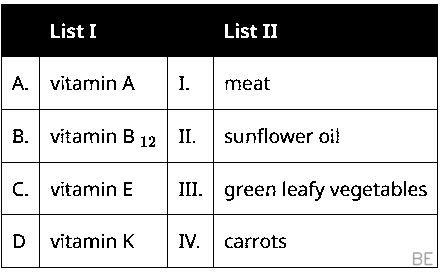
Match the vitamins in List I with their sources in List II List IList IIA.vitamin AI.meatB.vitamin B II.sunflower oilC.vitamin EIII.green leafy vegetablesDvitamin KIV.carrotsChoose the correct answer from the options given below.[NEET 2026 Re-exam]
Which of the following is the sweetest sugar? (1999)
The correct statement about peptides and proteins is[NEET 2026 Re-exam]
The -glucose and -glucose differ from each other due to difference in carbon atom with respect to its (1995)
The couplings between base units of DNA is through (1992)
The number of molecules of ATP produced in the lipid metabolism of a molecule of palmitic acid is (1998)
Sugar ' 'A. is found in honey B. is a keto sugar C. exists in and - anomeric forms D. Is laevorotatory. ' ' is :
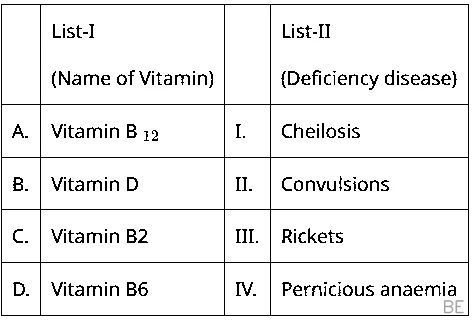
Match List-I with List-II. List-I (Name of Vitamin) List-II (Deficiency disease) A. Vitamin B I. Cheilosis B. Vitamin D II. Convulsions C. Vitamin B2 III. Rickets D. Vitamin B6 IV. Pernicious anaemia Choose the correct answer from the options given below:
Fehling's solution ' ' is
Want unlimited AI-generated Biomolecules questions?
Sign up free and practice with adaptive difficulty — Easy, Medium, Hard. New questions every session.
Start practising for free →