Q261JEE Main 2020MCQ
Which of the following is an equivalent cyclic process corresponding to the thermodynamic cyclic given in the figure ? where, 1 → 2 is adiabatic. (Graphs are schematic and are not to scale)

JEE Main · Physics
Generate JEE Main level questions on Thermodynamics. Focus on Laws of thermodynamics, Carnot engine, and Calorimetry.
400 questions · 20 PYQs · 0 AI practice · JEE Main 2027
Which of the following is an equivalent cyclic process corresponding to the thermodynamic cyclic given in the figure ? where, 1 → 2 is adiabatic. (Graphs are schematic and are not to scale)
An engine takes in 5 moles of air at and 1 atm, and compresses it adiabaticaly to of the original volume. Assuming air to be a diatomic ideal gas made up of rigid molecules, the change in its internal energy during this process comes out to be kJ. The value of to the nearest integer is ______.
Number of molecules in a volume of of a perfect monoatomic gas at some temperature and at a pressure of of mercury is close to ? (Given, mean kinetic energy of a molecule (at T) is , , density of mercury )
Consider a mixture of n moles of helium gas and 2 n moles of oxygen gas (molecules taken to be rigid) as an ideal gas. Its value will be :
A balloon filled with helium and1.7 atm.) bursts. Immediately afterwards the expansion of helium can be considered as:
Three rods of identical cross-section and lengths are made of three different materials of thermal conductivity and respectively. They are joined together at their ends to make a long rod (see figure). One end of the long rod is maintained at and the other at (see figure). If the joints of the rod are at and in steady state and there is no loss of energy from the surface of the rod, the correct relationship between and is :

When the temperature of a metal wire isincreased from to its length increasesby The percentage change in its massdensity will be closest to:
Initially a gas of diatomic molecules is contained in a cylinder of volume at a pressure and temperature . Assuming that of the molecules get dissociated causing a change in number of moles. The pressure of the resulting gas at temperature when contained in a volume is given by . The ratio is.
An ideal gas in a closed container is slowly heated. As its temperature increases, which of the following statements are true? (A) the mean free path of the molecules decreases. (B) the mean collision time between the molecules decreases. (C) the mean free path remains unchanged. (D) the mean collision time remainsunchanged.
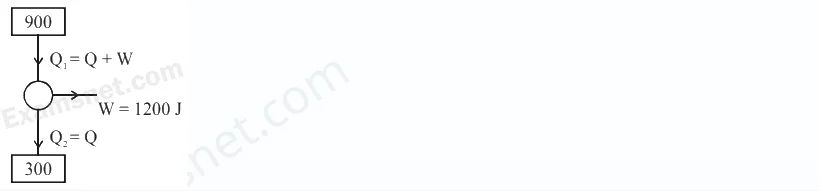
A Carnot engine operates between two reservoirs of temperatures 900 K and 300 K. The engine performs 1200 J of work per cycle. The heat energy (in J) delivered by the engine to the low temperature reservoir, in a cycle, is____. [7-Jan-2020 Shift 1]
The specific heats, and of a gas of diatomic molecules, A, are given (in units of ) by 29 and 22, respectively. Another gas of diatomic molecules, B, has the corresponding values 30 and 21 If they are treated as ideal gases, then :
The gas mixture constists of 3 moles of oxygen and 5 moles of argon at temperature T. Considering only translational and rotational modes, the total inernal energy of the system is:
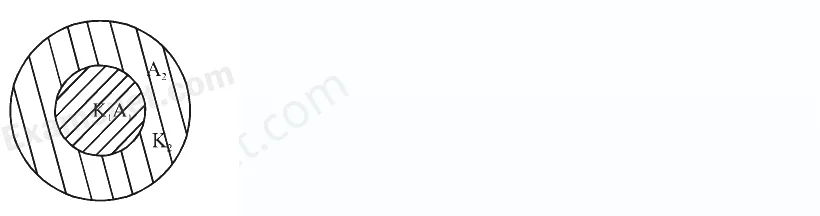
A cylinder of radius R is surrounded by a cylindrical shell of inner radius R and outer radius 2R. The thermal conductivity of the material of the inner cylinder is and that of the outer cylinder is . Assuming no loss of heat, the effective thermalconductivity of the system for heat flowing along the length of the cylinder is:
A mixture of 2 moles of helium gas (atomic mass= 4 u), and 1 mole of argon gas (atomic mass= 40 u) is kept at 300 K in a container. The ratio of their rms speeds , is close to [9-Jan-2019 Shift 1]
Two moles of helium gas is mixed with three moles of hydrogen molecules (taken to be rigid). What is the molar specific heat of mixture at constant volume? (R = 8.3 J/mol K)
Two materials having coefficients of thermal conductivity '3K' and 'K' and thickness 'd' and '3d', respectively, are joined to forma slab as shown in the figure. The temperatures of the outer surfaces are and respectively, . The temperature at the interface is:

Two identical beakers A and B contain equal volumes of two different liquids at 60°C each and left to cool down. Liquid in A has density of and specific heat of while liquid in B has density of and specific heat of . Which of the following best describes their temperature versus time graph schematically? (Assume the emissivity of both the beakers to be the same)
An ideal gas occupies a volume of 2m3 at a pressure of 3 × 10⁶ Pa. The energy of the gas is:
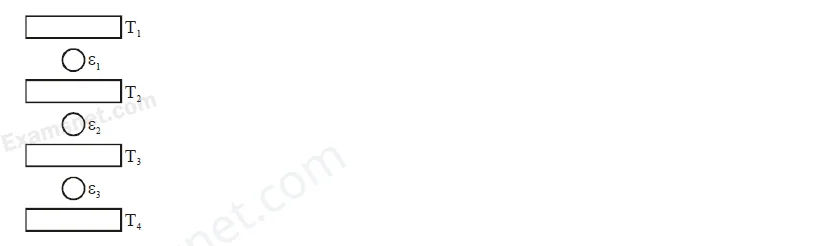
Three Carnot engines operate in series between a heat source at a temperature and a heat sink at temperature (see figure). There are two other reservoirs at temperature , and , as shown, with > > > . The three engines are equallyefficient if:
When heat Q is supplied to a diatomic gas of rigid molecules, at constant volume its temperature increases by .The heat required to produce the same change in temperature, at a constant pressure is:
Want unlimited AI-generated Thermodynamics questions?
Sign up free and practice with adaptive difficulty — Easy, Medium, Hard. New questions every session.
Start practising for free →