Q241JEE Main 2020MCQThe plot that depicts the behavior of the mean free time t (time between two successive collisions) for the molecules of an ideal gas, as a function of temperature (T), qualitatively, is: (Graphs are schematic and not drawn to scale)A.B.C.D.Show Answer🚀 Solve in Practice Mode📖 ExplanationMean free time = Mean free path/Average speed=\text{ Mean free path}/\text{Average speed}= Mean free path/Average speed =1/2πD2n/8RTπMw={1/{\sqrt2\pi D^2n}}/{\sqrt{\frac{8RT}{\pi M_w}}}=1/2πD2n/πMw8RT t∝1/sqrtTt\propto 1/\text{sqrtT}t∝1/sqrtT
Q242JEE Main 2020NATNitrogen gas is at 300°C300°{C}300°C temperature. The temperature (in K{K}K ) at which the rms{\text{rms}}rms speed of a H2{H}_{2}H2 molecule would be equal to the rms speed of a nitrogen molecule, is _____. (Molar mass of N2{N}_{2}N2 gas 28g28{g}28g )Show Answer🚀 Solve in Practice Mode📖 ExplanationVrms=sqrt3RTM{V}_{ {\text{rms}}} =\\sqrt{ \frac{3 {RT}}{ {M}}}Vrms=sqrtM3RT VN2=VH2{V}_{{N}_{2}} = {V}_{ {H}_{2}}VN2=VH2 3RTN2/MN2=3RTH2/MH2\sqrt{{3 {RT}_{ {N}_{2}}}/{ {M}_{ {N}_{2}}}}=\sqrt{{3 {RT}_{ {H}_{2}}}/{ {M}_{ {H}_{2}}}}3RTN2/MN2=3RTH2/MH2 57328=TH2/2\frac{573}{28}={{T}_{ {H}_{2}}}/{2}28573=TH2/2 ⇒TH2=40.928\Rightarrow {T}_{ {H}_{2}}=40.928⇒TH2=40.928
Q243JEE Main 2020MCQA bullet of mass 5 g5 \text{ g}5 g, travelling with a speed of 210 m/s210 \text{ m/s}210 m/s, strikes a fixed wooden target. One half of its kinetic energy is converted into heat in the bullet while the other half is converted into heat in the wood. The rise of temperature of the bullet if the specific heat of its material is 0.030 cal/(g-∘C)0.030 \text{ cal/(g-}^\circ\text{C)}0.030 cal/(g-∘C) (1 cal=4.2×10⁷ ergs1 \text{ cal} = 4.2 \times 10^7 \text{ ergs}1 cal=4.2×10⁷ ergs) close to :A. 83.3∘C83.3^\circ\text{C}83.3∘CB. 87.5∘C87.5^\circ\text{C}87.5∘CC. 119.2∘C119.2^\circ\text{C}119.2∘CD. 38.4∘C38.4^\circ\text{C}38.4∘CShow Answer🚀 Solve in Practice Mode📖 Explanation12mv2×12=msΔT\frac{1}{2} {mv}^{2}\times \frac{1}{2}= {ms} \Delta{T}21mv2×21=msΔT ΔT=v24times5\Delta{T}=\frac{{v}^{2}}{4 \\times 5}ΔT=4times5v2 =21024times30times4.200= \frac{210^{2}}{4 \\times 30 \\times 4.200}=4times30times4.2002102 =87.5°C=87.5°{C}=87.5°C
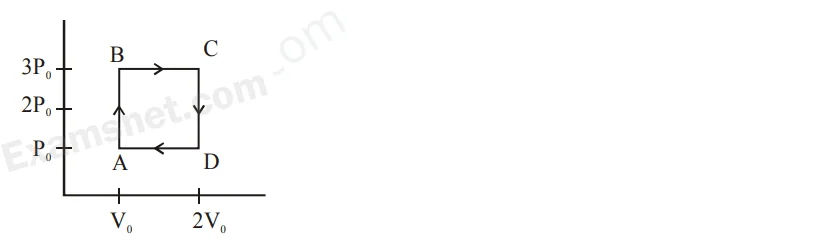
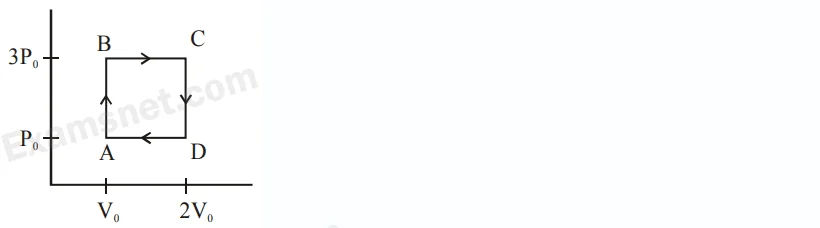
Q244JEE Main 2020NATAn engine operates by taking a monatomic ideal gas through the cycle shown in the figure. The percentage efficiency of the engine is close to ________.Show Answer🚀 Solve in Practice Mode📖 ExplanationWABCDA=2P0V0{\text{W}}_{{\text{ABCDA}}}=2 {\text{P}}_{0} {\text{V}}_{0}WABCDA=2P0V0 Q∈=QAB+QBC{\text{Q}}_{{\in}}={\text{Q}}_{{\text{AB}}}+{\text{Q}}_{{\text{BC}}}Q∈=QAB+QBC QAB=nC(TB−TA){\text{Q}}_{{\text{AB}}}={\text{nC}}({\text{T}}_{{\text{B}}}-{\text{T}}_{{\text{A}}})QAB=nC(TB−TA) =n3R/2(TB−TA)={{\text{n}} 3 {\text{R}}}/{2}({\text{T}}_{{\text{B}}}-{\text{T}}_{{\text{A}}})=n3R/2(TB−TA) =32(PBVB−PAVA)=\frac{3}{2}({\text{P}}_{{\text{B}}} {\text{V}}_{{\text{B}}}-{\text{P}}_{{\text{A}}} {\text{V}}_{{\text{A}}})=23(PBVB−PAVA) =32(3PBV0=P0V0)=\frac{3}{2}(3 {\text{P}}_{{\text{B}}} {\text{V}}_{0}={\text{P}}_{0} {\text{V}}_{0})=23(3PBV0=P0V0) =3P0V0=3 {\text{P}}_{0} {\text{V}}_{0}=3P0V0 QBC=nCP(TC−TB){\text{Q}}_{{\text{BC}}}={\text{nC}}_{{\text{P}}}({\text{T}}_{{\text{C}}}-{\text{T}}_{{\text{B}}})QBC=nCP(TC−TB) =n5R/2(TC−TB)={{\text{n}} 5 {\text{R}}}/{2}({\text{T}}_{{\text{C}}}-{\text{T}}_{{\text{B}}})=n5R/2(TC−TB) =52(PCVC−PBVB)=\frac{5}{2}({\text{P}}_{{\text{C}}} {\text{V}}_{{\text{C}}}-{\text{P}}_{{\text{B}}} {\text{V}}_{{\text{B}}})=25(PCVC−PBVB) =52(6P0V0−3P0V0)=\frac{5}{2}(6 {{\text{P}}}_{0} {\text{V}}_{0}-{3} {{\text{P}}}_{0} {\text{V}}_{0})=25(6P0V0−3P0V0) =152P0V0=\frac{15}{2} {\text{P}}_{0} {\text{V}}_{0}=215P0V0 η=W/Q∈×100\eta ={{\text{W}}}/{{\text{Q}}_{{\in}}} \times 100η=W/Q∈×100 =2P0V0/3P0V0+152P0V0×100={2 {\text{P}}_{0} {\text{V}}_{0}}/{3 {\text{P}}_{0} {\text{V}}_{0}+{15}{2} {\text{P}}_{0} {\text{V}}_{0}} \times 100=2P0V0/3P0V0+152P0V0×100 η=40021=19.04≈19\eta =\frac{400}{21}=19.04 \approx 19η=21400=19.04≈19 η=19\eta =19η=19
Q245JEE Main 2020MCQMolecules of an ideal gas are known to have three translational degrees of freedom and two rotational degrees of freedom. The gas is maintained at a temperature of T. The total internal energy, U of a mole of this gas, and the value of γ=CPCv\gamma = \frac{C_P}{C_v}γ=CvCP given, respectively, by:A. U=52RT\text{U} = \frac{5}{2} \text{RT}U=25RT and γ=65\gamma = \frac{6}{5}γ=56B. U=5RT\text{U} = 5 \text{RT}U=5RT and γ=75\gamma = \frac{7}{5}γ=57C. U=5RT\text{U} = 5 \text{RT}U=5RT and γ=65\gamma = \frac{6}{5}γ=56D. U=52RT\text{U} = \frac{5}{2} \text{RT}U=25RT and γ=75\gamma = \frac{7}{5}γ=57Show Answer🚀 Solve in Practice Mode📖 ExplanationTotal degree of freedom =3+2=5=3+2=5=3+2=5 U=nfRT/2⇒5RT/2{U}={{\text{nfRT}}}/{2} \Rightarrow {5 {\text{RT}}}/{2}U=nfRT/2⇒5RT/2 γ⇒CP/CV⇒1+2f\gamma \Rightarrow {\text{C}_{\text{P}}}/{\text{C}_{\text{V}}} \Rightarrow 1+\frac{2}{f}γ⇒CP/CV⇒1+f2 ⇒1+25⇒75\Rightarrow 1+\frac{2}{5} \Rightarrow \frac{7}{5}⇒1+52⇒57
Q246JEE Main 2020MCQTwo ideal Carnot engines operate in cascade (all heat given up by one engine is used by the other engine to produce work) between temperatures, T1T _1T1 and T2T_2T2 . The temperature of the hot reservoir of the first engine is T1T _1T1 and the temperature of the cold reservoir of the second engine is T2T_2T2. T is temperature of the sink of first engine which is also the source for the second engine. How is T related to T1T _1T1 and T2T _2T2 , if both the engines perform equal amount of work ?A. T=2T1T2T1+T2T=\frac{2T_1T_2}{T_1+T_2}T=T1+T22T1T2B. T=T1T2T=\sqrt{T_1T_2}T=T1T2C. T=T1+T2/2T={T_1+T_2}/2T=T1+T2/2D. T=0T=0T=0Show Answer🚀 Solve in Practice Mode📖 ExplanationQH/QL=T1/TQ_H/Q_L=T_1/TQH/QL=T1/T and W=QH−QLW=Q_H-Q_LW=QH−QL....(1)QL/QL′=T/T2Q_L/Q'_L=T /T_2QL/QL′=T/T2 and W=QL−QL′W=Q_L-Q'_LW=QL−QL′....(2)
Q247JEE Main 2020MCQA thermodynamic cycle xyzx is shown on a V-T diagram.The P-V diagram that best describes this cycle is : (Diagrams are schematic and not to scale)A.B.C.D.Show Answer🚀 Solve in Practice Mode📖 Explanationx → y ⇒ Isobaricy → z ⇒ Isochoricz → x ⇒ Isothermal
Q248JEE Main 2020MCQUnder an adiabatic process, the volume of an ideal gas gets doubled. Consequently the mean collision time between the gas molecule changes from τ1\tau _1τ1 to τ2\tau _2τ2. If Cp/Cv=γC_p/C_v=\gamma Cp/Cv=γ for this gas then a good estimate for τ2/τ1\tau _2/ \tau _1τ2/τ1 is given by :A. (1/2)γ+1/2(1/2)^{{\gamma +1}/2}(1/2)γ+1/2B. 2C. 1/21/21/2D. (1/2)γ(1/2)^\gamma (1/2)γShow Answer🚀 Solve in Practice Mode📖 Explanation Mean free path, λ=( RT2πd2NAP)\;\text{ Mean free path, }\; \lambda =(\;\frac{ R T }{\sqrt{ 2 } \pi d ^{2} N _{ A } P }) Mean free path, λ=(2πd2NAPRT) Vrms= 3RTMV _{ rms }=\sqrt{\;\frac{ 3 R T }{ M }}Vrms=M3RT ∴τ= λVrms= RT2πd2NA P× M3RT\therefore \tau =\;\frac{\lambda }{ V _{ rms }}=\;\frac{ R T }{\sqrt{ 2 }\pi d^{2}{N_A} \;P} \times \sqrt{\;\frac{ M }{ 3 R T }}∴τ=Vrmsλ=2πd2NAPRT×3RTM τ∝ TP\tau \propto \;\frac{\sqrt{ T }}{ P }τ∝PT τ1τ2= T1/P1× P2/T2=( P2P1) T1T2\;\frac{\tau _{1}}{\tau _{2}}=\;{\sqrt{ T _{1}}}/{ P _{1}} \times \;{ P _{2}}/{\sqrt{ T _{2}}}=(\;\frac{ P _{2}}{ P _{1}}) \sqrt{\;\frac{ T _{1}}{ T _{2}}}τ2τ1=T1/P1×P2/T2=(P1P2)T2T1 PV=nRTPV = nRTPV=nRT P1P2× V1V2= T1T2\;\frac{ P _{1}}{ P _{2}} \times \;\frac{ V _{1}}{ V _{2}}=\;\frac{ T _{1}}{ T _{2}}P2P1×V2V1=T2T1 ⇒2γ× V2V= T1T2\Rightarrow 2^{\gamma } \times \;\frac{ V }{2 V }=\;\frac{ T _{1}}{ T _{2}}⇒2γ×2VV=T2T1 ⇒ T1T2=(2γ−1)\Rightarrow \;\frac{ T _{1}}{ T _{2}}=(2^{\gamma -1})⇒T2T1=(2γ−1) ∴ τ1τ2=( P2P1)× T1T2= 12γ×2γ−1= 2γ−12/2γ\therefore \;\frac{\tau _{1}}{\tau _{2}}=(\;\frac{ P _{2}}{ P _{1}}) \times \sqrt{\;\frac{ T _{1}}{ T _{2}}}=\;\frac{1}{2^{\gamma }} \times \sqrt{2^{\gamma -1}}=\;{2^{\frac{\gamma -1}{2}}}/{2^{\gamma }}∴τ2τ1=(P1P2)×T2T1=2γ1×2γ−1=22γ−1/2γ τ2τ1= 2γ/2( γ−12)=2γ−( γ−12)=2 γ+12\;\frac{\tau _{2}}{\tau _{1}}=\;{2^{\gamma }}/{2^{(\;\frac{\gamma -1}{2})}}=2^{\gamma -(\;\frac{\gamma -1}{2})}=2^{\;\frac{\gamma +1}{2}}τ1τ2=2γ/2(2γ−1)=2γ−(2γ−1)=22γ+1 ⇒ τ1τ2=( 12) γ+12\Rightarrow \;\frac{\tau _{1}}{\tau _{2}}=(\;\frac{1}{2})^{\;\frac{\gamma +1}{2}}⇒τ2τ1=(21)2γ+1
Q249JEE Main 2020MCQA litre of dry air at STP expands adiabatically to a volume of 3 litres. If γ=1.40\gamma = 1.40γ=1.40, the work done by air is : (31.4=4.6555)(3^1.4 = 4.6555)(31.4=4.6555) [Take air to be an ideal gas] [7-Jan-2020 Shift 1]A. 90.5 JB. 48 JC. 60.7 JD. 100.8 JShow Answer🚀 Solve in Practice Mode📖 Explanationw=nR(T1−T2)γ−1w=\frac{nR(T_1-T_2)}{\gamma -1}w=γ−1nR(T1−T2) =P1V1−P2V2/0.4={P_1V_1-P_2V_2}/0.4=P1V1−P2V2/0.4 =100−100/4.6555×3/0.4=88.90={100-100/4.6555\times 3}/0.4=88.90=100−100/4.6555×3/0.4=88.90
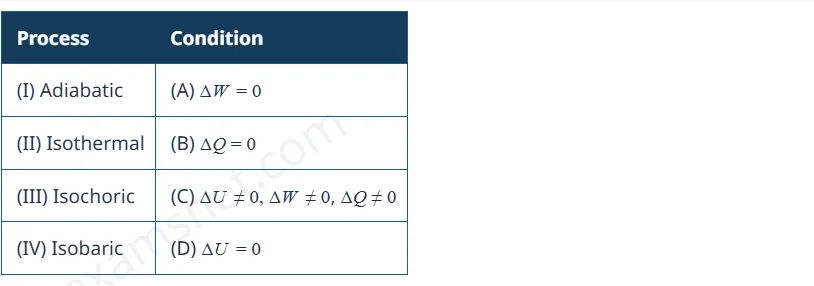
Q250JEE Main 2020MCQMatch the thermodynamic processes taking place in a system with the correct conditions. In the table : ΔQ\Delta QΔQ is the heat supplied, ΔW\Delta WΔW is the work done and ΔU\Delta UΔU is change in internal energy of the system : Process Condition (I) Adiabatic (A) ΔW=0\Delta W=0ΔW=0 (II) Isothermal (B) ΔQ=0\Delta Q=0ΔQ=0 (III) Isochoric (C) ΔU≠0,ΔW≠0,ΔQ≠0\Delta U \neq 0, \Delta W \neq 0, \Delta Q \neq 0ΔU=0,ΔW=0,ΔQ=0 (IV) Isobaric (D) ΔU=0\Delta U=0ΔU=0A. I-B, II-D, III-A, IV-CB. I-B, II-A, III-D, IV-CC. I-A, II-A, III-B, IV-CD. I-A, II-B, III-D, IV-DShow Answer🚀 Solve in Practice Mode📖 Explanation(I) Adiabatic process ⇒\DeltaQ=0\Rightarrow\DeltaQ=0⇒\DeltaQ=0 No exchange of heat takes place with surroundings (II) Isothermal proess ⇒\Rightarrow⇒ Temperature remains constant (ΔT=0)(\Delta{T}=0)(ΔT=0) Δu=F2nRΔT⇒Δu=0\Delta{u}=\frac{{F}}{2} {nR} \Delta{T} \Rightarrow \Delta{u}=0Δu=2FnRΔT⇒Δu=0 No change in internal energy [Δu=0][\Delta{u}=0][Δu=0] (III) Isochoric process Volume remains constant ΔV=0\Delta{V}=0ΔV=0 W=∫P.dV=0{W}=∫{P.dV}=0W=∫P.dV=0 Hence work done is zero. (IV) Isobaric process ⇒\Rightarrow⇒ Pressure remains constant W=P.ΔV≠0{W}= {P.} \Delta{V} \ne 0W=P.ΔV=0 Δu=F2nRΔT\Delta{u}=\frac{{F}}{2} {nR} \Delta{T}Δu=2FnRΔT =F2[PΔV]≠0=\frac{{F}}{2}[ {P} \Delta{V}] \ne 0=2F[PΔV]=0 ΔQ=nCpΔT≠0\Delta{Q}= {nC}_{ {p}} \Delta{T} \ne 0ΔQ=nCpΔT=0
Q251JEE Main 2020MCQThe specific heat of water =4200Jkg−1K−1=4200 {J} {kg}^{-1} {K}^{-1}=4200Jkg−1K−1 and the latent heat of ice =3.4×10⁵ J kg−1=3.4\times 10^{5} \ {J} \ {kg}^{-1}=3.4×10⁵ J kg−1 100 grams of ice at 0°C0° {C}0°C is placed in 200 g200 \ {g}200 g of water at 25°C25°{C}25°C. The amount of ice that will melt as the temperature of water reaches 0°C0°{C}0°C is close to (in grams):A. 61.7B. 63.8C. 69.3D. 64.6Show Answer🚀 Solve in Practice Mode📖 ExplanationHere the water will provide heat for ice to melt therefore mwswΔθ=miceLice{m}_{ {w}} {s}_{ {w}} \Delta\theta = {m}_{ {\text{ice}}} {L}_{ {\text{ice}}}mwswΔθ=miceLice mice= 0.2times4200times253.4times105\ {m}_{ {\text{ice}}}=\ \frac{0.2 \\times 4200 \\times 25}{3.4 \\times 10^{5}} mice= 3.4times1050.2times4200times25 =0.0617 kg=0.0617 \ {kg}=0.0617 kg =61.7 gm=61.7 \ {gm}=61.7 gm Remaining ice will remain un-melted so correct answer is 1
Q252JEE Main 2020MCQThree different processes that can occur in an ideal monoatomic gas are shown in the P\ {P} P vs V\ {V} V diagram. The paths are labelled as A→B,A→C\ {A} \to {B}, {A}\to {C} A→B,A→C and A→D.\ {A}\to {D} . A→D. The change ininternal energies during these process are taken as EAB,EAC\ {E}_{ {AB}}, {E}_{ {AC}} EAB,EAC and EAD{E}_{ {AD}}EAD and the workdone as WAB{W}_{ {AB}}WAB WAC{W}_{ {AC}}WAC and WAD{W}_{ {AD}}WAD. The correct relation between these parametersare :A. EAB=EAC<EAD,WAB>0,WAC=0,WAD<0E _{ AB }= E _{ AC } < E _{ AD }, W _{ AB } > 0, W _{ AC }=0, W _{ AD } < 0EAB=EAC<EAD,WAB>0,WAC=0,WAD<0B. EAB=EAC=EAD,WAB>0,WAC=0,WAD<0E _{ AB } = E _{ AC } = E _{ AD }, W _{ AB } > 0, W _{ AC }=0, W _{ AD } < 0EAB=EAC=EAD,WAB>0,WAC=0,WAD<0C. EAB<EAC<EAD,WAB>0,WAC>WADE_{A B} < E_{A C} < E_{A D}, W_{A B} > 0, W_{A C} > W_{A D}EAB<EAC<EAD,WAB>0,WAC>WADD. EAB>EAC>EAD,WAB<WAC<WADE_{A B} > E_{A C} > E_{A D}, W_{A B} < W_{A C} < W_{A D}EAB>EAC>EAD,WAB<WAC<WADShow Answer🚀 Solve in Practice Mode📖 Explanation(b) Temperature change ΔT\Delta TΔT is same for all three processes A→B;A→CA \to B ; A \to CA→B;A→C and A→DA \to DA→D ΔU=nCvΔT=\Delta U=n C_{v} \Delta T=ΔU=nCvΔT= same EAB=EAC=EADE_{A B}=E_{A C}=E_{A D}EAB=EAC=EAD Work done, W=P×ΔVW=P \times \Delta VW=P×ΔV AB→A B \to AB→ volume is increasing ⇒WAB>0\Rightarrow W_{A B}>0⇒WAB>0 AD→A D \to AD→ volume is decreasing ⇒WAD<0\Rightarrow W_{A D}<0⇒WAD<0 AC→A C \to AC→ volume is constant ⇒WAC=0\Rightarrow W_{A C}=0⇒WAC=0
Q253JEE Main 2020MCQTwo gases-argon (atomic radius 0.07 nm, atomic weight 40) and xenon (atomic radius 0.1 nm, atomic weight 140) have the same number density and are at the same temperature. The raito of their respective mean free times is closest to :A. 3.67B. 4.67C. 1.83D. 2.3Show Answer🚀 Solve in Practice Mode📖 Explanationλ=1/2πnvd2\lambda =1/{\sqrt2\pi n_vd^2}λ=1/2πnvd2 τ=λ/v=1/2πnvd2v\tau =\lambda /v=1/{\sqrt2\pi n_vd^2v}τ=λ/v=1/2πnvd2v =1/2πnvd2m/3RT=1/{\sqrt2\pi n_vd^2}\sqrt{m/{3RT}}=1/2πnvd2m/3RT τ1/τ2=M1/M2d22/d12\tau _1/\tau _2=\sqrt{M_1/M_2}d_2^2/d_1^2τ1/τ2=M1/M2d22/d12 =40/140(0.1)2/(0.07)2=1.09=\sqrt{40/140} (0.1)^2/(0.07)^2=1.09=40/140(0.1)2/(0.07)2=1.09∴ Nearest possible answer (3)
Q254JEE Main 2020MCQA heat engine is involved with exchange ofheat of 1915J,−40J,+125J1915 {J},-40 {J},+125 {J}1915J,−40J,+125J and QJ,{QJ},QJ, duringone cycle achieving an efficiency of 50.0%50.0 \%50.0%. The value of Q{Q}Q is:A. 640 JB. 400 JC. 980 JD. 40 JShow Answer🚀 Solve in Practice Mode📖 Explanationη=Work done Heat supplied\eta = {\text{Work done }}{\text{ Heat supplied}}η=Work done Heat supplied 12=η=1915−40+125−Q1915+125\frac{1}{2}=\eta = \frac{1915-40+125-{Q}}{1915+125}21=η=1915+1251915−40+125−Q 12=2000−Q2040\frac{1}{2}= \frac{2000- {Q}}{2040}21=20402000−Q 2040=4000−2Q2040=4000-2 {Q}2040=4000−2Q 2 Q=19602 \ {Q}=19602 Q=1960 Q=980J{Q}=980 {J}Q=980J
Q255JEE Main 2020MCQTwo different wires having lengths L1L_{1}L1 and L2L_{2}L2 , and respective temperature coefficient of linear expansion α1\alpha_{1}α1 and α2,\alpha_{2},α2, are joined end-to-end. Then the effective temperature coefficient of linear expansion is :A. 4α1α2α1+α2L2L1(L2+L1)24\frac{\alpha_{1} \alpha_{2}}{\alpha_{1}+\alpha_{2}} \frac{{L}_{2} { L}_{1}}{({ L}_{2}+{L}_{1} )^{2}}4α1+α2α1α2(L2+L1)2L2L1B. 2α1α22\sqrt{\alpha_{1} \alpha_{2}}2α1α2C. α1+α22\frac{\alpha_{1}+\alpha_{2}}{2}2α1+α2D. α1L1+α2L2L1+L2\frac{\alpha_{1} {L}_{1}+\alpha_{2} {L}_{2}}{{L}_{1}+{ L}_{2}}L1+L2α1L1+α2L2Show Answer🚀 Solve in Practice Mode📖 ExplanationAt T°C L=L1+L2{T}°{C} \;\;\;{L}= {L}_{1}+ { L}_{2}T°CL=L1+L2 At T+ΔT Leq′=L1′+L′+2{T}+\Delta{T} \;\;\;{L}'_{ {\text{eq}}}= {L}'_{1}+ { L}'+_{2}T+ΔTLeq′=L1′+L′+2 where L1′=L1(1+α1\DeltaT)L_{1}'=L_{1} (1+\alpha _{1} \DeltaT )L1′=L1(1+α1\DeltaT) L2′=L2(1+α2\DeltaT){L}_{2}'= {L}_{2} (1+\alpha _{2} {\DeltaT} )L2′=L2(1+α2\DeltaT) Leq′=(L1+L2)(1+αavgΔT){L}_{{\text{eq}}}'=({L}_{1}+{L}_{2} ) (1+\alpha _{ {\text{avg}}} \Delta{T} )Leq′=(L1+L2)(1+αavgΔT) ⇒(L1+L2\Rightarrow ({L}_{1}+{L}_{2}⇒(L1+L2(1+\alpha { {\text{avg}}} {ST} ) = {L}{1}+{L}{2}+{L}{1} \alpha {1} \Delta{T}+ {L}{2} \alpha {2} \Delta{T} \Rightarrow ({L}{1}+{L}_{2} ) \alpha { {\text{avg}}}= {L}{1} \alpha {1}+{L}{2} \alpha {2} \Rightarrow \alpha { {\text{avg}}}=\frac{{L}{1} \alpha {1}+{L}{2} \alpha {2}}{{L}{1}+{L}{2}}$
Q256JEE Main 2020NATA closed vessel contains 0.1 mole0.1 \ {\text{mole}}0.1 mole of a monoatomic ideal gas at 200 K. If 0.05 mole of the same gas at 400 K400 \ {K}400 K is added to it, the final equilibrium temperature (in K\ {K} K ) of the gas in the vessel will be closed to ______.Show Answer🚀 Solve in Practice Mode📖 ExplanationAs work done on gas and heat supplied to the gas are zero, total internal energy of gases remain same u1+ u2= u1′+ u2′\ {u}_{1}+\ {u}_{2}=\ {u}_{1}'+\ {u}_{2}' u1+ u2= u1′+ u2′ (0.1)Cv(200)+(0.05)Cv(400)(0.1) {C}_{ {v}}(200)+(0.05) {C}_{ {v}}(400)(0.1)Cv(200)+(0.05)Cv(400) =(0.15)CvT=(0.15) {C}_{ {v}} {T}=(0.15)CvT T=8003k=266.67 k{T}= \frac{800}{3} {k}=266.67 \ {k}T=3800k=266.67 k
Q257JEE Main 2020MCQConsider a gas of triatomic molecules. Themolecules are assumed to the triangular andmade of massless rigid rods whose vertices areoccupied by atoms. The internal energy of a mole of the gas at temperature T\ {T} T is :A. 92 RT\ \frac{9}{2} \ {RT} 29 RTB. 32 RT\ \frac{3}{2} \ {RT} 23 RTC. 52 RT\ \frac{5}{2} \ {RT} 25 RTD. 3 RT3 \ {RT}3 RTShow Answer🚀 Solve in Practice Mode📖 Explanation DOF=3+3=6\ {DOF}=3+3=6 DOF=3+3=6 U=f2nRT=3 RT\ {U}=\frac{{f}}{2} {nRT}=3 \ {RT} U=2fnRT=3 RT
Q258JEE Main 2020MCQTo raise the temperature of a certain mass of gas by 50°C50°{C}50°C at a constant pressure, 160 calories of heat is required. When the same mass of gas is cooled by 100°C100°{C}100°C at constant volume, 240 calories of heat is released. How many degrees of freedom does each molecule of this gas have (assume gas to be ideal)?A. 5B. 3C. 6D. 7Show Answer🚀 Solve in Practice Mode📖 ExplanationnCP(50)=160{nC}_{ {P}}(50)=160nCP(50)=160 nCv(100)=240{nC}_{ {v}}(100)=240nCv(100)=240 ⇒Cp2Cv=160240=γ2\Rightarrow \frac{C_{p}}{2 C_{v}}= \frac{160}{240}= \frac{\gamma }{2}⇒2CvCp=240160=2γ ∴γ=43\therefore \gamma = \frac{4}{3}∴γ=34 and f=2γ−1=6f= \frac{2}{\gamma -1}=6f=γ−12=6
Q259JEE Main 2020MCQMatch the Cp/CV{C}_{ {p}} / {C}_{ {V}}Cp/CV ratio for ideal gases with different type of molecules: Molecular type Cp/CV{C}_{ {p}} / {C}_{ {V}}Cp/CV (A) Monoatomic (I) 7/57 / 57/5 (B) Diatomic rigidmolecules (II) 9/79 / 79/7 (C) Diatomic non-rigidmolecules (III) 4/34 / 34/3 (D) Triatomic rigidmolecules (IV) 5/35 / 35/3A. A-IV, B-I, C-II, D-IIIB. A-IV, B-II, C-I, D-IIIC. A-III, B-IV, C-II, D-ID. A-II, B-III, C-I, D-IVShow Answer🚀 Solve in Practice Mode📖 Explanationγ=CpCv=1+2f\gamma = \frac{C_{p}}{C_{v}}=1+ \frac{2}{f}γ=CvCp=1+f2 where 'f' is degree of freedom (A) Monoatomic f=3,γ=1+23=53\ {f}=3, \gamma =1+ \frac{2}{3}= \frac{5}{3} f=3,γ=1+32=35 (B) Diatomic rigid molecules, f=5,γ=1+ 23=75{f}=5, \gamma =1+\ \frac{2}{3}= \frac{7}{5}f=5,γ=1+ 32=57 (C) Diatomic non-rigid molecules f=7,γ=1+27=9/7{f}=7, \gamma =1+ \frac{2}{7}= {9}/ {7}f=7,γ=1+72=9/7 (D) Triatomic rigid molecules f=6,γ=1+26=43{f}=6, \gamma =1+ \frac{2}{6}= \frac{4}{3}f=6,γ=1+62=34
Q260JEE Main 2020NATA bakelite beaker has volume capacity of 500 cc500 \text{ cc}500 cc at 30∘C30^\circ\text{C}30∘C. When it is partially filled with VmV_mVm volume (at 30∘30^\circ30∘) of mercury, it is found that the unfilledvolume of the beaker remains constant astemperature is varied. If γbeaker=6×10⁻⁶ ∘C−1\gamma_{\text{beaker}} = 6 \times 10^{-6} \ ^\circ\text{C}^{-1}γbeaker=6×10⁻⁶ ∘C−1 and γmercury=1.5×10⁻⁴ ∘C−1,\gamma_{\text{mercury}} = 1.5 \times 10^{-4} \ ^\circ\text{C}^{-1},γmercury=1.5×10⁻⁴ ∘C−1, where γ\gammaγ is thecoefficient of volume expansion, then VmV_mVm (in cc) is close to _____.Show Answer🚀 Solve in Practice Mode📖 Explanation[ΔV=(V0−Vm)[\Delta{V}=({V}_{0}- {V}_{ {m}} )[ΔV=(V0−Vm) After increasing temperature ΔV′=(V0′−Vm′)\Delta{V}'=({{V}_{0}'- {V}_{ {m}}'})ΔV′=(V0′−Vm′) ΔV′=ΔV\Delta{V}'=\Delta{V}ΔV′=ΔV V0−Vm=V0(1+γbΔT){V}_{0}- {V}_{ {m}}= {V}_{0} (1+\gamma _{ {b}} \Delta{T} )V0−Vm=V0(1+γbΔT) −Vm(1+γMΔT)- {V}_{ {m}}(1+\gamma _{ {M}} \Delta{T} )−Vm(1+γMΔT) V0γb= Vmγm\ {V}_{0} \gamma _{ {b}}=\ {V}_{ {m}} \gamma _{ {m}} V0γb= Vmγm Vm=V0γb/γm{V}_{ {m}}={{V}_{0} \gamma _{ {b}}}/{\gamma _{ {m}}}Vm=V0γb/γm =(500)(6times10−6)(1.5times10−4)= \frac{(500) (6 \\times 10^{-6} )}{ (1.5 \\times 10^{-4} )}=(1.5times10−4)(500)(6times10−6) =20 CC=20 \ {CC}=20 CC