Q181JEE Main 2021NAT
A sample of gas with is taken through an adiabatic process in which the volume is compressed from to . If the initial pressure is . The absolute value of the work done by the gas in the process is ......... J.
JEE Main · Physics
Generate JEE Main level questions on Thermodynamics. Focus on Laws of thermodynamics, Carnot engine, and Calorimetry.
400 questions · 20 PYQs · 0 AI practice · JEE Main 2027
A sample of gas with is taken through an adiabatic process in which the volume is compressed from to . If the initial pressure is . The absolute value of the work done by the gas in the process is ......... J.
A monoatomic ideal gas, initially at temperature is enclosed in a cylinder fitted with a frictionless piston. The gas is allowed to expand adiabatically to a temperature by releasing the piston suddenly. If and are the lengths of the gas column, before and after the expansion respectively, then the value of will be :
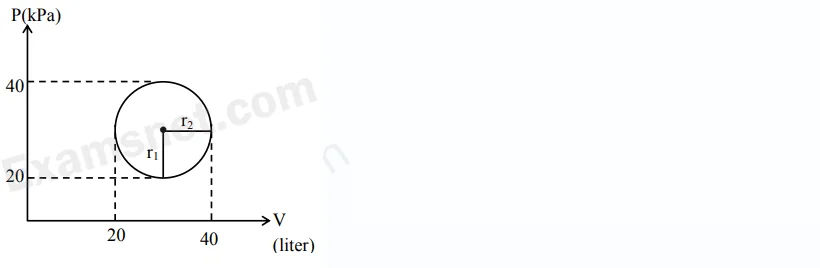
In the reported figure, heat energy absorbed by a system in going through a cyclic process is ______ πJ.
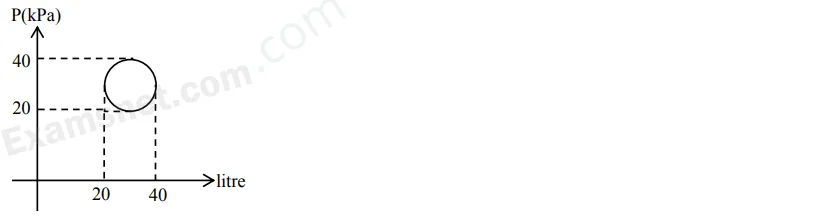
Which of the following graphs represent the behavior of an ideal gas ? Symbols have their usual meaning.
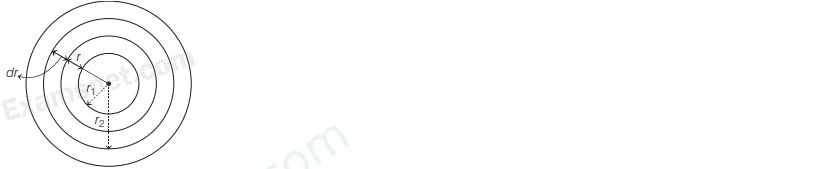
Two thin metallic spherical shells of radii and are placed with their centres coinciding. A material of thermal conductivity K is filled in the space between the shells. The inner shell is maintained at temperature and the outer shell at temperature . The rate at which heat flows radially through the material is
Consider a sample of oxygen behaving like an ideal gas. At , the ratio of root mean square (rms) velocity to the average velocity of gas molecule would be (Molecular weight of oxygen is ; )
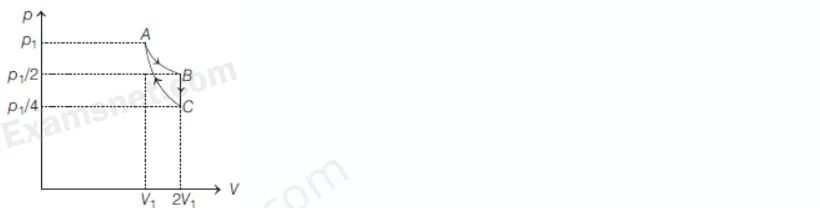
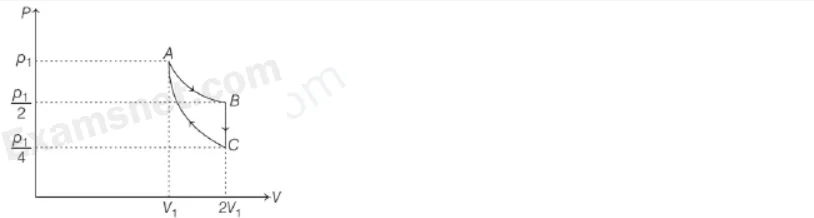
If one mole of an ideal gas at is allowed to expand reversibly and isothermally ( to ), its pressure is reduced to one-half of the original pressure (see figure). This is followed by a constant volume cooling till its pressure is reduced to one-fourth of the initial value . Then, it is restored to its initial state by a reversible adiabatic compression ( to ). The net work done by the gas is equal to
The area of cross-section of a railway track is . The temperature variation is . Coefficient of linear expansion of material of track is . The energy stored per meter in the track is _______ . (Young's modulus of material of track is )
Which one is the correct option for the two different thermodynamic processes?

A balloon carries a total load of at normal pressure and temperature of . What load will the balloon carry on rising to a height at which the barometric pressure is of Hg and the temperature is ? [Assuming, the volume constant.]
The correct relation between the degrees offreedom and the ratio of specific heat is :
The amount of heat needed to raise the temperature of 4 moles of a rigid diatomic gas from 0°C to 50°C when no work is done is _______. (R is the universal gas constant)
A heat engine operates between a cold reservoir at temperature and a hot reservoir at temperature . It takes 300 f of heat from the hot reservoir and delivers of heat to the cold reservoir in a cycle. The minimum temperature of the hot reservoir has to be ........... K.
A diatomic gas having and , is heated at constant pressure. The ratio is
The volume of an enclosure contains a mixture of three gases, of oxygen, of nitrogen and of carbon dioxide at absolute temperature . Consider as universal gas constant. The pressure of the mixture of gases is
One mole of an ideal gas is taken through an adiabatic process where the temperature rises from to . If the ideal gas is composed of polyatomic molecule that has 4 vibrational modes, which of the following is true?
A mixture of hydrogen and oxygen has volume , temperature , pressure and mass . The ratio of masses of oxygen to hydrogen will be
A bimetallic strip consists of metals and . It is mounted rigidly as shown. The metal has higher coefficient of expansion compared to that of metal . When the bimetallic strip is placed in a cold bath, it will

The temperature at the junction of two insulating sheets, having thermal resistances and as well as top and bottom temperatures and (as shown in figure) is given by

Given below are two statements: one is labelled as Assertion A and the other is labelled as Reason R. Assertion (A) When a rod lying freely is heated, no thermal stress is developed in it. Reason (R) On heating, the length of the rod increases. In the light of the above statements, choose the correct answer from the options given below
Want unlimited AI-generated Thermodynamics questions?
Sign up free and practice with adaptive difficulty — Easy, Medium, Hard. New questions every session.
Start practising for free →