500 mL of 0.2MMnO4− solution in basic medium when mixed with 500 mL of 1.5 M KI solution, oxidises iodide ions to liberate molecular iodine. This liberated iodine is then titrated with a standard x M thiosulphate solution in presence of starch till the end point. If 300 mL of thiosulphate was consumed, then the value of x is _____ .[JEE Main 6 Apr 2026 shift 2]
The principle of chemical equivalence allows us to equate the reacting species based on their respective n-factors, which simplifies the stoichiometry of redox titrations. To find the equivalents of the permanganate ion acting as the oxidizing agent in a basic medium, we determine its n-factor, which is 3 given the reduction from MnO4− to MnO2. Using 0.2 M and 0.5 L of solution, the number of equivalents is calculated as 0.2×0.5×3=0.3.
For the iodide solution, the n-factor is 1, and the total equivalents available are 1.5×0.5×1=0.75. Comparing these two, the permanganate is the limiting reagent, effectively determining that 0.3 equivalents of molecular iodine are produced. This amount of iodine then reacts with an equivalent quantity of the thiosulfate titrant to reach the end point.
Equating the equivalents of the iodine generated to the equivalents of the thiosulfate consumed, we account for the known volume of 0.3 L and an n-factor of 1 for thiosulfate. The calculation for the unknown molarity x is defined by x×0.3×1=0.3. Solving this yields x=1.
Q2JEE Main 2026MCQ
One mole of Cl2(g) was passed into 2 L of cold 2 M KOH solution. After the reaction, the concentrations of Cl−,ClO−and OH−are respectively (assume volume remains constant)
The disproportionation reaction of chlorine in cold, dilute potassium hydroxide is represented by the balanced equation Cl2+2OH−→Cl−+ClO−+H2O. Initial amounts are 1 mole of Cl2 and 4 moles of OH−, making Cl2 the limiting reagent since it requires 2 moles of OH− for complete consumption. Consequently, the reaction consumes 1 mole of Cl2 and 2 moles of OH−, producing 1 mole of Cl− and 1 mole of ClO−, while leaving 2 moles of OH− unreacted in the solution. With a constant volume of 2 L, the final concentrations are 0.5 M for Cl−, 0.5 M for ClO−, and 1 M for OH−.
Q3JEE Main 2026MCQ
In order to oxidise a mixture of 1 mole each of FeC2O4,Fe2(C2O4)3,FeSO4 and Fe2(SO4)3 in acidic medium, the number of moles of KMnO4 required is :[JEE Main 4 Apr 2026 Shift 1]
Redox reactions are dictated by the law of equivalence, which requires that the total equivalents of reducing agents equal the total equivalents of the oxidizing agent. In this mixture containing 1 mole each of the four compounds, FeC2O4, Fe2(C2O4)3, and FeSO4 serve as reducing agents, while Fe2(SO4)3 contains iron in its stable +3 state and does not participate. By summing the contribution of each species, we find that FeC2O4 provides 3 equivalents, Fe2(C2O4)3 provides 6, and FeSO4 provides 1, for a cumulative total of 10 equivalents. Since KMnO4 in an acidic medium has an n-factor of 5, we divide the 10 total equivalents by 5 to determine that 2 moles of KMnO4 are necessary for the reaction.
Q4JEE Main 2026NAT
500 mL of 1.2 M KI solution is mixed with 500 mL of 0.2MKMnO4 solution in basic medium. The liberated iodine was titrated with standard 0.1MNa2S2O3 solution in the presence of starch indicator till the blue color disappeared. The volume (in L ) of Na2S2O3 consumed is ____ . (Nearest integer)
The redox reaction between permanganate and iodide in a basic medium proceeds according to the following balanced equation: 2MnO4−+6I−+4H2O→2MnO2+3I2+8OH−
The initial moles are calculated as n=M×V, yielding 0.1 mol of MnO4− and 0.6 mol of I−. Given that the stoichiometry requires 3 moles of I− per mole of MnO4−, the permanganate ion is the limiting reagent, which produces 0.1×23=0.15 mol of I2. The liberated iodine is titrated with thiosulfate according to the reaction: I2+2S2O32−→2I−+S4O62−
The moles of thiosulfate consumed correspond to 0.15×2=0.3 mol. Using the formula V=Mn, the volume of the Na2S2O3 solution is V=0.10.3=3 L.
Q5JEE Main 2026MCQ
The oxidation state of chromium in the final product formed in the reaction between KI and acidified K2Cr2O7 solution is :
In acidic medium, the dichromate ion (Cr2O72−) functions as a potent oxidizing agent that is reduced upon reacting with iodide ions (I−). The chemical change is described by the redox equation Cr2O72−+14H++6I−→2Cr3++3I2+7H2O, where the chromium atom \in the dichromate ion is reduced from an oxidation state of +6 to the +3 state found \in the chromic ion. Since the chromium product exists as the Cr3+ species, the oxidation state of chromium in the final product is +3.
Q6JEE Main 2026MCQ
Given below are two statements :Statement (I) : Oxidising power of halogens decreases in the order F2>Cl2>Br2>I2, which is the basis of "Layer test".Statement (II): "Layer test" to identify Br2 and I2 in aqueous solution involves the oxidation of bromide or iodide into Br2 or I2 respectively with Cl2, which is a type of displacement redox reaction.In the light of the above statements, choose the correct answer from the options given below :[JEE Main 2 apr 2026 Shift 1]
The oxidizing power of halogens decreases down the group following the sequence F2>Cl2>Br2>I2, which means a stronger halogen can displace a weaker one from its aqueous salt solution. This hierarchy forms the basis of the "Layer test," in which chlorine water acts as an oxidizing agent to displace bromine or iodine from bromide or iodide solutions through a standard displacement redox process. Because this analytical technique relies on displacement reactions such as NaBr+Cl2→Br2+NaCl and NaI+Cl2→I2+NaCl, both statements regarding the oxidizing capacity and the nature of the test are scientifically accurate.
Q7JEE Main 2026NAT
200 cc of x×10−3M potassium dichromate is required to oxidise 750 cc of 0.6 M Mohr's salt solution in acidic medium. Here x=____.
The equivalence of a reactant in a redox titration is determined by the product of its molarity, volume, and n-factor, and at the equivalence point, the number of equivalents of the oxidizing agent, potassium dichromate, equals the number of equivalents of the reducing agent, Mohr's salt. The n-factor for potassium dichromate is 6 due to the reduction of Cr6+ to Cr3+, while the n-factor for Mohr's salt is 1 due to the oxidation of Fe2+ to Fe3+. Applying the relationship M1V1n1=M2V2n2 with M1=x×10−3, V1=200, n1=6, M2=0.6, V2=750, and n2=1 results in:
(x×10−3)×200×6=0.6×750×1
Simplification of the equation leads to 1.2x=450, which gives x=375.
Q8JEE Main 2026NAT
X and Y are the number of electrons involved, respectively during the oxidation of I−to I2 and S2− to S by acidified K2Cr2O7. The value of X+Y is ____
Acidified potassium dichromate functions as an oxidizing agent, undergoing a reduction characterized by the half-reaction Cr2O72−+14H++6e−→2Cr3++7H2O, which necessitates the transfer of 6 electrons per mole of dichromate. For the oxidation of iodide ions, the balanced redox reaction is Cr2O72−+14H++6I−→2Cr3++3I2+7H2O, where 6 electrons are released from 6 moles of I−, identifying X=6. Similarly, for the oxidation of sulfide ions, the balanced reaction is Cr2O72−+14H++3S2−→2Cr3++3S+7H2O, where 6 electrons are released from 3 moles of S2−, identifying Y=6. The summation of these values yields X+Y=6+6=12.
Q9JEE Main 2025MCQ
Which of the following oxidation reactions are carried out by both K2Cr2O7 and KMnO4 in acidic medium? A. I−⟶I2 B. S2−⟶S C. Fe2+⟶Fe3+ D. I−⟶IO3− E. S2O32−⟶SO42− Choose the correct answer from the option given below.
Potassium permanganate (KMnO4) and potassium dichromate (K2Cr2O7) act as powerful oxidizing agents in acidic solutions, typically driving the conversion of common reducing agents to higher oxidation states. Both reagents effectively oxidize iodide ions (I−) to iodine (I2), sulfide ions (S2−) to elemental sulfur (S), and ferrous ions (Fe2+) to ferric ions (Fe3+). While some oxidants can achieve more extensive transformations, such as converting iodide to iodate or thiosulfate to sulfate, these specific reactions are not standard shared characteristics for both of these agents under typical acidic laboratory conditions.
Q10JEE Main 2025MCQ
The species which does not undergo disproportionation reaction is:
A disproportionation reaction requires the central atom to simultaneously increase and decrease its oxidation state, which is only possible if that atom is currently in an intermediate oxidation state. If an element has already reached its maximum possible oxidation state, such as +7 for chlorine, it cannot be further oxidized, thereby preventing the necessary electron loss for disproportionation. Since the chlorine atom in ClO4− exists in this +7 maximum oxidation state, it is chemically incapable of acting as a reducing agent and consequently does not participate in these reactions.
Q11JEE Main 2025MCQ
Given below are two statements : Statement I: In the oxalic acid vs KMnO4 (in the presence of dil H2SO4 ) titration the solution needs to be heated initially to 60∘C, but no heating is required in Ferrous ammonium sulphate (FAS) vs KMnO4 titration (in the presence of dill H2SO4 )Statement II : In oxalic acid vs KMnO4 titration, the initial formation of MnSO4 takes place at hightemperature, which then acts as catalyst for further reaction. In the case of FAS vs KMnO4, heating oxidizes Fe2+ into Fe3+ by oxygen of air and error may be introduced in the experiment. In the light of the above statements, choose the correct answer from the options given below
The reaction rate is the primary factor determining the conditions for these titrations. The reaction between oxalic acid and KMnO4 in the presence of dilute H2SO4 is kinetically slow at room temperature due to a high activation energy, which necessitates an initial heating to 60 °C to allow the reaction to proceed at a measurable rate. Conversely, the reaction between ferrous ammonium sulphate and KMnO4 occurs spontaneously and rapidly at room temperature, rendering external heating unnecessary for the procedure.
The distinction in these protocols arises from both catalytic requirements and the need to prevent side reactions. In the titration of oxalic acid, the reaction is autocatalytic, meaning the initial formation of MnSO4 at higher temperatures produces the Mn2+ ions necessary to catalyze the remainder of the reaction. In contrast, heating a solution of ferrous ammonium sulphate is detrimental because it promotes the unwanted oxidation of Fe2+ ions to Fe3+ ions by atmospheric oxygen, an effect that introduces significant experimental error by altering the stoichiometry of the titration.
Q12JEE Main 2025MCQ
0.1 M solution of KI reacts with excess of H2SO4 and KIO3 solutions. According to equation 5I−+IO3−+6H+⟶3I2+3H2OIdentify the correct statements : (A) 200 mL of KI solution reacts with 0.004 mol of KIO3(B) 200 mL of KI solution reacts with 0.006 mol of H2SO4(C) 0.5 L of KI solution produced 0.005 mol of I2(D) Equivalent weight of KIO3 is equal to (5Molecular weight)Choose the correct answer from the options given below :
In redox stoichiometry, the conservation of matter and electrons dictates that the number of moles of each reactant consumed must align with the molar coefficients of the balanced equation. Given the reaction 5I−+IO3−+6H+⟶3I2+3H2O, the stoichiometry establishes a clear ratio between the reactants and products. A solution containing 200 mL of 0.1 M KI provides 0.02 moles of I−, which according to the 5:1 molar ratio, reacts precisely with 0.004 moles of KIO3, confirming the first statement. Regarding the equivalent weight of KIO3, the oxidation state of iodine changes from +5 in the iodate ion to 0 in the diatomic iodine molecule, indicating a change of 5 electrons per iodine atom; thus, the n-factor is 5, making the equivalent weight equal to the molecular weight divided by 5.
Calculations for the remaining scenarios reveal they are incorrect based on the same stoichiometric proportions. For the consumption of acid, 0.02 moles of I− require 0.024 moles of H+ ions, which, because each mole of H2SO4 yields two moles of H+, necessitates 0.012 moles of H2SO4 rather than the 0.006 moles stated in the options. Similarly, reacting 0.5 L of a 0.1 M KI solution, which contains 0.05 moles of I−, should produce 0.03 moles of I2 based on the 5:3 stoichiometric ratio, which contradicts the claim that only 0.005 moles of I2 would be produced.
Q13JEE Main 2025MCQ
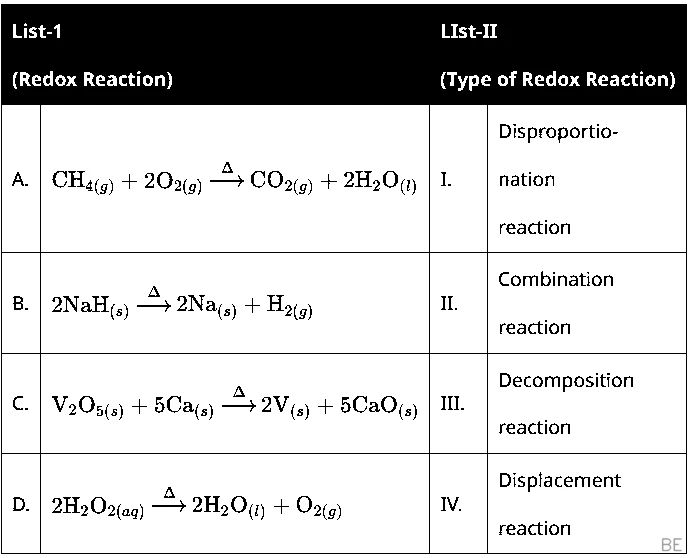
List-1 (Redox Reaction) List-II (Type of Redox Reaction)
A. CH4(g)+2O2(g)ΔCO2(g)+2H2O(l) I. Disproportio- nation reaction
B. 2NaH(s)Δ2Na(s)+H2(g) II. Combination reaction
C. V2O5(s)+5Ca(s)Δ2V(s)+5CaO(s) III. Decomposition reaction
D. 2H2O2(aq)Δ2H2O(l)+O2(g) IV. Displacement reaction
Choose the correct answer from the options given below:
Redox reactions are systematically categorized based on how the reactants rearrange and interact to form products. By examining the oxidation state shifts and the structural changes occurring in each chemical process, we can determine the specific type of transformation taking place.
In the first reaction, CH4(g)+2O2(g)ΔCO2(g)+2H2O(l), the reactants undergo combustion to produce carbon dioxide and water, which aligns with the classification of a combination-type redox process. Regarding the thermal breakdown of sodium hydride, 2NaH(s)Δ2Na(s)+H2(g), a single compound splits into its constituent elements, characterizing it as a decomposition reaction.
When calcium reacts with vanadium(V) oxide, V2O5(s)+5Ca(s)Δ2V(s)+5CaO(s), the calcium atoms replace the vanadium atoms in the oxide lattice, fitting the criteria for a displacement reaction. Finally, the decomposition of hydrogen peroxide, 2H2O2(aq)Δ2H2O(l)+O2(g), involves oxygen atoms simultaneously increasing and decreasing in oxidation state to yield water and oxygen gas, which is the definitive characteristic of a disproportionation reaction.
Q14JEE Main 2025NAT
Some CO2 gas was kept in a sealed container at a pressure of 1 atm and at 273 K . This entire amount of CO2 gas was later passed through an aqueous solution of Ca(OH)2. The excess unreacted Ca(OH)2 was later neutralized with 0.1 M of 40 mL HCl . If the volume of the sealed container of CO2 was x, then x is ______ cm3 (nearest integer). [Given : The entire amount of CO2(g) reacted with exactly half the initial amount of Ca(OH)2 present in the aqueous solution]
The core principle relies on stoichiometric titration analysis to determine the amount of carbon dioxide consumed by linking the final neutralisation data back to the initial reaction conditions. We begin by calculating the moles of hydrochloric acid used to neutralize the excess base, which is found by multiplying the concentration by the volume as 0.1×0.04=0.004 moles. Based on the chemical equation Ca(OH)2+2HCl→CaCl2+2H2O, the stoichiometric ratio implies the remaining base is 0.004/2=0.002 moles.
Since the carbon dioxide reacted with half the initial calcium hydroxide and the excess base was neutralized by the acid, the moles of CO2 must be equal to the moles of the excess base, which is 0.002 moles. Knowing this molar amount, we apply the molar volume of a gas at standard temperature and pressure, where one mole occupies 22.4 liters. Multiplying the moles of gas by this factor gives 0.002×22.4=0.0448 liters, which is equivalent to 44.8 cubic centimeters. Rounding this result to the nearest integer provides the final volume of 45.
Q15JEE Main 2025NAT
KMnO4 acts as an oxidising agent in acidic medium. " X " is the difference between the oxidation states of Mn in reactant and product, " Y " is the number of ' d ' electrons present in the brown red precipitate formed at the end of the acetate ion test with neutral ferric chloride. The value of X+Y is ____
In acidic medium, KMnO4 acts as an oxidizing agent where manganese is reduced from the +7 oxidation state in MnO4− to the +2 oxidation state in Mn2+, resulting in a difference of X=(+7)−(+2)=5. The acetate ion test with neutral ferric chloride produces a brown-red precipitate of basic ferric acetate, often represented by the complex [Fe3(OH)2(CH3COO)6]+, wherein the iron remains in the Fe3+ oxidation state. The ground state electronic configuration of the iron atom is [Ar]3d64s2, and the Fe3+ ion is formed by losing three electrons to achieve a configuration of [Ar]3d5, which contains 5 electrons in the d-subshell, yielding Y=5. Summing these calculated values, X+Y=5+5=10.
Q16JEE Main 2024MCQ
In acidic medium, K2Cr2O7 shows oxidising action as represented in the half reaction Cr2O72−+XH++Ye−→2A+ZH2OX,Y,Z and A are respectively are: [1-Feb-2024 Shift 1]
The balancing of the dichromate half-reaction in an acidic medium relies on the principles of mass and charge conservation. Dichromate ions, Cr2O72−, undergo reduction where each chromium atom transitions from an oxidation state of +6 to +3, requiring a total of 6e− to form 2Cr3+ ions. Because the reactant contains seven oxygen atoms, seven H2O molecules must be produced on the right side, which necessitates the presence of 14H+ ions on the reactant side to balance the hydrogen atoms. Putting these coefficients into the half-reaction yields the balanced equation: Cr2O72−+14H++6e−→2Cr3++7H2O
Comparing this result to the given template where the reaction is Cr2O72−+XH++Ye−→2A+ZH2O, we identify X=14, Y=6, Z=7, and A=Cr3+.
Q17JEE Main 2024MCQ
In alkaline medium. MnO4−oxidises I−to [29-Jan-2024 Shift 1]
The permanganate ion functions as a potent oxidizing agent in an alkaline solution, undergoing reduction to form manganese dioxide. As it accepts electrons from the iodide ion, the iodide is pushed to a higher oxidation state. Specifically, the reaction between MnO4− and I− in this basic environment proceeds such that the iodide is oxidized to the iodate ion:
2MnO4−+H2O+I−→2MnO2+2OH−+IO3−
Q18JEE Main 2024NAT
In the reaction of potassium dichromate, potassium chloride and sulfuric acid (conc.), the oxidation state of the chromium in the product is (+)___ [31-Jan-2024 Shift 2]
The reaction between potassium dichromate, potassium chloride, and concentrated sulfuric acid is a classic chemical procedure known as the chromyl chloride test, which results in the formation of chromyl chloride (CrO2Cl2) as the primary chromium-containing product. By applying standard oxidation rules to this neutral molecule, we assign oxygen an oxidation state of -2 and chlorine an oxidation state of -1. Solving for the unknown oxidation state x of chromium using the mathematical expression x+2(−2)+2(−1)=0 confirms that the chromium atom maintains an oxidation state of +6.
Q19JEE Main 2024NAT
2MnO4−+bI−+cH2O→xI2+yMnO2+zOH−If the above equation is balanced with integer coefficients, the value of z is____ [30-Jan-2024 Shift 1]
Oxidation-reduction reactions rely on balancing the exchange of electrons between reactants in a basic medium. The reduction half-reaction involves permanganate ions gaining electrons to form manganese dioxide, which requires water molecules and produces hydroxide ions to account for the change in oxidation states and charge balance: 2MnO4−+4H2O+6e−→2MnO2+8OH− To satisfy the electron exchange, the oxidation half-reaction consumes iodide ions, which lose electrons to form iodine: 6I−→3I2+6e− By adding these two balanced half-reactions and eliminating the electrons, we arrive at the complete stoichiometric equation: 2MnO4−+6I−+4H2O→3I2+2MnO2+8OH− This balanced equation confirms that the integer coefficient z for the hydroxide ions is 8.
Q20JEE Main 2024NAT
The oxidation number of iron in the compound formed during brown ring test for NO3−ion is___ [29-Jan-2024 Shift 2]
The brown ring test produces the coordination complex [Fe(H2O)5(NO)]2+. In this structure, the five water molecules function as neutral ligands, and the nitrosyl ligand is treated as NO+ to account for the specific electronic environment of the central metal. By balancing the sum of the oxidation states of these ligands with the total complex charge of +2, we determine that the oxidation number of the iron central atom is +1.