Given below are two statements : Statement I : [CoBr4]2− ion will absorb light of lower energy than [CoCl4]2− ion. Statement II: In [CoI4]2− ion, the energy separation between the two set of d-orbitals is more than [CoCl4]2− ion. In the light of the above statements, choose the correct answer from the options given below:
According to the spectrochemical series, the magnitude of crystal field splitting (Δ) for halide ligands follows the order I−<Br−<Cl−<F−, which directly correlates to the energy of absorbed light (E=hν). Since Br− is a weaker field ligand than Cl−, the [CoBr4]2− complex experiences smaller splitting and thus absorbs light of lower energy than [CoCl4]2−, confirming that Statement I is true. Conversely, because I− is a weaker field ligand than Cl−, the energy separation between the d-orbitals in [CoI4]2− is smaller than in [CoCl4]2−, which makes Statement II false.
Q2JEE Main 2026MCQ
Given below are two statements :Statement-I : Presence of large number of unpaired electrons in transition metal atoms results in higher enthalpies of their atomisation.Statement-II : dxy=dxz=dyz<dx2−y2=dz2 and dx2−y2=dz2<dxy=dxz=dyz are the d-orbital splittings in [Fe(H2O)6]3+ and [Ni(Cl)4]2− complex ions respectively.In the light of the above statements, choose the correct answer from the options given below :[JEE Main 5 April 2026 Shift 2]
The strength of metallic bonding in transition metals is directly proportional to the number of unpaired electrons available for delocalization, which means that a greater number of unpaired electrons requires significantly more energy to break the atomic lattice, resulting in higher enthalpies of atomization. Crystal field theory demonstrates that the geometric arrangement of ligands dictates the splitting pattern of d-orbitals, where the octahedral field in [Fe(H2O)6]3+ lowers the energy of the dxy,dxz,dyz set relative to the dx2−y2,dz2 set (dxy=dxz=dyz<dx2−y2=dz2), whereas the tetrahedral field in [Ni(Cl)4]2− forces an inverted energy hierarchy such that the dx2−y2,dz2 set is lower than the dxy,dxz,dyz set (dx2−y2=dz2<dxy=dxz=dyz).
Q3JEE Main 2026NAT
The total number of unpaired electrons present in the d3,d4 (low spin) d5 (high spin), d6 (high spin) and d7 (low spin) octahedral complex systems is _______ .[JEE Main 5 April 2026 Shift 2]
Determining the number of unpaired electrons in octahedral complexes relies on Crystal Field Theory, where the distribution of electrons between t2g and eg orbitals depends on the strength of the ligand field. A d3 configuration possesses three unpaired electrons, whereas a low-spin d4 system forces pairing within the lower energy orbitals to yield two unpaired electrons. High-spin complexes maximize unpaired electrons by populating the d-orbitals singly before pairing, resulting in five unpaired electrons for d5 and four for d6. A low-spin d7 system accommodates six electrons in the t2g set and one in the eg set, leaving one unpaired electron. Summing these individual counts as 3+2+5+4+1=15 provides the final result.
Q4JEE Main 2026MCQ
The correct statements about metal carbonyls areA. The metal-carbon bonds in metals carbonyls possess both σ and π−character.B. Due to synergic bonding interactions between metals and CO ligand the metal-carbon bond becomes weak.C. The metal-carbon σ bond is formed by the donation of lone pair of electrons on the carbonyl carbon into a vacant orbital of metal.D. The metal-carbon π bond is formed by the donation of electrons from filled d-orbital of metal into vacant π∗ orbital of CO.Choose the correct answer from the options given below:[JEE Main 5 Apr 2026 Shift 1]
Metal carbonyls are stabilized through a synergic bonding mechanism that imparts both σ and π character to the metal-carbon interaction. The σ-component forms by the donation of a lone pair from the carbonyl carbon into a vacant metal orbital, while the π-component is established when electrons are donated from a filled metal d-orbital into the vacant π∗ antibonding orbital of the CO ligand. Because this synergic effect actually strengthens the metal-carbon bond, the assertion that such interactions weaken the bond is inaccurate.
Q5JEE Main 2026NAT
X is the number of geometrical isomers exhibited by [Pt(NH3)(H2O)BrCl]. Y is the number of optically inactive isomer(s) exhibited by [CrCl2(ox)2]3− Z is the number of geometrical isomers exhibited by [Co(NH3)3(NO2)3]. The value of X+Y+Z is ____。
Square planar complexes of the type [Mabcd] exhibit three distinct geometrical isomers because fixing the position of one ligand allows the remaining three ligands to be arranged in three unique spatial configurations, so X=3. The octahedral complex [CrCl2(ox)2]3− exists in cis and trans geometrical forms; the cis-isomer is chiral and therefore optically active, whereas the trans-isomer possesses a plane of symmetry, rendering it optically inactive, so Y=1. The octahedral complex [Co(NH3)3(NO2)3] follows the [Ma3b3] configuration, which exhibits geometrical isomerism in the facial (fac) and meridional (mer) forms, so Z=2. Calculating the sum yields X+Y+Z=3+1+2=6.
Q6JEE Main 2026MCQ
Given below are two statements: Statement I : The number of paramagnetic species among [CoF6]3−,[TiF6]3−,V2O5 and [Fe(CN)6]3− is 3 . Statement II : K4[Fe(CN)6]<K3[Fe(CN)6]<[Fe(H2O)6]SO4⋅H2O<[Fe(H2O)6]Cl3 is the correct order in terms of number of unpaired electron(s) present in the complexes. In the light of the above statements, choose the correct answer from the options given below
The paramagnetism of transition metal complexes is determined by the number of unpaired electrons, which is dictated by the d-electron configuration of the metal ion and the field strength of the ligands. In [CoF6]3− (d6 high-spin), [TiF6]3− (d1), and [Fe(CN)6]3− (d5 low-spin), the central metal ions possess 4, 1, and 1 unpaired electrons respectively, making them paramagnetic, while V2O5 (V5+, d0) is diamagnetic, verifying that Statement I is correct. For Statement II, the respective numbers of unpaired electrons for K4[Fe(CN)6] (d6 low-spin), K3[Fe(CN)6] (d5 low-spin), [Fe(H2O)6]SO4⋅H2O (d6 high-spin), and [Fe(H2O)6]Cl3 (d5 high-spin) are 0, 1, 4, and 5, which validates the inequality 0<1<4<5 and confirms Statement II is also correct.
Q7JEE Main 2026NAT
Total number of unpaired electrons present in the central metal atoms/ions of [Ni(CO)4],[NiCl4]2−,[PtCl2(NH3)2],[Ni(CN)4]2− and [Pt(CN)4]2− is ____ .
Crystal field theory dictates the arrangement of electrons in transition metal complexes, where the coordination geometry and ligand field strength determine if electrons remain unpaired. For [Ni(CO)4], nickel exists in the 0 oxidation state with a 3d84s2 configuration, and the strong field ligand CO forces pairing, leading to 0 unpaired electrons. The complex [NiCl4]2− contains Ni2+ with a 3d8 configuration coordinated with the weak field ligand Cl− in a tetrahedral geometry, resulting in 2 unpaired electrons due to the e4t24 occupancy. In the square planar complexes [PtCl2(NH3)2], [Ni(CN)4]2−, and [Pt(CN)4]2−, the metal centers (Ni2+ or Pt2+) have d8 configurations, and the strong field ligands ensure all d electrons are paired, yielding 0 unpaired electrons for each species. The total number of unpaired electrons is calculated as 0+2+0+0+0=2.
Q8JEE Main 2026MCQ
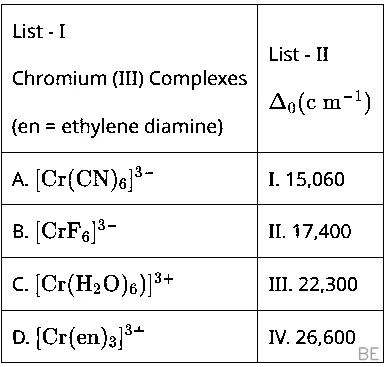
Match List - I with List - II.List - IChromium (III) Complexes(en = ethylene diamine)List - IIΔ0(c m−1)A. [Cr(CN)6]3−I. 15,060B. [CrF6]3−II. 17,400C. [Cr(H2O)6)]3+III. 22,300D. [Cr(en)3]3+IV. 26,600Choose the correct answer from the options given below :[JEE Main 2 apr 2026 Shift 1]
The magnitude of crystal field splitting, Δ0, is governed by the field strength of the ligands, as defined by the spectrochemical series where stronger ligands induce a larger splitting of the d-orbitals. Ordering the ligands-cyanide, ethylenediamine, water, and fluoride-by their donor strength determines the sequence of their corresponding energy splitting values.
The cyanide ligand is the strongest in this set and induces the highest splitting of 26,600 cm⁻¹ for [Cr(CN)6]3−, which corresponds to IV. Ethylenediamine acts as the next strongest ligand, producing a splitting of 22,300 cm⁻¹ for [Cr(en)3]3+, which aligns with III. The water ligand is weaker, leading to a splitting of 17,400 cm⁻¹ for [Cr(H2O)6]3+, matching II. Finally, the fluoride ion is the weakest ligand, resulting in the smallest splitting value of 15,060 cm⁻¹ for [CrF6]3−, which corresponds to I.
Q9JEE Main 2026MCQ
Consider a mixture ' X ' which is made by dissolving 0.4 mol of [Co(NH3)5SO4]Br and 0.4 mol of [Co(NH3)5Br]SO4 in water to make 4 L of solution. When 2 L of mixture ' X ' is allowed to react with excess of AgNO3, it forms precipitate ' Y '. The rest 2 L of mixture ' X ' reacts with excess BaCl2 to form precipitate ' Z '. Which of the following statements is CORRECT?
Coordination compounds dissociate in aqueous solution such that only the ions outside the coordination sphere become available for precipitation reactions. A 2 L portion of the mixture contains 0.2 mol of [Co(NH3)5SO4]Br and 0.2 mol of [Co(NH3)5Br]SO4. Upon addition of excess AgNO3, the bromide ion dissociates from [Co(NH3)5SO4]Br to form 0.2 mol of AgBr precipitate 'Y' according to the reaction Br−+Ag+→AgBr(s). When the other 2 L sample reacts with excess BaCl2, the sulfate ion dissociates from [Co(NH3)5Br]SO4 to form precipitate 'Z' via the reaction SO42−+Ba2+→BaSO4(s), which yields 0.2 mol of BaSO4.
Q10JEE Main 2026MCQ
Given below are two statements : Statement I : Hybridisation, shape and spin only magnetic moment of K3[Co(CO3)3] is sp3d2, octahedral and 4.9 BM respectively. Statement II: Geometry, hybridisation and spin only magnetic moment values ( BM ) of the ions [Ni(CN)4]2−,[MnBr4]2− and [CoF6]3− respectively are square planar, tetrahedral, octahedral; dsp2,sp3,sp3d2 and 0,5.9,4.9. In the light of the above statements, choose the correct answer from the options given below
Valence bond theory and crystal field theory dictate the hybridization, geometry, and magnetic properties of coordination complexes based on the oxidation state of the central metal ion and the field strength of the ligands. In K3[Co(CO3)3], the oxidation state of cobalt is +3, corresponding to a 3d6 electronic configuration. Because the carbonate (CO32−) ion acts as a weak field ligand, it does not cause electron pairing, leading to sp3d2 hybridization, an octahedral geometry, and four unpaired electrons (t2g4eg2) which results in a spin-only magnetic moment of μ=4(4+2)=24≈4.9 BM.
For [Ni(CN)4]2−, the strong field ligand CN− causes pairing of the d-electrons in the Ni2+ ion (3d8), resulting in dsp2 hybridization, square planar geometry, and diamagnetic behavior where μ=0 BM. The complex [MnBr4]2− consists of Mn2+ (3d5) coordinated with weak field Br− ligands, resulting in sp3 hybridization, tetrahedral geometry, and five unpaired electrons, which corresponds to a magnetic moment of μ=5(5+2)=35≈5.9 BM. Finally, [CoF6]3− involves Co3+ (3d6) with weak field F− ligands, yielding an outer orbital sp3d2 octahedral complex with four unpaired electrons and a magnetic moment of μ=4(4+2)=24≈4.9 BM. Since both Statement I and Statement II correctly describe these properties, the assertions are valid.
Q11JEE Main 2026MCQ
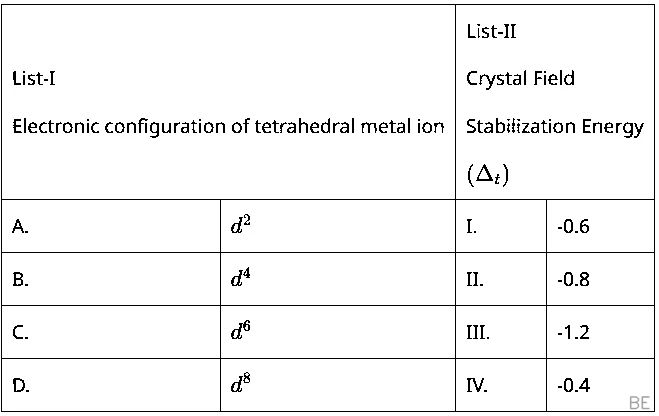
Match the List-I with List-II List-IElectronic configuration of tetrahedral metal ion List-IICrystal FieldStabilization Energy(Δt) A. d2 I. -0.6 B. d4 II. -0.8 C. d6 III. -1.2 D. d8 IV. -0.4 Choose the correct answer from the options given below :[JEE Main 6 Apr 2026 shift 1]
In a tetrahedral crystal field, the d-orbitals split into a lower-energy e set and a higher-energy t2 set, where occupying the e orbitals stabilizes the system by −53Δt per electron, while occupying t2 orbitals raises energy by +52Δt. The total CFSE is determined by the formula CFSE=[−53n1+52n2]Δt, where n1 and n2 are the number of electrons in the e and t2 orbitals, respectively.
For a d2 metal ion, both electrons enter the lower energy e set, resulting in 2×(−53)=−1.2Δt, which matches III. A d4 configuration distributes two electrons into each set, giving 2×(−53)+2×(52)=−0.4Δt, corresponding to IV. A d6 ion places three electrons in each level, calculating as 3×(−53)+3×(52)=−0.6Δt, matching I. Finally, the d8 configuration places four electrons in each set, yielding 4×(−53)+4×(52)=−0.8Δt, which aligns with II.
Q12JEE Main 2026MCQ
Identify the correct statements from the following:(A) [Fe(C2O4)3]3− is the most stable complex among [Fe(OH)6]3−,[Fe(C2O4)3]3− and [Fe(SCN)6]3−(B) The stability of [Cu(NH3)4]2+ is greater than that of [Cu(en)2]2+(C) The hybridization of Fe in K4[Fe(CN)6] is d2sp3(D) [Fe(NO2)3Cl3]3− exhibits linkage isomerism(E) NO2− and SCN− ligands are NOT ambidentate ligandsChoose the correct answer from the options given below :[JEE Main 5 April 2026 Shift 2]
The stability of coordination complexes is heavily influenced by the chelation effect, where multidentate ligands form stable rings around the central metal atom. Because the oxalate ion in [Fe(C2O4)3]3− acts as a bidentate chelating agent, this complex demonstrates superior stability compared to the others mentioned which involve monodentate ligands. In contrast, when comparing [Cu(NH3)4]2+ and [Cu(en)2]2+, the complex containing ethylenediamine is actually more stable due to this same chelation phenomenon, rendering the assertion that [Cu(NH3)4]2+ is more stable incorrect.
When considering the bonding in K4[Fe(CN)6], the iron exists in the Fe2+ state with a 3d6 electronic configuration. The presence of a strong field ligand like cyanide induces electron pairing, which empties the necessary orbitals to facilitate d2sp3 hybridization. Finally, linkage isomerism is a distinct property displayed by complexes containing ambidentate ligands, such as NO2−, which can coordinate to a metal center through either its nitrogen or oxygen atom. Since both NO2− and SCN− are inherently ambidentate, the statement denying this characteristic is false, whereas the complex [Fe(NO2)3Cl3]3− is correctly identified as one capable of exhibiting linkage isomerism.
Q13JEE Main 2026MCQ
The correct increasing order of spin-only magnetic moment values of the complex ions [MnBr4]2−(A),[Cu(H2O)6]2+(B),[Ni(CN)4]2−(C) and [Ni(H2O)6]2+(D) is :
The spin-only magnetic moment μ is determined by the number of unpaired electrons n through the relation μ=n(n+2) BM. For the [MnBr4]2− complex, the Mn2+ ion (3d5) occupies a tetrahedral geometry with weak field ligands, resulting in n=5. For [Cu(H2O)6]2+, the Cu2+ ion (3d9) has n=1 unpaired electron. The [Ni(CN)4]2− complex contains Ni2+ (3d8), where the strong field CN− ligand induces pairing to form a square planar geometry, resulting in n=0. In [Ni(H2O)6]2+, the Ni2+ (3d8) ion in an octahedral field with weak field ligands retains two unpaired electrons, so n=2. Arranging these complexes according to their respective n values of 5 (A), 1 (B), 0 (C), and 2 (D) in increasing order results in 0<1<2<5, which corresponds to the sequence C < B < D < A.
Q14JEE Main 2026MCQ
Given below are two statements :Statement-I : Among Zn, Mn, Sc and Cu, the energy required to remove the third valence electron is highest for Zn and lowest for Sc.Statement-II : The correct order of the following complexes in terms of CFSE is [Co(H2O)6]2+<[Co(H2O)6]3+<[Co(en)3]3+.In the light of the above statements, choose the correct answer from the options given below :[JEE Main 2 apr 2026 Shift 2]
The third ionization energy (IE3) represents the energy required to remove an electron from the M2+ ion, which generally increases across the transition series as the effective nuclear charge rises. For scandium, the removal of the third electron is relatively easier, corresponding to a value of 2393 kJ/mol, whereas for zinc, removing an electron from the stable, fully filled 3d10 subshell is exceptionally difficult, requiring 3837 kJ/mol. Since the values for manganese and copper fall between these extremes, the increasing order of Sc<Mn<Cu<Zn confirms that the first statement is true.
The Crystal Field Stabilization Energy (CFSE) depends on both the oxidation state of the central metal ion and the field strength of the ligands. Because Co3+ ions induce greater splitting than Co2+ ions, and ethylenediamine functions as a stronger field ligand compared to water, the stabilization energies follow the order: [Co(H2O)6]2+<[Co(H2O)6]3+<[Co(en)3]3+
This hierarchy validates that the second statement is also true.
Q15JEE Main 2026MCQ
Consider the metal complexes [Ni(en)3]2+(A),[NiCl4]2−(B) and [Ni(NH3)6]2+(C). Choose the CORRECT option by considering the number of unpaired electron present in (A), (B) and (C) respectively and the order of frequency of absorption.[JEE Main 4 Apr 2026 Shift 2]
In all three complexes, the central nickel ion is in the +2 oxidation state with a 3d8 electronic configuration. Regardless of whether the geometry is octahedral or tetrahedral, the distribution of these electrons consistently leaves two unpaired electrons in each case. The frequency of light absorbed is directly proportional to the magnitude of the crystal field splitting energy, which is significantly larger in octahedral complexes like [Ni(en)3]2+ and [Ni(NH3)6]2+ compared to the tetrahedral complex [NiCl4]2−. Because the ligand field strength of ethylenediamine exceeds that of ammonia, the octahedral complex with ethylenediamine experiences the greatest splitting, leading to the overall trend where the absorption frequency of (A) is greater than (C), which is greater than (B).
Q16JEE Main 2026NAT
An excess of AgNO3 is added to 100 mL of a 0.05 M solution of tetraaquadichloridochromium (III) chloride. The number of moles of AgCl precipitated will be _____ ×10−3. (Nearest integer)[JEE Main 6 Apr 2026 shift 2]
The behavior of coordination compounds in aqueous solution depends on the distinction between ligands bound inside the coordination sphere and counter-ions residing outside. Only the counter-ions that dissociate completely when dissolved are available to participate in precipitation reactions with reagents like silver nitrate. In the complex [Cr(H2O)4Cl2]Cl, the chlorine atom outside the square bracket acts as the ionizable counter-ion, while the two chlorine atoms inside are firmly bonded to the chromium center and do not ionize.
Because the ratio of this specific complex to its dissociable chloride ion is 1:1, every mole of the complex produces one mole of AgCl upon reaction with excess silver nitrate. We determine the initial amount of the complex by multiplying its molar concentration by its volume in liters, calculating 0.05×0.1=0.005 moles. Given the 1:1 stoichiometry, this leads to the formation of exactly 5×10⁻³ moles of AgCl, identifying the required integer as 5.
Q17JEE Main 2026MCQ
Given below are two statements : Statement I : Among [Cu(NH3)4]2+,[Ni(en)3)]2+,[Ni(NH3)6]2+ and [Mn(H2O)6]2+,[Mn(H2O)6]2+ has the maximum number of unpaired electrons. Statement II : The number of pairs among {[NiCl4]2−,[Ni(CO)4]},{[NiCl4]2−,[Ni(CN)4]2−} and {[Ni(CO)4],[Ni(CN)4]2−} that contain only diamagnetic species is two. In the light of the above statements, choose the correct answer from the options given below:
Statement I is true because calculating the number of unpaired electrons based on electron configuration and ligand field splitting reveals that [Cu(NH3)4]2+ (d9) has one, [Ni(en)3]2+ and [Ni(NH3)6]2+ (d8 octahedral) have two, and [Mn(H2O)6]2+ (d5 high-spin) possesses five unpaired electrons, which is the maximum. Statement II is false because evaluating the magnetic properties shows that only the pair {[Ni(CO)4],[Ni(CN)4]2−} consists entirely of diamagnetic species, whereas the pairs containing [NiCl4]2− (which is paramagnetic) do not satisfy this condition, resulting in a total count of only one such pair rather than two.
Q18JEE Main 2026MCQ
Given below are two statements :Statement I : Each electron in eg orbitals destabilizes the orbitals by +0.6Δ0 and each electron in the t2g orbitals stabilizes the orbitals by −0.4Δ0 in an octahedral field on the basis of crystal field theory.Statement II : All the d-orbitals of the transition metals have the same energy in their free atomic state but when a complex is formed the ligands destroy the degeneracy of these orbitals on the basis of crystal field theory.In the light of the above statements, choose the correct answer from the options given below.[JEE Main 5 Apr 2026 Shift 1]
Crystal Field Theory explains that transition metal d-orbitals are degenerate when in a free atomic state, but this symmetry is broken upon the formation of an octahedral complex due to electrostatic repulsions between metal electrons and incoming ligands. This interaction causes the d-orbitals to split, where the eg orbitals are destabilized by an energy shift of +0.6Δo and the t2g orbitals are stabilized by an energy shift of −0.4Δo to maintain the system's overall average energy.
Q19JEE Main 2026NAT
The number of isoelectronic species among Sc3+,Cr2+,Mn3+,Co3+ and Fe3+ is ' n '. If ' n ' moles of AgCl is formed during the reaction of complex with formula CoCl3(en)2NH3 with excess of AgNO3 solution, then the number of electrons present in the t2g orbital of the complex is ____ .
The number of electrons in each species is determined by the formula Z−charge, yielding 18 for Sc3+, 22 for Cr2+, 22 for Mn3+, 24 for Co3+, and 23 for Fe3+. Comparing these, only Cr2+ and Mn3+ share an identical number of electrons, which establishes that n=2.
The formation of n=2 moles of AgCl indicates the presence of two ionizable chloride ions in the complex [Co(en)2(NH3)Cl]Cl2. In this octahedral complex, the central metal ion is Co3+, which possesses a 3d6 electronic configuration. Under the influence of the strong field ligand ethylenediamine, the electrons pair within the t2g orbitals to form a low-spin t2g6eg0 configuration, resulting in 6 electrons in the t2g orbital.
Q20JEE Main 2026NAT
The crystal field splitting energy of [Co(oxalate)3]3− complex is ' n ' times that of the [Cr(oxalate)3]3− complex. Here ' n ' is ____ . (Assume Δ0≫P )
The crystal field stabilization energy (CFSE) for octahedral complexes is calculated using the formula CFSE=(−0.4×nt2g+0.6×neg)Δo. For the [Cr(oxalate)3]3− complex, the Cr3+ (d3) ion exhibits an electronic configuration of t2g3eg0, resulting in a CFSE magnitude of 1.2Δo. Conversely, for the [Co(oxalate)3]3− complex, the Co3+ (d6) ion under the condition Δo≫P adopts a low-spin configuration of t2g6eg0, which results in a CFSE magnitude of 2.4Δo. The value of n is determined by the ratio of these stabilization energies, 1.2Δo2.4Δo=2.