Q1GATE 2025NAT
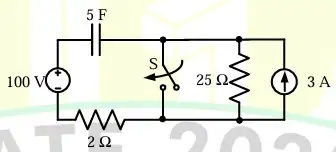
The switch (S) closes at . The time, in sec, the capacitor takes to charge to 50 V is ___________ (round off to one decimal place).
GATE EE · Electrical And Electronic Measurements
Generate GATE-level questions on Measurement basics. Focus on: 1. Static characteristics: Accuracy, Precision, Sensitivity, Resolution, and Linearity. 2. Error analysis: Systematic, Random, and Limiting errors, Propagation of errors. 3. Dynamic characteristics: Speed of response, Fidelity, and Dynamic error.
8 questions · 8 PYQs · 0 AI practice · GATE EE 2027
🎯 These are sample questions
Just sign in to unlock everything. Free for all students.
The switch (S) closes at . The time, in sec, the capacitor takes to charge to 50 V is ___________ (round off to one decimal place).
A non-ideal Si-based pn junction diode is tested by sweeping the bias applied across its terminals from -5 V to +5 V. The effective thermal voltage, , for the diode is measured to be (29 2) mV. The resolution of the voltage source in the measurement range is 1 mV. The percentage uncertainty (rounded off to 2 decimal plates) in the measured current at a bias voltage of 0.02 V is _______.
The following measurements are obtained on a single phase load: V = 220V 1%, I = 5.0A 1% and W=555W 2%. If the power factor is calculated using these measurements, the worst case error in the calculated power factor in percent is ________.
Two resistors with nominal resistance values have additive uncertainties and , respectively. When these resistances are connected in parallel, the standard deviation of the error in the equivalent resistance R is
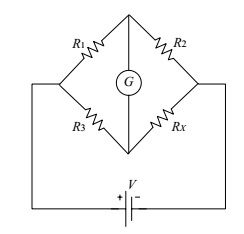
When the Wheatstone bridge shown in the figure is used to find the value of resistor , the galvanometer G indicates zero current when and . If is known with % tolerance on its nominal value of 100 , what is the range of in Ohms?
The measurement system shown in the figure uses three sub-systems in cascade whose gains are specified as . The relative small errors associated with each respective subsystem are . The error associated with the output is :

A variable w is related to three other variables x, y, z as w=xy/z. The variables are measured with meters of accuracy 0.5% reading, 1% of full scale value and 1.5% reading. The actual readings of the three meters are 80, 20 and 50 with 100 being the full scale value for all three. The maximum uncertainty in the measurement of w will be
Resistances and have, respectively, nominal values of 10 and 5 , and tolerances of % and %. The range of values for the parallel combination of and is
Want unlimited AI-generated Characteristics Of Instruments And Measurement Systems questions?
Sign up free and practice with adaptive difficulty — Easy, Medium, Hard. New questions every session.
Start practising for free →

