To determine the number of valid insertion sequences, we first identify the dependency constraints for each key based on the hash function h(k)=kmod10 and linear probing:
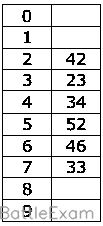
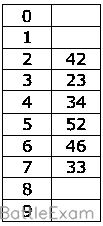
- Independent Keys: 42 (h=2), 23 (h=3), 34 (h=4), and 46 (h=6) are hash-independent and can be inserted in any relative order as long as they appear before their dependent keys.
- Dependent Keys:
- 52 (h=2) collides with 42,23,34 and is placed at index 5. Thus, 42,23,34 must be inserted before 52.
- 33 (h=3) collides with 23,34,52,46 and is placed at index 7. Thus, 23,34,52,46 must be inserted before 33.
Let the keys be A=42,B=23,C=34,D=52,E=46,F=33. The constraints are:
- A,B,C<D
- B,C,D,E<F
Since F must be inserted after B,C,D,E, and D must be inserted after A,B,C, F must be the last element (position 6). For the remaining 5 keys {A,B,C,D,E}, we must satisfy the condition that D appears after A,B,C. In any random permutation of these 5 keys, D will appear after A,B,C in exactly 41 of the cases (because in the set {A,B,C,D}, D is the last of the four in 4!3!=41 of permutations).
Total permutations = 5!=120.
Valid sequences = 120×41=30.