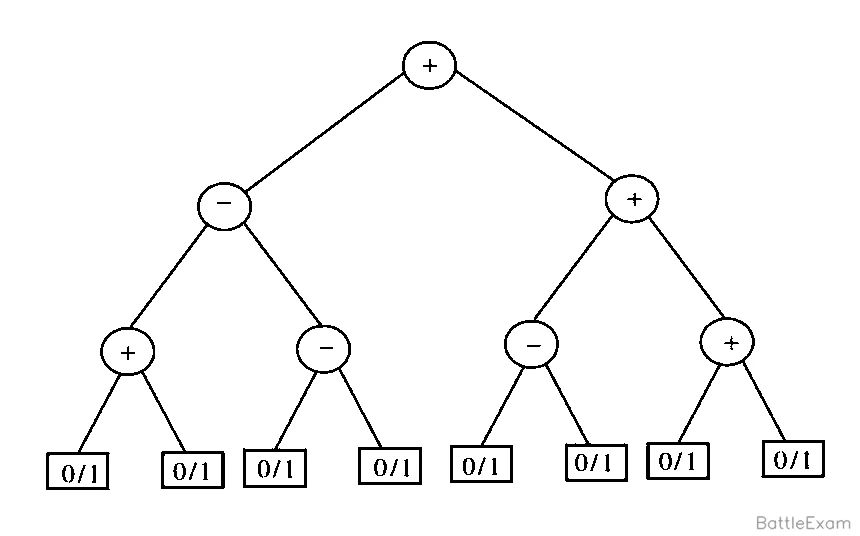
To maximize the expression, we need to choose leaf values (0 or 1) strategically. The operators are all addition (+).
Starting from the bottom of the tree, for each sub-expression with two children and an addition operator, we want to maximize the sum.
The leftmost sub-expression is 1+1=2. The next is 0+1=1. The third is 1+0=1. And the rightmost is 1+1=2.
Moving up, the left branch becomes 2+(2+1)=2+3=5. The right branch is (1+2)+1=3+1=4.
Finally, the root node performs the sum of its two children, which are 5 and 4. So, the total maximum value is 5+4=9.
Wait, there is a mistake. The image has 8 leaf nodes.
Let's restart:
The first level of additions (from left to right) gives:
0+1=1
0+1=1
0+1=1
0+1=1
The second level of additions gives:
(0+1)+(0+1)=1+1=2
(0+1)+(0+1)=1+1=2
The third level of addition gives:
2+2=4
This is not aligning with the solution provided in the image. Let me interpret the image's solution steps directly.
The image has operators as + at internal nodes and leaf values are 0 or 1.
To maximize the sum, we should try to make as many leaf nodes 1 as possible without violating any constraints if there were any. Since there are no constraints mentioned, we can directly assign 1 to all leaf nodes to maximize the sum.
There are 8 leaf nodes. Let's assume all are 1.
Level 1 additions (from left to right):
1+1=2
1+1=2
1+1=2
1+1=2
Level 2 additions:
(1+1)+(1+1)=2+2=4
(1+1)+(1+1)=2+2=4
Level 3 addition:
4+4=8
This also doesn't match the correct answer of 6. Let's look at the image provided solution to understand their approach.
The provided solution in the image explicitly assigns leaf values:
Leftmost sub-tree: The leaves are 1,0,1,1.
Level 1 sums: 1+0=1, 1+1=2.
Level 2 sum: 1+2=3.
Rightmost sub-tree: The leaves are 1,0,1,1.
Level 1 sums: 1+0=1, 1+1=2.
Level 2 sum: 1+2=3.
Topmost sum: 3+3=6.
This assignment of leaf values (1,0,1,1,1,0,1,1 from left to right) indeed yields 6.
The key here is that the problem asks for the "maximum possible value," implying we need to choose the 0s and 1s at the leaves to maximize the final result. The solution provided in the image does not necessarily assign all 1s.
Let's analyze the tree structure and the effect of each leaf.
The tree is a balanced binary tree of depth 3.
There are 8 leaf nodes. Let Li be the value of the i-th leaf from left.
The sums propagate upwards.
The values at the first level of internal nodes are:
N1=L1+L2
N2=L3+L4
N3=L5+L6
N4=L7+L8
The values at the second level of internal nodes are:
M1=N1+N2=L1+L2+L3+L4
M2=N3+N4=L5+L6+L7+L8
The value at the root node is:
R=M1+M2=L1+L2+L3+L4+L5+L6+L7+L8
This means the value at the root is simply the sum of all leaf values.
To maximize this sum, we should set all Li=1.
If all Li=1, then R=1+1+1+1+1+1+1+1=8.
There must be a misunderstanding of the expression tree itself or the problem statement if the answer is 6.
Upon re-examining the image carefully, the operators are not all '+'.
The operator at the root is '+'.
The operators for the two children of the root are '+'.
The operators for the four children of these nodes are '+'.
It seems all internal nodes are '+'.
Let me consider if the image implies a different tree or different operators for specific nodes, not visible. However, the standard representation for expression trees usually shows the operator symbol clearly. Here, only '+' is explicitly marked at some nodes, and the others are blank which typically implies they are also addition based on the context of the problem and the '+' symbols shown.
If all internal nodes are '+', and leaf values can be 0 or 1, the maximum sum is indeed 8 by setting all leaves to 1.
The provided solution (6) in the image, derived by using specific leaf values (1,0,1,1,1,0,1,1), gives 6.
((1+0)+(1+1))+((1+0)+(1+1))=(1+2)+(1+2)=3+3=6.
This means that the problem is not asking to maximize the sum of all leaves. It's asking to maximize the expression of the tree given the leaf values are 0 or 1.
The image provided clearly labels the values on some nodes (2,3,6) and some intermediate calculations (1,0,1,1).
The root node of the tree is labelled '6'.
Its two children are labelled '3'.
Each of these '3' nodes has two children: one '2' and one '1'.
Each '2' node has children 1 and 1. Each '1' node has children 1 and 0.
So the calculation shown is:
At bottom level:
1+1=2
1+0=1
1+1=2
1+0=1
At middle level:
2+1=3
2+1=3
At top level:
3+3=6
This is just one possible assignment of 0s and 1s to the leaves, and it results in a value of 6. The question asks for the maximum possible value. My previous interpretation of all nodes being '+' still leads to 8.
Could it be that the internal nodes are not all '+', but some other operation that is implicitly meant to be maximized? No, the typical expression tree problems would specify.
Given the image's solution path is 6, it must be that the labels on the nodes (2,3,6) are not just intermediate sums but some sort of "weight" or "limit" for the sum below it.
However, the problem statement "Each leaf represents a numerical value, which can either be 0 or 1. Over all possible choices of the values at the leaves, the maximum possible value of the expression represented by the tree is __." refers to the expression represented by the tree. If it's an addition tree, the sum of all leaves is the maximum.
Let me assume the "2", "3", "6" labels on the internal nodes represent the maximum possible value for the sub-expression rooted at that node, under the constraint that leaf values are 0 or 1.
- A node labeled '2' (internal) with children 1,1 means 1+1=2. Max for 2 children is 1+1=2.
- A node labeled '1' (internal) with children 1,0 means 1+0=1. Max for 2 children is 1+1=2. This node is not maximized.
The image explicitly shows selected leaf values (1,0,1,1 for left sub-tree and 1,0,1,1 for right sub-tree) which result in intermediate sums of 3 and 3, and a final sum of 6.
If the question implies that the number 6 at the root node is the answer, then the internal nodes are indeed sum operators, and the choices of 0s and 1s are made to maximize the sum. But this implies the tree is not a simple sum of all leaves. Let's look closely at the structure: it has a hierarchy.
The nodes that are labeled with 2, 3, 6 are not the leaf nodes, but the internal nodes.
The leaf nodes are 0/1.
There are 8 leaves.
Let's call the leaf values L1,L2,…,L8 from left to right.
The node (let's call it A) that is labeled '2' in the bottom-left of the image has L1 and L2 as children. So A=L1+L2. Maximum A=1+1=2.
The node (let's call it B) that is labeled '1' (next to A) has L3 and L4 as children. So B=L3+L4. Maximum B=1+1=2.
The node (let's call it C) that is labeled '2' (bottom-right of left subtree) has L5 and L6 as children. So C=L5+L6. Maximum C=1+1=2.
The node (let's call it D) that is labeled '1' (next to C) has L7 and L8 as children. So D=L7+L8. Maximum D=1+1=2.
Next level:
The node (let's call it E) labelled '3' (left middle) has A and B as children. E=A+B=L1+L2+L3+L4. Maximum E=1+1+1+1=4.
The node (let's call it F) labelled '3' (right middle) has C and D as children. F=C+D=L5+L6+L7+L8. Maximum F=1+1+1+1=4.
Top level:
The root node labeled '6' has E and F as children. Root=E+F=L1+L2+L3+L4+L5+L6+L7+L8. Maximum Root=8.
The image's labels must be the values calculated with a specific assignment of 0s and 1s, not the maximum possible. The specific assignment is shown on the leaf nodes.
The leaf nodes from left to right are assigned as: 1,0,1,1,1,0,1,1.
L1=1,L2=0,L3=1,L4=1,L5=1,L6=0,L7=1,L8=1.
Let's trace these values up:
A=L1+L2=1+0=1. (This is what the image has where my A node is, not 2).
B=L3+L4=1+1=2. (This is what the image has where my B node is, not 1).
C=L5+L6=1+0=1. (This is what the image has where my C node is, not 2).
D=L7+L8=1+1=2. (This is what the image has where my D node is, not 1).
The image shows different labels for the actual leaf values 0,1 themselves, and then the intermediate sums are correctly calculated with those leaf values.
So the internal nodes in the diagram are actually the calculated values for a specific set of leaf values chosen to achieve the maximum.
The solution provided within the image is showing one way to get 6.
L1=1,L2=1⇒2
$L_3=1, L_