Q1GATE 2026MCQ
The probability density function of a random variable which takes real values is Which one of the following statements is correct about the random variable ?
GATE CSE · Engineering Mathematics
Practice problems for Probability Theory in Engineering Mathematics.
93 questions · 20 PYQs · 0 AI practice · GATE CSE 2027
🎯 These are sample questions
Just sign in to unlock everything. Free for all students.
The probability density function of a random variable which takes real values is Which one of the following statements is correct about the random variable ?
Suppose an unbiased coin is tossed times. Each coin toss is independent of all previous coin tosses. Let be the event that among the second, fourth, and sixth coin tosses, there are at least two heads. Let be the event that among the first, second, third, and fifth coin tosses, there are equal number of heads and tails. The conditional probability is equal to ________ (rounded off to one decimal place)
Let be a random variable which takes values in the set . Further, and . The expected value of , denoted by , is equal to ________. (rounded off to two decimal places)
An urn contains one red ball and one blue ball. At each step, a ball is picked uniformly at random from the urn, and this ball together with another ball of the same color is put back in the urn. The probability that there are equal number of red and blue balls after two steps is
Consider a probability distribution given by the density function .
The probability that lies between 2 and 3, i.e., is _________. (rounded off to three decimal places)
Suppose a 5-bit message is transmitted from a source to a destination through a noisy channel. The probability that a bit of the message gets flipped during transmission is 0.01. Flipping of each bit is independent of one another. The probability that the message is delivered error-free to the destination is _________. (rounded off to three decimal places)
A quadratic polynomial over complex numbers is said to be square invariant if . Suppose from the set of all square invariant quadratic polynomials we choose one at random. The probability that the roots of the chosen polynomial are equal is ______. (rounded off to one decimal place)
A box contains 5 coins: 4 regular coins and 1 fake coin. When a regular coin is tossed, the probability and for a fake coin, . You pick a coin at random and toss it twice, and get two heads. The probability that the coin you have chosen is the fake coin is _______. (rounded off to two decimal places)
The unit interval is divided at a point chosen uniformly distributed over in into two disjoint subintervals. The expected length of the subinterval that contains 0.4 is ___________. (rounded off to two decimal places)
Let and be two events in a probability space with , and . Which of the following statements is/are TRUE?
Consider a permutation sampled uniformly at random from the set of all permutations of for some . Let be the event that 1 occurs before 2 in the permutation, and the event that 3 occurs before 4 . Which one of the following statements is TRUE?
A bag contains 10 red balls and 15 blue balls. Two balls are drawn randomly without replacement. Given that the first ball drawn is red, the probability (rounded off to 3 decimal places) that both balls drawn are red is ____
When six unbiased dice are rolled simultaneously, the probability of getting all distinct numbers (i.e., 1, 2, 3, 4, 5, and 6) is
Consider a random experiment where two fair coins are tossed. Let A be the event that denotes HEAD on both the throws, B be the event that denotes HEAD on the first throw, and C be the event that denotes HEAD on the second throw. Which of the following statements is/are TRUE?
In an examination, a student can choose the order in which two questions (QuesA and QuesB) must be attempted. If the first question is answered wrong, the student gets zero marks. If the first question is answered correctly and the second question is not answered correctly, the student gets the marks only for the first question. If both the questions are answered correctly, the student gets the sum of the marks of the two questions. The following table shows the probability of correctly answering a question and the marks of the question respectively.
Assuming that the student always wants to maximize her expected marks in the examination, in which order should she attempt the questions and what is the expected marks for that order (assume that the questions are independent)?
A bag has red balls and black balls. All balls are identical except for their colours. In a trial, a ball is randomly drawn from the bag, its colour is noted and the ball is placed back into the bag along with another ball of the same colour. Note that the number of balls in the bag will increase by one, after the trial. A sequence of four such trials is conducted. Which one of the following choices gives the probability of drawing a red ball in the fourth trial?
For a given biased coin, the probability that the outcome of a toss is a head is 0.4. This coin is tossed 1,000 times. Let X denote the random variable whose value is the number of times that head appeared in these 1,000 tosses. The standard deviation of X (rounded to 2 decimal place) is ________
Consider the two statements. S1: There exist random variables and such that S2: For all random variables and , Which one of the following choices is correct?
The lifetime of a component of a certain type is a random variable whose probability density function is exponentially distributed with parameter 2. For a randomly picked component of this type, the probability that its lifetime exceeds the expected lifetime (rounded to 2 decimal places) is _________
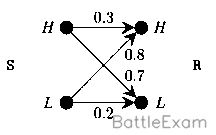
A sender (S) transmits a signal, which can be one of the two kinds: H and L with probabilities 0.1 and 0.9 respectively, to a receiver (R) In the graph below, the weight of edge is the probability of receiving when is transmitted, where . For example, the probability that the received signal is given the transmitted signal was , is 0.7. If the received signal is , the probability that the transmitted signal was (rounded to 2 decimal places) is __________.
Want unlimited AI-generated Probability Theory questions?
Sign up free and practice with adaptive difficulty — Easy, Medium, Hard. New questions every session.
Start practising for free →