Q1GATE 2017MCQ
Using Newton-Raphson method, a root correct to 3 decimal places of
GATE CSE · Engineering Mathematics
Practice problems for Numerical Method in Engineering Mathematics.
38 questions · 20 PYQs · 0 AI practice · GATE CSE 2027
🎯 These are sample questions
Just sign in to unlock everything. Free for all students.
Using Newton-Raphson method, a root correct to 3 decimal places of
What is the sum to infinity of the series,
The velocity v (in kilometer/minute) of a motorbike which starts from rest, is given at fixed intervals of time t (in minutes) as follows: The approximate distance (in kilometers) rounded to two places of decimals covered in 20 minutes using Simpson's rule is _______________.

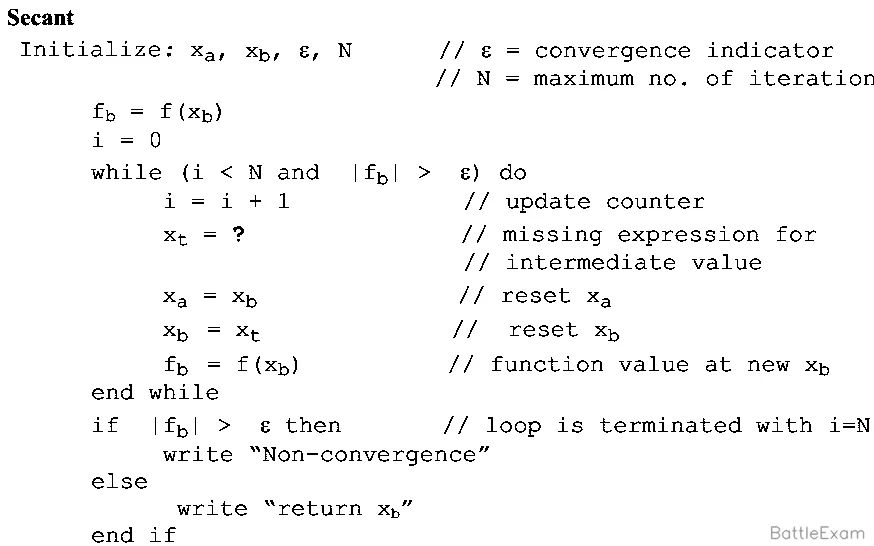
The secant method is used to find the root of an equation f(x)=0. It is started from two distinct estimates and for the root. It is an iterative procedure involving linear interpolation to a root. The iteration stops if is very small and then is the solution. The procedure is given below. Observe that there is an expression which is missing and is marked by ?. Which is the suitable expression that is to be put in place of ? so that it follows all steps of the secant method?
In the Newton-Raphson method, an initial guess of is made and the sequence is obtained for the function Consider the statements (I) =0. (II) The method converges to a solution in a finite number of iterations. Which of the following is TRUE?
With respect to the numerical evaluation of the definite integral, , where a and b are given, which of the following statements is/are TRUE? (I) The value of K obtained using the trapezoidal rule is always greater than or equal to the exact value of the definite integral. (II) The value of K obtained using the Simpson's rule is always equal to the exact value of the definite integral.
The Guass-Seidal iterative method can be used to solve which of the following sets?
Function f is known at the following points: The value of computed using the trapezoidal rule is

The bisection method is applied to compute a zero of the function in the interval [1,9]. The method converges to a solution after _____iterations.
Given X: 0 10 16 Y: 6 16 28 The interpolated value X=4 using piecewise linear interpolation is
Newton-Raphson method is used to compute a root of the equation with 3.5 as the initial value. The approximation after one iteration is
A root of equation can be computed to any degree of accuracy if a 'good' initial approximation is chosen for which
Consider the polynomial , where . The minimum number of multiplications needed to evaluate p on an input x is:
The formula is
Consider the function . Suppose an execution of the Newton-Raphson method to find a zero of starts with an approximation of . What is the value of , the approximation of that algorithm produces after two iterations, rounded to three decimal places?
The Newton-Raphson iteration can be used to compute the
The trapezoidal method is used to evaluate the numerical value of . Consider the following values for the step size h. i. ii. iii. iv. For which of these values of the step size h, is the computed value guaranteed to be correct to seven decimal places. Assume that there are no round-off errors in the computation.
Consider the series obtained from the Newton-Raphson method. The series converges to
x+y/2=9 3x+y=10 The value of the Frobenius norm for the above system of equations is
x+y/2=9 3x+y=10 What can be said about the Gauss-Siedel iterative method for solving the above set of linear equations?
Want unlimited AI-generated Numerical Method questions?
Sign up free and practice with adaptive difficulty — Easy, Medium, Hard. New questions every session.
Start practising for free →