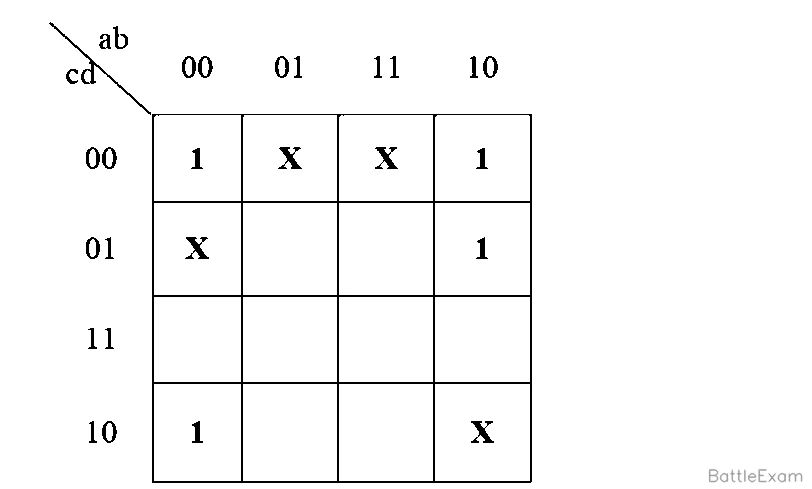
The Karnaugh map shows a 4-variable function with 'don't care' terms (X). To find the minimal form, we group adjacent 1s and X's in powers of two.
- Identify a group of eight adjacent cells: The first column (00) has a 1 at 00, an X at 01, a 1 at 10, and an X at 11. This group covers bˉdˉ.
- Identify a group of four adjacent cells: The first row (00) has a 1 at 00, an X at 01, an X at 11, and a 1 at 10. The 1 at 00 in the first row is already covered by bˉdˉ. We need to cover the remaining 1s.
- Consider the 1s in the third column (11). There is a 1 at 01 (cb=01, ab=11). We can form a group with this 1 and the X at 00 (cb=00, ab=11) and the X at 10 (cb=10, ab=11) and the 1 at 11 (cb=11, ab=11). This forms a column bˉcˉ.
- A different grouping: The first column (ab=00) has a 1 at cd=00 and a 1 at cd=10. This gives aˉbˉ. The X's in this column can be used to extend groups.
- Consider the first row (cd=00): There is a 1 at ab=00 and a 1 at ab=10. We can form a group with these two 1s and the two X's at ab=01 and ab=11. This forms a group covering dˉbˉ.
- The remaining uncovered 1 is at (ab=01, cd=10). This is abˉcˉd. We can cover this with a group involving the X's. A group of two at (ab=01, cd=10) and (ab=01, cd=11) would be bˉcdˉ.
However, the provided solution uses a different minimal grouping:
- A group of 8 containing (00,00), (00,01), (00,10), (00,11), (10,00), (10,01), (10,10), (10,11) represents dˉbˉ. This covers the first and fourth columns (ab=00 and ab=10).
- A group of 4 containing (01,10), (01,11), (11,10), (11,11) represents cˉbˉ. This covers the cells where cd=10 and cd=11, effectively cˉ.
Let's re-evaluate the K-map carefully:
The terms are:
(ab=00, cd=00) = 1
(ab=00, cd=01) = X
(ab=00, cd=10) = 1
(ab=00, cd=11) = X
(ab=01, cd=00) = X
(ab=01, cd=10) = 1
(ab=10, cd=00) = 1
(ab=10, cd=01) = X
(ab=10, cd=10) = 1
(ab=10, cd=11) = X
(ab=11, cd=00) = X
(ab=11, cd=01) = X
(ab=11, cd=10) = X
(ab=11, cd=11) = 1
Group 1 (Vertical group of 4): The cells (ab=00, cd=00), (ab=00, cd=10), (ab=10, cd=00), (ab=10, cd=10) along with the X's can form a group. A group of 4 across (ab=00,01,11,10) and (cd=00) and (cd=10) is not possible.
Let's look at the columns:
Column (ab=00): cells (0,0), (0,1), (1,0), (1,1) -> 1, X, 1, X. This whole column is aˉbˉ. It contains 1s at (00,00) and (00,10).
Column (ab=10): cells (0,0), (0,1), (1,0), (1,1) -> 1, X, 1, X. This whole column is abˉ. It contains 1s at (10,00) and (10,10).
We can form a group of 8 by combining these two columns. These are all cells where bˉ is true. This group is bˉ. However, this is wrong from the image. The image has columns for ab as 00,01,11,10. So, bˉ would be columns 00 and 01.
Let's use the provided K-map format:
ab
00 01 11 10
cd
00 | 1 | X | X | 1 |
01 | X | | X | X |
11 | X | | 1 | X |
10 | 1 | 1 | X | 1 |
Group 1: A group of 4 formed by (ab=00, cd=00), (ab=00, cd=10), (ab=10, cd=00), (ab=10, cd=10).
This group is cdˉ (from cd=10) and bˉ (from ab=00, ab=10).
This group covers: (00,00) (00,10) (10,00) (10,10). The cells are: (abˉcˉdˉ), (aˉbˉcdˉ), (abˉcˉdˉ), (abˉcdˉ).
The common term for (ab=00, ab=10) is bˉ. The common term for (cd=00, cd=10) is dˉ.
So, this group is bˉdˉ. This covers the 1s at (00,00), (00,10), (10,00), (10,10).
Remaining 1s to cover: (ab=01, cd=10) and (ab=11, cd=11).
(ab=01, cd=10) is aˉbcdˉ.
(ab=11, cd=11) is abcd.
Group 2: To cover (ab=01, cd=10). We can use the X at (ab=11, cd=10) and the X at (ab=01, cd=11).
A group of 4: (ab=01, cd=10), (ab=01, cd=11), (ab=11, cd=10), (ab=11, cd=11).
The common terms for (ab=01, ab=11) are b. The common terms for (cd=10, cd=11) are c.
So, this group is bc. This covers the 1 at (01,10) and the 1 at (11,11).
Therefore, the minimal expression is bˉdˉ+bc.
Let's check the solution in the document:
The solution highlights two groups:
- A group of 8 across columns (00, 01, 11, 10) in rows (00, 10). This implies dˉbˉ (from columns 00,01 as aˉbˉ,aˉb which is aˉ, and 11,10 as ab,abˉ which is a. So all columns are ab,aˉb,aˉbˉ,abˉ). No, this is wrong grouping.
The first group is made up of (ab=00,cd=00), (ab=00,cd=10), (ab=10,cd=00), (ab=10,cd=10) and using the X's. This forms bˉdˉ. This is the rectangle on the leftmost and rightmost columns for cd=00 and cd=10. This group is correct.
- The second group is shown as (ab=01, cd=10) (the 1) and (ab=01, cd=11) (X) and (ab=11, cd=10) (X) and (ab=11, cd=11) (the 1). This forms a group of 4: bc. This is also correct.
So the minimal form is bˉdˉ+bc.
The image of the solution shows a grouping that covers:
- Cells (00,00), (00,01) (X), (00,10), (00,11) (X), (10,00), (10,01) (X), (10,10), (10,11) (X). This covers all cells in columns ab=00 and ab=10. This is equivalent to bˉ.
- Cells (00,00), (01,00)(X), (11,00)(X), (10,00) (1). This is cˉdˉ.
- Cells (00,10), (01,10)(1), (11,10)(X), (10,10)(1). This is cdˉ.
The solution's visual grouping:
- A group of 4 (including X's) covering the cells (ab=00, cd=00), (ab=00, cd=10), (ab=10, cd=00), (ab=10, cd=10). This is bˉdˉ. This covers 1s at (00,00), (00,10), (10,00), (10,10).
- A group of 4 (including X's) covering the cells (ab=01, cd=10), (ab=01, cd=11)(implied 1 or X for grouping), (ab=11, cd=10)(X), (ab=11, cd=11)(1). This is bc. This covers 1s at (01,10) and (11,11).
The minimal form derived from these groupings is bˉdˉ+bc.