Q1GATE 2026MCQ
Consider concurrent execution of two transactions and in a DBMS, both of which access a data object . For these two transactions to not conflict on , which one of the following statements must be true?
GATE CSE · Dbms
Master topic for Transactions. Includes Transactions - View Serializability, Concurrency - Two-Phase Locking (2PL), Timestamp Ordering Protocol.
120 questions · 20 PYQs · 0 AI practice · GATE CSE 2027
🎯 These are sample questions
Just sign in to unlock everything. Free for all students.
Consider concurrent execution of two transactions and in a DBMS, both of which access a data object . For these two transactions to not conflict on , which one of the following statements must be true?
An audit of a banking transactions system has found that on an earlier occasion, two joint holders of account attempted simultaneous transfers of Rs. 10000 each from account to account . Both transactions read the same value, Rs. 11000, as the initial balance in and were allowed to go through. was credited Rs. 10000 twice. was debited only once and ended up with a balance of Rs. 1000. Which of the following properties is/are certain to have been violated by the system?
Consider the database transactions and , and data items and . Which of the schedule(s) is/are conflict serializable?
A schedule of three database transactions , , and is shown. and denote read and write of data item by transaction , . The transaction aborts at the end. Which other transaction(s) will be required to be rolled back?
Which of the following statements about the Two Phase Locking (2PL) protocol is/are TRUE?
Consider the following read-write schedule over three transactions , and , where the subscripts in the schedule indicate transaction IDs: Which of the following transaction schedules is/are conflict equivalent to ?
Once the DBMS informs the user that a transaction has been successfully completed, its effect should persist even if the system crashes before all its changes are reflected on disk. This property is called
Let and denote read and write operations on a data element by a transaction , respectively. Consider the schedule with four transactions. S: Which one of the following serial schedules is conflict equivalent to ?
Let and denote read and write operations respectively on a data item by a transaction . Consider the following two schedules. Which one of the following options is correct?
Suppose a database system crashes again while recovering from a previous crash. Assume checkpointing is not done by the database either during the transactions or during recovery. Which of the following statements is/are correct?
Let S be the following schedule of operations of three transactions in a relational database system: Consider the statements P and Q below: P: S is conflict-serializable. Q: If commits before finishes, then S is recoverable. Which one of the following choices is correct?
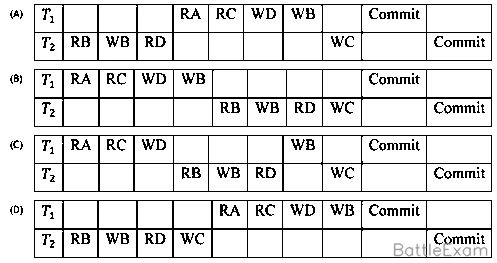
Consider a schedule of transactions T1 and T2: Here, RX stands for "Read(X)" and WX stands for "Write(X)". Which one of the following schedules is conflict equivalent to the above schedule?

Consider the following two statements about database transaction schedules: I. Strict two-phase locking protocol generates conflict serializable schedules that are also recoverable. II. Timestamp-ordering concurrency control protocol with Thomas' Write Rule can generate view serializable schedules that are not conflict serializable. Which of the above statements is/are TRUE?
Let us assume that transaction T1 has arrived before transaction T2. Consider the schedule s=r1(A);r2(B):w2(A);w1(B) Which of the following is true?
Two transactions are given as: where denotes a read operation by transaction on a variable V and denotes a write operations by transaction on a variable V. The total number of conflict serializable schedules that can be formed by is _____________.
Which of the following concurrency control protocol ensures both conflict and free from deadlock? ,
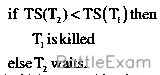
In a database system, unique time stamps are assigned to each transaction using Lamport's logical clock . Let TS( ) and TS( ) be the timestamps of transactions and respectively. Besides, holds a lock on the resource R, and has requested a conflicting lock on the same resource R. The following algorithm is used to prevent deadlocks in the database system assuming that a killed transaction is restarted with the same timestamp. Assume any transactions that is not killed terminates eventually. Which of the following is TRUE about the database system that uses the above algorithm to prevent deadlocks?
ACID properties of a transactions are
Trigger is
Consider the following databases chedule with two transactions, T1 and T2. where denotes a read operation by transaction on avariable Z, denotes a write operation by on avariable Z and denotes an abort by transaction . Which one of the following statements about the above schedule is TRUE?
Want unlimited AI-generated Transactions questions?
Sign up free and practice with adaptive difficulty — Easy, Medium, Hard. New questions every session.
Start practising for free →