Q1GATE 2026MCQ
In the context of DBMS, consider the two sets and given below.
Which one of the following is the correct match from to ?
GATE CSE · Dbms
Master topic for File System. Includes Indexing - Secondary B+ Tree, Hashing - Extendible Hashing.
97 questions · 20 PYQs · 0 AI practice · GATE CSE 2027
🎯 These are sample questions
Just sign in to unlock everything. Free for all students.
In the context of DBMS, consider the two sets and given below.
Which one of the following is the correct match from to ?
An index in a DBMS is said to be dense if an index entry appears for every search-key value in the indexed file. Otherwise it is called a sparse index. Consider the following two statements. : A hash index must be a dense index : A tree index can be a sparse index Which one of the following options is correct?
Which of the following file organizations is/are I/O efficient for the scan operation in DBMS?
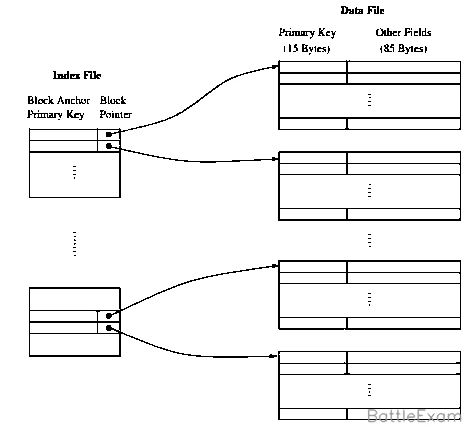
Consider a database of fixed-length records, stored as an ordered file. The database has 25,000 records, with each record being 100 bytes, of which the primary key occupies 15 bytes. The data file is block-aligned in that each data record is fully contained within a block. The database is indexed by a primary index file, which is also stored as a block-aligned ordered file. The figure below depicts this indexing scheme. Suppose the block size of the file system is 1024 bytes, and a pointer to a block occupies 5 bytes. The system uses binary search on the index file to search for a record with a given key. You may assume that a binary search on an index file of blocks takes block accesses in the worst case. Given a key, the number of block accesses required to identify the block in the data file that may contain a record with the key, in the worst case, is _____
Consider a linear list based directory implementation in a file system. Each directory is a list of nodes, where each node contains the file name along with the file metadata, such as the list of pointers to the data blocks. Consider a given directory foo. Which of the following operations will necessarily require a full scan of foo for successful completion?
A data file consisting of 1,50,000 student-records is stored on a hard disk with block size of 4096 bytes. The data file is sorted on the primary key RollNo. The size of a record pointer for this disk is 7 bytes. Each student-record has a candidate key attribute called ANum of size 12 bytes. Suppose an index file with records consisting of two fields, ANum value and the record pointer the corresponding student record, is built and stored on the same disk. Assume that the records of data file and index file are not split across disk blocks. The number of blocks in the index file is ______
Consider a database implemented using B+ tree for file indexing and installed on a disk drive with block size of 4 KB. The size of search key is 12 bytes and the size of tree/disk pointer is 8 bytes. Assume that the database has one million records. Also assume that no node of the B+ tree and no records are present initially in main memory. Consider that each record fits into one disk block. The minimum number of disk accesses required to retrieve any record in the database is _______
Which one of the following statements is NOT correct about the tree data structure used for creating an index of a relational database table?
in a file which contains 1 million records and the order of the tree is 100, then what is the maximum number of nodes to be accessed if B+ tree index is used?
Which of the following is dense index?
A B-Tree used as an index for a large database table has four levels including the root node. If a new key is inserted in this index, then the maximum number of nodes that could be newly created in the process are
In a tree, if the search -key value is 8 bytes long, the block size is 512 bytes and the block pointer size is 2 bytes, then maximum order of the tree is _______________.
Which of these is characteristic of RAID 5?
The order of a leaf node in a - tree is the maximum number of (value, data record pointer) pairs it can hold. Given that the block size is 1K bytes, data record pointer is 7 bytes long, the value field is 9 bytes long and a block pointer is 6 bytes long, what is the order of the leaf node?
A clustering index is defined on the fields which are of type
A file is organized so that the ordering of data records is the same as or close to the ordering of data entries in some index. Then that index is called
Consider a B+ tree in which the search key is 12 bytes long, block size is 1024 bytes, record pointer is 10 bytes long and block pointer is 8 bytes long. The maximum number of keys that can be accommodated in each non-leaf node of the tree is ____________.
Given a block can hold either 3 records or 10 key pointers. A database contains n records, then how many blocks do we need to hold the data file and the dense index
Consider a system where each file is associated with a 16 bit number. For each file, each user should have the read and write capability. How much memory is needed to store each user's access data?
The physical location of a record determined by a formula that transforms a file key into a record location is
Want unlimited AI-generated File System questions?
Sign up free and practice with adaptive difficulty — Easy, Medium, Hard. New questions every session.
Start practising for free →