📘 Divide And Conquer – Concept Summary
### 1. Definitions and Fundamental Paradigm
The **Divide and Conquer (D&C)** paradigm is a high-level algorithmic framework designed to solve complex problems by decomposing them into smaller, more manageable sub-units. For a GATE aspirant, D&C is not merely a recursive strategy but a critical optimization tool that reduces computational overhead from polynomial to logarithmic or near-linear scales.
The paradigm strictly adheres to a three-step tactical execution:
- **Divide**: Partition the original problem into a set of independent subproblems that are smaller instances of the same problem.
- **Conquer**: Solve these subproblems recursively. If the subproblem size is sufficiently small (the "base case"), solve it directly without further recursion.
- **Combine**: Synthesize the solutions of the subproblems to form the final result.
> **Professor’s SME Insight**: A common mistake is confusing "Pure Recursion" with "Divide and Conquer." While all D&C algorithms are recursive, not all recursion is D&C. The defining characteristic of D&C is the Combine step (e.g., the `merge()` function in Merge Sort). Real-world intuition can be found in a knock-out tournament: with 64 players, we divide them into brackets; the "conquer" is the match play, and the "combine" is the progression of winners until $n-1$ total games (63) identify the champion. This structured decomposition provides the mathematical foundation for analyzing recursive growth.
### 2. The Core Idea: Recursive Decomposition
Recursive decomposition is the engine of D&C efficiency. By partitioning a problem of size $n$ into smaller segments, we fundamentally change the depth of the work required.
- **The Recursion Tree**: This tool allows us to visualize the total work done. In a balanced D&C algorithm, the tree height is typically $\log_b n$. Since work is distributed across these levels, the total complexity often yields the coveted $O(n \log n)$ result.
- **The Prerequisite of Independence**: D&C requires that subproblems be independent. If subproblems overlap (i.e., they share the same sub-calculations), D&C becomes inefficient due to redundant work. In such cases, the examiner expects you to identify Dynamic Programming as the correct paradigm.
- **Mechanics of Reduction**: Consider an array search. A linear scan reduces the problem by 1 at each step ($n \to n-1$), leading to $O(n)$. D&C reduces the problem by a factor ($n \to n/2$). This exponential reduction in problem size is what permits logarithmic time complexity.
### 3. Key Properties and Constraints
Understanding the constraints of D&C is essential for "Multiple Select Questions" (MSQs) in GATE, where nuanced properties are tested.
- **The Impact of Combine Cost**: The total time complexity is often dominated by the "Combine" or "Divide" phase ($f(n)$). For example, in Merge Sort, the `merge()` step takes $O(n)$ time, which, when repeated across $\log n$ levels, results in $O(n \log n)$.
- **Recursion Stack Space**: Students frequently overlook that recursion is not "free." Each call is pushed onto the system stack. For balanced trees (Merge Sort), the space is $O(\log n)$. For skewed trees (Worst-case Quick Sort), it can hit $O(n)$, potentially causing a system crash or stack overflow.
- **Architectural Advantages**: D&C algorithms are highly parallelizable because independent subproblems can be executed on different cores simultaneously. Furthermore, they exhibit high Cache Efficiency, as they work on small data segments that fit within the local CPU cache.
### 4. General Divide and Conquer Framework
Standardizing your implementation prevents the "infinite recursion" traps common in the Technical Section.
**Generic Pseudocode Template:**
```javascript
Algorithm DivideAndConquer(P):
if (size of P <= Threshold):
return SolveDirectly(P) // Base Case
// Divide Phase
Partitions = Split(P)
// Conquer Phase (Recursive calls)
for each SubP in Partitions:
SubSol = DivideAndConquer(SubP)
// Combine Phase
return Combine(SubSols)
```
**Examiner's Alert: Implementation Traps:**
| Common Mistake | Prevention Strategy |
| :--- | :--- |
| **Midpoint Overflow** | Never use `mid = (low + high) / 2`. If `low + high` exceeds $2^{31}-1$, it overflows. Use `low + (high - low) / 2`. |
| **Incorrect Base Case** | Ensure the base case covers both 0 and 1 elements to avoid infinite recursion. |
| **Redundant Work** | If the "Combine" step re-scans the entire original array unnecessarily, complexity will degrade. |
### 5. Recurrence Relations and the Master Theorem
In GATE, speed is the differentiator. Master Theorem is your primary weapon for solving recurrences of the form $T(n) = aT(n/b) + f(n)$.
**The Master Theorem (Tight Bounds):**
Given $a \ge 1, b > 1$, and $c_{\text{crit}} = \log_b a$:
- **Case 1 (Leaf-Heavy)**: If $f(n) = O(n^c)$ where $c < c_{\text{crit}}$, then $T(n) = \Theta(n^{c_{\text{crit}}})$.
- **Case 2 (Balanced)**: If $f(n) = \Theta(n^{c_{\text{crit}}} \log^k n)$, then $T(n) = \Theta(n^{c_{\text{crit}}} \log^{k+1} n)$.
- **Case 3 (Root-Heavy)**: If $f(n) = \Omega(n^c)$ where $c > c_{\text{crit}}$ AND $a f(n/b) \le k f(n)$ for $k < 1$ (Regularity Condition), then $T(n) = \Theta(f(n))$.
> **Professor’s Note on the Regularity Condition**: You must check this for Case 3! It ensures that the work at the root dominates the total work and that the work strictly decreases as we move down the tree.
**GATE Master-Level Challenge (Nested Recurrences):**
Based on recent trends, examiners may nest recurrences.
- **Problem**: Solve $T_1(n) = 4T_1(n/2) + T_2(n)$, where $T_2(n) = 5T_2(n/4) + \Theta(\log n)$.
- **Step 1**: Solve $T_2(n)$. $a=5, b=4$. $c_{\text{crit}} = \log_4 5 \approx 1.16$. Since $f(n) = \log n$ is $O(n^{1.16-\epsilon})$, Case 1 applies: $T_2(n) = \Theta(n^{\log_4 5})$.
- **Step 2**: Solve $T_1(n)$. $a=4, b=2$. $c_{\text{crit}} = \log_2 4 = 2$. $f(n) = \Theta(n^{1.16})$. Since $1.16 < 2$, Case 1 applies again: $T_1(n) = \Theta(n^2)$.
### 6. Time and Space Complexity Analysis
| Algorithm | Recurrence Relation | Best Case | Worst Case | Space | Comparisons |
| :--- | :--- | :--- | :--- | :--- | :--- |
| **Binary Search** | $T(n) = T(n/2) + 1$ | $O(1)$ | $O(\log n)$ | $O(1)$ (Iterative) or $O(\log n)$ (Recursive) | $\approx \log_2 n$ |
| **Merge Sort** | $T(n) = 2T(n/2) + n$ | $O(n \log n)$ | $O(n \log n)$ | $O(n)$ | $n \log_2 n$ |
| **Quick Sort** | $T(n) = T(k) + T(n-k-1) + n$ | $O(n \log n)$ | $O(n^2)$ | $O(\log n)$ | $\approx 2n \ln n$ (Avg) |
| **Min-Max (D&C)** | $T(n) = 2T(n/2) + 2$ | $\Theta(n)$ | $\Theta(n)$ | $O(\log n)$ | $1.5n - 2$ |
> **Examiner’s Trap**: Do not confuse $T(n) = 2T(n/2) + n$ (Merge Sort: $O(n \log n)$) with $T(n) = T(n-1) + n$ (Insertion/Worst-case Quick Sort: $O(n^2)$). The latter is linear reduction, not D&C.
### 7. Divide and Conquer vs. Other Paradigms
The choice of paradigm is governed by subproblem structure:
- **D&C**: Use when subproblems are independent.
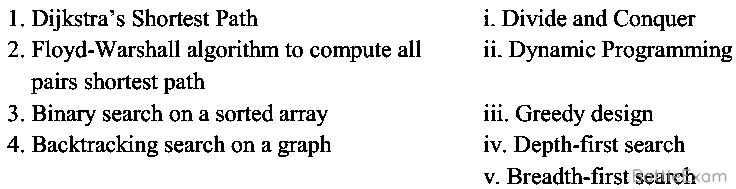
- **Dynamic Programming**: Use when subproblems overlap (e.g., Fibonacci, Matrix Chain Multiplication).
- **Greedy**: Use for local optimal choices that lead to a global optimum (e.g., Huffman Coding, Prim’s).
- **Brute Force**: Use when $n$ is extremely small; it explores all possibilities ($O(2^n)$ or $O(n!)$).
### 8. Classic D&C Algorithms: GATE Essential Deep Dive
- **Merge Sort**: Stable (preserves relative order). Requires $O(n)$ auxiliary space.
- *GATE Twist*: Merge Sort can be optimized to $O(n)$ best-case if it detects the array is already sorted before entering the merge phase.
- **Quick Sort**: Unstable. Pivot selection is everything.
- *Proportional Split Trap*: If the pivot is always the $n/4$-th smallest element, the recurrence is $T(n) = T(n/4) + T(3n/4) + cn$. Even though unbalanced, this still results in $\Theta(n \log n)$.
- **Strassen’s Matrix Multiplication**: Reduces multiplications from 8 to 7, yielding $O(n^{\log_2 7}) \approx O(n^{2.81})$.
- **Median of Two Sorted Arrays**: Can be solved in $O(\log (\min(m, n)))$ using a D&C approach on the partition index.
- **Maximum Subarray Sum**: D&C approach is $O(n \log n)$.
- *Professor's Warning*: In the exam, if asked for the most efficient way, choose Kadane’s Algorithm ($O(n)$). D&C is only used here to test your understanding of "crossing-midpoint" logic.
### 9. Binary Search: Deep Dive and Variants
Binary Search is the most versatile D&C algorithm, often applied to non-array problems ("Binary Search on Answers").
- **The Sorted and Rotated Array**: A favorite GATE pattern. Even if you don't know the rotation factor $k$, you can find an element in $O(\log n)$ as long as the elements are unique. In each step, at least one half of the array must be sorted; use this to decide your direction.
- **Lower/Upper Bounds**: Essential for finding the first/last occurrence of a duplicate element.
### 10. Comparison: Merge Sort vs. Quick Sort
| Feature | Merge Sort | Quick Sort | Reasoning |
| :--- | :--- | :--- | :--- |
| **Stability** | Stable | Unstable | Merge Sort maintains order of equal elements. |
| **Best Data Structure** | Linked Lists | Arrays | Linked lists lack random access; Merge Sort only needs to change pointers ($O(1)$ extra space if pointers are reused). Quick Sort relies on random access (indexing) for partitioning, making it ideal for arrays. |
| **Space** | $O(n)$ | $O(\log n)$ (stack) | Quick Sort uses in-place partitioning with recursion. |
### 11. Common GATE PYQ Patterns and Analysis
- **The Min-Max Tournament**: Standard linear scan takes $2n - 2$ comparisons. D&C takes exactly $1.5n - 2$ comparisons (assuming $n$ is a power of 2). This is achieved by comparing elements in pairs first, then finding max among winners and min among losers.
- **The BST Trap (Made Easy Q.9)**: "Time complexity of picking an element smaller than the maximum in a BST." Students often jump to $O(\log n)$. The Answer is $\Theta(1)$. Simply pick the root; if it's the max, pick its left child. If it's not the max, it is already "smaller than the maximum."
- **Almost Sorted Arrays**: If an array has at most $n$ inversions, Insertion Sort is actually $\Theta(n)$, making it superior to Merge or Quick Sort in this specific edge case.
### 12. Fast Revision Notes and Cheat Sheet
- **Master Theorem Quick-Scan**:
- $a = \text{subproblems}$, $b = \text{reduction factor}$.
- $n^{\log_b a} > f(n) \implies \Theta(n^{\log_b a})$
- $n^{\log_b a} = f(n) \implies \Theta(n^{\log_b a} \log n)$
- $n^{\log_b a} < f(n) \implies \Theta(f(n))$ (Check regularity!)
- **Essential Formula Log**:
- Min-Max comparisons: $1.5n - 2$.
- Matrix Mult (Strassen): 7 multiplications, 18 additions.
- Exponentiation ($x^n$): $\Theta(\log n)$ via squaring.
- Knock-out Tournament: $n-1$ matches to find 1 winner.
- **Most Repeated GATE Topics**:
- **Recurrence Solvability**: Identifying when Master Theorem does not apply (e.g., $T(n) = T(n-1) + \log n$).
- **Quick Sort Worst Case**: Triggered by sorted/reverse-sorted arrays when the pivot is the first/last element.
- **Stability/Space Trade-offs**: Knowing that Merge Sort is stable but space-expensive.
- **Strategic Mindset**: On exam day, if a recurrence looks unfamiliar, draw the Recursion Tree. Most D&C marks are lost by failing to verify the base case or forgetting the stack space overhead. Stay precise.