Structural Fasteners – GATE CE Steel StructuresPractice Questions & PYQs
Generate GATE-level questions on Structural Fasteners in Steel Structures. Focus on core concepts, previous year patterns, and numerical problem-solving techniques.
31 questions · 20 PYQs · 0 AI practice · GATE CE 2027
🎯 These are sample questions
Get the full Structural Fasteners experience — 100% free
✓ Attempt tracking & analytics
✓ Timer & exam-mode simulation
✓ Adaptive difficulty (Easy → Hard)
✓ Bookmarks, notes & mistake review
Just sign in to unlock everything. Free for all students.
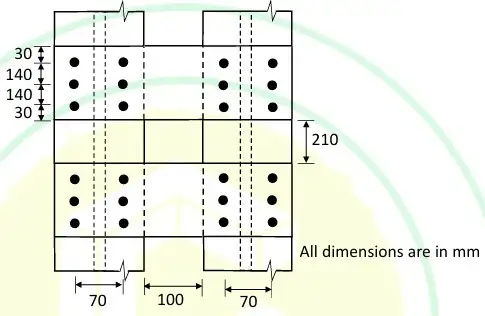
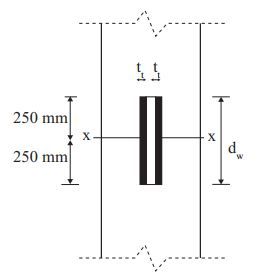
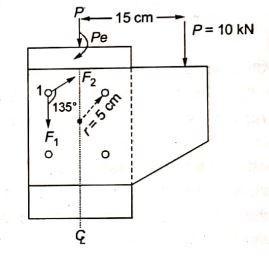
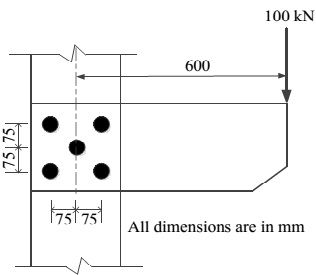
Consider the built-up column made of two I-sections as shown in the figure, with each batten plate bolted to a component I-section of the column through 6 black bolts. Each connection of the batten plate with the component section is to be designed for a longitudinal shear of 70 kN and moment of 10kN.m . The minimum bolt value required (in kN ) is _________ (rounded off to the nearest integer).
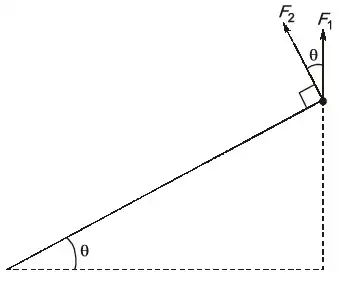
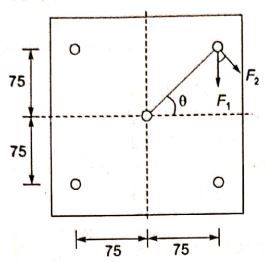
Minimum bolt value required = ? Concept: The bolt value < Maximum resultant shear force on bolt. (1) Direct shear force on bolt, F1=nVL=670=11.67kN (2) Maximum torsional shear on bolt, F2=∑ri2(T.M.)rmax=4×144.312+2×35210×103×144.31=16.82kN (3) Minimum angle of inclination between F1 and F2 will be θ=tan−1(35140)=75.96∘ (4) Maximum resultant shear force on bolt,
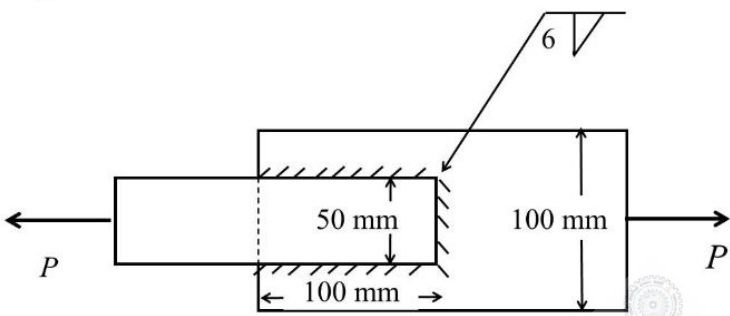
A circular tube of thickness 10 mm and diameter 250 mm is welded to a flat plate using 5 mm fillet weld along the circumference. Assume Fe410 steel and shop welding. As per IS 800:2007, the torque that can be resisted by the weld (in kN.m) is ______ (round off to one decimal place).
Weld type: Circular fillet weld Effective throat thickness for fillet weld: t=0.7×5=3.5,mm Length of weld (perimeter of tube): L=π×250=785.4,mm Section modulus for circular weld (as per IS 800:2007): Zp=4π×D2×tZp=43.1416×2502×3.5=171,887.3,mm3 Design shear strength of weld: fw=3×γmwfu For Fe410 steel, fu=410,MPa , shop weld ⇒γmw=1.25fw=3×1.25410=189.46,MPa Torque resisted by weld: T=fw×Zp=189.46×171,887.3=32,545,925.8,N.mm Convert to kN.m: T=10632,545,925.8=32.5,kN.m (Incorrect) Check formula for polar section modulus of circular weld (IS 800:2007): Zp=42πD2t=2πD2tZp=23.1416×2502×3.5=343,774.6,mm3T=189.46×343,774.6=65,091,851.6,N.mm=65.1,kN.m
Q3GATE 2022MCQ
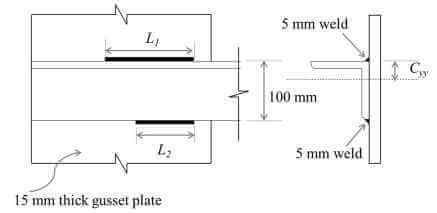
A weld is used for joining an angle section ISA 100 mm x 100 mm x 10 mm to a gusset plate of thickness 15 mm to transmit a tensile load. The permissible stress in the angle is 150 MPa and the permissible shear stress on the section through the throat of the fillet weld is 108 MPa. The location of the centroid of the angle is represented by Cyy in the figure, where Cyy=28.4mm . The area of cross-section of the angle is 1903 mm2 . Assuming the effective throat thickness of the weld to be 0.7 times the given weld size, the lengths L1 and L2 (rounded- off to the nearest integer) of the weld required to transmit a load equal to the full strength of the tension member are, respectively
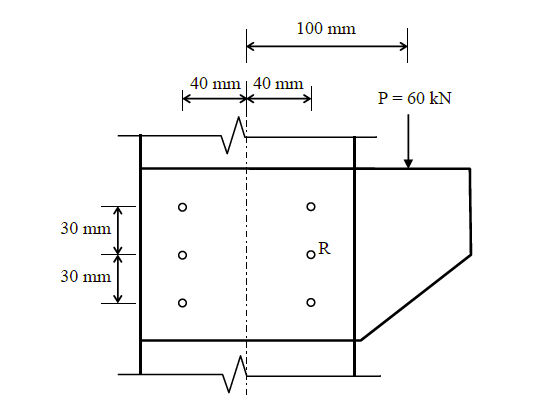
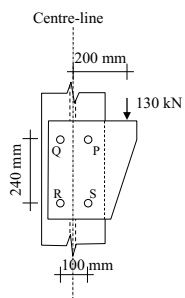
A column is subjected to a total load (P) of 60 kN supported through a bracket connection, as shown in the figure (not to scale). The resultant force in bolt R (in kN,round off to one decimal place) is ________
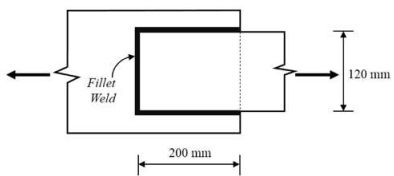
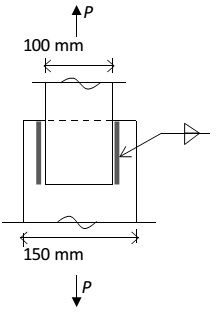
Two steel plates are lap jointed in a workshop using 6 mm thick fillet weld as shown in the figure (not drawn to the scale). The ultimate strength of the weld is 410 MPa. As per Limit State Design is IS 800 : 2007, the design capacity (in kN, round off to three decimal places) of the welded connection, is _______.
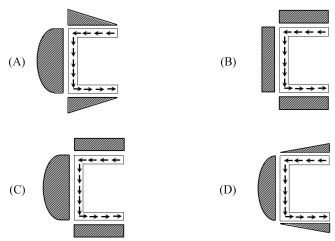
For a channel section subjected to a downward vertical shear force at its centroid, which one of the following represents the correct distribution of shear stress in flange and web?
Shear flow in horizontal member (flange) is linear with zero at free end and in vertical member (web) it is parabolic.
Q7GATE 2019NAT
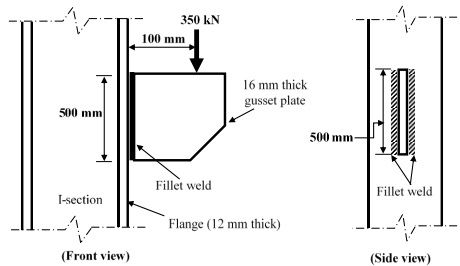
A 16 mm thick gusset plate is connected to the 12 mm thick flange plate of an I-section using fillet welds on both sides as shown in the figure. The gusset plate is subjected to a point load of 350 kN acting at a distance of 100 mm from the flange plate. Size of fillet weld is 10 mm. The maximum resultant stress (in MPa, round off to 1 decimalplace) on the fillet weld along the vertical plane would be ____
Direct concentrated load (P) = 350 kN Eccentricity (e) = 100 mm Depth of weld ( dw ) at each face = 500 mm Size of weld (S) = 10 mm Throat thickness of weld ( tt ) = 0.7S = 7 mm It is a case of combined shear (P) and Bending moment (M = P.e) Shear stress acting on weld due to direct shear force P,
(q)=AwP=2dwttP=2×500×7350×103=50MPa
Bending normal stress acting at ith point from Neutral axis [fi]=IMyi Maximum bending stress at extreme point in weld
As per IS800:2007. Maximum resultant stress an equivalent stress in fllet weld due to combined shear and bending stress
(feq)=f2+3q2=602+3×502=105.3MPa
Q8GATE 2018NAT
In a fillet weld, the direct shear stress and bending tensile stress are 50 MPa and 150 MPa, respectively. As per IS 800: 2007, the equivalent stress (in MPa, up to two decimal places) will be ______
(Hence OK) Note: The above check for combination of stressed need not be done for fillet welds where the sum of normal and shear stresses does not exceed fwd [Clause 10.5.10.1.2(b)]. Thus, fa+q=150+50=200 MPa fa+q>fwd (= 184.75 MPa) ⇒fe=173.21 MPa Thus, the weld is designed for an equivelent stress of 173.21 MPa
Q9GATE 2018MCQ
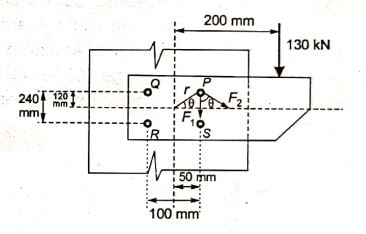
Four bolts P, Q, R and S of equal diameter are used for a bracket subjected to a load of 130 kN as shown in the figure. The force in bolt P is
A fillet weld is simultaneously subjected to factored normal and shear stresses of 120 MPa and 50 MPa, respectively. As per IS 800 : 2007, the equivalent stress (in MPa, up to two decimal places) is ______
Note: The above check for combination of stresses need not be done for fillet welds where the sum of normal and shear stresses does not exceed fwd [clause 10.5.10.1.2(b)]. Hence, sum of normal and shear stresses =120+50=170MPa≤fwd(=184.75MPa) So, the above check need not be done. So, weld is designed for a resultant shear stress of (fr)
fr=fa2+q2=1202=502=130N/mm2
So, the design stress is 130N/mm2 ; however equivalent stress 147.99 MPa.
Q11GATE 2017NAT
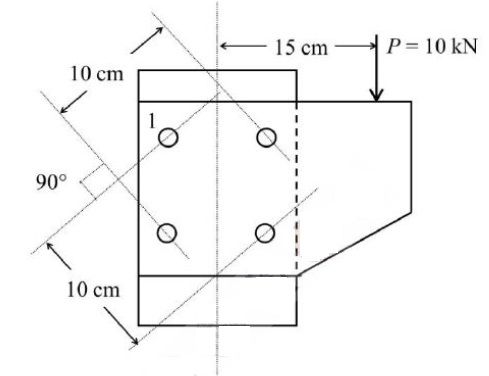
A column is subjected to a load through a bracket as shown in the figure. The resultant force (in kN, up to one decimal place) in the bolt 1 is_____
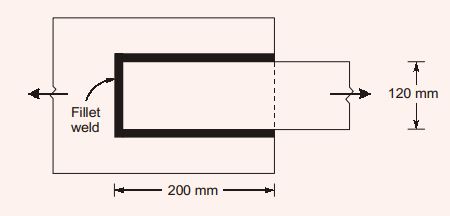
Two plates of 8 mm thickness each are connected by a fillet weld of 6 mm thickness as shown in the figure. The permissible stresses in the plate and the weld are 150 MPa and 110 MPa, respectively. Assuming the length of the weld shown in the figure to be the effective length, the permissible load P (in KN) is
Two plates are connected by fillet welds of size 10 mm and subjected to tension, as shown in the figure. The thickness of each plate is 12 mm. The yield stress and the ultimate tensile stress of steel are 250 MPa and 410 MPa, respectively. The welding is done in the workshop (γmw=1.25) . As per the Limit State Method of IS800:2007, the minimum length (rounded off to the nearest higher multiple of 5 mm) of each weld to transmit a force P equal to 270 kN (factored) is
Maximum force carried by plates, P=γm0Agfy=1.1(100×12)×250=272.73kN Load carried by each weld =2P=136.36kN For minimum length of weld, Strength of weld = Load carried by weld lWtt3γmWfu=136.36×10³ or, lW×(10×0.7)×3×1.2410=136.36×10³⇒lW=102.9mm=105mm (rounded off to nearest higher multiple of 5 mm)
Q14GATE 2016MCQ
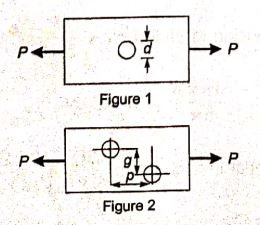
Two bolted plates under tension with alternative arrangement of bolt holes are shown in figures 1 and 2. The hole diameter, pitch, and gauge length are d, p and g, respectively. Which one of the following conditions must be ensured to have higher net tensile capacity of configuration shown in Figure 2 than that shown in Figure 1 ?
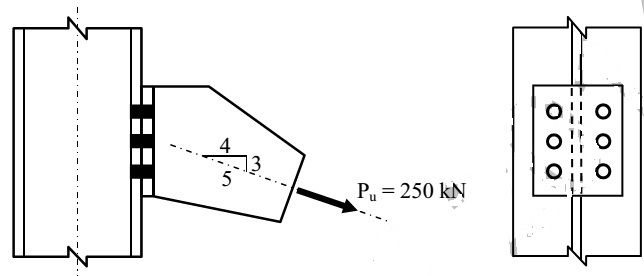
A bracket plate connected to a column flange transmits a load of 100 kN as shown in the following figure. The maximum force for which the bolts should be designed is ___________ kN.
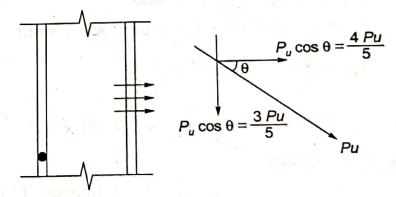
tanθ=43,cosθ=54,sinθ=53 Tension in each bolt =5×64Pu=5×64×250=33.33kN Shear in each bolt =5×63Pu=5×63×250=25kN
Q18GATE 2014MCQ
A steel section is subjected to a combination of shear and bending actions. The applied shear force is V and the shear capacity of the section is Vs . For such a section, high shear force (as per IS:800-2007) is defined as
Effective throat thickness is the shortest distance from the root of fillet weld to the face of the line joining the toes. The effective throat thickness should not be less than 3 mm. Effective throat thickness =Ks where s is the size of weld in mm and K is a constant. The value of K depends upon the angle between the fusion faces.