Q21GATE 2015MCQ
Total Kjeldahal Nitrogen (TKN) concentration (mg/L as N) in domestic sewage is the sum of the concentration of :
GATE CE · Environmental Engineering
Generate GATE-level questions on Treatment Of Waste Water in Environmental Engineering. Focus on core concepts, previous year patterns, and numerical problem-solving techniques.
43 questions · 20 PYQs · 0 AI practice · GATE CE 2027
Total Kjeldahal Nitrogen (TKN) concentration (mg/L as N) in domestic sewage is the sum of the concentration of :
In a wastewater treatment plant, primary sedimentation tank (PST) designed at an overflow rate of 32.5 is 32.5 m long, 8.0 m wide and liquid depth of 2.25 m. If the length of the weir is 75 m, the weir loading rate (in ) is ___________.
The amount of generated (in kg) while completely oxidizing one kg of to the end productsis ____________
The dominating microorganisms in an activated sludge process reactor are
A waste water stream (flow=2 /s, ultimate BOD=90 mg/l) is joining a small river (flow=12 /s, ultimate BOD=5 mg/l). Both water streams get mixed up instantaneously. Cross sectional area of the river is 50 . Assuming the de-oxygenation rate constant, k'=0.25/day the BOD (in mg/l) of the river water, 10 km downstream of the mixing point is
A sample of domestic sewage is digested with silver sulphate, sulphuric acid, potassium dichromate and mercuric sulphate in chemical oxygen demand (COD) test. The digested sample is then titrated with standard ferrous ammonium sulphate (FAS) to determine the un-reacted amount of
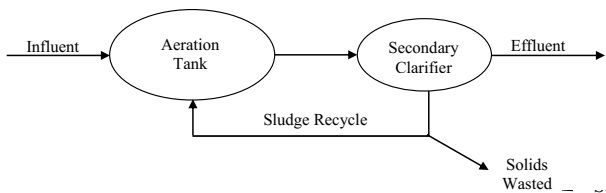
An activated sludge system (sketched below) is operating at equilibrium with the following information. Wastewater related data:flow rate = 500 /hour, influent BOD = 150 mg/L, effluent BOD = 10 mg/L. Aeration tank related data: hydraulic retention time = 8 hours, mean-cell-residence time = 240 hours, volume = 4000 , mixed liquor suspended solids = 2000 mg/L. The mass (in kg/day) of solids wasted from the system is
The sludge from the aeration tank of the activated sludge process (ASP) has solids content (by weight) of 2%. This sludge is put in a sludge thickener, where sludge volume is reduced to half. Assume that the amount of solids in the supernatant from the thickener is negligible, the specific gravity of sludge solids is 2.2 and the density of water is 1000 . What is the solids content (by weight) of the thickened sludge?
An aerobic reactor receives wastewater at a flow rate of 500 having a COD of 2000 mg/L. The effluent COD is 400 mg/L. Assuming that wastewater contains 80% biodegradable waste, the daily volume of methane produced by the reactor is
The correct match of Column-I with Column-II is

Two biodegradable components of municipal solid waste are
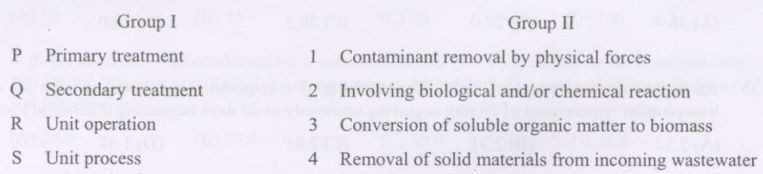
Match Group-I (Terminology) with Group-II (Definition/ Brief Description) for wastewater treatment system
A completely mixed activated sludge process is used to treat a wastewater flow of 1 million litres per day (1 MLD) having a of 200 mg/L. The biomass concentration in the aeration tank is 2000 mg/L and the concentration of the net biomass leaving the system is 50 mg/L. The aeration tank has a volume of 200 . What is the average time for which the biomass stays in the system ?
In aerobic environment, nitrosomonas convert
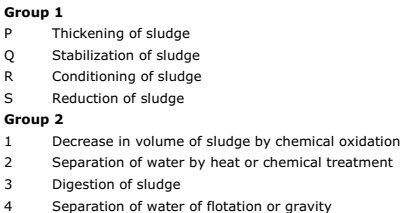
Match the following
Bulking sludge refers to having
An analysis for determination of solids in the return sludge of Activated Sludge Process was done as follows: 1.) A crucible was dried to a constant mass of 62.485 g. 2.) 75 mL of a well-mixed sample was taken in the crucible. 3.) The crucible with the sample was dried to a constant mass of 65.020 g in a drying oven at . 4.) The crucible with the dried sample was placed in a muffle furnace at , for an hour. After cooling, the mass of the crucible with residues was 63.145 g. The concentration of organic fraction of solids present in the return sludge sample is
The following data are given for a channel-type grit chamber of length 7.5 m. 1. flow-through velocity = 0.3 m/s 2. the depth of waste water at peak flow in the channel = 0.9 m 3. specific gravity of inorganic particles = 2.5 4. g = 9.80 m/ , m= at 20 C, Assuming that the Stoke's law is valid, the largest diameter particles that would be removed with 100 percent efficiency is
From amongst the following sewage treatment options, largest land requirements for a given discharge will be needed for
Settling test on a sample drawn from Aeration Tank liquor of ASP ( MLSS = 2800 mg/L) was carried out with 1 litre sample. The test yielded a settled volume of 200 mL. The value of Sludge Volume Index shall be
Want unlimited AI-generated Treatment Of Waste Water questions?
Sign up free and practice with adaptive difficulty — Easy, Medium, Hard. New questions every session.
Start practising for free →