Q21NEET UG 2023MCQ
The amount of energy required to form a soap bubble of radius from a soap solution is nearly (surface tension of soap solution )
NEET UG · Physics
Generate NEET level questions on Properties of Matter. Focus on NCERT concepts.
94 questions · 20 PYQs · 0 AI practice · NEET UG 2027
The amount of energy required to form a soap bubble of radius from a soap solution is nearly (surface tension of soap solution )
The amount of elastic potential energy per unit volume (in SI unit) of a steel wire of length to stretch it by is (if Young's modulus of the wire ) : [NEET 2023 mpr]
The venturi-meter works on
Which of the following statement is not true? [NEET 2023 mpr]
The viscous drag acting on a metal sphere of diameter , falling through a fluid of viscosity s with a velocity of is equal to : [NEET 2023 mpr]
A The terminal velocity of a copper ball of radius falling through a tank of oil at room temperature is . If the viscosity of oil at room temperature is , the viscous drag force is:
If a soap bubble expands, the pressure inside the bubble
Two copper vessels and have the same. base area but of different shapes. A take twice the volume of water as that requires to fill upto a particular common height. Then the correct statement among the following is: ,
Two rods one made of copper and other made of steel of the same length and same cross sectional area are joined together. The thermal conductivity of copper and steel are and respectively. The free ends of copper and steel are held at and respectively. The temperature at the junction is, nearly:
Given below are two statements : One is labelled as Assertion (A) and the other is labelled as Reason (R). Assertion (A): The stretching of a spring is determined by the shear modulus of the material of the spring. Reason (R): A coil spring of copper has more tensile strength than a steel spring of same dimensions. In the light of the above statements, choose the most appropriate answer from the options given below
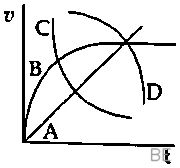
A spherical ball is dropped in a long column of a highly viscous liquid. The curve in the graph shown, which represents the speed of the ball as a function of time is
The velocity of a small ball of mass and density , when dropped in a container filled with glycerine becomes constant after some time. If the density of glycerine is , then the viscous force acting on the ball will be
A wire of length L, area of cross section A is hanging from a fixed support. The length of the wire changes to when mass M is suspended from its free end. The expression for Young's modulus is :
A capillary tube of radius r is immersed in water and water rises in it to a height h. The mass of the water in the capillary is 5 g. Another capillary tube of radius 2r is immersed in water. The mass of water that will rise in this tube is :
When a block of mass M is suspended by a long wire of length L, the length of the wire becomes (L + l). The elastic potential energy stored in the extended wire is :
A copper rod of 88 cm and an aluminium rod of unknown length have their increase in length independent of increase in temperature. The length of aluminium rod is : ( and )
Two small spherical metal balls, having equal masses, are made from materials of densities and and have radii of and , respectively. They are made to fall vertically (from rest) in a viscous medium whose coefficient of viscosity equals and whose density is . The ratio of their terminal velocities would be :-
A small hole of area of cross-section 2 mm2 is present near the bottom of a fully filled open tank of height 2 m. Taking g = 10 m/s2, the rate of flow of water through the open hole would be nearly
A soap bubble, having radius of 1 mm, is blown from a detergent solution having a surface tension of 2.5 × 10 N/m. The pressure inside the bubble equals at a point Z below the free surface of water in a container. Taking g = 10 m/s, densityof water = 10 kg/m, the value of Z is :
The stress-strain curves are drawn for two different materials and . It is observed that the ultimate strength point and the fracture point are close to each other for material but are far apart for material . We can say that materials and are likely to be (respectively)
Want unlimited AI-generated Properties Of Matter questions?
Sign up free and practice with adaptive difficulty — Easy, Medium, Hard. New questions every session.
Start practising for free →