Q1NEET UG 2026MCQ
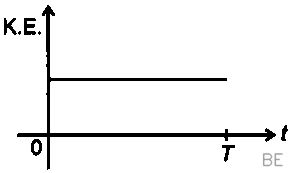
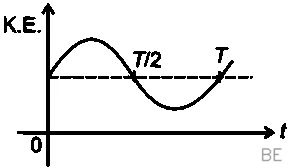
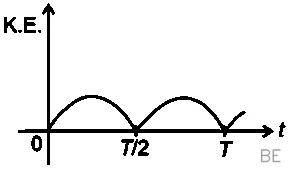
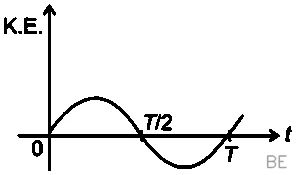
For a simple pendulum, having time period , the variation of kinetic energy (K.E.) with time is represented by:
NEET UG · Physics
Generate NEET level questions on Oscillations. Focus on NCERT concepts.
78 questions · 20 PYQs · 0 AI practice · NEET UG 2027
🎯 These are sample questions
Just sign in to unlock everything. Free for all students.
For a simple pendulum, having time period , the variation of kinetic energy (K.E.) with time is represented by:
A simple harmonic oscillator has an amplitude and time period . The time required by it to travel from to is (1992)
A linear harmonic oscillator of force constant and amplitude has a total mechanical energy of 160 J. Its (1996)
Consider a spring-mass simple harmonic oscillator in one dimension. The mass of the particle is and the spring constant is . At a given instant, the extension of the spring is -meter and the speed of the particle is . On the plane, if the graph of as a function of is a circle, then the correct option is:[NEET 2026 Re-exam]
The sum of kinetic energy and potential energy of a simple pendulum bob is 0.02 joule. The speed of the simple pendulum bob at equilibrium position is approximately:(Consider mass of the bob )
A loaded vertical spring executes S.H.M. with a time period of 4 sec. The difference between the kinetic energy and potential energy of this system varies with a period of (1994)
Savitha, a XI standard student, while conducting an experiment to determine the effective length of a simple pendulum , notes down the data of time taken to complete 30 oscillations as 60 s and hence calculates the length of the simple pendulum as: (Take , and )
The composition of two simple harmonic motions of equal periods at right angle to each other and with a phase difference of results in the displacement of the particle along (1990)
A particle executes S.H.M. along -axis. The force acting on it is given by (1994, 1988)
A particle, with restoring force proportional to displacement and resisting force proportional to velocity is subjected to a force . If the amplitude of the particle is maximum for and the energy of the particle is maximum for then (1998, 1989)
The angular velocity and the amplitude of a simple pendulum is and respectively. At a displacement from the mean position if its kinetic energy is and potential energy is , then the ratio of to is (1991)
In a simple harmonic motion, when the displacement is one-half the amplitude, what fraction of the total energy is kinetic? (1995)
A cylindrical cork of uniform density floats in a liquid of density . If the cork is depressed slightly and released, it oscillates harmonically with time period . If the same cork floats in another liquid of density , then the similar oscillation has time period . The value of is:[NEET 2026 Re-exam]
A body executes simple harmonic motion with an amplitude . At what displacement from the mean position is the potential energy of the body is one fourth of its total energy? (1993)
Two identical point masses and , suspended from two separate massless springs of spring constants and , respectively, oscillate vertically. If their maximum speeds are the same, the ratio (\frac{A_Q}{A_P}A_QQA_PP$ is
In an oscillating spring mass system, a spring is connected to a box filled with sand. As the box oscillates, sand leaks slowly out of the box vertically so that the average frequency and average amplitude of the system change with time . Which one of the following options schematically depicts these changes correctly?
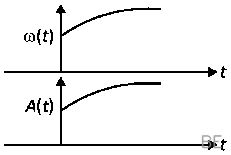
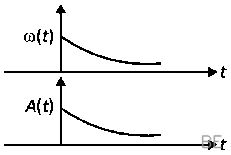
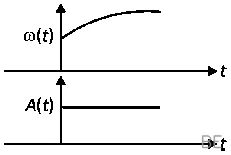
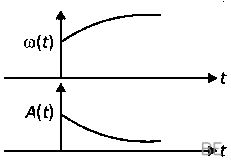
If the mass of the bob in a simple pendulum is increased to thrice its original mass and its length is made half its original length, then the new time period of oscillation is times its original time period. Then the value of is:
The two-dimensional motion of a particle, described by is a/an:A. parabolic pathB. elliptical pathC. periodic motionD. simple harmonic motionChoose the correct answer from the options given below:[NEET 2024 Re]
A particle executing simple harmonic motion with amplitude has the same potential and kinetic energies at the displacement[NEET 2024 Re]
If represents the motion of a particle executing simple harmonic motion, the amplitude and time period of motion, respectively, are
Want unlimited AI-generated Oscillations questions?
Sign up free and practice with adaptive difficulty — Easy, Medium, Hard. New questions every session.
Start practising for free →