📖 Explanation
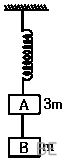
When the string is cut, we must account for the immediate response of the spring force versus the instantaneous disappearance of tension. In the moments before the cut, the lower block of mass m is held in equilibrium by the tension in the string, establishing T=mg. Simultaneously, the upper block of mass 3m supports both the lower block and itself against the spring, requiring the spring to exert an upward force equal to 3mg+T, or 4mg.
Once the string snaps, the tension vanishes instantly, but the spring force remains constant at 4mg because springs cannot change their force state instantaneously. For the lower block, the only remaining force is its weight, resulting in a downward acceleration of
aB=mmg=g
For the upper block, the upward spring force of 4mg acts against its weight of 3mg, creating a net upward force of mg. Dividing this net force by the mass of the block gives an acceleration of
aA=3mmg=3g