Q61NEET UG 2023MCQ
A copper wire of radius contains free electrons per cubic metre. The drift velocity for free electrons when current flows through the wire will be (Given, charge on electron ) : [NEET 2023 mpr]
NEET UG · Physics
Generate NEET level questions on Current Electricity. Focus on NCERT concepts.
154 questions · 20 PYQs · 0 AI practice · NEET UG 2027
A copper wire of radius contains free electrons per cubic metre. The drift velocity for free electrons when current flows through the wire will be (Given, charge on electron ) : [NEET 2023 mpr]
The equivalent capacitance of the arrangement shown in figure is : [NEET 2023 mpr]

The equivalent resistance of the infinite network given below is:

As the temperature increases, the electrical resistance
Two resistors of resistance, and are connected in parallel in an electrical circuit. The ratio of the thermal energy developed in \Omega to that in \Omega in a given time is
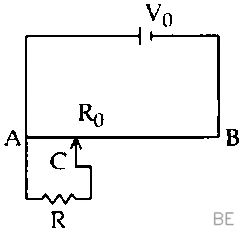
The sliding contact C is at one fourth of thelength of the potentiometer wire (AB) from A asshown in the circuit diagram. If the resistance of the wire is , then the potential drop across the resistor is
A wheatstone bridge is used to determine the value of unknown resistance by adjusting the variable resistance as shown in the figure. For the most precise measurement of , the resistances and

A cell of emf and internal resistance is connected to a external resistance. The terminal potential difference of the cell is .
The reciprocal of resistance is:
A copper wire of length and radius has electrical resistance of . The current density in the wire for an electric field strength of is
In a potentiometer circuit a cell of EMF 1.5 V gives balance point at 36 cm length of wire. If another cell of EMF 2.5 V replaces the first cell, then at what length of the wire, the balance point occurs?
The effective resistance of a parallel connection that consists of four wires of equal length, equal area of cross-section and same material is 0.25 Ω . What will be the effective resistance if they are connected in series?
Column-I gives certain physical terms associated with flow of current through a metallic conductor. Column-II gives some mathematical relations involving electrical quantities. Match Column-I and Column-II with appropriate relations. Column-I Column-II (A) Drift Velocity (P) (B) Electrical Resistivity (Q) (C) Relaxation Period (R) (D) Current Density (S)

Three resistors having resistances and are connected as shown in the given circuit. The ratio of currents in terms of resistances used in the circuit is

A resistance wire connected in the left gap of a meter bridge balances a resistance in the right gap at a point which divides the bridge wire in the ratio 3 : 2. If the length of the resistance wire is 1.5 m, then the length of of the resistance wire is :
The color code of a resistance is given below The values of resistance and tolerance, respectively, are

The solids which have the negative temperature coefficient of resistance are:
A charged particle having drift velocity of in an electric field of , has a mobility in of :
Which of the following graph represents the variation of resistivity (ρ) with temperature (T) for copper?


The metre bridge shown is in balanced position with . If we now interchange the positions of galvanometer and cell, will the bridge work ? If yes, what will be balance condition ?

Want unlimited AI-generated Current Electricity questions?
Sign up free and practice with adaptive difficulty — Easy, Medium, Hard. New questions every session.
Start practising for free →