Q61NEET UG 2024MCQ
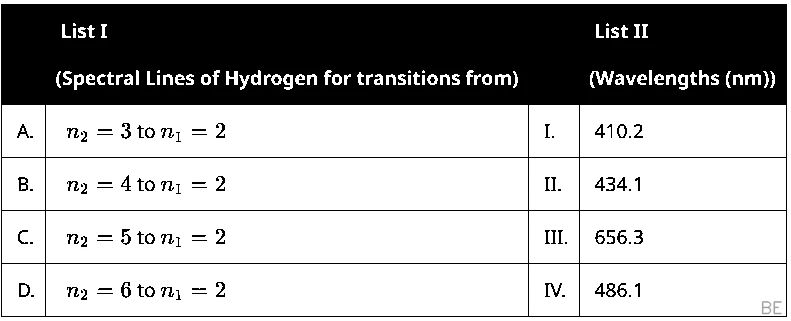
Match List I with List II. List I (Spectral Lines of Hydrogen for transitions from) List II (Wavelengths (nm)) A. to I. 410.2 B. to II. 434.1 C. to III. 656.3 D. to IV. 486.1 Choose the correct answer from the options given below:
NEET UG · Physics
Generate NEET level questions on Atoms and Nuclei. Focus on NCERT concepts.
185 questions · 20 PYQs · 0 AI practice · NEET UG 2027
Match List I with List II. List I (Spectral Lines of Hydrogen for transitions from) List II (Wavelengths (nm)) A. to I. 410.2 B. to II. 434.1 C. to III. 656.3 D. to IV. 486.1 Choose the correct answer from the options given below:
Water is used as a coolant in a nuclear reactor because of its[NEET 2024 Re]
Select the correct statements among the following :A. Slow neutrons can cause fission in than fast neutrons.B. -rays are Helium nuclei.C. -rays are fast moving electrons or positrons.D. -rays are electromagnetic radiations of wavelengths larger than -rays.Choose the most appropriate answer from the options given below :[NEET 2024 Re]
In the nuclear emission stated above, the mass number and atomic number of the product respectively, are
The spectral series which corresponds to the electronic transition from the levels to the level is[NEET 2024 Re]
The half life of a radioactive substance is 20 minutes. In how much time, the activity of substance drops to of its initial value?
The ground state energy of hydrogen atom is . The energy needed to ionize hydrogen atom from its second excited state will be : [NEET 2023 mpr]
The radius of inner most orbit of hydrogen atom is . What is the radius of third allowed orbit of hydrogen atom?
The angular momentum of an electron moving in an orbit of hydrogen atom is . The energy in the same orbit is nearly. [NEET 2023 mpr]
In hydrogen spectrum, the shortest wavelength in the Balmer series is . The shortest wavelength in the Bracket series is
The wavelength of Lyman series of hydrogen atom appears in: [NEET 2023 mpr]
Given below are two statements: Statement I: The law of radioactive decay states that the number of nuclei undergoing the decay per unit time is inversely proportional to the total number of nuclei in the sample. Statement II : The half life of a radionuclide is the sum of the life time of all nuclei, divided by the initial concentration of the nuclei at time t = 0. In the light of the above statements, choose the most appropriate answer from the options given below:
Let and be the energy of an electron in the first and second excited states of hydrogen atoms, respectively. According to the Bohr's model of an atom, the ratio is
Let be the radius of the second stationary and be the radius of the fourth stationary orbit of an electron in Bohr's model. The ratio is :
A nucleus of mass number 189 splits into two nuclei having mass number 125 and 64 . The ratio of radius of two daughter nuclei respectively is
At any instant, two elements and have same number of radioactive atoms. If the decay constant of and are and respectively, then thetime when the ratio of their atoms becomes respectively will be:
In the given nuclear reaction, the element is
A radioactive nucleus undergoes spontaneous decay in the sequence, where is the atomic number of element . The possible decay particles in the sequence are
A nucleus with mass number 240 breaks into two fragments each of mass number 120, the binding energy per nucleon of unfragmented nuclei is 7.6 MeV while that of fragments is 8.5 MeV. The total gain in the Binding Energy in the process is
The half-life of a radioactive nuclide is 100 hours. The fraction of original activity that will remain after 150 hours would be
Want unlimited AI-generated Atoms And Nuclei questions?
Sign up free and practice with adaptive difficulty — Easy, Medium, Hard. New questions every session.
Start practising for free →