Q21NEET UG 2026MCQ
An electron makes a transition from orbit to the orbit of a hydrogen atom. What is the wavelength of the emitted radiations? Rydberg's constant (1995)
NEET UG · Physics
Generate NEET level questions on Atoms and Nuclei. Focus on NCERT concepts.
185 questions · 20 PYQs · 0 AI practice · NEET UG 2027
An electron makes a transition from orbit to the orbit of a hydrogen atom. What is the wavelength of the emitted radiations? Rydberg's constant (1995)
The figure indicates the energy level diagram of an atom and the origin of six spectral lines in emission ( , line no. 5 arises from the transition from level to ).Which of the following spectral lines will occur in the absorption spectrum? (1995)

Which source is associated with a line emission spectrum? (1993)
A radioactive sample with a half life of 1 month has the label : 'Activity micro curies on What would be itsactivity two months earlier? (1988)
In the nucleus of , the number of protons, neutrons and electrons are (1991)
Curie is a unit of (1989)
Which of the following is used as a moderator in nuclear reaction? (1997)
The binding energy per nucleon is maximum in case of (1993)
The ratio of the radii of the nuclei and approximately (1990)
The half life of radium is 1600 years. The fraction of a sample of radium that would remain after 6400 years (1991)
An element decays into element by a two step process Then (1989)
The binding energies per nucleon for a deuteron and an -particle are and respectively. The energy released in thereaction is (1995)
Solar energy is due to (1992)
The energy of the ground electronic state of hydrogen atom is - . The energy of the first excited state will be (1997)
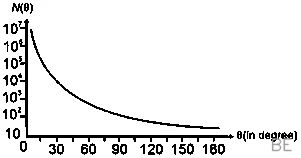
In Geiger-Marsden experiment, the number of scattered -particles is plotted as a function of scattering angle . Which of the following options represents the correct plot?[NEET 2026 Re-exam]


To explain his theory, Bohr used (1989)
What is the respective number of and particles emitted in the following radioactive decay? (1995)
The ionization energy of hydrogen atom is . Following Bohr's theory, the energy corresponding to a transition between and orbit is (1992)
The nucleus absorbs an energetic neutron and emits a beta particle The resulting nucleus is (1990)
The atomic number of silicon is 14. Its ground state electron configuration is (1989)
Want unlimited AI-generated Atoms And Nuclei questions?
Sign up free and practice with adaptive difficulty — Easy, Medium, Hard. New questions every session.
Start practising for free →