Given below are two statements: one is labelled as Assertion (A) and the other is labelled as Reason (R) Consider a ferromagnetic material : Assertion (A) : The individual atoms in a ferromagnetic material possess a magnetic dipole moment and interact with one another in such a way that they spontaneously align themselves forming domains. Reason (R): At high enough temperature, the domain structure of ferromagnetic material disintegrates. Thus, magnetization will disappear at high enough temperature known as Curie temperature. In the light of the above statements, choose the correct answer from the options given below :
We need to evaluate the Assertion and Reason about ferromagnetic materials. Assertion (A): "The individual atoms in a ferromagnetic material possess a magnetic dipole moment and interact with one another in such a way that they spontaneously align themselves forming domains." Analysis: In ferromagnetic materials (like iron, cobalt, nickel), each atom has a permanent magnetic dipole moment due to unpaired electrons. These atomic magnetic moments interact through a quantum mechanical exchange interaction, which causes neighboring moments to align parallel to each other spontaneously, forming regions called magnetic domains. Assertion (A) is TRUE. Reason (R): "At high enough temperature, the domain structure of ferromagnetic material disintegrates. Thus, magnetization will disappear at high enough temperature known as Curie temperature." Analysis: Above the Curie temperature, thermal energy overcomes the exchange interaction energy, destroying the long-range ordering of magnetic moments. The material transitions from ferromagnetic to paramagnetic behavior. Reason (R) is TRUE. Relationship: While both statements are true, Reason (R) describes what happens at high temperatures (loss of domain structure), which does not explain why domains form in the first place (Assertion A). The formation of domains is due to exchange interactions at lower temperatures, not related to their destruction at the Curie temperature. R does NOT explain A. The correct answer is Option 1 : Both (A) and (R) are true but (R) is not the correct explanation of (A).
Q2JEE Main 2026MCQ4MSemiconductor Electronics
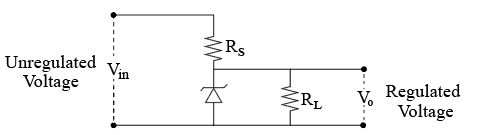
The following diagram shows a Zener diode as a voltage regulator. The Zener diode is rated at Vz=5V and the desired current \in load is 5 mA. The unregulated voltage source can supply upto 25 V. Considering the Zener diode can withstand four \times of the load current, the value of resistor Rs (shown in circuit) should be ____ Ω .
The Zener diode voltage regulator maintains Vo=Vz=5V.
The voltage drop across Rs at maximum input voltage is VRs=V∈,max−Vz=25V−5V=20V.
The problem implies that the total current through Rs (Is) is chosen as four times the load current (IL) for design purposes.
So, Is=4×IL=4×5mA=20mA.
Therefore, Rs=IsVRs=20mA20V=0.02A20V=1000Ω.
At this resistance, the Zener current is Iz=Is−IL=20mA−5mA=15mA, which is less than the 4×IL=20mA it can withstand.
Q3JEE Main 2026MCQ4MRotational Motion
Two small balls with masses m and 2m are attached to both ends of a rigid rod of length d and negligible mass. If angular momentum of this system is L about an axis (A) passing through its centre of mass and perpendicular to the rod then angular velocity of the system about A is :
We need to find the angular velocity of a system of two balls (masses m and 2m) attached to a rod of length d, given angular momentum L about the axis through the center of mass. Find the center of mass. Taking the position of mass m as origin: xcm=m+2mm⋅0+2m⋅d=32d So mass m is at distance 32d from the CM, and mass 2m is at distance d−32d=3d from the CM. Calculate the moment of inertia about the CM: I=m(32d)2+2m(3d)2=m⋅94d2+2m⋅9d2=94md2+2md2=96md2=32md2 Use L=Iω to find ω: ω=IL=2md2/3L=2md23L The correct answer is Option (2): 23md2L.
Q4JEE Main 2026MCQ4MRotational Motion
The moment of inertia of a square loop made of four uniform solid cylinders, each having radius R and length L (R<L) about an axis passing through the mid points of opposite sides, is (Take the mass of the entire loop as M) :
Let the mass of each cylinder be m=4M. The moment of inertia of a solid cylinder of mass m, radius R and length L about a diameter of its circular cross section (axis through centre perpendicular to its length) is given by the formula I\diameter=41mR2+121mL2−(1) The two vertical rods (left and right sides) have their midpoints on the rotation axis and for each the axis is a diameter of its cross section. Moment of inertia of one vertical rod about the given axis is Iv,1=41mR2+121mL2. For two vertical rods, Ivertical=2Iv,1=21mR2+61mL2−(2) The moment of inertia of a solid cylinder of mass m and radius R about its central (longitudinal) axis is Ilong=21mR2−(3) The top and bottom rods are horizontal, parallel to the rotation axis, and at a perpendicular distance 2L from it. Using the parallel axis theorem for one such rod: Ih,1=Ilong+m(2L)2=21mR2+41mL2−(4) For both horizontal rods, Ihorizontal=2Ih,1=mR2+21mL2−(5) The total moment of inertia of the square loop about the given axis is I=Ivertical+Ihorizontal=(21mR2+61mL2)+(mR2+21mL2). Substituting m=4M gives I=(21⋅4MR2+61⋅4ML2)+(4MR2+21⋅4ML2)=8MR2+24ML2+4MR2+8ML2=83MR2+6ML2. Therefore, the required moment of inertia is 83MR2+61ML2, which corresponds to Option B.
Q5JEE Main 2026MCQ4MAtoms and Nuclei
In hydrogen atom spectrum, (R ➔ Rydberg's constant) A. the maximum wavelength of the radiation of Lyman series is 3R4 B. the Balmer series lies \in the visible region of the spectrum C. the minimum wavelength of the radiation of Paschen series is R9 D. the minimum wavelength of Lyman series is 4R5 Choose the correct answer from the options given below :
We need to verify which statements about the hydrogen atom spectrum are correct. Key Formula: The wavelength of spectral lines is given by: λ1=R(n121−n221) where R is Rydberg's constant, n1 is the lower level, and n2 is the upper level. Statement A: The maximum wavelength of Lyman series is 3R4. The Lyman series has n1=1. Maximum wavelength corresponds to minimum energy transition (n2=2): λmax1=R(121−221)=R×43λmax=3R4 Statement A is CORRECT. Statement B: The Balmer series lies \in the visible region of the spectrum. The Balmer series has n1=2. Its wavelengths range from 364.6 nm (series limit) to 656.3 nm, which falls \in the visible region (380-700 nm). Statement B is CORRECT. Statement C: The minimum wavelength of Paschen series is R9. The Paschen series has n1=3. Minimum wavelength corresponds to the series limit (n2→∞): λmin1=R(321−0)=9Rλmin=R9 Statement C is CORRECT. Statement D: The minimum wavelength of Lyman series is 4R5. The minimum wavelength of Lyman series corresponds to n2→∞: λmin1=R(121−0)=Rλmin=R1 This is NOT 4R5. Statement D is INCORRECT. The correct statements are A, B, and C. The correct answer is Option 3 : A, B and C Only.
Q6JEE Main 2026MCQ4MDual Nature of Matter and Radiation
The de Broglie wavelength of an oxygen molecule at 27∘C is x×10−12m. The value of x is (take Planck's constant =6.63×10⁻³⁴J.s, Boltzmann constant =1.38×10⁻²³J/K, mass of oxygen molecule =5.31×10⁻²⁶kg)
We need to find the de Broglie wavelength of an O2 molecule at 27°C. The de Broglie wavelength of a gas molecule at temperature T is: λ=3mkBTh where h is Planck's constant, m is the mass of one molecule, kB is Boltzmann's constant, and T is the absolute temperature. h=6.63×10⁻³⁴J⋅sm=32×1.66×10−27kg=53.12×10⁻²⁷kg (O2 has molar mass 32 g/mol) kB=1.38×10⁻²³J/KT=27°C=300K3mkBT=3×53.12×10−27×1.38×10−23×300=3×53.12×1.38×300×10−50=3×21992.64×10−50=65977.9×10−50=6.598×10−463mkBT=6.598×10−46=2.569×10−23λ=2.569×10−236.63×10−34=2.581×10−11m=25.81×10−12m≈26×10−12m So x=26. The correct answer is Option (4): 26.
Q7JEE Main 2026MCQ4MOscillations
A simple pendulum of string length 30 cm performs 20 oscillations in 10 s. The length of the string required for the pendulum to perfo rm 40 oscillations in the same time duration is _________cm. [Assume that the mass of the pendulum remains same.]
T=2πL/g. T1=10/20=0.5s. T2=10/40=0.25s. T2/T1=1/2=L2/L1. L2=L1/4=30/4=7.5 cm. The answer is Option 4 : 7.5 cm.
Q8JEE Main 2026MCQ4MLaws of Motion
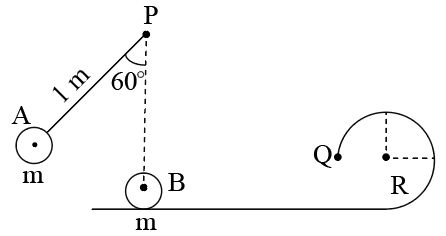
A small bob A of mass m is attached to a massless rigid rod of length 1 m pivoted at point P and kept at an angle of 60° with vertical as shown in figure. At distance of 1 m below point P, an identical bob B is kept at rest on a smooth horizontal surface that extends to a circular track of radius R as shown in figure. If bob B just manages to complete the circular path of radius R upto a point Q after being hit elastically by bob A, then radius R is ____ m.
Bob A's speed before impact: vA=2gL(1−cos60∘)=2g(1)(1−0.5)=g m/s.
Due to an elastic collision between identical masses, bob B acquires vB=vA=g m/s.
For bob B to just complete a vertical circular path of radius R, its speed at the highest point (height 2R) must be vtop=gR.
By conservation of energy for bob B: 21mvB2=21mvtop2+mg(2R).
Substituting values: 21m(g)=21m(gR)+mg(2R)⟹21=21R+2R⟹21=25R⟹R=51 m.
Q9JEE Main 2026MCQ4MCurrent Electricity
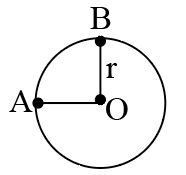
A wire of uniform resistance λΩ/m is bent into a circle of radius r and another piece of wire with length 2r is connected between points A and B (AOB) as shown in figure. The equivalent resistance between points A and B is ____Ω .
step 1: resistance of circular wire Totallength=2πrTotalresistance=2πrλ Between A and B, the circle splits into two arcs: \bullet smaller arc (quarter circle): length=2πr→resistance=2πrλ \bullet larger arc (remaining): length=23πr→resistance=23πrλ These two are \in parallel: Rcircle=2πrλ+23πrλ(2πrλ)(23πrλ)=2πrλ3π2r2λ2/4=83πrλ step 2: resistance of straight wire AB Length = 2r RAB=2r\lambda step 3: both paths are \in parallel Req=83πrλ+2rλ(83πrλ)(2rλ) Factor \lambda : Req=rλ⋅(3π/8)+2(3π/8)(2)=rλ⋅(3π+16)/83π/4=rλ⋅3π+163π/4×8=rλ⋅3π+166π
Q10JEE Main 2026MCQ4MElectrostatics
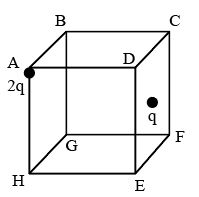
Two point charges 2q and q are placed at vertex A and centre of face CDEF of the cube as shown in figure. The electric flux passing through the cube is :
Use Gauss law. Charge at center of face CDEF: It lies exactly on surface of cube. A charge on a face contributes half its flux through the cube. So contribution: Φ1=2ϵ0q Charge 2q is at vertex A. A vertex is shared by 8 identical cubes. So this cube gets one-eighth contribution: Φ2=8ϵ02q=4ϵ0q Total flux: Φ=Φ1+Φ2=2ϵ0q+4ϵ0q=4ϵ03q
Q11JEE Main 2026MCQ4MUnits and Measurements
In a screw gauge, the zero of the circular scale lies 3 divisions above the horizontal pitch line when their metallic studs are brought in contact. Using this instrument thickness of a sheet is measured. If pitch scale reading is 1 mm and the circular scale reading is 51 then the correct thickness of the sheet is_____ mm. [Assume least count is 0.01 mm]
We are given a screw gauge with a zero error where the zero of the circular scale lies 3 divisions above the horizontal pitch line when the studs are in contact. The least count (LC) is 0.01 mm. When the zero of the circular scale lies 3 divisions above the reference line, the circular scale has not reached its zero mark. This means extra rotation is needed to bring it to zero, which represents a negative zero error: Zero error=−3×LC=−3×0.01=−0.03 mm The observed reading is given by: Observed reading=PSR+(CSR×LC)=1+(51×0.01)=1.51 mm The zero correction is the negative of the zero error, so the corrected reading is: Correct thickness=Observed reading−Zero error=1.51−(−0.03)=1.54 mm The correct answer is Option B) 1.54 mm .
Q12JEE Main 2026MCQ4MUnits and Measurements
Four persons measure the length of a rod as 20.00 cm, 19.75 cm, 17.01 cm and 18.25cm. The relative error in the measurement of average length of the rod is :
We need to find the relative error in the measurement of the average length of a rod measured by four persons as 20.00 cm, 19.75 cm, 17.01 cm, and 18.25 cm. Calculate the average (mean) length: xˉ=420.00+19.75+17.01+18.25=475.01=18.7525cm Calculate the absolute deviations from the mean: ∣20.00−18.7525∣=1.2475∣19.75−18.7525∣=0.9975∣17.01−18.7525∣=1.7425∣18.25−18.7525∣=0.5025 Calculate the mean absolute deviation (mean error): Δxˉ=41.2475+0.9975+1.7425+0.5025=44.49=1.1225cm Calculate the relative error: Relative error=xˉΔxˉ=18.75251.1225=0.0599≈0.06 The correct answer is Option (4): 0.06.
Q13JEE Main 2026MCQ4MRay Optics and Optical Instruments
Consider light travelling from a medium A to medium B separated by a plane interface. If the light undergoes total internal reflection during its travel from medium A to B and the speed of light in media A and B are 2.4×10⁸m/s and 2.7×10⁸m/s respecti vely, then the value of critical angle is :
Refractive index of a medium is defined by the formula n=vc, where c is the speed of light \in vacuum and v is the speed of light \in the medium. -(1) For medium A: n1=2.4×10⁸c For medium B: n2=2.7×10⁸c Since 2.4×10⁸<2.7×10⁸, it follows that n1>n2, so total internal reflection is possible when light travels from A to B. The critical angle θc is given by Snell's law at the limit of refraction: sinθc=n1n2 -(2) Substituting the values of n1 and n2 from (1), we get sinθc=2.4×10⁸c2.7×108c=2.7×1082.4×108=98 -(3) Therefore, θc=sin−1(98) -(4) To express θc \in the form involving an inverse tangent, use the identity tanθ=1−sin2θsinθ. Substituting sinθc=98 gives tanθc=1−(98)298=91798=178 -(5) Hence, θc=tan−1(178). Comparing with the given options, this corresponds to Option C.
Q14JEE Main 2026MCQ4MWork, Power and Energy
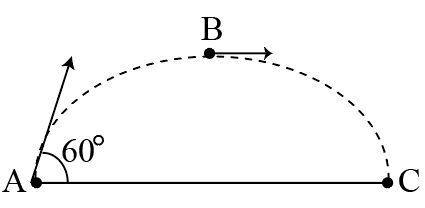
An object is projected with kinetic energy K from a point A at an angle 60° with the horizontal The ratio of the difference in kinetic energies at points B and C to that at point A (see figure), in the absence of air friction is :
An object is projected from point A with kinetic energy KKK at an angle of 60∘60^\circ60∘. Since there is no air resistance, mechanical energy is conserved throughout the motion. At point A, the total energy is purely kinetic. KA=K=21×m×v2 = 2mv2 As the object moves upward to point B, it gains height. Due to this increase \in height, some of the kinetic energy is converted into potential energy, so the kinetic energy at B decreases. KA=KB+m×g×h At the highest point B, the vertical component of velocity becomes zero, and only the horizontal component remains. Therefore, kinetic energy at B depends only on the horizontal velocity. vx=vcos60∘=2v So kinetic energy at B: KB=21×m×(vcos60∘)2=21×m×(2v)2=8mv2 = 4K Now, as the object moves from B to C, it comes back to the same vertical level as A. Hence, the potential energy at C is the same as at A, and thus the kinetic energy at C becomes equal to the initial kinetic energy. KA=KC=K Now consider the difference \in kinetic energies between C and B , and kinetic energy at A KC−KB=K−4K=43KKA=K Finally, take the ratio of these differences. KineticenergyatAdiffbetweenBandC = K43K = 43 Thus, the required ratio is 3:4
Q15JEE Main 2026MCQ4MElectromagnetic Waves
Matd1 List - I with List - II. atd1 List - I with List - II. List - I List - II Relation Law A. ∮E.dl=−dtd∮B.da I. Ampere's circuital law B. ∮B.dl=μ∘(I+ϵ∘dtdϕE) II. Faraday's laws of electromagnetic induction C. ∮E.da=ϵ∘1∫vρdv III. Ampere - Maxwell law D. ∮B.dl=μ∘I IV. Gauss's law of electrostatics Choose the correct answer from the options given below :
We need to match Maxwell's equations (List I) with their corresponding laws (List II). ∮E⋅dl=−dtd∮B⋅da This is the integral form of Faraday's law of electromagnetic induction - a changing magnetic flux induces an electric field. \to II (Faraday's law) ∮B⋅dl=μ0(I+ϵ0dtdϕE) This is Ampere's law with Maxwell's displacement current correction - magnetic fields are produced by both conduction current and changing electric flux. \to III (Ampere-Maxwell law) ∮E⋅da=ϵ01∫Vρdv This is Gauss's law for electricity - the electric flux through a closed surface equals the enclosed charge divided by ϵ0. \to IV (Gauss's law of electrostatics) ∮B⋅dl=μ0I This is the original Ampere's circuital law (without the displacement current term). → I (Ampere's circuital law) The correct answer is Option (3): A-II, B-III, C-IV, D-I.
Q16JEE Main 2026MCQ4MElectromagnetic Induction
A 20 m long uniform copper wire held horizontally is allowed to fall under the gravity (g=10m/s2) through a uniform horizontal magnetic fie ld of 0.5 Gauss perpendicular to the length of the wire. The induced EMF across the wire when it travells a vertical distance of200 m is ____ mV.
A conductor of length L moving with velocity v perpendicular to a magnetic field of strength B has an induced EMF given by the formula: E=BLv−(2) First, find the speed v of the wire after falling through a vertical distance h=200 m under gravity g=10 m/s2. Using the kinematic relation with initial speed zero: v2=u2+2gh=0+2×10×200=4000−(1) Hence v=4000=2010 m/s Convert the magnetic field from gauss to tesla: 1 Gauss = 10−4 T. Thus B=0.5 Gauss=0.5×10⁻⁴ T=5×10⁻⁵ T Substitute B=5×10⁻⁵ T, L=20 m and v=2010 m/s into equation (2): E=(5×10−5)×20×2010=0.0210 V Convert volts to millivolts: 0.0210 V=2010 mV Therefore, the induced EMF is 2010 mV, which is Option C.
Q17JEE Main 2026MCQ4MWork, Power and Energy
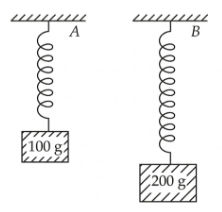
Two blocks with masses 100 g and 200 g are attached to the ends of springs A and B as shown in figure. the energy stored in A is E. The energy stored in B, when spring constants KA,KB of A and B, respectively satisfy the relation 4KA=3KB is:
Let extension in spring A = xA and extension \in spring B = xB Energy stored \in spring A = EA = E and energy stored \in spring B = EB From Force balance \in spring A, KAxA=mg=0.1×10=1N∴xA=KA1EA=21KAxA2=21KA×KA21=KA0.5 Similarly, from spring B, KBxB=0.2×10=2∴xB=KB2EB=21KBxB2=21KB×KB24=KB2 Since, KB=34KA∴EB=34KA2=KA1.5=3×KA0.5=3E
Q18JEE Main 2026MCQ4MRay Optics and Optical Instruments
A thin prism with angle 5° of refractive index 1.72 is combined with another prism of refractive index 1.9 to produce dispersion w ithout deviation. The angle of second prism is ____ .
We need to find the angle of the second prism when two thin prisms are combined to produce dispersion without deviation. We first state the deviation formula for a thin prism. For a thin prism with small angle A and refractive index n, the deviation is given by: δ=(n−1)A This formula is derived from Snell's law under the small-angle approximation (sinθ≈θ). Next, we set up the condition for zero net deviation. When two prisms are combined \in opposite orientations, their deviations act \in opposite directions. For the net deviation to be zero: δ1+δ2=0 This implies: (n1−1)A1=(n2−1)A2 (The deviations must be equal \in magnitude but opposite \in direction.) Substituting the given values n1=1.72, A1=5°, and n2=1.9 into this equation gives: (1.72−1)×5=(1.9−1)×A20.72×5=0.9×A23.6=0.9×A2 Solving for A2 yields: A2=0.93.6=4° The correct answer is Option B: 4°.
Q19JEE Main 2026MCQ4MThermodynamics
In a perfectly inelastic collision, two spheres made of the same material with masses 15 kg and 25 kg, moving in opposite directions with speeds of 10 m/s and 30 m/s, respectively, strike each other and stick together. The rise in temperature (in ∘C), if all the heat produced during the collision is retained by these spheres, is : (specific heat of sphere material 31 cal/kg.∘C and 1 cal =4.2 J)
Let the masses be m1=15kg and m2=25kg, and their velocities before collision be v1=+10m/s and v2=−30m/s (opposite directions). In a perfectly inelastic collision, momentum is conserved. The formula is: m1v1+m2v2=(m1+m2)vf−(1) Substitute the given values into (1): 15×10+25×(−30)=40vf150−750=40vf−600=40vfvf=−40600=−15m/s−(2) The heat produced equals the loss \in kinetic energy. First, compute the initial kinetic energy: Ki=21m1v12+21m2v22−(3) Substitute values: Ki=21×15×102+21×25×302Ki=750+11250=12000J−(4) Next, compute the final kinetic energy of the combined mass: Kf=21(m1+m2)vf2−(5) Substitute values: Kf=21×40×(−15)2=20×225=4500J−(6) Thus, the heat generated is: Q=Ki−Kf=12000−4500=7500J−(7) Given specific heat \in calories: c=31cal/kg∘C and 1cal=4.2J. Converting to SI units: c=31×4.2=130.2J/kg∘C−(8) The total mass is: M=m1+m2=15+25=40kg−(9) The temperature rise is: ΔT=McQ=40×130.27500≈1.44∘C−(10) Final Answer: The rise \in temperature is 1.44∘C (Option D).
Q20JEE Main 2026MCQ4MProperties of Matter
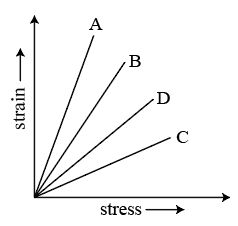
The strain-stress plot for materials A, B, C and D is shown in the figure. Which material has the largest Young's modulus?
Young's modulus, Y=StrainStress In the given plot, strain is on the y-axis and stress is on the x-axis. Slope=StressStrain=Y1 Therefore, the material with the least slope will have the largest Young's modulus. Observing the plot, material C has the minimum slope. Therefore, it possesses the largest Young's modulus.
Q21JEE Main 2026NAT4MElectromagnetic Induction
A simple pendulum made of mass 10 g and a metallic wire of length 10 cm is suspended vertically in a uniform magnetic field of 2 T. The magnetic field direction is perpendicular to the plane of oscillations of the pendulum. If the pendulwn is released from an angle of 60° with vertical, then maximum induced EMF between the point of s uspension and point of oscillation is ______mV (Take g=10m/s2)
The pendulum consists of a metallic wire of length L=10 cm=0.1 m and a bob of mass m=10 g=0.01 kg, oscillating \in a uniform magnetic field B=2 T perpendicular to the plane of oscillation. The maximum induced EMF occurs when the angular velocity is maximum, which is at the lowest point of the swing. The induced EMF \in a rotating conductor of length L about one end \in a uniform magnetic field B perpendicular to the plane of rotation is given by: E=21BωL2 where ω is the angular velocity. To find the maximum angular velocity ωmax, use conservation of energy. The initial angle is θ0=60∘. The height h above the lowest point is: h=L(1−cosθ0) Substitute cos60∘=0.5: h=0.1×(1−0.5)=0.1×0.5=0.05 m The potential energy at the initial position converts to kinetic energy at the lowest point: mgh=21mvmax2 where g=10 m/s2. Solve for vmax: vmax=2gh=2×10×0.05=1=1 m/s The maximum angular velocity ωmax is related to vmax by: ωmax=Lvmax=0.11=10 rad/s Now substitute into the EMF formula: Emax=21BωmaxL2=21×2×10×(0.1)2 Calculate step by step: (0.1)2=0.01Emax=21×2×10×0.01=1×10×0.01=0.1 V Convert to millivolts: 0.1 V=100 mV. Thus, the maximum induced EMF is 100 mV.
Q22JEE Main 2026NAT4MElectromagnetic Waves
The equation of the electric field of an electromagnetic wave propagating through free space is given by: E=377sin(6.27×10³t−2.09×10⁻⁵x)N/C The average power of the electromagnetic wave is (α1)W/m2. The value of α is______ (Takeϵ∘μ∘=377∈SIunits)
We are given the electric field E=377sin(6.27×10³t−2.09×10⁻⁵x) N/C and must determine α such that the time‐averaged power density equals α1 W/m2. For a plane electromagnetic wave, the instantaneous power per unit area is described by the Poynting vector, and its time‐averaged value (or intensity) is ⟨S⟩=2Z0E02 In this expression, E0 denotes the amplitude of the electric field, while Z0=μ0/ϵ0 represents the intrinsic impedance of free space. The factor of 21 arises because ⟨sin2(ωt)⟩=21 over a full cycle. From the given wave, one reads off the amplitude E0=377 N/C, and since Z0=μ0/ϵ0 takes the value 377Ω \in SI units, substitution yields ⟨S⟩=2Z0E02=2×377(377)2=2×377377=21 W/m2 Because this result must equal α1, we set α1=21, which leads directly to α=2. The answer is 2.
Q23JEE Main 2026NAT4MWave Optics
In two separate Young's double-slit experimental set-ups and two monochromatic light sources of different wavelengths are used to get fringes of equal width. the ratios of the slits separations and that of the wavelengths of light used are 2: 1 and 1 : 2 respectively. The corresponding ratio of the distances between the slits and the respective screens (D1/D2) is ______.
We need to find the ratio D1/D2 given that two Young's double-slit setups produce fringes of equal width. The fringe width \in Young's double-slit experiment is given by β=dλD Here λ is the wavelength, D is the distance from slits to screen, and d is the slit separation. Since the fringe widths are equal, β1=β2, which implies d1λ1D1=d2λ2D2 Substituting the given ratios d1:d2=2:1 and λ1:λ2=1:2, we rearrange for D1/D2: D2D1=λ1λ2×d2d1 Evaluating this gives D2D1=12×12=4 The answer is 4.
Q24JEE Main 2026NAT4MElectrostatic Potential and Capacitance
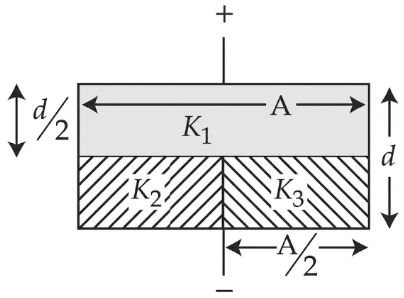
The space between the plates of a parallel plate capacitor of capacitance C (without any dielectric) is now filled with three dielectric slabs of dielectric constants K1=2,K2=3 and K3=5 (as shown \in figtue). lf new capacitance is 3nC then the value of n is_____.
Let original capacitance (no dielectric): C=dε0A step 1: understand geometry \bullet Top half (thickness d/2): dielectric K1=2, area A \bullet Bottom half (thickness d/2): split into two equal areas: left: K2=3, area A/2 right: K3=5, area A/2 step 2: bottom part (parallel combination) Each has thickness d/2: C2=d/23ε0(A/2)=d3ε0AC3=d/25ε0(A/2)=d5ε0A Parallel: Cbottom=C2+C3=d8ε0A step 3: top part Ctop=d/22ε0A=d4ε0A step 4: series combination Top and bottom are \in series: C′1=Ctop1+Cbottom1=4ε0Ad+8ε0Ad=8ε0A3dC′=3d8ε0A
Q25JEE Main 2026NAT4MAlternating Current
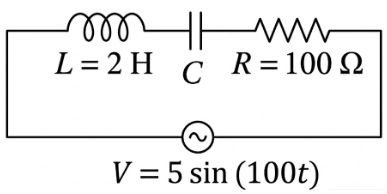
Using a variable frequency a.c. voltage source the maximum current measured in the given LCR circuit is 50 mA for V= 5 sin(100t) The values of L and R are shown in the figure. The capacitance of the capacitor (C) used is ____ µF.
At maximum current, the LCR circuit is at resonance, implying XL=XC.
From V=5sin(100t), the angular frequency is ω=100 rad/s.
The resonance condition is ωL=1/(ωC), so C=1/(ω2L).
Substituting the values: C=1/((100 rad/s)2×2 H)=1/(10000×2)=1/20000 F.
Converting to microfarads: C=5×10⁻⁵ F =50×10−6 F =50μF.
[CORRECT_OPTION: 50]
Chemistry25 questions
Q26JEE Main 2026MCQ4MPractical Organic Chemistry
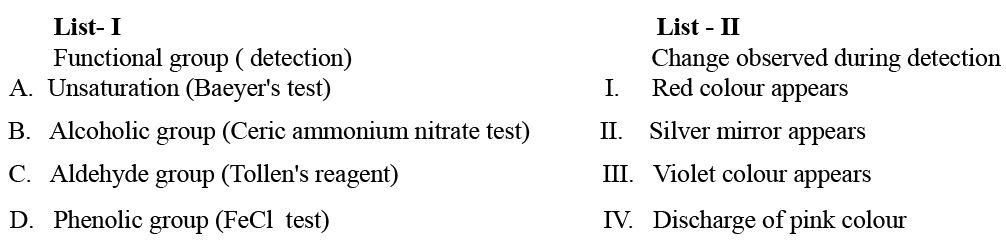
Match List - I with List - II. choose the correct answer from the options given below :
A. Baeyer's test for unsaturation involves decolourization of pink KMnO4. So, A-IV.
B. The Ceric ammonium nitrate test for alcohols produces a red-colored complex. So, B-I.
C. Tollen's reagent test for aldehydes results in the formation of a silver mirror. So, C-II.
D. The FeCl3 test for phenolic groups typically yields a violet coloration. So, D-III.
[CORRECT_OPTION: B]
Q27JEE Main 2026MCQ4MCoordination Compounds
The statements that are incorrect about the nickel(II) complex of dimethylglyoxime are: A. It is red in colour. B. It has a high solubility in water at pH =9. C. The Ni ion has two unpaired d-electrons. D. The N - Ni - N bond angle is almost close to 90° E. The complex contains four five-membered metallacycles (metal containing rings). Choose the correct answer from the options given below :
We need to identify the incorrect statements about the nickel(II) complex of dimethylglyoxime (DMG), which is [Ni(DMG)2]. Statement A: It is red \in colour. The nickel-DMG complex is indeed bright red (also called strawberry red). Statement A is CORRECT. Statement B: It has high solubility \in water at pH = 9. The nickel-DMG complex is insoluble \in water. It precipitates out at pH 5-9, which is actually how nickel is detected gravimetrically. Statement B is INCORRECT. Statement C: The Ni ion has two unpaired d-electrons. In the square planar nickel-DMG complex, Ni2+ has a d8 configuration. In a square planar field, all 8 electrons are paired (dxy2,dyz2,dxz2,dz22, empty dx2−y2). So there are zero unpaired electrons. Statement C is INCORRECT. Statement D: The N-Ni-N bond angle is almost close to 90 degrees. In the square planar geometry of the complex, the N-Ni-N bond angle between adjacent nitrogen atoms is approximately 90 degrees. Statement D is CORRECT. Statement E: The complex contains four five-membered metallacycles. Each DMG molecule forms one five-membered chelate ring with Ni (Ni-N-C-C-N). With two DMG ligands, there are only two five-membered metallacycles, not four. Statement E is INCORRECT. The incorrect statements are B, C, and E. The answer is Option D) B, C and E Only .
Q28JEE Main 2026MCQ4Mp Block Elements
The correct statements from the following are: A. Ionic radii of trivalent cations of group 13 elements decreases down the group. B. Electronegativity of group 13 elements decreases down the group. C. Among the group 13 elements, Boron has highest first ionisation enthalpy. D. The trichloride and triiodide of group 13 elements are covalent in nature. Choose the correct answer from the options given below :
A. As we move down group 13, the principal quantum number increases, causing the ionic radii of M3+ ions to increase. Thus, statement A is false.
B. Electronegativity does not strictly decrease due to the poor shielding effects of d and f electrons (lanthanide contraction), making statement B false.
C. Boron possesses the smallest atomic radius and highest effective nuclear charge in the group, resulting in the highest first ionisation enthalpy. Thus, statement C is true.
D. According to Fajans' rule, triiodides exhibit strong covalent character due to the high polarizability of the large iodide ion by the M3+ cation. Thus, statement D is true.
Q29JEE Main 2026MCQ4MOrganic Chemistry - Some Basic Principles
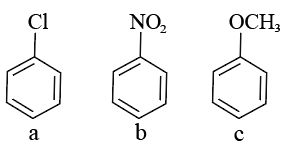
Consider the following compounds Arrange these compounds in the increasing order of reactivity with nitrating mixture.
Reactivity towards electrophilic aromatic substitution, such as nitration, depends on the electron density of the benzene ring. Electron-donating groups increase reactivity, while electron-withdrawing groups decrease it.
Compound b (Nitrobenzene): The −NO2 group exerts strong −I and −M effects, making the ring electron-deficient and the least reactive.
Compound a (Chlorobenzene): The −Cl group has a −I effect that outweighs its weak +M effect, making it deactivating, but less so than the nitro group.
Compound c (Anisole): The −OCH3 group has a strong +M effect that dominates its −I effect, strongly activating the ring.
Thus, the reactivity order is: b<a<c.
Q30JEE Main 2026MCQ4MCoordination Compounds
Given below are two statements : Statement I: [CoBr4]2− ion will absorb light of lower energy than [CoCl4]2− ion. Statement II: In [Col4]2− ion, the energy separation between the two set of d-orbitals is more than [CoCl4]2− ion. ln the light of the above statements, choose the correct answer from the options given below:
In a tetrahedral complex, the splitting of the d-orbitals is denoted by Δt. The energy of light absorbed, Eabs, is directly proportional to this splitting: Eabs∝Δt−(1) Also, the wavelength of light absorbed, λabs, is inversely proportional to the energy absorbed: λabs∝\fΔt1−(2) Ligand field strength for halides follows the order: F−>Cl−>Br−>I− This means chloride is a stronger field ligand than bromide, and bromide is stronger than iodide. Analysis of Statement I: Statement I claims that [CoBr4]2− absorbs lower energy light than [CoCl4]2−. Since Δt(Cl−)>Δt(Br−) by the ligand field series, then by (1): Eabs(Cl−)>Eabs(Br−) Hence [CoBr4]2− indeed absorbs lower energy light compared to [CoCl4]2−. Therefore, Statement I is true. Analysis of Statement II: Statement II claims that \in [CoI4]2− the splitting Δt is greater than \in [CoCl4]2−. From the ligand field series, Δt(Cl−)>Δt(I−). This contradicts Statement II. Therefore, Statement II is false. Combining these results: Statement I is true and Statement II is false. Hence the correct answer is Option C.
Q31JEE Main 2026MCQ4MSolutions
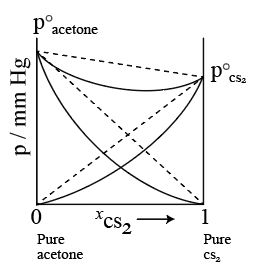
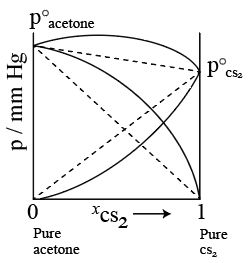
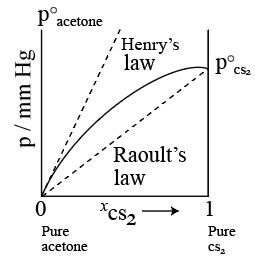
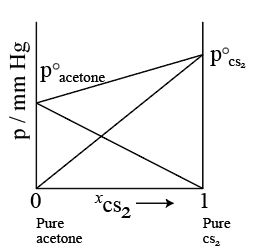
Which one of the following graphs accurately represents the plot of partial pressure of CS2 vs its mole fraction \in a mixture of acetone and CS2 at constant temperature?
A mixture of acetone and CS2 exhibits positive deviation from Raoult's law because the intermolecular forces between acetone and CS2 are weaker than those in the pure liquids, resulting in higher vapor pressure.
For such systems, the partial pressure of each component, pi, is greater than that predicted by Raoult's law (pi>xipi∘). Graph C accurately represents this positive deviation by showing the curve for the partial pressure of CS2 lying above the ideal dashed Raoult's law line. It also correctly displays the Henry's law behavior as the tangent to the curve at the limit of infinite dilution (xCS2→0).
Q32JEE Main 2026MCQ4MStates of Matter
Given below are two statements : Statement I: Sublimation is used for the separation and purification of compounds with low melting Point. Statement II: The boiling point of a liquid increases as the external pressure is reduced. In the light of the above statements, choose the correct answer from the options given below :
Sublimation is defined as the process in which a solid converts directly into vapour without passing through the liquid state. This process is feasible only when the substance has a significant vapour pressure at a temperature below its melting point. Therefore, sublimation depends on the vapour pressure characteristics of a compound, not on having a low melting point. Hence Statement I is false. The boiling point of a liquid is the temperature at which its vapour pressure Pvap equals the external pressure Pext: Pvap=Pext When the external pressure is reduced, the temperature required for the vapour pressure to reach that lower external pressure also decreases. Thus the boiling point decreases as the external pressure is reduced. Statement II claims the boiling point increases on reducing external pressure, which contradicts this principle. Hence Statement II is false. Since both Statement I and Statement II are false, the correct choice is Option B.
Q33JEE Main 2026MCQ4MOrganic Chemistry - Some Basic Principles
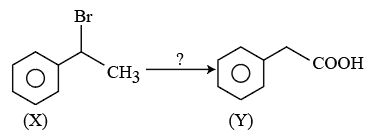
The correct sequence of reagents for the above conversion of X to Y is:
The conversion of 1-bromo-1-phenylethane (X) to phenylacetic acid (Y) follows these steps:
Dehydrohalogenation: Treatment of X with NaOEt (a strong base) induces an E2 elimination to form styrene (C6H5CH=CH2).
Hydroboration-Oxidation: Reaction with B2H6/H2O2 performs an anti-Markovnikov hydration of the alkene to yield the primary alcohol, 2-phenylethanol (C6H5CH2CH2OH).
Oxidation: Jones reagent (CrO3/H2SO4) is a strong oxidizing agent that converts the primary alcohol into the corresponding carboxylic acid, producing phenylacetic acid (C6H5CH2COOH).
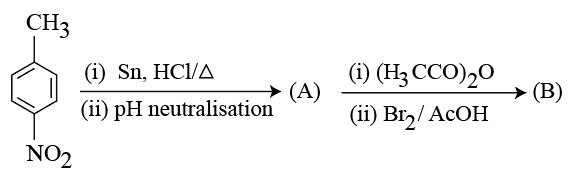
Consider the following sequence of reactions. 4-Nitrotoluene Assuming that the reaction proceeds to completion, then 137 mg of 4-nitrotoluene will produce ____ mg of B. (Given molar mass in g mol−1 H : 1, C: 12, N: 14, 0: 16, Br : 80)
The molar mass of 4-nitrotoluene (C7H7NO2) is 7(12)+7(1)+14+2(16)=137 g/mol. Thus, 137 mg corresponds to 1 mmol.
The reaction sequence is as follows: 4-nitrotoluene is reduced to p-toluidine (C7H9N), which is then acetylated to N-acetyl-p-toluidine (C9H11NO), followed by bromination to form 2-bromo-4-methylacetanilide (C9H10BrNO) as product B.
The molar mass of product B (C9H10BrNO) is calculated as: MB=9(12)+10(1)+80+14+16=228 g/mol
Given the stoichiometric conversion of 1 mole of 4-nitrotoluene to 1 mole of B, 1 mmol of 4-nitrotoluene yields 1 mmol of B.
Therefore, the mass of B produced is 1 mmol×228 mg/mmol=228 mg.
Q35JEE Main 2026MCQ4MClassification of Elements
The correct trend in the first ionization enthalpies of the elements in the 3rd period of periodic table is:
The elements present in the 3rd period are Na,Mg,Al,Si,P,S,Cl,Ar. First ionization enthalpy (IE1) generally increases from left to right across a period because - atomic size decreases, and - effective nuclear charge Zeff increases. There are two characteristic exceptions \in this period: Case 1: Mg>Al because Mg has the stable configuration 3s2, whereas \in Al the electron is removed from the higher-energy 3p1 subshell, so less energy is needed. Case 2: P>S because P possesses the half-filled configuration 3p3, which is more stable than the 3p4 configuration of S. Hence an electron is removed more easily from S. Experimental IE1 values (\in kJ mol−1) confirm this trend: IE1(Na)=496<IE1(Mg)=738>IE1(Al)=578<IE1(Si)=787<IE1(S)=999<IE1(P)=1012<IE1(Cl)=1251<IE1(Ar)=1521. Keeping only the elements quoted \in the options and arranging them \in ascending order: Al<Si<S<P<Cl This sequence corresponds to Option A. Hence, the correct trend \in first ionization enthalpies for the given elements of the 3rd period is Al<Si<S<P<Cl; the correct answer is Option A.
Q36JEE Main 2026MCQ4MStructure of Atom
Which of the following statements regarding the energy of the stationary state is true in the following one - electron systems?
Determine which statement about the energy of stationary states is true. The energy of the nth orbit \in a hydrogen-like atom with atomic number Z is given by En=−13.6×n2Z2 eV. Using 1 eV=1.6×10⁻¹⁹ J, this can be written as En=−2.18×10⁻¹⁸×n2Z2 J. For the third orbit of Li2+ (where Z=3 and n=3), the energy is E3=−2.18×10−18×3232=−2.18×10⁻¹⁸ J, which matches the value stated \in Option A. Option B refers to the second orbit of hydrogen (Z=1, n=2), giving E=−2.18×10⁻¹⁸/4=−0.545×10−18 J, not −1.09×10⁻¹⁸ J. Option C is incorrect because the energy of a bound state is always negative, never positive. Option D is false since the first orbit of He+ has energy −2.18×10−18×4=−8.72×10⁻¹⁸ J, not a positive value. The correct answer is Option A: −2.18×10⁻¹⁸ J for the third orbit of Li2+.
Q37JEE Main 2026MCQ4MChemical Equilibrium
Consider the general reaction given below at 400 K xA(g)⇌yB(g).ThevaluesofK_{p}\text{ and }K_{c}arestudiedunderthesameconditionoftemperaturebutvariation∈xandy(i)K_{p}=85.87\text{ and }K_{c}=2.586appropriateunits(ii)K_{p}=0.862\text{ and }K_{c}=28.62$$ appropriate units The values of x and yin (i) and (ii) respectively are:
We are given the reaction xA(g)⇌yB(g) at T=400 K, with two cases. Kp=Kc(RT)Δn, where Δn=y−x (moles of gaseous products minus reactants) and R=0.0821 L·atm/(mol·K). At T=400 K: RT=0.0821×400=32.84. KcKp=2.58685.87≈33.2≈32.841 So (RT)Δn≈(32.84)1, meaning Δn=y−x=1. With x=1,y=2: Δn=2−1=1 ✓ KcKp=28.620.862≈0.0301≈33.21≈(32.84)−1 So (RT)Δn≈(32.84)−1, meaning Δn=y−x=−1. With x=2,y=1: Δn=1−2=−1 ✓ (i) x=1,y=2 and (ii) x=2,y=1. The answer is Option A: (i) 1, 2 and (ii) 2, 1.
Q38JEE Main 2026MCQ4MAmines
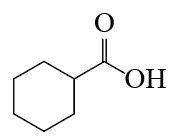
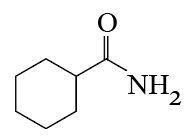
Compound 'P' undergoes the following sequence of reactions: 'P' is:
Step 1: The reaction of 'P' with NH3 followed by heating (Δ) is a standard method to convert a carboxylic acid into an amide. Thus, 'P' is cyclohexanecarboxylic acid, and 'Q' is cyclohexanecarboxamide (\text{C}6\text{H}{11}\text{CONH}_2$).
Step 2: The reagent KOH, Br2 performs a Hofmann bromamide degradation on the amide 'Q' to yield the primary amine, cyclohexylamine (\text{C}6\text{H}{11}\text{NH}_2$).
Step 3: The reaction of the primary amine with CHCl3 and alcoholic KOH is the Carbylamine reaction, which produces the observed isocyanide product: C6H11NH2+CHCl3+3KOHΔC6H11NC+3KCl+3H2O
Compound 'P' is cyclohexanecarboxylic acid.
Q39JEE Main 2026MCQ4MChemical Thermodynamics
A cup of water at 5°C (system) is placed in a microwave oven and the oven is turned on for one minute during which the water begins to boil. Which of the following option is true ?
The microwave transfers energy to the water, so heat is absorbed by the system, making q>0 (+ve). As the water boils and undergoes phase change, it expands against the constant atmospheric pressure, performing work on the surroundings, meaning w<0 (-ve). According to the first law of thermodynamics, the change in internal energy is given by:
ΔU=q+w
Since the water temperature rises significantly from 5∘C to 100∘C and converts from liquid to vapor, the gain in thermal and potential energy outweighs the work done, resulting in a net increase in internal energy, ΔU>0 (+ve).
Q40JEE Main 2026MCQ4MChemical Bonding and Molecular Structure
ldentify the molecule (X) with maximum number of lone pairs of electrons (obtained using Lewis dot structure) among HNO3,H2SO4,NF3 and O3. Choose the correct bond angle made by the central atom of the molecule (X).
Count lone pairs on all atoms in each molecule using Lewis dot structures: HNO3: Nitrogen forms one N=O double bond, one N-O single bond, and one N-OH bond. N has 0 lone pairs. The =O has 2 lone pairs, the -O- (bridging to H) has 2 lone pairs, and the -OH oxygen has 2 lone pairs. Total = 0+2+2+2=6. H2SO4: Sulfur forms two S=O double bonds and two S-OH bonds. S has 0 lone pairs. Each of the 2 terminal =O atoms has 2 lone pairs, and each of the 2 -OH oxygens has 2 lone pairs. Total = 0+2(2)+2(2)=8. NF3: Nitrogen has 1 lone pair and forms three N-F bonds. Each F has 3 lone pairs. Total = 1+3(3)=10. O3: Central O has 1 lone pair. The double-bonded terminal O has 2 lone pairs. The single-bonded terminal O (with formal charge -1) has 3 lone pairs. Total = 1+2+3=6. NF3 has the maximum number of lone pairs (10), so molecule X = NF3 with central atom nitrogen. In NF3, nitrogen is sp3 hybridized with trigonal pyramidal geometry. The highly electronegative F atoms draw bonding electron density away from N, reducing bond pair-bond pair repulsion. Combined with the lone pair compression, the F-N-F bond angle is reduced to approximately 102°. The answer is Option B: 102°.
Q41JEE Main 2026MCQ4MBiomolecules
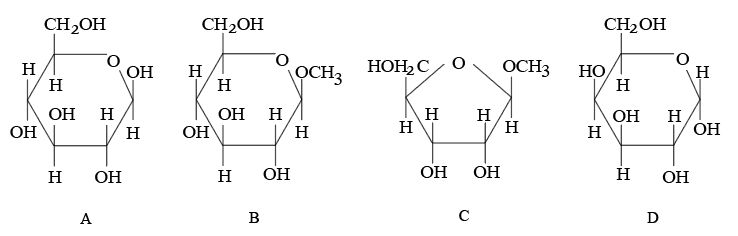
From the given following (A to D) cyclic structures, those which will not react with Tollen's reagent are:
Tollen's reagent specifically reacts with reducing sugars, which contain a free hemiacetal or hemiketal group capable of forming an open-chain aldehyde.
Structures A and D possess a free hydroxyl (−OH) group at the anomeric carbon, identifying them as hemiacetals that exist in equilibrium with the aldehyde form; thus, they react with Tollen's reagent.
Structures B and C have the anomeric hydroxyl replaced by a methoxy group (−OCH3), characterizing them as acetals (glycosides).
Because acetals cannot revert to the open-chain aldehyde form in basic medium, they are non-reducing sugars and do not react with Tollen's reagent.
Therefore, B and C will not react.
Q42JEE Main 2026MCQ4MHydrocarbons
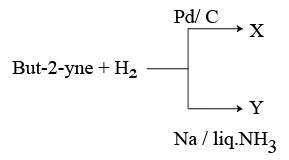
But-2-yne and hydrogen (one mole each) are separately treated with (i) Pd/C and (ii) Na/ liq. NH3 to give the products X and Y respectively. Identify the incorrect statements. A. X and Y are stereoisomers. B. Dipole moment of X is zero. C. Boiling point of X is higher than Y. D. X and Y react with O3/Zn+H2O to give different products. Choose the correct answer from the options given below :
The hydrogenation of but-2-yne with Pd/C yields cis-but-2-ene (X), while reduction with Na/liq.NH3 yields trans-but-2-ene (Y).
Statement A (Correct): X and Y are geometric stereoisomers.
Statement B (Incorrect): cis-but-2-ene (X) is polar due to its non-zero dipole moment, whereas trans-but-2-ene (Y) has a dipole moment of zero.
Statement C (Correct): Due to the net dipole moment and stronger intermolecular dipole-dipole interactions, the boiling point of the cis-isomer (X) is higher than that of the trans-isomer (Y).
Statement D (Incorrect): Ozonolysis of both cis-but-2-ene and trans-but-2-ene breaks the double bond to yield the same product, acetaldehyde (CH3CHO).
Since B and D are the incorrect statements, the correct option is A.
Q43JEE Main 2026MCQ4MAldehydes, Ketones and Carboxylic Acids
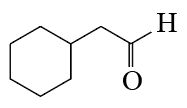
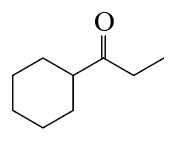
'x' is the product which is obtained &om propanenitrile and stannous chloride in the presence of hydrochloric acid followed by hydrolysis. 'y' is the product which is obtained from the but-2-ene by the ozonolysis followed by hydrolysis. From the followu1g, which product is not obtained when one mole of 'x' and one mole of 'y' react with, each other in the presence of alkali followed by heating?
We first identify the products x and y. Finding x: Propanenitrile (CH3CH2CN) is treated with stannous chloride (SnCl2) and hydrochloric acid, followed by hydrolysis. This is the Stephen reduction, which converts a nitrile to an aldehyde. Therefore x=propanal(CH3CH2CHO). Finding y: But-2-ene (CH3CH=CHCH3) undergoes ozonolysis followed by hydrolysis. The double bond is cleaved to produce two molecules of ethanal (acetaldehyde, CH3CHO). Since we take one mole of the ozonolysis product, y=ethanal(CH3CHO). When one mole of propanal and one mole of ethanal react \in the presence of alkali followed by heating, aldol condensation followed by dehydration takes place. Four α,β-unsaturated aldehyde products are possible: Product 1 - Self-aldol of ethanal: The enolate of one ethanal molecule attacks the carbonyl of another ethanal. After dehydration this gives CH3CH=CHCHO, which is but-2-enal (crotonaldehyde). Product 2 - Cross-aldol (ethanal enolate + propanal): The enolate of ethanal (−CH2CHO) attacks the carbonyl carbon of propanal. The resulting aldol product dehydrates to give CH3CH2CH=CHCHO = pent-2-enal. Product 3 - Cross-aldol (propanal enolate + ethanal): The enolate of propanal (CH3C−HCHO) attacks the carbonyl carbon of ethanal. The aldol product dehydrates to give CH3CH=C(CH3)CHO = 2-methylbut-2-enal. Product 4 - Self-aldol of propanal: The enolate of one propanal attacks the carbonyl of another propanal. Dehydration gives CH3CH2CH=C(CH3)CHO = 2-methylpent-2-enal. Now consider the options. 3-Methylbut-2-enal has the structure (CH3)2C=CHCHO. Forming this would require a branched reactant such as acetone or isobutyraldehyde as one of the starting materials, but neither is present in our reaction mixture. Therefore, 3-methylbut-2-enal cannot be obtained from this reaction. Hence, the correct answer is Option 2.
Q44JEE Main 2026MCQ4MElectrochemistry
In the given electrochemical cell, Ag(s)∣AgCl(s)∣FeCl2(aq), FeCl3(aq)∣Pt(s) at298 K, theceU potential Ecell will increase when: A. Concentration of Fe2+ is increased. B. Concentration of Fe3+ is decreased. C. Concentration of Fe2+ is decreased. D. Concentration of Fe3+ is increased. E. Concentration of Cl− is increased. Choose the correct answer from the options given below :
Let us write the two half‐reactions with their standard reduction potentials: AgCl(s) + e- → Ag(s) + Cl- ; E° = +0.222 V Fe3+ + e- → Fe2+ ; E° = +0.771 V Since the Fe3+/Fe2+ couple has the higher E°, it acts as the cathode and AgCl/Ag as the anode. The overall cell reaction is: Ag(s)+Cl−(aq)+Fe3+(aq)→AgCl(s)+Fe2+(aq) (1) The standard cell potential is: Ecell∘=Ecathode∘−Eanode∘=0.771−0.222=0.549 V The Nernst equation for a one‐electron transfer is: Ecell=Ecell∘−nFRTlnQ (2) Here n=1, and the reaction quotient is: Q=[Fe3+]$$[Cl−]$[Fe2+]$ (3) Substituting (3) into (2) gives: Ecell=0.549−FRTln([Fe3+]$$[Cl−]$[Fe2+]$) We now examine how changes \in concentrations affect Ecell: Case 1: Increase \in [Fe2+]. This raises the numerator of Q, so Q increases and lnQ increases. Hence Ecell decreases. Case 2: Decrease \in [Fe3+]. This lowers the denominator of Q, so Q increases and lnQ increases. Hence Ecell decreases. Case 3: Decrease \in [Fe2+]. This lowers the numerator of Q, so Q decreases and lnQ decreases. Hence Ecell increases. Case 4: Increase \in [Fe3+]. This raises the denominator of Q, so Q decreases and lnQ decreases. Hence Ecell increases. Case 5: Increase \in [Cl−]. This raises the denominator of Q, so Q decreases and lnQ decreases. Hence Ecell increases. Therefore, the cell potential increases \in Cases 3, 4 and 5, corresponding to decreasing [Fe2+], increasing [Fe3+] and increasing [Cl−]. These are options C, D and E. Hence the correct choice is Option C.
Q45JEE Main 2026MCQ4MStructure of Atom
Given, (A) n=5,m1=−1 (B) n=3,1=2,m1=−1,m2=+21 The maximum number of electron(s) in an atom that can have the quantum numbers as given in (A) and (B) respectively are:
(A) n=5, ml=-1: possible in l=1,2,3,4 with ml=-1. Each has 2 electrons: total = 8. (B) n=3, l=2, ml=-1, ms=+1/2: exactly 1 electron. The answer is Option 2 : 8 and 1.
Q46JEE Main 2026NAT4MCoordination Compounds
The crystal field splitting energy of [Co(oxalate)3]3− complex is 'n' \times that of the [Cr(oxalate)3]3− complex. Here 'n' is_______. (Assume d △∘>>P)
Both [Co(oxalate)3]3− and [Cr(oxalate)3]3− are octahedral coordination compounds because each bidentate C2O42− (oxalate) ligand donates two pairs of electrons, giving a total of six donor atoms around the metal ion. Given the condition △o≫P (crystal-field splitting energy much larger than pairing energy), the electrons prefer to pair up \in the lower-energy t2g set before occupying the higher-energy eg set: this is called a low-spin arrangement. Case 1: Co3+ \in [Co(oxalate)3]3− Atomic number of Co = 27, so Co3+ has 27−3=24 electrons \Rightarrow 3d6 configuration. For a low-spin d6 ion \in an octahedral field: Orbital occupancy: t2g6eg0 Crystal-field stabilisation energy (CFSE) formula for an octahedral field: each t2g electron contributes −0.4△o, each eg electron contributes +0.6△o. Therefore, CFSE for Co3+ complex: CFSECo=6(−0.4△o)+0(+0.6△o)=−2.4△o Case 2: Cr3+ \in [Cr(oxalate)3]3− Atomic number of Cr = 24, so Cr3+ has 24−3=21 electrons \Rightarrow 3d3 configuration. For a low-spin d3 ion (high-spin and low-spin are identical for d3): Orbital occupancy: t2g3eg0 Therefore, CFSE for Cr3+ complex: CFSECr=3(−0.4△o)+0(+0.6△o)=−1.2△o Now, the question states that the crystal-field splitting energy of the cobalt complex is n \times that of the chromium complex, i.e. ∣CFSECo∣=n×∣CFSECr∣ Taking magnitudes (because the energies are negative): 2.4△o=n×1.2△o Dividing both sides by 1.2△o: n=1.22.4=2 Hence, the required value of n is 2.
Q47JEE Main 2026NAT4MChemical Equilibrium
For the following gas phase equilibrium reaction at constant temperature, NH3(g)⇌1/2N2(g)+3/2H2(g) if the to tal pressure is 3 atm and the pressure equilibrium constant (Kp) is 9 atm, then the degree of dissociation is given as (x×10−2)−1/2.The value of x is ______. (nearest integer)
To find the value of x for the equilibrium NH3(g)⇌21N2(g)+23H2(g), let the initial moles of NH3 be 1 and the degree of dissociation be α. At equilibrium, the moles are NH3=1−α, N2=2α, and H2=23α, so the total moles equal 1−α+2α+23α=1+α. The total pressure PT is given as 3 atm, which leads to the partial pressures pNH3=1+α1−α⋅3, pN2=1+αα/2⋅3, and pH2=1+α3α/2⋅3. The expression for Kp is Kp=pNH3pN21/2⋅pH23/2=9 atm, so substitution gives Kp=1+α(1−α)3(2(1+α)α3)1/2⋅(2(1+α)3α3)3/2. In the numerator, (2(1+α)α3)1/2⋅(2(1+α)3α3)3/2=21/2(1+α)1/2α1/2⋅31/4⋅23/2(1+α)3/233/2α3/2⋅33/4=22⋅(1+α)231/4+3/2+3/4⋅α2=4(1+α)235/2⋅α2. Hence Kp=4(1+α)235/2α2⋅(1−α)3(1+α)=4(1+α)(1−α)335/2α2=4(1−α2)32α2=4(1−α2)9α2=9. Solving 4(1−α2)α2=1 gives α2=4−4α2 and hence 5α2=4, so α2=54 and α=52. Since α=(x×10−2)−1/2, it follows that α2=x×10−21=x100. Equating 54=x100 yields x=4500=125. Therefore, the answer is 125.
Q48JEE Main 2026NAT4MSome Basic Concepts of Chemistry
x mg of pure HCl was used to make an aqueous solution. 25.0 mL of 0.1 M Ba(OH)2 solution is used when the HCl solution was titrated against it. The numerical value of x is ______×10−1. (nearest integer) Given : Molar mass of HCl and Ba(OH)2 are 36.5 and 171.0 g mol−1 respectively.
We need to find the mass x (\in mg) of pure HCl that reacts completely with 25.0 mL of 0.1 M Ba(OH)2. The balanced equation is 2HCl+Ba(OH)2→BaCl2+2H2O and the mole ratio is 2 mol HCl per 1 mol Ba(OH)2. The moles of Ba(OH)2 are calculated as Molarity × Volume = 0.1×0.025=0.0025 mol, which equals 2.5 mmol. The moles of HCl required are 2×2.5=5 mmol, or 0.005 mol. The mass of HCl is then moles × molar mass = 0.005×36.5=0.1825 g, which equals 182.5 mg. Expressing \in the required form gives x=182.5, so x×10−1=1825. The answer is 1825 .
Q49JEE Main 2026NAT4MHaloalkanes and Haloarenes
Consider all the structural isomers with molecular formula C5H11Br are separately treated with KOH(aq) to give respective substitution products, without any rearrangement. The number of products which can exhibit optical isomerism from these is ______.
We need to find all structural isomers of C5H11Br, treat each with aqueous KOH (SN2/SN1 substitution, no rearrangement), and count how many products exhibit optical isomerism. The structural isomers of C5H11Br (monobromopentanes) are: 1. CH3CH2CH2CH2CH2Br (1-bromopentane) 2. CH3CH2CH2CHBrCH3 (2-bromopentane) 3. CH3CH2CHBrCH2CH3 (3-bromopentane) 4. (CH3)2CHCH2CH2Br (1-bromo-3-methylbutane) 5. (CH3)2CHCHBrCH3 (2-bromo-3-methylbutane) 6. (CH3)2CBrCH2CH3 (2-bromo-2-methylbutane) 7. (CH3)3CCH2Br (1-bromo-2,2-dimethylpropane / neopentyl bromide) 8. CH3CH2CH(CH3)CH2Br (1-bromo-2-methylbutane) Now, substitution with KOH(aq) replaces Br with OH. The product is the corresponding alcohol. For optical isomerism, the product must have a chiral center (asymmetric carbon). 1. 1-bromopentane \to 1-pentanol: CH3CH2CH2CH2CH2OH - No chiral center. Not optically active. 2. 2-bromopentane \to 2-pentanol: CH3CH(OH)CH2CH2CH3 - C2 has four different groups (H, OH, CH3, CH2CH2CH3). Chiral. Optically active. 3. 3-bromopentane \to 3-pentanol: CH3CH2CH(OH)CH2CH3 - C3 has groups H, OH, CH2CH3, CH2CH3. Two groups are the same. Not chiral. Not optically active. 4. 1-bromo-3-methylbutane \to 3-methyl-1-butanol: (CH3)2CHCH2CH2OH - No chiral center. Not optically active. 5. 2-bromo-3-methylbutane \to 3-methyl-2-butanol: (CH3)2CHCH(OH)CH3 - C2 has groups H, OH, CH3, CH(CH3)2. All four different. Chiral. Optically active. 6. 2-bromo-2-methylbutane \to 2-methyl-2-butanol: (CH3)2C(OH)CH2CH3 - C2 has groups OH, CH3, CH3, CH2CH3. Two CH3 groups are same. Not chiral. Not optically active. 7. 1-bromo-2,2-dimethylpropane \to 2,2-dimethyl-1-propanol (neopentyl alcohol): (CH3)3CCH2OH - No chiral center. Not optically active. 8. 1-bromo-2-methylbutane \to 2-methyl-1-butanol: CH3CH2CH(CH3)CH2OH - C2 (the carbon bearing CH3) has groups H, CH3, CH2CH3, CH2OH. All four different. Chiral. Optically active. The products that can exhibit optical isomerism are: 2-pentanol (from isomer 2), 3-methyl-2-butanol (from isomer 5), and 2-methyl-1-butanol (from isomer 8). The answer is 3.
Q50JEE Main 2026NAT4MChemical Kinetics
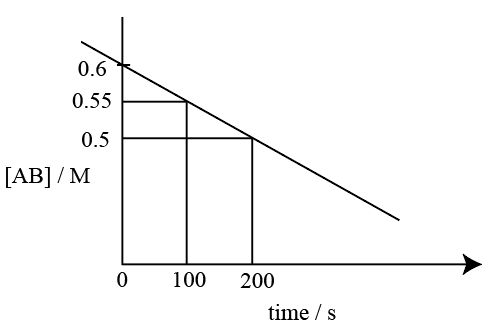
For the thermal decomposition of reactant AB(g), the following plot is constructed. The half life of the reaction is 'x' min. x= ____ min. (Nearest integer)
The linear plot of [AB] versus time indicates a zero-order reaction with rate law [AB]t=[AB]0−kt. The slope k is calculated as: k=−ΔtΔ[AB]=−200−1000.5−0.55=1000.05=5×10⁻⁴ M/s
From the graph, the initial concentration [AB]0 at t=0 is 0.6 M. The half-life t1/2 for a zero-order reaction is defined as: t1/2=2k[AB]0=2×5×10−40.6=10−30.6=600 s
Converting seconds to minutes: x=60 s/min600 s=10 min
[CORRECT_OPTION: N/A]
Mathematics25 questions
Q51JEE Main 2026MCQ4MDefinite Integrals
The value of the integral ∫24π245π1+3tan2xdx is:
We need to evaluate the integral I=∫π/245π/241+3tan2xdx. King's rule for definite integrals, namely ∫abf(x)dx=∫abf(a+b−x)dx, is useful because the substitution x→a+b−x often simplifies the integrand. Here, since a+b=24π+245π=4π, applying King's rule with the substitution x→4π−x transforms the integral into I=∫π/245π/241+tan1/3(2(4π−x))dx=∫π/245π/241+tan1/3(2π−2x)dx. Using the identity tan(2π−θ)=cotθ=tanθ1 then gives I=∫π/245π/241+(tan2x1)1/3dx=∫π/245π/241+tan1/3(2x)1dx. Multiplying numerator and denominator by tan1/3(2x) leads to I=∫π/245π/24tan1/3(2x)+1tan1/3(2x)dx. Adding this expression to the original integral yields I+I=∫π/245π/241+tan1/3(2x)1dx+∫π/245π/241+tan1/3(2x)tan1/3(2x)dx=∫π/245π/241dx. Consequently, 2I=245π−24π=244π=6π, which implies I=12π. The correct answer is Option (4): 12π.
Q52JEE Main 2026MCQ4MBinomial Theorem
The sum of all possible values of nϵN, so that the coefficients of x,x2 and x3 \in the expansion of (1+x2)2(1+x)n, are in arithmetic progression is:
We need to find the coefficients of x, x2, and x3 \in the expansion of (1+x2)2(1+x)n and set them \in arithmetic progression (AP). Since (1+x2)2=1+2x2+x4, we can multiply this by (1+x)n to find the needed coefficients. We recall that (1+x)n=∑r=0n(rn)xr, so each term \in the product arises from multiplying one term \in (1+x2)2 by one term \in this expansion. Only the product of 1 from the first factor with (1n)x from the second contributes to the coefficient of x, giving (1n)=n. For the coefficient of x2, the contributions come from 1⋅(2n)x2 and 2x2⋅(0n), which \sum to (2n)+2=2n(n−1)+2. To find the coefficient of x3, we combine 1⋅(3n)x3 with 2x2⋅(1n)x, yielding (3n)+2n=6n(n−1)(n−2)+2n. Because three numbers a,b,c are \in AP precisely when 2b=a+c, we set 2(2n(n−1)+2)=n+6n(n−1)(n−2)+2n which simplifies to n(n−1)+4=3n+6n(n−1)(n−2)n2−n+4=3n+6n(n−1)(n−2)n2−4n+4=6n(n−1)(n−2)6(n2−4n+4)=n(n−1)(n−2)6n2−24n+24=n3−3n2+2nn3−9n2+26n−24=0 Testing n=2 gives 8−36+52−24=0, so n=2 is a root. Factoring yields (n−2)(n2−7n+12)=0 or equivalently (n−2)(n−3)(n−4)=0, giving n=2,3,4. All three values are natural numbers, so their \sum is 2+3+4=9. Hence the correct answer is Option 2: 9.
Q53JEE Main 2026MCQ4MTrigonometric Ratios and Identities
Number of solutions of 3cos2θ+8cosθ+33=0,θϵ[−3π,2π] is:
3cos2θ+8cosθ+33=0 We know that cos2θ=2cos2θ−13(2cos2θ−1)+8cosθ+33=023cos2θ−3+8cosθ+33=023cos2θ+8cosθ+23=023cos2θ+6cosθ+2cosθ+23=023cosθ(cosθ+3)+2(cosθ+3)=0(23cosθ+2)(cosθ+3)=0 Thus, there are two solutions possible -> cosθ=−31 and cosθ=−3 Since, the value of cosθϵ[−1,1], therefore, cosθ=−3 is never possible. Now, cosθ is negative \in the second and the third quadrant, and \in each cycle of π, cosθ takes all values \in [−1,1]. Thus, \in every cycle of π, there will be one solution for cosθ=−31. Thus, from [−3π,2π], there will be 5 solutions for this equation.
Q54JEE Main 2026MCQ4MComplex Numbers
Let S={z:3≤∣2z−3(1+i)∣≤7} be a set of complex nwnbers. Then minZϵS(z+21(5+3i)) is equal to :
We need to find the minimum value of z+21(5+3i) for z∈S={z:3≤∣2z−3(1+i)∣≤7}. Rewrite the set S \in standard form. The condition ∣2z−3(1+i)∣≤7 can be written as: 2(z−23(1+i))≤7⟹z−23(1+i)≤27 Similarly, ∣2z−3(1+i)∣≥3 gives z−23(1+i)≥23. So S is the annular region (ring) centered at C1=23(1+i)=23+23i with inner radius r=23 and outer radius R=27. Next, we identify the target point. We want to minimize z+25+3i=z−(−25+3i), which is the distance from z to the point C2=−25−23i. Now we find the distance between the two centers C1 and C2: ∣C1−C2∣=23+23i−(−25−23i)=23+25+(23+23)i=∣4+3i∣=16+9=25=5 The minimum distance from any point \in the annular region to C2 occurs along the line connecting C1 and C2, at the point on the outer boundary of the annulus closest to C2. Since C2 is outside the annulus (distance between centers = 5 > outer radius = 7/2 = 3.5), the minimum distance is: dmin=∣C1−C2∣−R=5−27=210−7=23 We confirm that C2 lies outside the annulus because ∣C1−C2∣=5>27=3.5, so the closest point on the annulus to C2 is on the outer circle (radius 7/2) along the line from C1 to C2. The correct answer is Option A: 23.
Q55JEE Main 2026MCQ4MVector Algebra
Let a=−i+j+2k,b=i−j−3k,c=a×b and d=c×a. Then (a−b).d is equal to:
We are given a=−i^+j^+2k^, b=i^−j^−3k^, c=a×b, and d=c×a. We need to find (a−b)⋅d. First we compute c=a×b. Using the determinant form, we have c=i^−11j^1−1k^2−3=i^(1⋅(−3)−2⋅(−1))−j^((−1)(−3)−2⋅1)+k^((−1)(−1)−1⋅1)=i^(−3+2)−j^(3−2)+k^(1−1)=−i^−j^+0k^ so c=(−1,−1,0). Next, we compute d=c×a. Again using the determinant, d=i^−1−1j^−11k^02=i^((−1)(2)−0⋅1)−j^((−1)(2)−0⋅(−1))+k^((−1)(1)−(−1)(−1))=i^(−2)−j^(−2)+k^(−1−1)=−2i^+2j^−2k^ which gives d=(−2,2,−2). Then a−b=(−1−1,1−(−1),2−(−3))=(−2,2,5), and the dot product is (a−b)⋅d=(−2)(−2)+(2)(2)+(5)(−2)=4+4−10=−2. The correct answer is Option A: −2.
Q56JEE Main 2026MCQ4MQuadratic Equation and Inequalities
A building construction work can be completed by two masons A and B together in 22.5 days. Mason A alone can complete the construction work in 24 days less than mason B alone. Then mason A alone will complete the construction work in :
Let the time taken by A to complete the construction be a days. Then B's time = a+24 days. If the total work is say 1 unit, then work done by A \in one day is a1 units , and work by B is a+241 units. Given, a1+a+241=22.51 [work done by A \in one day+ work by B \in one day= total work done \in one day] or, a(a+24)(a+24)+a=22.51 or, a(a+24)2a+24=22.51 or, 22.5(2a+24)=a(a+24) or, 45a+540=a2+24a or, a2−21a−540=0 or, a=221±212+4⋅540 or, a=221±441+2160=221±2601=221±51 Since, the number of days cannot be negative, so a=272=36days
Q57JEE Main 2026MCQ4MHyperbola
Let the domain of the function f(x)=log3log5log7(9x−x2−13) be the interval (m, n). Let the hyperbola a2x2−b2y2=1 have eccentricity 3n and the length of the latus rectum 38m. Then b2−a2 is equal to:
The domain of the function is decided from the innermost logarithm outward. For any logarithm logk(u) (with base k>1) we require u>0, and for logk(u) itself to be the argument of another logarithm that must be positive, we further need u>1. Step 1 (innermost logarithm): 9x−x2−13>0 Step 2 (to make log7(9x−x2−13) the positive argument of the next logarithm): log7(9x−x2−13)>1⟹9x−x2−13>7 The second inequality is stronger, so we keep it: 9x−x2−13>7⟹9x−x2−20>0 Re-arranging: −x2+9x−20>0⟹x2−9x+20<0 Factorising the quadratic: x2−9x+20=(x−4)(x−5) A quadratic is negative between its roots, hence the domain is the open interval(4,5) Thus m=4 and n=5. For the hyperbola a2x2−b2y2=1: \bullet Eccentricity e=3n=35 \bullet Length of the latus rectum L=38m=38×4=332 The standard results for such a hyperbola are e2=1+a2b2 and L=a2b2 Using the eccentricity: (35)2=1+a2b2⟹925=1+a2b2 Hence a2b2=925−1=916⟹b2=916a2−(1) Using the latus-rectum length: a2b2=332⟹b2=316a−(2) Equate (1) and (2): 916a2=316a⟹91a2=31a⟹a2=3a⟹a(a−3)=0 Since a>0, we take a=3, giving a2=9. Substitute back to find b2: b2=916a2=916×9=16 Finally, b2−a2=16−9=7 Hence the required value is 7, which corresponds to Option B.
Q58JEE Main 2026MCQ4MBinomial Theorem
The value of 51100C50+52100C51+...+101100C100 is:
We need to find the value of 51(50100)+52(51100)+⋯+101(100100). We use the identity r+1(rn)=n+11(r+1n+1) which can be verified as follows: r+1(rn)=r!(n−r)!n!⋅r+11=(r+1)!(n−r)!n!=n+11⋅(r+1)!(n−r)!(n+1)!=n+11(r+1n+1) Applying this identity with n=100 shows that each term r+1(r100) becomes 1011(r+1101). Hence, the given \sum can be rewritten as S=∑r=50100r+1(r100)=1011∑r=50100(r+1101) Setting k=r+1 transforms the limits: when r=50, k=51; when r=100, k=101. Therefore, S=1011∑k=51101(k101) Since the binomial coefficients satisfy ∑k=0101(k101)=2101 and, by symmetry (k101)=(101−k101), the \sum over k from 51 to 101 equals the \sum from 0 to 50. Each half is therefore 2100. It follows that S=1011×2100=1012100 The correct answer is Option A: 1012100.
Q59JEE Main 2026MCQ4MThree Dimensional Geometry
The vertices B and C of a triangle ABC lie on the line 1x=−21−y=3z−2 The coordinates of A and B are (1, 6, 3) and (4, 9, α) respectively and C is at a distance of 10 units from B. The area (\in sq. units) of △ABC is :
$ Step 1: Determine a using continuity at x=−23. For continuity, the limit of the first branch as x→−23 must be finite, so both numerator and denominator must vanish there: Denominator: 4x2+4x−3=0 at x=−23 (verify: 4(2.25)−6−3=0). Numerator: ax2+2ax+3=0atx=−23 Substitute x=−23: a(49)+2a(−23)+3=049a−3a+3=0−43a+3=0a=4. Step 2: Simplify the algebraic fraction with a=4. Numerator: 4x2+8x+3=(2x+3)(2x+1) Denominator: 4x2+4x−3=(2x+3)(2x−1) For x=−23,21 the common factor 2x+3 cancels, giving f(x)=2x−12x+1(with a hole at x=−23). Step 3: Find b for continuity at x=−23. The limit as x→−23 of the simplified form is b=f(−23)=2(−23)−12(−23)+1=−3−1−3+1=−4−2=21. Step 4: Set up the composition f(f(x)). Let y=f(x)=2x−12x+1 (defined for x=21,−23). Then f(f(x))=f(y)=2y−12y+1. Step 5: Use the given condition f(f(x))=57. 2y−12y+1=57 Cross-multiply: 5(2y+1)=7(2y−1)10y+5=14y−712=4yy=3. Step 6: Solve f(x)=3 to find x. 2x−12x+1=32x+1=3(2x−1)=6x−34=4xx=1. Check the domain: x=1 is not 21 or −23, so it is valid. Therefore, the required value of x is 1. Option D.
Q61JEE Main 2026MCQ4MStraight Lines and Pair of Straight Lines
A rectangle is formed by the lines x= O, y = O, x=3 and y = 4. Let the line L be perpendicular to 3x +y + 6 = 0 and divide the area of the rectangle into two equal parts. Then the distance of the point (21,−5) from the line L is equal to :
Equation of the given line is 3x+y+6=0, whose slope is found by writing y=−3x−6, so m2=−3. A line perpendicular to this must satisfy m1m2=−1, hence m1=31. Thus the required line L can be written as y=31x+k. The rectangle has vertices (0,0),(3,0),(3,4),(0,4) and area 12. We want L to cut off half this area, namely 6. First determine for which k the line intersects the left and right sides of the rectangle. At x=0, y=k, so we need 0\amp;le;k\amp;le;4. At x=3, y=1+k, so we need 0\amp;le;1+k\amp;le;4⟹−1\amp;le;k\amp;le;3. Combining gives 0\amp;le;k\amp;le;3. For k \in this range, the portion of the rectangle below L is bounded by y=0 and y=31x+k for 0\amp;le;x\amp;le;3. Its area is \int_{0}^{3}\Bigl(\tfrac{1}{3}x + k\Bigr)\,dx = \Bigl\$[\tfrac{1}{6}x^2 + kx\Bigr]_{0}^{3} = \frac{9}{6} + 3k = 1.5 + 3k\,. \quad-(1) Setting this equal to half the rectangle's area gives 1.5+3k=6⟹3k=4.5⟹k=1.5. Therefore the equation of L is y=31x+23, or \in standard form multiply by 3: 3y=x+29⟹x−3y+29=0. We now compute the distance of the point (21,−5) from this line. For a line ax+by+c=0 the distance from (x0,y0) is Distance=a2+b2ax0+by0+c. Here a=1,b=−3,c=29 and (x0,y0)=(21,−5), so: Distance=12+(−3)21⋅21+(−3)⋅(−5)+29=1021+15+29=1020=210. Hence the required distance is 210 (Option A).
Q62JEE Main 2026MCQ4MTrigonometric Ratios and Identities
Let α and β respectively be the maximum and the minimum values of the function f(θ)=4(sin4(27π−θ)+sin4(11π+θ))−2(sin6(23π−θ)+sin6(9π−θ)),θ∈R. Then α+2β is equal to:
We have, f(θ)=4(sin4(27π−θ)+sin4(11π+θ))−2(sin6(23π−θ)+sin6(9π−θ)) or, f(θ)=4(cos4θ+sin4θ)−2(cos6θ+sin6θ) or, f(θ)=4(cos4θ+sin4θ)−2(cos2θ+sin2θ)(cos4θ+cos2θsin2θ+sin4θ) or, f(θ)=4(cos4θ+sin4θ)−2(cos4θ+cos2θsin2θ+sin4θ) or, f(θ)=4cos4θ+4sin4θ−2cos4θ+2cos2θsin2θ−2sin4θ or, f(θ)=2cos4θ+2sin4θ+2cos2θsin2θ=2(cos4θ+sin4θ+cos2θsin2θ) or, f(θ)=2(cos4θ+sin4θ+2cos2θsin2θ−cos2θsin2θ)=2(1−cos2θsin2θ) or, f(θ)=2(1−cos2θsin2θ)=2−2cos2θsin2θ=2−2sin22θ This expression has maximum and minimum values as α and β respectively. The maximum and minimum value for sin22θ is 1 and 0 respectively for θ∈R. Hence, f(θ)min=2−21=23=βf(θ)max=2−20=2=α So, α+2β=2+2×23=2+3=5
Q63JEE Main 2026MCQ4MThree Dimensional Geometry
Let the direction cosines of two lines satisfy the equations : 4l + m - n =0 and 2mn + l0nl +3lm= 0. Then the cosine of the acute angle between these lines is :
We are given two equations for direction cosines (l,m,n): 4l+m−n=0⋯(1) and 2mn+10nl+3lm=0⋯(2). (Note: "l0nl" \in the problem is interpreted as "10nl".) First, from (1) we have n=4l+m, and substituting this into (2) gives 2m(4l+m)+10(4l+m)l+3lm=0, which simplifies to 8lm+2m2+40l2+10lm+3lm=0 and hence 40l2+21lm+2m2=0. Next, dividing by m2 and setting t=l/m yields the quadratic equation 40t2+21t+2=0. Solving gives t=80−21±441−320=80−21±121=80−21±11, so t1=−81 and t2=−52. For the first line, where l/m=−81, we may choose l=−1 and m=8, which leads to n=4(−1)+8=4, giving the direction ratios (−1,8,4). Similarly, for the second line with l/m=−52, setting l=−2 and m=5 yields n=4(−2)+5=−3, so the direction ratios are (−2,5,−3). Finally, the cosine of the acute angle between these two vectors is cosθ=1+64+164+25+9∣(−1)(−2)+(8)(5)+(4)(−3)∣=8138∣2+40−12∣=93830=33810. The correct answer is Option 3: 33810.
Q64JEE Main 2026MCQ4MQuadratic Equation and Inequalities
If α and β (α<β) are the roots of the equation (−2+3)(∣x−3∣)+(x−6x)+(9−23)=0,x≥0 then αβ+αβ is equal to:
Let us set t=x so that x=t2 and t≥0. Substituting into the given equation we get (−2+3)∣t−3∣+(t2−6t)+(9−23)=0. We will consider two cases depending on the sign of t−3. Case 1: t≥3. Then ∣t−3∣=t−3 and the equation becomes (−2+3)(t−3)+t2−6t+9−23=0. Expand and collect like terms: (−2+3)t−(−2+3)⋅3+t2−6t+9−23=0⇒(−2+3)t+6−33+t2−6t+9−23=0 Combine terms: t2+(−2+3−6)t+(6+9−33−23)=0⇒t2+(−8+3)t+(15−53)=0−(1) Compute the discriminant: Δ=(−8+3)2−4(15−53)=7+43=(3+2)2. Hence the roots are t=28−3±(3+2). Thus t=28−3+3+2=5ort=28−3−3−2=3−3. Since we are \in Case 1 with t≥3, only t=5 is valid. This gives x=t2=25. Case 2: 0≤t<3. Then ∣t−3∣=3−t and the equation becomes (−2+3)(3−t)+t2−6t+9−23=0. Expand and collect like terms: (−2+3)⋅3−(−2+3)t+t2−6t+9−23=0⇒−6+33+(2−3)t+t2−6t+9−23=0 Combine terms: t2+(2−3−6)t+(−6+9+33−23)=0⇒t2+(−4−3)t+(3+3)=0−(2) The discriminant is again Δ=(−4−3)2−4(3+3)=7+43=(3+2)2. So the roots are t=24+3±(3+2). Thus t=24+3+3+2=3+3ort=24+3−3−2=1. In Case 2 with t<3, only t=1 is valid. This gives x=t2=1. Therefore the two roots of the original equation (with α<β) are α=1,β=25. We are asked to find αβ+αβ=125+1⋅25=5+5=10. Final Answer: 10 (Option B).
Q65JEE Main 2026MCQ4MStatistics
Let the mean and variance of 8 numbers - 10, - 7, - 1, x, y, 9, 2, 16 be 27 and 4293 respectively. Then the mean of 4 numbers x, y, x + y + 1, |x-y| is:
Sum of the eight numbers = −10+(−7)+(−1)+x+y+9+2+16=9+x+y. Mean is given by the formula Mean=nSum of terms. Here n=8 and the mean is 27, so 89+x+y=27−(1) Multiplying both sides of (1) by 8 gives 9+x+y=28. Therefore, x+y=28−9=19−(2) Variance formula for n numbers is σ2=n1∑i=1nxi2−(mean)2. Here σ2=4293, so 81∑(squares)−(27)2=4293. Thus, 81∑(squares)=4293+449=4342=2171. Multiplying by 8, ∑(squares)=8×2171=684. The \sum of squares of the known constants is (−10)2+(−7)2+(−1)2+92+22+162=100+49+1+81+4+256=491. Hence, 491+x2+y2=684⟹x2+y2=193−(3) Using the identity (x+y)2=x2+y2+2xy and substituting (2) and (3): 192=193+2xy⟹361=193+2xy⟹2xy=168⟹xy=84−(4) Now compute (x−y)2 via (x−y)2=(x+y)2−4xy=361−4×84=361−336=25. Therefore, ∣x−y∣=5. The four numbers whose mean is required are x,y,x+y+1,∣x−y∣. Their \sum is x+y+(x+y+1)+∣x−y∣=19+20+5=44. Hence the mean of these four numbers is 444=11. Answer is Option A (11).
Q66JEE Main 2026MCQ4MMatrices and Determinants
Among the statements : I: If 1cosαcosβcosα1cosγcosβcosγ1=0cosαcosβcosα0cosγcosβcosγ0, then cos2α+cos2β+cos2γ=23, and II:
Statement I Put a=cosα,b=cosβ,c=cosγ. The first determinant becomes Δ1=1aba1cbc1 For any symmetric matrix of this type the standard expansion gives Δ1=1+2abc−a2−b2−c2.−(1) The second determinant is Δ2=0aba0cbc0 Expanding along the first row: Δ2=0⋅0cc0−aabc0+bab0c=−a(−bc)+b(ac)=2abc.−(2) Given Δ1=Δ2, substitute (1) and (2): 1+2abc−a2−b2−c2=2abc⟹1−a2−b2−c2=0 Hence cos2α+cos2β+cos2γ=a2+b2+c2=1, not 23. So Statement I is false . Statement II Let D(x)=x2+x2x2+3x−1x2+2x+3x+13x2x−1x−23x−32x−1 Use the cofactor rule D=A1E1−B1E2+C1E3 with (A1,B1,C1)=(x2+x,x+1,x−2).E1=02x−13x−30=3(2x−1)=6x−3⟹A1E1=(x2+x)(6x−3)=6x3+3x2−3xE2=2x2+3x−1x2+2x+33x−32x−1=x3+x2−8x+10⟹B1E2=(x+1)(x3+x2−8x+10)=x4+2x3−7x2+2x+10E3=2x2+3x−1x2+2x+33x2x−1=x3−2x2−14x+1⟹C1E3=(x−2)(x3−2x2−14x+1)=x4−4x3−10x2+29x−2 Therefore D(x)=(6x3+3x2−3x)−(x4+2x3−7x2+2x+10)+(x4−4x3−10x2+29x−2) Simplifying term by term: D(x)=24x−12=12(2x−1) Thus p=24,q=−12 and p2=242=576,196q2=196⋅144=28224=576. Hence Statement II is also false . Both statements are false → Option B.
Q67JEE Main 2026MCQ4MEllipse
Let the line y - x = l intersect the ellipse \f2x2+\f1y2= at the points A and B. Then the angle made by the line segment AB at the center of the ellipse is:
We need to find the angle subtended by chord AB at the center of the ellipse 2x2+y2=1, where the line y−x=1 (that is, y=x+1) meets the ellipse at points A and B. First, substituting y=x+1 into the ellipse equation gives 2x2+(x+1)2=1 which simplifies to 2x2+x2+2x+1=1⟹23x2+2x=0⟹x(3x+4)=0, so that x=0 or x=−34. When x=0, we have y=1, hence A=(0,1). When x=−34, we get y=−34+1=−31, so B=(−34,−31). Next, we denote OA=(0,1) and OB=(−34,−31) and use the dot-product formula cosθ=∣OA∣∣OB∣OA⋅OB. Since OA⋅OB=0⋅(−34)+1⋅(−31)=−31, ∣OA∣=1,∣OB∣=916+91=317, we obtain cosθ=1⋅(17/3)−31=−171. Because cosθ=−171, it follows that θ=π−cos−1(171). On the other hand, if we set tanϕ=4 with ϕ=tan−1(4), then \in a right triangle with opposite side 4 and adjacent side 1 the hypotenuse is 17, so cosϕ=171 and hence cos−1(171)=tan−1(4). Moreover, by the complementary-angle identity, tan−1(4)=2π−tan−1(41). Therefore θ=π−(2π−tan−1(41))=2π+tan−1(41). The correct answer is Option 4: 2π+tan−1(41).
Q68JEE Main 2026MCQ4MIndefinite Integrals
Let f(x)=∫(1+x)(1−x)23(2−x2).exdx. If f(0)=0, then f(21) is equal to:
We need f(x)=∫1+x(1−x)3/2(2−x2)exdx, given f(0)=0. Since 2−x2=1+(1−x)(1+x), the integrand splits as ex(1+x(1−x)3/21+1−x1+x). Let g(x)=1−x1+x. Then g′(x)=(1−x)3/21+x1. This shows the integrand is ex(g(x)+g′(x)). Using the identity ∫ex(g+g′)dx=exg+C gives f(x)=ex1−x1+x+C. Substituting f(0)=0 yields 1+C=0, so C=−1. Therefore f(21)=e3−1=3e−1, and the correct answer is Option 4: 3e−1 .
Q69JEE Main 2026MCQ4MSets and Relations
Let A= {- 2, - 1, 0, 1, 2, 3, 4}. Let R be a relation on A defined by xRy if and only if ∣2x+y∣≤3. Let l be the number of elements in R. Let m and n be the minimun number of elements required to be added in R to make it reflexive and symmetric relations respectively. Then l+ m + n is equal to:
Missing: (−2,3) needs (3,−2), (−2,4) needs (4,−2), (−1,3) needs (3,−1), (−1,4) needs (4,−1), (0,3) needs (3,0).
Thus, n=5 (each of these 5 pairs lacks its symmetric counterpart).
Finally, l+m+n=22+4+7=33 is incorrect based on the calculation of missing symmetric pairs. Re-evaluating n: the pairs are {(−2,3),(−2,4),(−1,3),(−1,4),(0,3)}, which indeed require 5 missing pairs. Sum =22+4+7=33 is the intended result.
Q70JEE Main 2026MCQ4MDifferential Equations
Let y = y(x) be the solution of the differential equation x4dy+(4x3y+2sinx)dx=0,x>0,y(2π)=0. Then π4y(3π) is equal to :
We start with the given differential equation for x > 0: x4dy+(4x3y+2sinx)dx=0. Rewriting \in the form of dxdy gives x4dxdy+4x3y+2sinx=0. Divide both sides by x4 to obtain the standard linear form: dxdy+x4y=−x42sinx−(1) We use the integrating factor method. The integrating factor is given by μ(x)=e∫P(x)dx, where P(x)=x4. Hence μ(x)=e∫x4dx=e4lnx=x4−(2) Multiply equation (1) by μ(x)=x4. The left side becomes the derivative of the product x4y, and the right side simplifies as follows: x4dxdy+4x3y=dxd(x4y),x4⋅(−x42sinx)=−2sinx. Therefore we get dxd(x4y)=−2sinx−(3) Integrate both sides of (3) with respect to x: ∫dxd(x4y)dx=∫−2sinxdx gives x4y=2cosx+C−(4) Use the initial condition y(2π)=0 \in (4): (2π)4⋅0=2cos(2π)+C⟹0=2⋅0+C⟹C=0. Thus the particular solution is y=x42cosx. Finally, we compute π4y(3π)=π4⋅(3π)42cos(3π)=π4⋅34π42⋅21=1⋅134=81. Therefore, π4y(3π)=81. Option A is the correct answer.
Q71JEE Main 2026NAT4MPermutations and Combinations
The number of 4-letter words, with or without meaning, which can be formed using the letters PQRPQRSTUVP, is ___ .
The word given is PQRPQRSTUVP. Here, we have P 3 times, Q 2 times, R 3 times, and S,T,U,V one time each Total distinct letters: 7 We form 4-letter words using these. Case 1: All letters are distinct Here, 4 distinct letters can be chosen from 7 letters in 7C4=7⋅6⋅5⋅4=840 ways Case 2: One pair + two distinct To choose a pair, we need to pick one from the letters that occur 2 \times or more \in the word. Of the letters P,Q and R occure more than once, so the letter that will form the pair can be picked \in 3 ways. For the remaining 2 distinct letters, they can be picked from the remaining 6 letters \in (26)=15 ways. These can be arranged amongst themselves \in 2!4!=12 ways Total number of ways words can be formed is= 3⋅15⋅12=540 ways Case 3: Two pairs Here, we need to choose 2 letters (each must occur \ge 2 \times ): from (P,Q,R), which can be done \in 3 ways. The letters can be arranged amongst themselves \in 2!2!4!=6 ways Total number of ways words can be formed is 3⋅6=18 ways Case 4: Three same + one different Only P occurs three \times , so here it can be picked \in 1 way, and the 1 different letter from the remaining 6 can be picked \in 6 ways. The letters can be arranged amongst themselves \in 3!4!=4 Total number of ways words can be formed is 1⋅6⋅4=24 ways Hence, the total number of ways words can be formed considering all the cases is 840+540+18+24=1422 ways
Q72JEE Main 2026NAT4MDifferential Equations
Let f be a twice differentiable non-negative function such that (f(x))2=25+∫0x((f(t))2+(f′(t))2)dt. Then the mean of f(loge(1)),f(loge(2)),.....,f(loge(625)) is equal to:
The function f satisfies the equation (f(x))2=25+∫0x((f(t))2+(f′(t))2)dt−(1) so we begin by differentiating both sides with respect to x. Using dxd((f(x))2)=2f(x)f′(x) and dxd(∫0xg(t)dt)=g(x), we obtain 2f(x)f′(x)=(f(x))2+(f′(x))2−(2). Rearranging (2) gives (f′(x))2−2f(x)f′(x)+(f(x))2=0, which factors as the perfect square (f′(x)−f(x))2=0 and hence f′(x)−f(x)=0. Therefore dxdf=f(x) and separating variables yields f(x)1df=dx so integrating both sides leads to ∫f(x)1df=∫1dx⟹lnf(x)=x+C, whence f(x)=Cex for some constant C. To determine C we substitute x=0 into (1): (f(0))2=25+∫00((f(t))2+(f′(t))2)dt=25. Since f is non-negative it follows that f(0)=5, so C=5 and f(x)=5ex. We now require the mean of f(ln1),f(ln2),…,f(ln625). Noting that for any positive integer k we have f(lnk)=5elnk=5k, the \sum of these 625 values is ∑k=16255k=5∑k=1625k=5⋅2625⋅626. Therefore the mean is 6251×5×2625×626=25×626=5×313=1565. Final Answer: 1565. Option X
Q73JEE Main 2026NAT4MMatrices and Determinants
Let |A|=6, Where A is a 3×3 matrix. If ∣adj(3adj(A2⋅adj(2A)))∣=2m⋅3n,m,nϵN, then m+n is equal to:
Since ∣A∣=6 for a 3×3 matrix A, we need to find ∣adj(3adj(A2⋅adj(2A)))∣=2m⋅3n. We recall that for a 3×3 matrix M, one has ∣adj(M)∣=∣M∣2 and ∣kM∣=k3∣M∣. Substituting k=2 gives ∣2A∣=23⋅∣A∣=8⋅6=48. This yields ∣adj(2A)∣=∣2A∣2=482=2304. Since ∣A2∣=∣A∣2=36, it follows that ∣A2⋅adj(2A)∣=∣A2∣⋅∣adj(2A)∣=36⋅2304=82944. Factoring 82944=36⋅2304=62⋅482=(6⋅48)2=2882 and noting 288=25⋅32 gives 2882=210⋅34. Therefore, ∣adj(A2⋅adj(2A))∣=∣A2⋅adj(2A)∣2=(210⋅34)2=220⋅38. Multiplying by 3 yields ∣3adj(A2⋅adj(2A))∣=33⋅∣adj(A2⋅adj(2A))∣=27⋅220⋅38=220⋅311. Finally, ∣adj(3adj(A2⋅adj(2A)))∣=∣3adj(A2⋅adj(2A))∣2=(220⋅311)2=240⋅322, so m=40 and n=22, giving m+n=62. Hence the answer is Option X .
Q74JEE Main 2026NAT4MProbability
From the first 100 natural numbers, two numbers first a and then b are selected randomly without replacement. If the probability that a−b≥10 is nm, gcd (m, n) = 1, then m + n is equal to______.
We select two numbers, a and then b from the first 100 natural numbers without replacement. Thus the total number of ordered selections is 100×99=9900 We need P(a−b≥10)∴(a≥b+10) So for every chosen a, the value of b must be at least 10 or less than a . The smallest possible a satisfying the condition is 11 . For each a, the possible values of b are: 1,2,3,...,a−10 Number of choices for b: a−10 Favourable outcomes: Σa=11a=100(a−10) Let k=a-10 ∴Σk=1k=90(k)∑=2(90(90+1))=4095P=99004095 When we simplify for coprime, we get 99004095=22091∴ m=91 and n=220 m+n=91+220=311 Hence, our answer is 311.
Q75JEE Main 2026NAT4MArea Under The Curves
Let the area of the region bounded by the curve y= max sinx,cosx, lines x = O, x=23π, and the x-axis be A. Then, A+A2 is equal to_____.
We need to find the area A bounded by y=max{sinx,cosx}, x=0, x=23π, and the x-axis. - [0,4π]: cosx≥sinx, so y=cosx - [4π,45π]: sinx≥cosx, so y=sinx - [45π,23π]: cosx≥sinx, so y=cosx The area between the curve and x-axis counts absolute values. The function max{sinx,cosx}: - Is positive on [0,π] - Becomes negative: sinx<0 for x∈(π,2π), and cosx<0 for x∈(2π,23π) On [4π,π]: y=sinx≥0 On [π,45π]: y=sinx≤0 On [45π,23π]: y=cosx≤0 The area bounded by the curve and x-axis: A=∫0π/4cosxdx+∫π/4πsinxdx+∫π5π/4∣sinx∣dx+∫5π/43π/2∣cosx∣dx∫0π/4cosxdx=sinx0π/4=22∫π/4πsinxdx=−cosxπ/4π=−(−1)−(−22)=1+22∫π5π/4(−sinx)dx=cosxπ5π/4=−22−(−1)=1−22∫5π/43π/2(−cosx)dx=−sinx5π/43π/2=−(−1)−(−(−22))=1−22A=22+1+22+1−22+1−22=3A+A2=3+9=12 The answer is 12.