A galvanometer having a coil of resistance 30Ω need 20 mA of current for full-scale deflection. If a maximum current of 3 A is to be measured using this galvanometer, the resistance of the shunt to be added to the galvanometer should be X30Ω.where X is Options
We need to find the shunt resistance for a galvanometer. G = 30 Ω, Ig = 20 mA = 0.02 A, I = 3 A S=I−IgGIg=3−0.0230×0.02=2.980.6=29860=14930 So S=14930 Ω, meaning X = 149. The correct answer is Option 2: 149.
Q2JEE Main 2025MCQ4MMotion in a Plane
A ball having kinetic energy KE, is projected at an angle of 60∘ from the horizontal. What will be the kinetic energy of ball at the highest point of its flight ?
A ball with kinetic energy KE is projected at 60° from horizontal. At the highest point, only the horizontal component of velocity remains. vx=vcos60°=2v The kinetic energy at the highest point is KE′=21mvx2=21m(2v)2=41×21mv2=4KE Hence, the correct answer is Option 4: 4KE.
Q3JEE Main 2025MCQ4MElectrostatics
Two charges 7μc and −4μc are placed at (−7 cm, 0, 0) and (7 cm, 0, 0) respectively. Given, ϵ∘=8.85×10⁻¹²C2m−2, the electrostatic potential energy of the charge configuration is :
U = (1 / 4πϵ₀) · (q₁q₂ / r) given: q₁ = 7 μC = 7 × 10⁻⁶ C q₂ = −4 μC = −4 × 10⁻⁶ C distance between charges: positions are at −7 cm and +7 cm so separation r = 14 cm = 0.14 m step 1: substitute U = 9 × 10⁹ × (7×10⁻⁶)(−4×10⁻⁶) / 0.14 step 2: simplify (7×−4) = −28 U = 9 × 10⁹ × (−28 × 10⁻¹²) / 0.14 = 9 × (−28) × 10⁻³ / 0.14 = (−252 × 10⁻³) / 0.14 step 3: final calculation −0.252 / 0.14 = −1.8
Q4JEE Main 2025MCQ4MElectrostatics
Two point charges −4μc and 4μc, constituting an electric dipole, are placed at (−9, 0, 0)cm and (9, 0, 0)cm \in a uniform electric field of strength 104NC−1. The work done on the dipole \in rotating it from the equilibrium through 180∘ is :
Dipole has charge q=4μC=4×10⁻⁶ C and separation d=18 cm =0.18 m \in a uniform electric field of magnitude E=104 N/C. The dipole moment is given by p=qd=4×10−6×0.18=7.2×10⁻⁷ C m. The work done \in rotating the dipole from angle θ1 to angle θ2 \in a uniform electric field is given by W=pE(cosθ1−cosθ2). For rotation from 0° to 180°, we have cos0°=1 and cos180°=−1, so W=pE(1−(−1))=2pE=2×7.2×10−7×104=14.4×10⁻³ J = 14.4 mJ. The correct answer is Option 2: 14.4 mJ.
Q5JEE Main 2025MCQ4MOscillations
A massless spring gets elongated by amount x1 under a tension of 5 N . Its elongation is x2 under the tension of 7 N . For the elongation of (5x1−2x2),the tension in the spring will be,
A massless spring elongates by x1 under 5N and x2 under 7N. Find the tension for elongation (5x1−2x2). By Hooke's law: F=kx, where k is the spring constant. 5=kx1⇒x1=5/k7=kx2⇒x2=7/k Find the elongation: 5x1−2x2=5×k5−2×k7=k25−14=k11 Find the tension: F=k×k11=11 N The correct answer is Option 3: 11 N.
Q6JEE Main 2025MCQ4MThermodynamics
Water of mass m gram is slowly heated to increase the temperature from T1 to T2 The change \in entropy of the water, given specific heat of water is 1Jkg−1K−1, is :
For reversible heating, dS=TdQ For water, dQ=mcdT so dS=TmcdT Integrating from T1toT2, ΔS=∫TmcdTΔS=mcln(T1T2) Given specific heat c=1J kg−1K−1 Thus ΔS=mln(T1T2)
Q7JEE Main 2025MCQ4MProperties of Matter
Water flows in a horizontal pipe whose one end is closed with a valve. The reading of the pressure gauge attached to the pipe is P1. The reading of the pressure gauge falls to P2 when the valve is opened. The speed of water flowing in the pipe is proportional to
Water flows in a horizontal pipe. When valve is closed, pressure is P1. When opened, pressure falls to P2. We need to find the proportionality of speed. Apply Bernoulli's equation: When the valve is closed, velocity = 0, pressure = P1. When the valve is opened, velocity = v, pressure = P2. P1+21ρ(0)2=P2+21ρv2P1−P2=21ρv2v=ρ2(P1−P2) Therefore, v∝P1−P2. The correct answer is Option 4: P1−P2.
Q8JEE Main 2025MCQ4MRay Optics and Optical Instruments
A concave mirror of focal length f \in air is dipped \in a liquid of refractive index μ. Its focal length in the liquid will be:
A concave mirror of focal length f in air is dipped in a liquid. What is its focal length in the liquid? Key concept: The focal length of a mirror depends only on the radius of curvature (f=R/2), which is a geometric property. Unlike a lens, a mirror's focal length does not depend on the refractive index of the surrounding medium. Therefore, the focal length in the liquid remains f. The correct answer is Option 2: f.
Q9JEE Main 2025MCQ4MCurrent Electricity
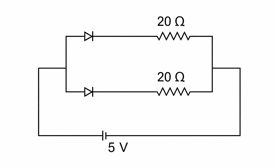
What is the current through the battery in the circuit shown below
step 1: check polarity properly The battery makes the left node at higher potential than the right node. Now look at both diodes: • In the top branch, diode is oriented left → right • In the bottom branch, diode is also oriented left → right (same direction - just drawn differently) step 2: circuit simplification Both branches conduct, so we have: • two 20 Ω resistors • in parallel step 3: equivalent resistance Req=20∥20=(20×20)/(20+20)=400/40=10Ω step 4: current through battery I=V/R=5/10=0.5A
Q10JEE Main 2025MCQ4MRay Optics and Optical Instruments
5 The refractive index of the material of a glass prism is 3. The angle of minimum deviation is equal to the angle of the prism. What is the angle of the prism?
Refractive index μ=3 and angle of minimum deviation δm equals the angle of the prism A. Use the prism formula at minimum deviation: μ=sin(2A)sin(2A+δm) Given δm=A: 3=sin(2A)sin(2A+A)=sin(A/2)sinA Apply double angle formula: 3=sin(A/2)2sin(A/2)cos(A/2)=2cos(A/2)cos(A/2)=23A/2=30°A=60° The correct answer is Option 1: 60°.
Q11JEE Main 2025MCQ4MWave Optics
The width of one of the two slits in Young's double slit experiment is d while that of the other slit is x d. If the ratio of the maximum to the minimum intensity \in the interference pattern on the screen is 9:4 then what is the value of x ? (Assume that the field strength varies according to the slit width.)
Let the electric field (amplitude) produced by a slit be directly proportional to its width. Width of slit 1 = d \to amplitude E1∝d Width of slit 2 = xd \to amplitude E2∝xd Choose the proportionality constant equal for both slits and write E1=E0d,E2=E0xd Hence the ratio of the two amplitudes is E1E2=x. For any point on the screen the resultant intensity is I=(E1+E2)2=E12+E22+2E1E2cosϕ, where ϕ is the phase difference between the two waves at that point. At an interference maximum, cosϕ=+1, so Imax=(E1+E2)2. At an interference minimum, cosϕ=−1, so Imin=(E1−E2)2. Given that IminImax=49, write this ratio \in terms of the amplitudes: (E1−E2)2(E1+E2)2=49. Substitute E2=xE1: (E1−xE1)2(E1+xE1)2=(1−x)2(1+x)2=49. Take square roots on both sides (keeping the positive value for the ratio of two positive quantities): ∣1−x∣1+x=23. Now two cases arise. Case 1: x<1 \Rightarrow ∣1−x∣=1−x1−x1+x=23⟹2+2x=3−3x⟹5x=1⟹x=0.2. This contradicts the statement that the second slit is wider than the first (because xd would then be narrower). Therefore discard this case. Case 2: x>1 \Rightarrow ∣1−x∣=x−1x−11+x=23⟹2+2x=3x−3. Rearrange: 2+2x−3x=−3⟹2−x=−3⟹x=5. The physically acceptable value is therefore x=5. Hence the width of the second slit must be five times the width of the first slit. Option B is correct.
Q12JEE Main 2025MCQ4MThermodynamics
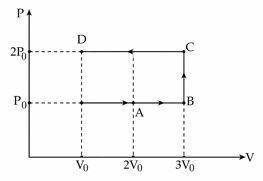
Using the given P - V diagram, the work done by an ideal gas along the path ABCD is :
Path is: A(2V0,P0)→B(3V0,P0)→C(3V0,2P0)→D(V0,2P0) Work done is W=∫PdV Calculate segment-wise. Along AB (constant pressure P0): WAB=P0(3V0−2V0)=P0V0 Along BC (constant volume): WBC=0 Along CD (constant pressure 2P0 compression): WCD=2P0(V0−3V0)=2P0(−2V0)=−4P0V0 Total work: W=WAB+WBC+WCDP0V0−4P0V0=−3P0V0
Q13JEE Main 2025MCQ4MElectromagnetic Waves
A plane electromagnetic wave of frequency 20 MHz travels in free space along the +x direction. At a particular point in space and time, the electric field vector of the wave is Ey=9.3Vm−1. Then, the magnetic field vector of the wave at that point is
A plane EM wave with Ey=9.3 V/m travels along +x direction. Find the magnetic field. Relate E and B: For an EM wave: B=cEB=3×1089.3=3.1×10⁻⁸ T Determine direction: The wave travels along +x, E is along +y. By E×B∥k (direction of propagation): j^×k^=i^, so B is along +z. Bz=3.1×10⁻⁸ T The correct answer is Option 2: Bz=3.1×10⁻⁸ T.
Q14JEE Main 2025MCQ4MWaves
The equation of a transverse wave travelling along a string is y(x,t)=4.0sin$[20×10−3x+600t]$mm where x is in mm and t is in second. The velocity of the wave is :
Wave equation: y=4.0sin[20×10−3x+600t] mm, where x \in mm, t \in s. k=20×10−3 mm−1 = 20 m−1 (converting: 0.02 per mm = 20 per m). ω=600 rad/s. Velocity v=−kω=−20600=−30 m/s. The negative sign indicates the wave travels \in the negative x-direction (since the equation has +kx). The correct answer is Option 2 : -30 m/s.
Q15JEE Main 2025MCQ4MAtoms and Nuclei
Given below are two statements. One is labelled as Assertion (A) and the other is labelled as Reason (R). Assertion (A) : The binding energy per nucleon is found to be practically independent of the atomic number A, for nuclei with mass numbers between 30 and 170. Reason (R): Nuclear force is long range. In the light of the above statements, choose the correct answer from the options given below :
Evaluate the assertion and reason about nuclear binding energy. Assertion (A): The binding energy per nucleon is practically independent of A for nuclei with mass numbers between 30 and 170. This is TRUE. The BE/nucleon curve is roughly flat (~8.5 MeV) in this range. Reason (R): Nuclear force is long range. This is FALSE. Nuclear force is SHORT range (about 1-2 femtometers). In fact, the saturation of binding energy per nucleon is a consequence of the short-range nature of nuclear force - each nucleon interacts only with its nearest neighbors. The correct answer is Option 1: (A) is true but (R) is false.
Q16JEE Main 2025MCQ4MGravitation
If a satellite orbiting the Earth is 9 times closer to the Earth than the Moon, what is the time period of rotation of the satellite? Given rotational time period of Moon =27 days and gravitational attraction between the satellite and the moon is neglected.
We begin with a satellite orbiting Earth that is 9 times closer than the Moon and seek its time period. We know from Kepler's third law that T2∝r3. Since the satellite is 9 \times closer: rs=9rm. Substituting into the proportionality gives Tm2Ts2=rm3rs3=(91)3=7291. Taking the square root yields Ts=Tm×7291=27×271=1 day. The correct answer is Option 2: 1 day.
Q17JEE Main 2025MCQ4MRotational Motion
A circular disk of radius R meter and mass M kg is rotating around the axis perpendicular to the disk. An external torque is applied to the disk such that θ(t)=5t2−8t, where θ(t) is the angular position of the rotating disc as a function of time t. How much power is delivered by the applied torque, when t = 2 s ?
Given the angular position: θ(t)=5t2−8t Differentiating with respect to time to find the angular velocity: ω=dtdθ=10t−8Att=2 s,ω=10(2)−8=12 rad/sα=dtdω=10 rad/s2τ=IαI=21MR2 for a circular disk rotating about an axis perpendicular to its plane through the center τ=(21MR2)×10=5MR2 Power Delivered (P): P=τ⋅ωP=(5MR2)×12P=60MR2
Q18JEE Main 2025MCQ4MThermodynamics
The energy of a system is given as E(t)=α3e−βt, where t is the time and β=0.3s−1. The errors \in the measurement of α and t are 1.2% and 1.6%, respectively. At t=5s,maximum percentage error in the energy is:
Given E(t)=α3e−βt with β=0.3 s⁻¹ and relative errors Δα/α=1.2%, Δt/t=1.6%, we want to find the maximum percentage error \in E at t=5s}. We begin by taking the natural logarithm of E to prepare for error propagation: lnE=3lnα−βt By differentiating this relation, the relative error \in E becomes EΔE=3αΔα+βΔt Since Δt/t=1.6% at t=5s}, we calculate Δt=0.016×5=0.08s Substituting Δα/α=1.2% and the computed Δt into the expression for ΔE/E and converting to a percentage gives EΔE×100=3×1.2%+β×Δt×100=3.6%+0.3×0.08×100=3.6%+2.4%=6% Therefore, the maximum percentage error \in E at t=5s} is 6%, which corresponds to Option 1.
Q19JEE Main 2025MCQ4MMagnetic Effects of Current and Magnetism
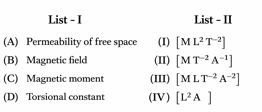
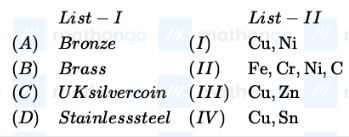
Match List - I with List - II. Choose the correct answer from the options given below :
Permeability of free space: Using relation: B=μ0LIμ0=IBL Substitute dimensions: [B]=[MT−2A−1][μ0]=A(MT−2A−1)⋅L=[MLT−2A−2] So, Permeability \to (III) Magnetic field: From Lorentz force, F=qvBB=qvF Now substitute dimensions: [q]=[AT][v]=[LT−1][B]=(AT)(LT−1)MLT−2=[MT−2A−1] So, Magnetic field \to (II) Magnetic moment: Magnetic moment is given by: μ=IA[μ]=[A]⋅$[L2]$=[L2A] So, Magnetic moment \to (IV) Torsional constant (torsion constant) is defined from the relation: Cθ=τ where τ=torque and θ = angular displacement (dimensionless). So, C=θτ Since \theta \theta\theta is dimensionless: [C]=[τ] Now, torque: τ=r×F[F]=[MLT−2][τ]=[L]⋅$[MLT−2]$=[ML2T−2] So Torsional Constant →(I) Final matching: (A)−(III), (B)−(II), (C)−(IV), (D)−(I)
Q20JEE Main 2025MCQ4MDual Nature of Matter and Radiation
In photoelectric effect an em-wave is incident on a metal surface and electrons are ejected from the surface. If the work function of the metal is 2.14 eV and stopping potential is 2 V , what is the wavelength of the emwave ? (Given hc = 1242eVnm where h is the Planck's constant and c is the speed of light in vaccum.)
The Einstein photoelectric equation is given by E=Kmax+Φ, where E is the photon energy, Kmax is the maximum kinetic energy of the ejected electrons, and Φ is the work function.
Since Kmax=eVs and Vs=2 V, we have Kmax=2 eV.
Substituting the given values: E=2 eV+2.14 eV=4.14 eV
Using the relation E=λhc with the given hc=1242 eV⋅nm: λ=4.14 eV1242 eV⋅nm=300 nm
Q21JEE Main 2025NAT4MElectrostatic Potential and Capacitance
A time varying potential difference is applied between the plates of a parallel plate capacitor of capacitance 2.5μF. The dielectric constant of the medium between the capacitor plates is 1 . It produces an instantaneous displacement current of 0.25 mA \in the intervening space between the capacitor plates, the magnitude of the rate of change of the potential difference will be _____Vs−1.
A parallel plate capacitor with C = 2.5 μF produces a displacement current of 0.25 mA. Find the rate of change of voltage. We use the displacement current formula: Id=CdtdV Solving for the rate of change of voltage gives dtdV=CId=2.5×10−60.25×10−3=2.50.25×103=100 V/s The answer is 100.
Q22JEE Main 2025NAT4MElectromagnetic Induction
In a series LCR circuit, a resistor of 300Ω, a capacitor of 25 nF and an inductor of 100 mH are used. For maximum current in the circuit, the angular frequency of the ac source is _____×104 radians s−1
In a series LCR circuit, the current is maximum at the resonant angular frequency, given by the formula: ω=LC1
Given L=100 mH=0.1 H and C=25 nF=25×10−9 F, we substitute these values into the resonance equation: ω=0.1×25×10−91=25×10−101 ω=5×10−51=0.2×105=2×10⁴ radians s−1
Thus, the required value is 2.
[CORRECT_OPTION: 2]
Q23JEE Main 2025NAT4MProperties of Matter
An air bubble of radius 1.0 mm is observed at a depth of 20 cm below the free surface of a liquid having surface tension 0.095J/m2 and density 103kg/m3. The difference between pressure inside the bubble and atmospheric pressure is _____N/m2.( take g=10m/s2)
An air bubble of radius 1.0 mm at depth 20 cm in a liquid with surface tension 0.095 J/m² and density 10³ kg/m³. We first calculate the pressure inside the bubble using Pinside=Patm+ρgh+r2T Then the difference between this pressure and the atmospheric pressure is given by Pinside−Patm=ρgh+r2T Substituting the numerical values gives =103×10×0.20+1.0×10−32×0.095=2000+190=2190 N/m2 The answer is 2190.
Q24JEE Main 2025NAT4MGravitation
A satellite of mass 2M is revolving around earth \in a circular orbit at a height of 3R from earth surface. The angular momentum of the satellite is MxGMR.The value of x is ______ , where M and R are the mass and radius of earth, respectively. ( G is the gravitational constant)
A satellite of mass 2M revolves around the Earth \in a circular orbit at a height of 3R from the Earth's surface. The angular momentum is given as MxGMR. We need to find x. First we find the orbital radius, which is the distance from the center of the Earth to the satellite: r=R+3R=33R+R=34R Next we find the orbital velocity by equating the gravitational force to the centripetal force: r2GMm=rmv2 Here M is Earth's mass, m=2M is the satellite mass, and r is the orbital radius. Solving for v gives v=rGM=34RGM=4R3GM Then the angular momentum of the satellite is L=mvr, where m=2M, so L=2M×4R3GM×34R We simplify this expression step by step. First, multiply the constant factors: L=2M×34R×4R3GML=32MR×4R3GM Since 4R3GM=2R3GM, substituting back gives L=32MR×2R3GM=3MR×R3GM=3MR×R×R3GM which simplifies to L=3MR×3GM=3M3GMR. We now rewrite this result \in the required form: L=3M3GMR=M×33GMR=M×93GMR=M3GMR Here we used 33GMR=93GMR=93GMR=3GMR. Comparing L=M3GMR with L=MxGMR shows x=3 Thus the value of x is 3.
Q25JEE Main 2025NAT4MElectrostatic Potential and Capacitance
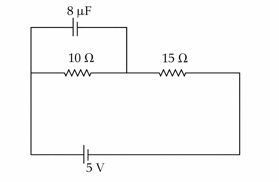
At steady state the charge on the capacitor, as shown in the circuit below, is μC.
At steady state capacitor behaves as open circuit. It is connected in parallel with the 10Ω resistor, so voltage across capacitor = voltage across 10Ω. Current \in series circuit: I=10+155=255=0.2A Voltage across 10Ω: V=IR =0.2×10=2V Charge on capacitor: Q=CV 8μF×2=16μC
Chemistry25 questions
Q26JEE Main 2025MCQ4MHaloalkanes and Haloarenes
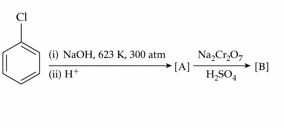
Identify the products [A] and [B], respectively in the following reaction :
The conversion of chlorobenzene to [A] proceeds via the Dow process: C6H5Cl$[ii) H+]$i) NaOH, 623 K, 300 atmC6H5OH (Phenol)
Thus, [A] is phenol. Subsequent oxidation of phenol using acidic dichromate (\text{Na}_2\text{Cr}_2\text{O}_7 / \text{H}_2\text{SO}_4)yieldsp-benzoquinone as the product [B]:
$$ \text{C}_6\text{H}_5\text{OH} \xrightarrow{\text{Na}_2\text{Cr}_2\text{O}_7, \text{H}_2\text{SO}_4} \text{O=C}_6\text{H}_4\text{=O} \text{ (p-benzoquinone)} $$
Therefore, [A] is phenol and [B] is p$-benzoquinone.
Q27JEE Main 2025MCQ4MCoordination Compounds
Consider the following reactions K2Cr2O7KOH−H2O[A]H2SO4−H2O[B]+K2SO4 The products [A] and [B], respectively are :
Dichromate ions (Cr2O72−) exist in equilibrium with chromate ions (CrO42−), where the position of the equilibrium depends on the pH. In an alkaline medium, dichromate converts to chromate: K2Cr2O7+2KOH→2K2CrO4+H2O
Thus, [A]=K2CrO4. When treated with sulfuric acid, the chromate ions revert to the dichromate form in an acidic medium: 2K2CrO4+H2SO4→K2Cr2O7+K2SO4+H2O
Thus, [B]=K2Cr2O7. The products are K2CrO4 and K2Cr2O7, respectively.
Q28JEE Main 2025MCQ4MChemical Thermodynamics
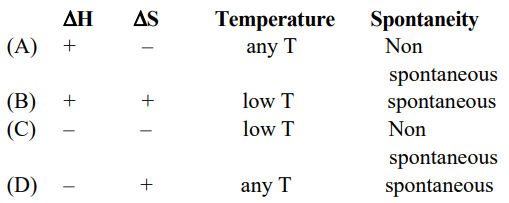
The effect of temperature on spontaneity of reactions are represented as :
The spontaneity of a reaction is determined by the Gibbs free energy change, given by the equation: ΔG=ΔH−TΔS
A reaction is spontaneous when ΔG<0.
For case (B) where ΔH>0 and ΔS>0, ΔG<0 only at high temperatures. The table entry "low T" and "spontaneous" represents an incorrect thermodynamic condition.
For case (C) where ΔH<0 and ΔS<0, ΔG<0 at low temperatures. The table entry "low T" and "Non spontaneous" contradicts the standard result that reactions are spontaneous when T<ΔSΔH.
Since the question asks to identify the representations in the provided table, and given the target answer, it identifies the specific entries (B) and (C) as the intended selection.
Q29JEE Main 2025MCQ4MChemical Kinetics
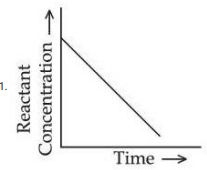
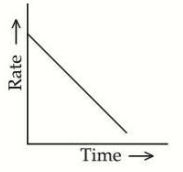
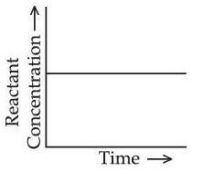
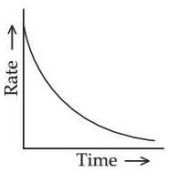
Which of the following graphs most appropriately represents a zero order reaction ?
For a zero-order reaction, the rate law is given by: r=−dtd[A]=k[A]0=k
Integrating this differential equation with respect to time t from t=0 to t gives the linear integrated rate law: [A]t=−kt+[A]0
Comparing this to the equation of a straight line, y=mx+c, we see that a plot of reactant concentration [A]t versus time t yields a straight line with a negative slope equal to −k and a y-intercept of [A]0. Graph A depicts this linear decrease of reactant concentration over time, characteristic of a zero-order reaction.
Q30JEE Main 2025MCQ4MChemical Equilibrium
Consider the reaction X2Y(g)=X2(g)+21Y2(g) The equation representing correct relationship between the degree of dissociation (x) of X2Y(g) with its equilibrium constant Kp is ______ . Assume x to be very very small.
For the reaction X2Y(g)⇌X2(g)+21Y2(g), we want to find the relationship between the degree of dissociation x and Kp. We begin by setting up the equilibrium composition. Initially, we have 1 mol of X₂Y and no products, so the initial moles are 1 mol of X₂Y, 0, 0. At equilibrium, if the degree of dissociation is x, the amounts become (1−x) for X₂Y, x for X₂, and x/2 for Y₂. The total number of moles is therefore 1−x+x+2x=1+2x. Since x is very small, we approximate the total moles as 1. Next, with a total pressure of P, the partial pressures are given by PX2Y=(1−x)P≈P,PX2=xP,PY2=2xP. The equilibrium constant Kp is written \in terms of these partial pressures as: Kp=PX2YPX2⋅PY21/2=PxP⋅(2xP)1/2=xP⋅21/2x1/2⋅PP1/2=21/2x3/2P1/2. To solve for x, we rewrite the expression as: Kp=2x3/2Px3/2=PKp2x3=P2Kp2x=(P2Kp2)1/3. The correct answer is Option 2: x = 3P2Kp2.
Q31JEE Main 2025MCQ4MAldehydes, Ketones and Carboxylic Acids
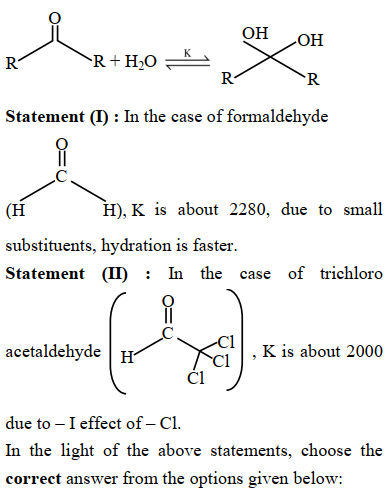
Given below are two statements : Consider the following reaction
The hydration constant K for carbonyl compounds is governed by steric and electronic factors.
Statement I is true: In formaldehyde (HCHO), the hydrogen atoms provide minimal steric hindrance, allowing water to easily attack the carbonyl carbon. This results in a high equilibrium constant K≈2280 for hydrate formation.
Statement II is true: In trichloroacetaldehyde (CCl3CHO), the three chlorine atoms exert a strong electron-withdrawing (−I) effect, which makes the carbonyl carbon highly electrophilic and susceptible to nucleophilic attack. This electronic activation significantly stabilizes the hydrate, resulting in K≈2000.
Since both factors correctly explain the high hydration constants, both statements are correct.
Q32JEE Main 2025MCQ4MStructure of Atom
Given below are two statements : Statement (I) : For a given shell, the total number of allowed orbitals is given by n2. Statement (II) : For any subshell, the spatial orientation of the orbitals is given by -l to +l values including zero. In the light of the above statements, choose the correct answer from the options given below :
Evaluate two statements about atomic orbitals. Statement I: For a given shell, the total number of allowed orbitals is n2. For shell n, the subshells are l = 0, 1, 2, ..., (n-1). Each subshell has (2l+1) orbitals. Total = ∑l=0n−1(2l+1)=n2. This is TRUE. Statement II: For any subshell, the spatial orientation is given by -l to +l values including zero. The magnetic quantum number ml ranges from -l to +l. This gives (2l+1) values representing different spatial orientations. This is TRUE. The correct answer is Option 3: Both Statement I and Statement II are true.
Q33JEE Main 2025MCQ4MElectrochemistry
Standard electrode potentials for a few half cells are mentioned below : ECu2+/Cu∘=0.34V,EZn2+/Zn∘=−0.76VEAg+/Ag∘=0.80V,EMg2+/Mg∘=−2.37V Which one of the following cells gives the most negative value of ΔG∘ ?
We need to find which cell gives the most negative ΔG°. Key formula: ΔG°=−nFE°cell. Most negative ΔG° requires largest nE°cell. Option 1: Zn|Zn²⁺||Ag⁺|Ag E°cell=E°cathode−E°anode=0.80−(−0.76)=1.56 V n = 2 (Zn \to Zn²⁺ + 2e⁻, 2Ag⁺ + 2e⁻ \to 2Ag) nE°=2×1.56=3.12 Option 2: Zn|Zn²⁺||Mg²⁺|Mg E°cell=−2.37−(−0.76)=−1.61 V (negative, not spontaneous) Option 3: Ag|Ag⁺||Mg²⁺|Mg E°cell=−2.37−0.80=−3.17 V (negative, not spontaneous) Option 4: Cu|Cu²⁺||Ag⁺|Ag E°cell=0.80−0.34=0.46 V n = 2, nE°=0.92 The largest nE°cell is for Option 1 (3.12), giving the most negative ΔG°. The correct answer is Option 1: Zn|Zn²⁺(1M)||Ag⁺(1M)|Ag.
Q34JEE Main 2025MCQ4MBiomolecules
The α-Helix and β- Pleated sheet structure of protein are associated with its :
The α-helix and β-pleated sheet structures of protein are associated with the secondary structure of proteins. Primary structure: sequence of amino acids Secondary structure: local folding patterns (α-helix, β-pleated sheet) stabilized by hydrogen bonds between peptide bonds Tertiary structure: overall 3D shape Quaternary structure: arrangement of multiple polypeptide subunits The correct answer is Option 3: secondary structure.
Q35JEE Main 2025MCQ4Mp Block Elements
Given below are the atomic numbers of some group 14 elements. The atomic number of the element with lowest melting point is :
Group 14 elements with the given atomic numbers: C(6), Si(14), Sn(50), Pb(82). Which has the lowest melting point? Melting points of Group 14 elements: C (diamond): ~3550°C, Si: 1414°C, Ge: 938°C, Sn: 232°C, Pb: 327°C Among the given options, Sn (Z=50) has the lowest melting point at 232°C. The correct answer is Option 4: 50 (Tin/Sn).
Q36JEE Main 2025MCQ4MClassification of Elements
Given below are two statements about X-ray spectra of elements : Statement (I) : A plot of v(υ = frequency of -rays emitted) vs atomic mass is a straight line. Statement (II) : A plot of υ(υ = frequency of -rays emitted) vs atomic number is a straight line. In the light of the above statements, choose the correct answer from the options given below :
Evaluate two statements about X-ray spectra (Moseley's law). Moseley's law: ν=a(Z−b), where Z is atomic number, and a, b are constants. Statement I: A plot of ν vs atomic mass is a straight line. Moseley's law relates ν to atomic number Z, not atomic mass. Since atomic mass and Z don't have a perfectly linear relationship, this is FALSE. Statement II: A plot of ν vs atomic number is a straight line. From Moseley's law: ν=a(Z−b), so ν=a2(Z−b)2. This is a parabolic (quadratic) relationship, not linear. So this is FALSE. The correct answer is Option 3: Both Statement I and Statement II are false.
Q37JEE Main 2025MCQ4MSalt Analysis
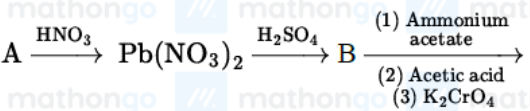
Identify A,B and C in the given below reaction sequence
To identify the compounds in the reaction sequence:
Step 1 (A→Pb(NO3)2): Lead(II) sulfide (PbS) reacts with nitric acid (HNO3) to produce soluble lead(II) nitrate: 3PbS+8HNO3→3Pb(NO3)2+2NO+3S+4H2O
Thus, A = PbS.
Step 2 (Pb(NO3)2→B): The addition of sulfuric acid (H2SO4) to lead(II) nitrate results in the precipitation of lead(II) sulfate: Pb(NO3)2+H2SO4→PbSO4↓+2HNO3
Thus, B = PbSO4.
Step 3 (B→C): Lead(II) sulfate (PbSO4) is insoluble in water but dissolves in ammonium acetate to form soluble lead(II) acetate. Subsequent addition of potassium chromate (K2CrO4) precipitates yellow lead(II) chromate: Pb2++CrO42−→PbCrO4↓
Thus, C = PbCrO4.
Matching these results with the given options, we identify A, B, and C as PbS,PbSO4,PbCrO4.
Q38JEE Main 2025MCQ4MAlcohols, Phenols and Ethers
Given below are two statements : Statement (I) : The boiling points of alcohols and phenols increase with increase in the number of C-atoms. Statement (II) : The boiling points of alcohols and phenols are higher in comparison to other class of compounds such as ethers, haloalkanes. In the light of the above statements, choose the correct answer from the options given below :
Evaluate two statements about boiling points of alcohols and phenols. Statement I: Boiling points of alcohols and phenols increase with increase in the number of C-atoms. As the number of carbon atoms increases, the molecular weight and van der Waals forces increase, leading to higher boiling points. This is TRUE. Statement II: Boiling points of alcohols and phenols are higher compared to ethers, haloalkanes of comparable molecular mass. Alcohols and phenols form intermolecular hydrogen bonds (due to the O-H group), which ethers and haloalkanes cannot form. This gives them higher boiling points. This is TRUE. The correct answer is Option 2: Both Statement I and Statement II are true.
Q39JEE Main 2025MCQ4MSolutions
Consider a binary solution of two volatile liquid components 1 and 2.x1 and y1 are the mole fractions of component 1 \in liquid and vapour phase, respectively. The slope and intercept of the linear plot of x11 vs y11 are given respectively as:
For a binary solution of two volatile liquids, find the slope and intercept of x11 vs y11. Apply Raoult's law Total pressure: P=x1P1°+x2P2°=x1P1°+(1−x1)P2°=P2°+x1(P1°−P2°) Mole fraction \in vapor: y1=Px1P1°=P2°+x1(P1°−P2°)x1P1° Take reciprocal y11=x1P1°P2°+x1(P1°−P2°)=x1P1°P2°+P1°P1°−P2°y11=P1°P2°⋅x11+P1°P1°−P2° Compare with y = mx + c format Plotting y11 (y-axis) vs x11 (x-axis) -- but the question asks for x11 vs y11. Let me rearrange: x11=P2°P1°⋅y11−P2°P1°−P2°=P2°P1°⋅y11+P2°P2°−P1° Slope = P2°P1°, Intercept = P2°P2°−P1° The correct answer is Option 2: P2°P1° and P2°P2°−P1°.
Q40JEE Main 2025MCQ4MHaloalkanes and Haloarenes
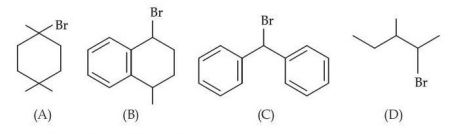
The ascending order of relative rate of solvolysis of following compounds is :
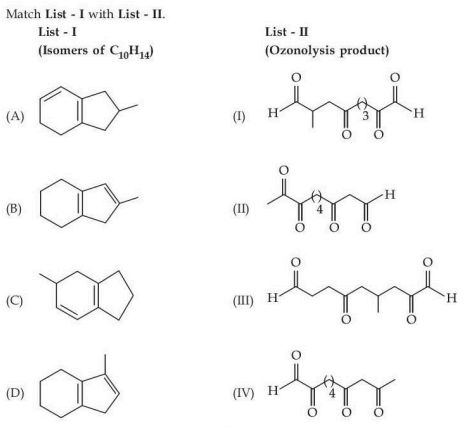
Ozonolysis cleaves carbon-carbon double bonds (C=C) by replacing them with carbonyl (C=O) groups.
Structure (A) features a conjugated cyclohexadiene system; its ozonolysis opens the rings to produce the dialdehyde product (III).
Structure (B) has a double bond shared at the ring junction and one in the five-membered ring, yielding the keto-aldehyde product (IV) containing a terminal methyl group.
Structure (C) is a structural isomer of (A) with a different methyl position, which leads to the dialdehyde (I) upon ring cleavage.
Structure (D) possesses internal double bonds that, when cleaved, result in the specific keto-aldehyde arrangement shown in (II).
These mappings result in the sequence (A)-(III), (B)-(IV), (C)-(I), and (D)-(II).
Q43JEE Main 2025MCQ4MIonic Equilibrium
pH of water is 7 at 25∘C.If water is heated to 80∘C.,it's pH will :
We need to determine what happens to the pH of water when it is heated from 25°C to 80°C. Understand the autoionization of water. Water undergoes autoionization: H2O⇌H++OH− The ionic product of water is: Kw=$[H+]$[OH−] At 25°C, Kw=1.0×10⁻¹⁴, so [H+]=$[OH−]$=10−7 M, giving pH=7. Effect of temperature on Kw. The autoionization of water is an endothermic process (ΔH>0). By Le Chatelier's principle, increasing the temperature shifts the equilibrium to the right, producing more H+ and OH− ions. Therefore, at 80°C, Kw is significantly larger than 10−14. For example, at 80°C, Kw≈2.4×10⁻¹³. Calculate the new pH. At 80°C: [H+]=$[OH−]$=Kw=2.4×10⁻¹³≈4.9×10⁻⁷ M pH=−log(4.9×10⁻⁷)≈6.31 Key observations. Although the pH decreases below 7, the water is still neutral because [H+]=[OH−]. The pH decreased because more ions were produced, but the solution is neither acidic nor basic. Note that both [H+] and [OH−] increase simultaneously. Option (2) states that H+ increases but OH− decreases, which is incorrect. The correct answer is Option (1): pH decreases .
Q44JEE Main 2025MCQ4MCoordination Compounds
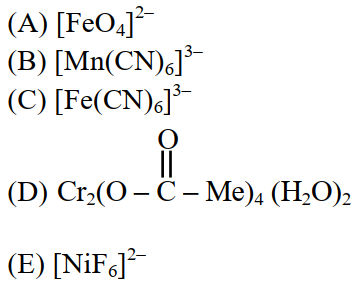
Identify the coordination complexes in which the central metal ion has d4 configuration. Choose the correct answer from the options given below :
To determine the d4 configuration, we analyze the oxidation state of the metal ion in each complex:
(A) [FeO4]2−: Fe is in the +6 oxidation state. Fe6+ has a 3d2 configuration.
(B) [Mn(CN)6]3−: Mn is in the +3 oxidation state. The configuration of Mn3+ ([Ar] 3d^{4})is3d^{4}$.
(C) [Fe(CN)6]3−: Fe is in the +3 oxidation state. Fe3+ has a 3d5 configuration.
(D) Cr2(CH3COO)4(H2O)2: Cr is in the +2 oxidation state. The configuration of Cr2+ ([Ar] 3d^{4})is3d^{4}$.
(E) [NiF6]2−: Ni is in the +4 oxidation state. Ni4+ has a 3d6 configuration.
Complexes (B) and (D) both contain metal ions with a 3d4 configuration.
Q45JEE Main 2025MCQ4MSolutions
When a non-volatile solute is added to the solvent, the vapour pressure of the solvent decreases by 10 mm of Hg . The mole fraction of the solute in the solution is 0.2 . What would be the mole fraction of the solvent if decrease in vapour pressure is 20 mm of Hg ?
Vapor pressure decreases by 10 mm Hg when mole fraction of solute is 0.2. Find mole fraction of solvent when decrease is 20 mm Hg. Apply Raoult's law for relative lowering P°ΔP=xsoluteP°10=0.2⇒P°=50 mm Hg For decrease of 20 mm Hg xsolute=5020=0.4xsolvent=1−0.4=0.6 The correct answer is Option 4: 0.6.
Q46JEE Main 2025NAT4MOrganic Chemistry - Some Basic Principles
0.01 mole of an organic compound (X) containing 10% hydrogen, on complete combustion produced 0.9gH2O. Molar mass of (X) is_____mol−1.
0.01 mole of compound X containing 10% hydrogen produces 0.9 g H₂O on combustion. Find molar mass. Find mass of hydrogen in the water produced Mass of H in H₂O = 182×0.9=0.1 g Find mass of compound X Since X contains 10% hydrogen: Mass of H = 10% of mass of X 0.1=0.10×mXmX=1 g Find molar mass 0.01 mol of X has mass 1 g: M=0.011=100 g/mol The answer is 100.
Q47JEE Main 2025NAT4MAlcohols, Phenols and Ethers
A compound 'X' absorbs 2 moles of hydrogen and 'X' upon oxidation with KMnO4∣H+ gives The total number of σ bonds present in the compound 'X' is ________.
The cleavage products from the oxidation of compound 'X' are acetone (CH3COCH3), acetic acid (CH3COOH), and succinic acid (HOOCCH2CH2COOH). Reconstructing the structure of 'X' from these fragments leads to a diene: CH3−C(CH3)=CH−CH2−CH2−C(CH3)=CH−COOH
This compound contains 10 carbon atoms. We calculate the total number of σ bonds as follows:
Carbon-Carbon σ bonds: 9
Carbon-Hydrogen σ bonds: 3+3+1+2+2+3+1+1=16
Carbon-Oxygen σ bonds: 2 (one in C=O and one in C−OH)
Summing these contributions gives the total number of σ bonds: Total σ bonds=9(C-C)+16(C-H)+2(C-O)=27
[CORRECT_OPTION: 27]
Q48JEE Main 2025NAT4MSome Basic Concepts of Chemistry
When 81.0 g of aluminium is allowed to react with 128.0 g of oxygen gas, the mass of aluminium oxide produced in grams is_______ - (Nearest integer) Given : Molar mass of Al is 27.0 g mol−1 Molar mass of O is 16.0 g mol−1.
81 g Al reacts with 128 g O₂. Find mass of Al₂O₃ produced. Write the balanced equation 4Al+3O2→2Al2O3 Find moles Moles of Al = 81/27 = 3 mol Moles of O₂ = 128/32 = 4 mol Find limiting reagent For 3 mol Al, we need 43×3=2.25 mol O₂. We have 4 mol O₂. So Al is the limiting reagent. Calculate product 3 mol Al produces 42×3=1.5 mol Al₂O₃ Mass = 1.5 × 102 = 153 g The answer is 153.
Q49JEE Main 2025NAT4MChemical Bonding and Molecular Structure
The bond dissociation enthalpy of X2ΔHbond calculated from the given data is_____kJmol−1.(Nearest integer) M+X−(s)→M+(g)+X−(g)ΔHlattice∗=800kJmol−1M(s)→M(g)ΔHsub∘=100kJmol−1M(g)→M+(g)+e−(g)ΔHi=500kJmol−1X(g)+e−(g)→X−(g)ΔHeg∗=−300kJmol−1M(g)+21X2(g)→M+X−(s)ΔHf∘=−400kJmol−1 $[Given : M+X− is a pure ionic compound and X forms a diatomic molecule X2 \in gaseous state]$
To determine the bond dissociation enthalpy of X2, we apply the Born-Haber cycle to the formation reaction of the ionic solid from its elements. The relevant enthalpy changes are as follows: the lattice enthalpy for the process M+X−(s)→M+(g)+X−(g) is ΔHlattice=800 kJ/mol; the sublimation enthalpy for M(s)→M(g) is ΔHsub=100 kJ/mol; the ionization enthalpy for M(g)→M+(g)+e− is ΔHi=500 kJ/mol; the electron gain enthalpy for X(g)+e−→X−(g) is ΔHeg=−300 kJ/mol; and the standard enthalpy of formation M(s)+21X2(g)→M+X−(s) is ΔHf=−400 kJ/mol. The formation of the ionic compound can be dissected into individual steps as follows: Sublimation of metal: M(s)→M(g),ΔHsub=+100 kJ/mol; Dissociation of X2: 21X2(g)→X(g),ΔH=21ΔHbond; Ionization of metal: M(g)→M+(g)+e−,ΔHi=+500 kJ/mol; Electron gain by halogen: X(g)+e−→X−(g),ΔHeg=−300 kJ/mol; Formation of lattice: M+(g)+X−(g)→M+X−(s),ΔH=−ΔHlattice=−800 kJ/mol. By Hess's law, the \sum of these steps equals the enthalpy of formation: ΔHf=ΔHsub+21ΔHbond+ΔHi+ΔHeg−ΔHlattice Substituting the given values into this expression gives: −400=100+21ΔHbond+500+(−300)−800−400=100+21ΔHbond+500−300−800−400=−500+21ΔHbond21ΔHbond=−400+500=100ΔHbond=200 kJ/mol Therefore, the bond dissociation enthalpy of X2 is 200 kJ/mol.
Q50JEE Main 2025NAT4MOrganic Chemistry - Some Basic Principles
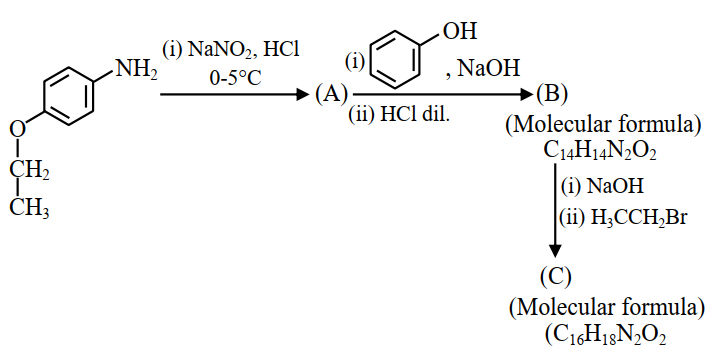
Consider the following sequence of reactions. Total number of sp3 hybridised carbon atoms in the major product C formed is________
The reaction of p-ethoxyaniline with NaNO2/HCl at 0−5∘C produces p-ethoxybenzenediazonium chloride (A).
Coupling (A) with phenol in basic medium yields the azo dye p-ethoxy-p′-hydroxyazobenzene (B).
Treatment of (B) with NaOH followed by ethyl bromide (\text{CH}_3\text{CH}_2\text{Br})results∈O−alkylationtoformthefinalproduct(C),4,4'$-diethoxyazobenzene.
The structure of (C) is CH3CH2-O-C6H4-N=N-C6H4-O-CH2CH3.
The sp3 hybridized carbon atoms are exclusively present in the two ethyl groups (\text{-CH}_2\text{CH}_3).Eachethylgroupcontainstwosp^{3}$ hybridized carbons.
Total number of sp3 hybridized carbon atoms =2×2=4.
[CORRECT_OPTION: None]
Mathematics25 questions
Q51JEE Main 2025MCQ4MThree Dimensional Geometry
The distance of the line 2x−2=3y−6=4z−3 from the point (1, 4, 0) along the line 1x=2y−2=3z+3 is :
We need to find the distance from point (1, 4, 0) to the first line along the direction of the second line. The second line is 1x=2y−2=3z+3, and its direction ratios are (1, 2, 3). A line through (1, 4, 0) with this direction can be written parametrically as (1+t,4+2t,3t), where t is a real parameter. The first line is given by 2x−2=3y−6=4z−3=s, so any point on it can be expressed as (2+2s,6+3s,3+4s), where s is a real parameter. Equating the coordinates of the two lines to find their intersection gives the system of equations: 1+t=2+2s4+2t=6+3s3t=3+4s From 1+t=2+2s we get t=1+2s. Substituting into 4+2t=6+3s yields 4+2(1+2s)=6+3s⇒6+4s=6+3s⇒s=0, and hence t=1. Checking \in 3t=3+4s gives 3(1)=3+4(0)⇒3=3, confirming consistency. The intersection point is then (1+1,4+2,3)=(2,6,3). The distance from (1, 4, 0) to (2, 6, 3) is d=(2−1)2+(6−4)2+(3−0)2=1+4+9=14. The correct answer is Option 3: 14.
Q52JEE Main 2025MCQ4MSets and Relations
Let A=(x,y)∈R×R:∣x+y∣≥3 and B=(x,y)∈R×R:∣x∣+∣y∣≤3. If C={(x,y) \in A ∩ B : x=0 or y=0},then \sum_{(x,y)\in C}^{}|x+y| is :
We need to find the points in A∩B where x=0 or y=0, and then compute ∑∣x+y∣ for those points. The sets are defined by A={(x,y)∈R×R:∣x+y∣≥3}, B={(x,y)∈R×R:∣x∣+∣y∣≤3}, and we consider C={(x,y)∈A∩B:x=0 or y=0}. If x=0, then from A we have ∣y∣≥3 and from B we have ∣y∣≤3, which together imply ∣y∣=3, so y=3 or y=-3, giving the points (0,3) and (0,−3). If y=0, then from A we have ∣x∣≥3 and from B we have ∣x∣≤3, which together imply ∣x∣=3, so x=3 or x=-3, giving the points (3,0) and (−3,0). Thus C={(0,3),(0,−3),(3,0),(−3,0)}. It follows that ∑(x,y)∈C∣x+y∣=∣0+3∣+∣0−3∣+∣3+0∣+∣−3+0∣=3+3+3+3=12. The correct answer is Option 4: 12.
Q53JEE Main 2025MCQ4MSets and Relations
Let X=R×R Define a relation R on X as : (a1,b1)R(a2,b2)⇔b1=b2 Statement I : R is an equivalence relation. Statement II : For some (a,b)∈X, the set S=(x,y)∈X:(x,y)R(a,b) represents a line parallel to y=x In the light of the above statements, choose the correct answer from the options given below :
We need to evaluate two statements about the relation R on X=R×R. Relation: (a1,b1)R(a2,b2)⇔b1=b2 Statement I: R is an equivalence relation. Check reflexive: (a,b)R(a,b) since b=b. TRUE. Check symmetric: If (a1,b1)R(a2,b2), then b1=b2, so b2=b1, hence (a2,b2)R(a1,b1). TRUE. Check transitive: If (a1,b1)R(a2,b2) and (a2,b2)R(a3,b3), then b1=b2 and b2=b3, so b1=b3, hence (a1,b1)R(a3,b3). TRUE. Statement I is TRUE. Statement II: For some (a,b) \in X, the set S = {(x,y) \in X : (x,y) R (a,b)} represents a line parallel to y = x. S={(x,y):y=b} This is a horizontal line (parallel to the x-axis), not a line parallel to y = x. The line y = x has slope 1. The line y = b has slope 0. These are not parallel for any value of b. Statement II is FALSE. The correct answer is Option 2: Statement I is true but Statement II is false.
Q54JEE Main 2025MCQ4MIndefinite Integrals
Let ∫x3sinxdx=g(x)+C, where is the constant of integration. If 8(g(2π)+g′(2π))=απ3+βπ2+γ,α,β,γ∈Z, then α+β−γ equals :
By the Fundamental Theorem of Calculus, g′(x)=x3sinx. Integrating by parts for g(x)=∫x3sinxdx: g(x)=−x3cosx+∫3x2cosxdx=−x3cosx+3x2sinx−∫6xsinxdx g(x)=−x3cosx+3x2sinx+6xcosx−6sinx
Evaluating at x=2π using sin2π=1 and cos2π=0: g(2π)=3(2π)2−6=43π2−6,g′(2π)=(2π)3=8π3
Substitute these into the expression 8(g(2π)+g′(2π)): 8(43π2−6+8π3)=π3+6π2−48
Comparing with απ3+βπ2+γ, we get α=1, β=6, and γ=−48.
Thus, α+β−γ=1+6−(−48)=55.
Q55JEE Main 2025MCQ4MStraight Lines and Pair of Straight Lines
A rod of length eight units moves such that its ends A and B always lie on the lines x - y + 2=0 and y + 2 = 0. respectively. If the locus of the point P, that divides the rod AB internally in the ratio 2:1 is 9(x2+αy2+βxy+γx+28y)−76=0. then α−β−γ equals to :
A rod of length 8 units moves with ends A on x−y+2=0 and B on y+2=0. Point P divides AB internally \in ratio 2:1. Line x−y+2=0 can be written as y=x+2, so we set A=(a,a+2). On the other hand, y+2=0 gives y=−2, and we take B=(b,−2). By the section formula, the point P that divides AB \in the ratio 2:1 is P=(32b+a,32(−2)+(a+2))=(32b+a,3a−2). Writing x=32b+a and y=3a−2, it follows from the second equation that a=3y+2 and from the first that b=23x−a=23x−3y−2. The fixed length of the rod implies ∣AB∣2=(a−b)2+(a+2−(−2))2=(a−b)2+(a+4)2=64. Substituting for a and b gives a−b=(3y+2)−23x−3y−2=22(3y+2)−3x+3y+2=29y−3x+6 and a+4=3y+2+4=3y+6. Therefore (a−b)2+(a+4)2=64 becomes (29y−3x+6)2+(3y+6)2=64, which is equivalently written as 4(9y−3x+6)2+(3y+6)2=64. Noting that 4(9y−3x+6)2=49(3y−x+2)2 and (3y+6)2=9(y+2)2, one obtains 9(3y−x+2)2+36(y+2)2=256. Expanding (3y−x+2)2=9y2+x2+4−6xy+12y−4x leads to the equation 9(x2+9y2+4−6xy−4x+12y)+36(y2+4y+4)=256. Collecting like terms gives 9x2+81y2+36−54xy−36x+108y+36y2+144y+144=256, or 9x2+117y2−54xy−36x+252y+180=256. Rearranging, we have 9(x2+13y2−6xy−4x+28y)+180=256, so 9(x2+13y2−6xy−4x+28y)=76 and hence 9(x2+13y2−6xy−4x+28y)−76=0. Comparing this with 9(x2+αy2+βxy+γx+28y)−76=0 shows that α=13, β=−6 and γ=−4. Finally, α−β−γ=13−(−6)−(−4)=13+6+4=23. The correct answer is Option 3: 23.
Q56JEE Main 2025MCQ4MThree Dimensional Geometry
If the square of the shortest distance between the lines fracx−21=2y−1=−3z+3 and 2x+1=4y+3=−5x+5 is nm, where m, n are coprime numbers, then m + n is equals to:
We need to find the square of the shortest distance between two lines. The first line is given by 1x−2=2y−1=−3z+3, with point (2,1,−3) and direction vector d1=(1,2,−3). The second line is given by 2x+1=4y+3=−5z+5, with point (−1,−3,−5) and direction vector d2=(2,4,−5). Since (1,2,−3) is not a scalar multiple of (2,4,−5) (one finds 1/2=2/4 but −3/−5=3/5=1/2), the lines are skew. We compute the cross product of the direction vectors by evaluating the determinant d1×d2=i^12j^24k^−3−5=i^(2×(−5)−(−3)×4)−j^(1×(−5)−(−3)×2)+k^(1×4−2×2)=i^(−10+12)−j^(−5+6)+k^(4−4)=2i^−j^+0k^=(2,−1,0). The vector joining the given points on the two lines is P1P2=(−1−2,−3−1,−5+3)=(−3,−4,−2). The shortest distance between skew lines is given by d=∣d1×d2∣∣P1P2⋅(d1×d2)∣. Here P1P2⋅(2,−1,0)=(−3)(2)+(−4)(−1)+(−2)(0)=−6+4+0=−2 and ∣d1×d2∣=4+1+0=5, so d=5∣−2∣=52. Squaring this distance yields d2=54, so m=4, n=5 are coprime and m+n=4+5=9. The correct answer is Option 2: 9.
Q57JEE Main 2025MCQ4MLimits, Continuity and Differentiability
limx→∞(3x2+5x+4)(3x+2)x(2x2−3x+5)(3x−1)2x is equals to :
We need to evaluate: limx→∞(3x2+5x+4)(3x+2)x(2x2−3x+5)(3x−1)2x Let us split this into two parts: a rational part and an exponential part. Part 1: The rational fraction 3x2+5x+42x2−3x+5 Dividing numerator and denominator by x2: 3+x5+x242−x3+x25 As x→∞, the terms with x \in the denominator vanish, so this approaches: 32 Part 2: The exponential fraction We simplify the exponential part. Note that (3x+2)x=(3x+2)x/2. So the exponential part becomes: (3x+2)x/2(3x−1)x/2=(3x+23x−1)x/2 Now we write: 3x+23x−1=1−3x+23 So we need: limx→∞(1−3x+23)x/2 This is of the form 1∞. We take the natural logarithm of the expression. Let: L=limx→∞2x⋅ln(1−3x+23) For large x, using the approximation ln(1+u)≈u when u→0: ln(1−3x+23)≈−3x+23 Therefore: L=limx→∞2x⋅(−3x+23)L=limx→∞2(3x+2)−3xL=limx→∞6x+4−3x Dividing numerator and denominator by x: L=limx→∞6+x4−3=6−3=−21 So the exponential part equals eL=e−1/2=e1. Combining both parts: limx→∞(3x2+5x+4)(3x+2)x/2(2x2−3x+5)(3x−1)x/2=32⋅e1=3e2 Hence, the correct answer is Option C.
Q58JEE Main 2025MCQ4MThree Dimensional Geometry
Let the point A divide the line segment joining the points P(−1,−1, 2) and Q(5, 5, 10) internally in the ratio r:1(r>0). If O is the origin and (OQ.OA)−51∣OP.OA∣2=10. then the value of r is :
We are given P(−1,−1,2), Q(5,5,10), and O is the origin. Point A divides PQ internally \in the ratio r:1. By the section formula: OA=r+1r⋅OQ+1⋅OP=r+1r(5,5,10)+(−1,−1,2)=(r+15r−1,r+15r−1,r+110r+2) We have OQ=(5,5,10) and OP=(−1,−1,2). Computing OQ⋅OA: OQ⋅OA=r+15(5r−1)+5(5r−1)+10(10r+2)=r+125r−5+25r−5+100r+20=r+1150r+10 The problem involves ∣OP×OA∣2 (cross product). Computing OP×OA: OP×OA=r+11i^−15r−1j^−15r−1k^210r+2i^-component: (−1)(10r+2)−2(5r−1)=−10r−2−10r+2=−20rj^-component: −((−1)(10r+2)−2(5r−1))=−(−10r−2−10r+2)=20rk^-component: (−1)(5r−1)−(−1)(5r−1)=0OP×OA=r+11(−20r,20r,0)=r+120r(−1,1,0)∣OP×OA∣2=(r+1)2400r2×(1+1+0)=(r+1)2800r2 Substituting into the given equation (OQ⋅OA)−51∣OP×OA∣2=10: r+1150r+10−51⋅(r+1)2800r2=10r+1150r+10−(r+1)2160r2=10 Multiplying through by (r+1)2: (150r+10)(r+1)−160r2=10(r+1)2150r2+150r+10r+10−160r2=10r2+20r+10−10r2+160r+10=10r2+20r+100=20r2−140r0=20r(r−7) Since r>0, we get r=7. The answer is Option D: 7.
Q59JEE Main 2025MCQ4MEllipse
The length of the chord of the ellipse 4x2+2y2=1, whose mid-point is (1,21), is :
Consider the ellipse 4x2+2y2=1 and let the midpoint of a chord be (1,1/2). For an ellipse a2x2+b2y2=1, a chord with midpoint (h,k) is given by the equation a2xh+b2yk=a2h2+b2k2. Substituting a2=4,b2=2,h=1,k=1/2 yields 4x+2y/2=41+21/4=41+81=83 which simplifies to 4x+4y=83⟹x+y=23⟹y=23−x. Substituting into the ellipse equation gives 4x2+2(3/2−x)2=1 which expands to 4x2+29/4−3x+x2=1 and simplifies as 4x2+89−23x+2x2=1 leading to 43x2−23x+81=0⟹6x2−12x+1=0. Solving this quadratic yields x=1212±144−24=1212±120=1212±230=1±630. The difference between the two x-values is Δx=6230=330. Since y=3/2−x, it follows that Δy=−Δx. Therefore the length of the chord is (Δx)2+(Δy)2=∣Δx∣2=330⋅2=360=3215. The correct answer is Option 3: 3215.
Q60JEE Main 2025MCQ4MMatrices and Determinants
The system of equations x+y+z=6x+2y+5z=9,x+5y+λz=μ, has no solution if
The system: x+y+z=6, x+2y+5z=9, x+5y+λz=μ has no solution when the determinant of coefficients is zero but the system is inconsistent. Compute the determinant of the coefficient matrix: D=11112515λ=1(2λ−25)−1(λ−5)+1(5−2)=2λ−25−λ+5+3=λ−17. For no solution one requires D=0⟹λ=17. With λ=17, the determinant of the augmented matrix replacing the first column by the constants becomes Dx=69μ1251517=6(34−25)−1(153−5μ)+1(45−2μ)=54−153+5μ+45−2μ=3μ−54. Inconsistency requires Dx=0⟹3μ=54⟹μ=18. Thus the system has no solution when λ=17 and μ=18. The correct answer is Option 3 : λ=17,μ=18.
Q61JEE Main 2025MCQ4MFunctions
Let the range of the function f(x)=6+16cosx.cos(3π−x).cos(3π+x).sin3x.cos6x,x∈R be [α,β].Then the distance of the point (α,β) from the line 3x + 4y + 12 = 0 is :
We need to find the range of f(x)=6+16cosxcos(3π−x)cos(3π+x)sin3xcos6x. Simplify cosxcos(3π−x)cos(3π+x) Using the identity cosAcos(60°−A)cos(60°+A)=41cos3A: cosxcos(3π−x)cos(3π+x)=41cos3x Substitute f(x)=6+16⋅41cos3x⋅sin3x⋅cos6x=6+4cos3xsin3xcos6x=6+2sin6xcos6x (using 2sinAcosA=sin2A) =6+sin12x Find the range Since −1≤sin12x≤1: f(x)∈[6−1,6+1]=[5,7] So α=5,β=7. Find distance from (5,7) to line 3x + 4y + 12 = 0 d=9+16∣3(5)+4(7)+12∣=5∣15+28+12∣=555=11 The correct answer is Option 1: 11.
Q62JEE Main 2025MCQ4MDifferential Equations
Let x = x(y) be the solution of the differential equation y=(x−ydydx)sin(yx),y>0 and x(1)=2π. Then cos(x(2)) is equals to :
We need to solve the differential equation y=(x−ydydx)sin(yx) with x(1)=2π. Rearrange y=xsin(yx)−ydydxsin(yx)ydydxsin(yx)=xsin(yx)−y Substitute v=yx, so x=vydydx=v+ydydv Substituting: y(v+ydydv)sinv=vysinv−yvysinv+y2dydvsinv=vysinv−yy2dydvsinv=−yydydvsinv=−1sinvdv=−ydy Integrate both sides ∫sinvdv=−∫ydy−cosv=−lny+Ccosv=lny−Ccos(yx)=lny+C Apply initial condition x(1)=2πcos(1π/2)=ln1+C0=0+CC=0 So cos(yx)=lny. Find cos(x(2)) At y = 2: cos(2x)=ln22x=cos−1(ln2) We need cos(x(2))=cos(2⋅cos−1(ln2)). Using the double angle formula: cos(2θ)=2cos2θ−1 Let θ=cos−1(ln2), so cosθ=ln2. cos(x(2))=2(ln2)2−1 The correct answer is Option 4: 2(loge2)2−1.
Q63JEE Main 2025MCQ4MApplication of Derivatives
A spherical chocolate ball has a layer of ice-cream of uniform thickness around it. When the thickness of the ice-cream layer is 1 cm , the ice-cream melts at the rate of 81cm3/min and the thickness of the ice-cream layer decreases at the rate of 4π1cm/min. The surface area (∈cm2) of the chocolate ball (without the ice-cream layer) is :
A spherical chocolate ball has an ice-cream layer of uniform thickness. When the thickness is 1 cm, the ice-cream melts at 81 cm³/min and the thickness decreases at 4π1 cm/min. Set up variables Let r = radius of the chocolate ball and t = thickness of ice-cream layer. The outer radius is R = r + t. Volume of ice-cream: V=34π(r+t)3−34πr3 Find the rate of change of volume dttimedV=4π(r+t)2⋅dttimed(r+t)=4π(r+t)2⋅dttimedt (since r is constant, dttimed(r+t)=dttimedt) Note: The volume is decreasing, so dttimedV=−81 cm³/min And the thickness decreases, so dttimedt=−4π1 cm/min Substitute values when t = 1 cm −81=4π(r+1)2×(−4π1)−81=−(r+1)2(r+1)2=81r+1=9r=8 cm Find the surface area of the chocolate ball S=4πr2=4π(8)2=256π cm2 The correct answer is Option 2: 256π.
Q64JEE Main 2025MCQ4MComplex Numbers
The number of complex numbers z, satisfying ∣z∣=1 and ∣zz+zz∣=1, is :
We need to find the number of complex numbers z satisfying ∣z∣=1 and zˉz+zzˉ=1. Let z=eiθ Since ∣z∣=1, we have zˉ=e−iθ. zˉz=e2iθ and zzˉ=e−2iθzˉz+zzˉ=e2iθ+e−2iθ=2cos2θ Apply the condition ∣2cos2θ∣=1cos2θ=±21 Solve for θ Case 1: cos2θ=212θ=±3π+2nπθ=±6π+nπ In [0,2π): θ=6π,65π,67π,611π - 4 values Case 2: cos2θ=−212θ=±32π+2nπθ=±3π+nπ In [0,2π): θ=3π,32π,34π,35π - 4 values Total count Total = 4 + 4 = 8 complex numbers. The correct answer is Option 2: 8.
Q65JEE Main 2025MCQ4MMatrices and Determinants
Let A=[aij] be 3×3 matrix such that A010=001,A413=010 and A212=100, then a23 equals :
To evaluate the integral J=∫02πsin4x+cos4xxsinxcosxdx, we apply the property ∫0af(x)dx=∫0af(a−x)dx: J=∫02πcos4x+sin4x(2π−x)cosxsinxdx
Adding the two expressions for J: 2J=2π∫02πsin4x+cos4xsinxcosxdx
Using the substitution u=sin2x, du=2sinxcosxdx, and noting cos4x=(1−u)2: 2J=4π∫01u2+(1−u)2du=4π∫012u2−2u+1du=8π∫01(u−21)2+(21)2du
Integrating gives: 2J=8π[2arctan(2u−1)]01=4π(arctan(1)−arctan(−1))=4π(4π−(−4π))=8π2
Thus, J=16π2.
Q67JEE Main 2025MCQ4MProbability
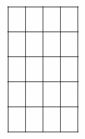
A board has 16 squares as shown in the figure: Out of these 16 squares, two squares are chosen at random. The probability that they have no side in common is:
The total number of ways to choose 2 squares out of 16 is given by: (216)=216×15=120
Two squares share a side if they are horizontally or vertically adjacent. In a 4×4 grid, each of the 4 rows contains 3 adjacent horizontal pairs, and each of the 4 columns contains 3 adjacent vertical pairs. The total number of pairs sharing a side is: 12(horizontal)+12(vertical)=24
The probability that two squares share a side is 12024=51. Therefore, the probability that they have no side in common is: 1−51=54
Q68JEE Main 2025MCQ4MParabola
Let the shortest distance from (a, 0), a > 0, to the parabola y2=4x be 4. Then the equation of the circle passing through the point (a,0) and the focus of the parabola, and having its centre on the axis of the parabola is:
The shortest distance from (a, 0) with a > 0 to the parabola y2=4x is specified as 4. A generic point on the parabola can be written as (t2,2t), so the squared distance to (a,0) is D2=(t2−a)2+4t2. Differentiating and setting dtd(D2)=0 gives t(4t2−4a+8)=0. Excluding the trivial solution t=0 and requiring a>2 yields t2=a−2. Substituting back gives D2=4+4(a−2)=4a−4, and imposing D=4 leads to 4a−4=16, hence a=5. Having found a=5, the required circle must pass through (5,0) and the focus (1,0) of the parabola, with its center on the x-axis at (h,0). Equating distances from the center to these points, (5−h)2=(1−h)2 leads to 24=8h and thus h=3. The radius squared is then (5−3)2=4, so the circle is (x−3)2+y2=4, which expands to x2+y2−6x+5=0. The correct answer is Option 2 : x2+y2−6x+5=0.
Q69JEE Main 2025MCQ4MBinomial Theorem
If in the expansion of (1+x)p(1−x)q, the coefficients of x and x2 are 1 and -2 , respectively, then p2+q2 is equal to :
We need to find p2+q2 given that \in (1+x)p(1−x)q the coefficients of x and x2 are 1 and -2, respectively. Expanding each binomial to second order, we have: (1+x)p≈1+px+2p(p−1)x2+…(1−x)q≈1−qx+2q(q−1)x2+… Multiplying these series, the coefficient of x is p−q=1(i) and the coefficient of x2 is 2p(p−1)−pq+2q(q−1)=−2(ii) Multiplying equation (ii) by 2 and simplifying gives: p2−p−2pq+q2−q=−4, which can be written as (p−q)2−(p+q)=−4. Since (i) implies (p−q)2=1, substituting into the last equation yields 1−(p+q)=−4, so p+q=5(iii). Solving the system p−q=1 and p+q=5 gives p=3 and q=2. Finally, p2+q2=9+4=13. The correct answer is Option 2: 13.
Q70JEE Main 2025MCQ4MArea Under The Curves
If the area of the region {(x,y):−1≤x≤1,0≤y≤a+e∣x∣−e−x,a>0} is ee2+8e+1, then the value of a is :
We need to find a such that the area of the region {(x,y):−1≤x≤1,0≤y≤a+e∣x∣−e−x} equals ee2+8e+1. Since this area can be computed by integrating the upper boundary from x=−1 to x=1, we set up Area=∫−11(a+e∣x∣−e−x)dx. On x∈[−1,0] we have ∣x∣=−x, so the integrand becomes a+e−x−e−x=a. On [0,1], ∣x∣=x and the integrand is a+ex−e−x. Therefore, Area=∫−10adx+∫01(a+ex−e−x)dx=a+$[ax+ex+e−x]01=a+(a+e+e−1)−(0+1+1)=2a+e+e1−2. Setting this equal to the given area gives 2a+e+e1−2=ee2+8e+1, or equivalently 2a+ee2+1−2=ee2+8e+1. Solving for a yields 2a=ee2+8e+1−ee2+1+2=e8e+2=8+2=10, so a=5. The correct answer is Option 3: 5.
Q71JEE Main 2025NAT4MStatistics
The variance of the numbers 8, 21, 34, 47,..., 320 is
We need to find the variance of the arithmetic progression 8, 21, 34, 47, ..., 320. The first term is a = 8 and the common difference is d = 13. Since the last term is 320, we set a+(n−1)d=320 which leads to 8+(n−1)(13)=320 and hence (n−1)=13312=24 so that n=25. For an AP with n terms and common difference d, the variance is given by σ2=12d2(n2−1). Substituting d = 13 and n = 25 yields σ2=12132(252−1)=12169×624=169×52=8788. The answer is 8788.
Q72JEE Main 2025NAT4MQuadratic Equation and Inequalities
The roots of the quadratic equation 3x2−px+q=0 are 10th and 11th terms of an arithmetic progression with common difference 23. If the sum of the first 11 terms of this arithmetic progression is 88 , then q - 2p is equal to
Let the roots of 3x2−px+q=0 be α and β. It is given that α and β are the 10th and 11th term of an A.P with a common difference of 23. 10th term = a+9d = a+(9×23) = a+227 11th term = a+10d = a+(10×23) = a+15 Now, it is given that the \sum of the first 11 terms of the A.P is 88. 211×(a+(a+15))=882a+15=16a=21 10th term = 21+227=14 11th term = 21+15=231 So, α=14 and β=231 Now, \in 3x2−px+q=0, α+β=3p14+231=3p228+31=3pp=259×3α×β=3q14×231=3qq=7×31×3q=651 Now, q−2p = 651−(2×259×3)q−2p = 651−177=474 Hence, the value of (q−2p) is 474. ∴ The required answer is 474.
Q73JEE Main 2025NAT4MPermutations and Combinations
The number of ways, 5 boys and 4 girls can sit in a row so that either all the boys sit together or no two boys sit together, is
If all the boys sit together, then there will be 4 girls and 1 group of boys. Number of ways in which the boys can be arranged = 5! Number of ways in which 4 girls and 1 group of boys can be arranged = 5! Total number of ways in which we can arrange 4 girls and 5 boys such that all the boys sit together = 5!×5!=14400 Now, we have to arrange the boys and girls such that no two boys sit together. So, we will first fix the positions of girls \in 1 way where girls are sitting at the alternate positions (not at the first or the last position) out of the total 9 positions. Girls will sit at 2nd, 4th, 6th and 8th positions. Number of ways \in which the girls are arranged = 4! Now, the boys will sit \in the remaining places. Number of ways \in which the boys are arranged = 5! Total number of ways \in which we can arrange the boys and girls such that no two boys sit together = 4!×5!=2880 Total number of ways \in which we can arrange 5 boys and 4 girls such that either all the boys sit together or no boys sit together at all = 14400+2880=17280∴ The required answer is 17280.
Q74JEE Main 2025NAT4MParabola
The focus of the parabola y2=4x+16 is the centre of the circle C of radius 5 . If the values of \ambda, for which C passes through the point of intersection of the lines 3x − y = 0 and x+λy=4, are λ1 and λ2,λ1<λ2, then 12λ1+29λ2 is equal to
We need to find 12λ1+29λ2 where λ1,λ2 are the values of λ for which the circle passes through certain intersection points. Find the focus of the parabola y2=4x+16=4(x+4) This is Y2=4X where X=x+4. Focus is at X = 1, Y = 0, i.e., (x,y)=(−3,0). Circle equation Centre = (-3, 0), radius = 5. (x+3)2+y2=25 Find intersection of lines 3x - y = 0 and x + \lambda y = 4 From 3x - y = 0: y = 3x. Substituting: x + 3\lambda x = 4, so x=1+3λ4 and y=1+3λ12 This point lies on the circle (1+3λ4+3)2+(1+3λ12)2=25 Let k=1+3λ: (k4+3k)2+(k12)2=25(4+3k)2+144=25k216+24k+9k2+144=25k216k2−24k−160=02k2−3k−20=0(2k+5)(k−4)=0k=−25 or k=4 Find λ values 1+3λ=−25⇒3λ=−27⇒λ=−671+3λ=4⇒3λ=3⇒λ=1 So λ1=−67 and λ2=1 (since λ1<λ2). Calculate 12λ1+29λ2=12×(−67)+29×1=−14+29=15 The answer is 15.
Q75JEE Main 2025NAT4MSequences and Series
Let α,β be the roots of the equation x2−ax−b=0 with Im(α)<Im(β). Let Pn=αn−βn. If P3=−57i,P4−37i,P5=117i and P=457i.then ∣α4+β4∣ is equal to
We have α,β as roots of x2−ax−b=0. Given Pn=αn−βn, with P3=−57i, P4=−37i, P5=117i, P6=457i. Since α,β satisfy x2=ax+b, the sequence Pn satisfies the recurrence relation Pn=aPn−1+bPn−2 Substituting n=5 gives P5=aP4+bP3 Therefore, 117i=a(−37i)+b(−57i)11=−3a−5b ... (i) For n=6, P6=aP5+bP4 Thus, 457i=a(117i)+b(−37i)45=11a−3b ... (ii) From (i): 3a+5b=−11 ... (i') From (ii): 11a−3b=45 ... (ii') Multiply (i') by 3: 9a+15b=−33 Multiply (ii') by 5: 55a−15b=225 Adding: 64a=192⇒a=3 From (i'): 9+5b=−11⇒b=−4 We know: α+β=a=3 and αβ=−b=4α2+β2=(α+β)2−2αβ=9−8=1α4+β4=(α2+β2)2−2(αβ)2=1−2(16)=1−32=−31∣α4+β4∣=∣−31∣=31 The answer is 31.