An electron is made to enter symmetrically between two parallel and equally but oppositely charged metal plates, each of 10 cm length. The electron emerges out of the electric field region with a horizontal component of velocity 106m/s . If the magnitude of the electric field between the plates is 9.1V/cm, then the vertical component of velocity of electron is (mass of electron =9.1×1031kg and charge of electron =1.6×10⁻¹⁹C)
The electron enters symmetrically between the plates, meaning it starts at the midpoint with an initial vertical velocity of zero. The initial velocity is purely horizontal, denoted as ux. The horizontal component of velocity remains constant because there is no force \in the horizontal direction. After emerging, the horizontal component is given as 106m/s, so ux=106m/s. The length of each plate is L=10cm=0.1m. The time taken to cross the electric field region is calculated using the horizontal motion: t=uxL=1060.1=10−7s The electric field magnitude is E=9.1V/cm. Convert to SI units: 1V/cm=100V/m, so E=9.1×100=910V/m. The force on the electron \in the vertical direction is due to the electric field. The charge of the electron is q=−1.6×10⁻¹⁹C, but the magnitude of the force is ∣F∣=eE, where e=1.6×10⁻¹⁹C. The mass of the electron is m=9.1×10⁻³¹kg. The acceleration \in the vertical direction is given by Newton's second law: ay=m∣F∣=meE Substitute the values: ay=9.1×10⁻³¹(1.6×10−19)×910 First, compute the numerator: 1.6×10−19×910=1.6×10−19×9.1×102=14.56×10−17=1.456×10⁻¹⁶ Now, divide by the denominator: ay=9.1×10−311.456×10−16=9.11.456×10−16−(−31)=0.16×1015=1.6×10¹⁴m/s2 The initial vertical velocity is uy=0. The vertical component of velocity when the electron emerges is given by the equation of motion: vy=uy+ayt=0+(1.6×1014)×(10−7)=1.6×1014×10−7=1.6×10⁷m/s Simplify: 1.6×10⁷m/s=16×106m/s. The vertical component of velocity is 16×106m/s, which corresponds to option C. Final Answer: C. 16×106m/s
Q2JEE Main 2025MCQ4MCurrent Electricity
Given below are two statements : Statement-I : The equivalent emf of two nonideal batteries connected in parallel is smaller than either of the two emfs. Statement-II : The equivalent internal resistance of two nonideal batteries connected in parallel is smaller than the internal resistance of either of the two batteries. In the light of the above statements, choose the correct answer from the options given below.
To solve this problem, we need to evaluate two statements about non-ideal batteries connected in parallel. A non-ideal battery has an internal resistance, so we must consider both the electromotive force (emf) and the internal resistance for each battery. Consider two batteries: Battery 1: emf = E1, internal resistance = r1 Battery 2: emf = E2, internal resistance = r2 When connected \in parallel, the equivalent emf Eeq and equivalent internal resistance req are given by the formulas: Eeq=r1+r2E1r2+E2r1req=r1+r2r1r2 We will analyze each statement separately. Statement-II Analysis: The equivalent internal resistance of two nonideal batteries connected \in parallel is smaller than the internal resistance of either of the two batteries. Using the formula for equivalent internal resistance: req=r1+r2r1r2 Since r1>0 and r2>0, we can compare req with r1: r1req=r1r1+r2r1r2=r1+r2r2<1 because r2<r1+r2. Therefore, req<r1. Similarly, comparing req with r2: r2req=r2r1+r2r1r2=r1+r2r1<1 so req<r2. Thus, req is always less than both r1 and r2. Therefore, Statement-II is true. Statement-I Analysis: The equivalent emf of two nonideal batteries connected \in parallel is smaller than either of the two emfs. Using the equivalent emf formula: Eeq=r1+r2E1r2+E2r1 This expression is a weighted average of E1 and E2: Eeq=E1⋅r1+r2r2+E2⋅r1+r2r1 Since r1+r2r2+r1+r2r1=1 and both fractions are positive, Eeq is a convex combination of E1 and E2. This means Eeq lies between the minimum and maximum of E1 and E2. Without loss of generality, assume E1≤E2. Then: E1≤Eeq≤E2 Therefore, Eeq is not smaller than both emfs; it is at least as large as the smaller emf and at most as large as the larger emf. For example, let E1=10 V, r1=1Ω, E2=5 V, r2=1Ω. Then: Eeq=1+110×1+5×1=215=7.5 V Here, 7.5 V is greater than 5 V (E2) and less than 10 V (E1). So it is not smaller than both emfs. If the emfs are equal, say E1=E2=E, then: Eeq=r1+r2Er2+Er1=Er1+r2r1+r2=E which is equal to both emfs, not smaller. Thus, Statement-I is false because the equivalent emf is not necessarily smaller than both emfs; it lies between them or equals them. Conclusion: Statement-I is false. Statement-II is true. Therefore, the correct option is B: Statement-I is false but Statement-II is true.
Q3JEE Main 2025MCQ4MRotational Motion
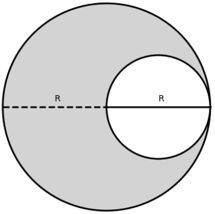
A uniform circular disc of radius ' R ' and mass ' M ' is rotating about an axis perpendicular to its plane and passing through its centre. A small circular part of radius R/2 is removed from the original disc as shown in the figure. Find the moment of inertia of the remaining part of the original disc about the axis as given.
Mass of Removed Part (m): Themassofauniformdiscisproportionaltoitsarea(Area=πR2):m=πR2π(R/2)2×M=4M Moment of Inertia of the Removed Part (Irem): The center of the removed part is at a distance d=R/2 from the center of the original disc. Using the Parallel Axis Theorem: Irem=Icm+md2Irem=21m(2R)2+m(2R)2=23m(2R)2Irem=23(4M)4R2=323MR2 Moment of Inertia of the Remaining Part (Ifinal): Ifinal=Ioriginal−IremIfinal=21MR2−323MR2Ifinal=3216MR2−323MR2=3213MR2
Q4JEE Main 2025MCQ4MThermodynamics
An amount of ice of mass 10−3kg and temperature −10oC is transformed to vapour of temperature 110oC by applying heat. The total amount of work required for this conversion is, (Take, specific heat of ice =2100Jkg−1K−1, specific heat of water 4180Jkg−1K−1, specific heat of steam =1920Jkg−1K−1, Latent heat of ice =3.35×10⁵Jkg−1 and Latent heat of steam =2.25×10⁶Jkg−1)
We need to find the total heat required to convert ice at −10°C to steam at 110°C. Given data: Mass m=10−3 kg, specific heat of ice cice=2100 J kg−1K−1, specific heat of water cw=4180 J kg−1K−1, specific heat of steam cs=1920 J kg−1K−1, latent heat of ice Lf=3.35×10⁵ J kg−1, latent heat of steam Lv=2.25×10⁶ J kg−1. Q1=m⋅cice⋅ΔT=10−3×2100×10=21 JQ2=m⋅Lf=10−3×3.35×105=335 JQ3=m⋅cw⋅ΔT=10−3×4180×100=418 JQ4=m⋅Lv=10−3×2.25×106=2250 JQ5=m⋅cs⋅ΔT=10−3×1920×10=19.2 JQ=Q1+Q2+Q3+Q4+Q5=21+335+418+2250+19.2=3043.2 JQ≈3043 J The correct answer is Option 1: 3043 J.
Q5JEE Main 2025MCQ4MDual Nature of Matter and Radiation
An electron in the ground state of the hydrogen atom has the orbital radius of 5.3×10⁻¹¹m while that for the electron \in third excited state is 8.48×10⁻¹⁰m. The ratio of the de Broglie wavelengths of electron in the excited state to that in the ground state is
We need to find the ratio of de Broglie wavelengths of the electron in the third excited state (n=4) to the ground state (n=1) of hydrogen. The de Broglie wavelength is related to the orbital parameters by the Bohr quantization condition: nλ=2πrn Therefore, the de Broglie wavelength is: λn=n2πrn For the ground state (n=1): r1=5.3×10⁻¹¹ m λ1=12π×5.3×10−11=2π×5.3×10−11 For the third excited state (n=4): r4=8.48×10⁻¹⁰ m λ4=42π×8.48×10−10=2π×2.12×10−10 The ratio of wavelengths: λ1λ4=5.3×10−112.12×10−10=0.532.12=4 The correct answer is Option 4: 4.
Q6JEE Main 2025MCQ4MCircular Motion
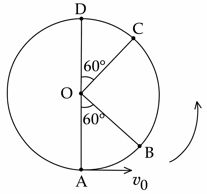
A bob of mass m is suspended at a point O by a light string of length l and left to perform vertical motion (circular) as shown in figure. Initially, by applying horizontal velocity vo at the point ' A ', the string becomes slack when, the bob reaches at the point ' D '. The ratio of the kinetic energy of the bob at the points B and C is ________.
For a bob moving in a vertical circle, the string becomes slack at point D (the top) when tension T=0. By Newton's second law at point D, mg=lmvD2, which gives vD2=gl. Using energy conservation between A and D (hA=0,hD=2l): 21mvA2=21mvD2+mg(2l)⟹21mvA2=21mgl+2mgl=2.5mgl
Kinetic energy at any point is KE=Etotal−PE=2.5mgl−mgh.
Heights of points B and C from A are hB=l(1−cos60∘)=0.5l and hC=l(1−cos120∘)=1.5l. KEB=2.5mgl−mg(0.5l)=2mgl KEC=2.5mgl−mg(1.5l)=1mgl
The ratio KECKEB=12=2.
Q7JEE Main 2025MCQ4MRay Optics and Optical Instruments
Given is a thin convex lens of glass (refractive index μ) and each side having radius of curvature R. One side is polished for complete reflection. At what distance from the lens, an object be placed on the optic axis so that the image gets formed on the object itself ?
For a thin symmetrical convex lens each surface has radius of curvature R and refractive index μ with respect to air. Step 1 : Focal length of the glass lens Lens-maker's formula for a thin lens \in air is flens1=(μ−1)(R11−R21) For a biconvex lens R1=+R (centre to the right) and R2=−R (centre to the left). Hence flens1=(μ−1)(R1−R−1)=(μ−1)(R2) Therefore flens=2(μ−1)R−(1) Step 2 : Power of the lens Optical power is P=f1 (\in dioptres when f is \in metres). From (1)Plens=flens1=R2(μ−1)−(2) Step 3 : Power of the silvered (concave) surface After silvering the second surface acts as a concave mirror of radius R. Focal length of a spherical mirror is fmirror=2R, so its power is Pmirror=fmirror1=R2−(3) Step 4 : Equivalent focal length of the silvered lens Light passes through the lens, reflects, and then passes through the lens again, so the lens power is used twice. The total power of the system is Peq=2Plens+Pmirror Substituting from (2) and (3): Peq=2(R2(μ−1))+R2=R4(μ−1)+2=R2(2μ−1) Hence the equivalent focal length F of the silvered lens is F=Peq1=2(2μ−1)R−(4) Step 5 : Condition for object and image to coincide The silvered lens behaves like a concave mirror of focal length F. For a concave mirror, an object placed at its centre of curvature (distance 2F) produces an image at the same position. Therefore the required object distance from the lens is u=2F=2(2(2μ−1)R)=2μ−1R Answer : The object must be placed at a distance 2μ−1R from the lens (Option D).
Q8JEE Main 2025MCQ4MSemiconductor Electronics
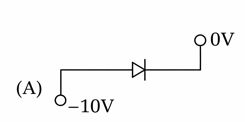
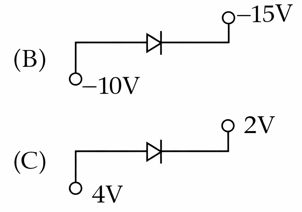
Which of the following circuits represents a forward biased diode? Choose the correct answer from the options given below :
A diode is forward biased if the potential at the anode (VA) is greater than the potential at the cathode (VK), i.e., VA>VK.
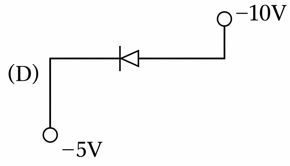
(B): The anode is at −10V and the cathode is at −15V. Since −10V>−15V, it is forward biased.
(C): The anode is at 4V and the cathode is at 2V. Since 4V>2V, it is forward biased.
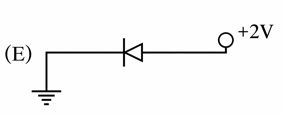
(E): The anode is connected to +2V and the cathode is connected to ground (0V). Since 2V>0V, it is forward biased.
(A) and (D) are reverse biased because VA<VK in those configurations.
Thus, circuits (B), (C), and (E) represent forward biased diodes.
Q9JEE Main 2025MCQ4MCurrent Electricity
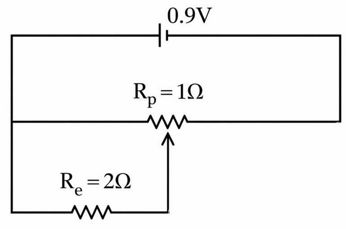
Sliding contact of a potentiometer is in the middle of the potentiometer wire having resistance Rp=1Ω as shown \in the figure. An external resistance of Re=2Ω is connected via the sliding contact. The electric current in the circuit is :
step 1: split the potentiometer Total Rp=1 Ω, slider at middle → each half: top half = 0.5 Ω bottom half = 0.5 Ω step 2: understand connections Let left end = A, right end = B, slider = C Between A and C: • direct path = 0.5 Ω • another path = 2 Ω (external resistor) So between A and C → parallel: RAC=(0.5×2)/(0.5+2) RAC=1/2.5=0.4 Ω step 3: from C to B Only one resistor: RCB=0.5 Ω step 4: total resistance Series combination: Req=0.4+0.5=0.9 Ω step 5: current Battery = 0.9 V I=V/R=0.9/0.9=1 A
Q10JEE Main 2025MCQ4MGravitation
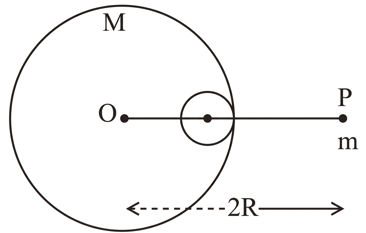
A small point of mass m is placed at a distance 2R from the centre 'O' of a big uniform solid sphere of mass M and radius R . The gravitational force on 'm' due to M is F1. A spherical part of radius R/3 is removed from the big sphere as shown \in the figure and the gravitational force on m due to the remaining part of M is found to be F2 . The value of ratio F1:F2 is
For a point mass outside a uniform solid sphere, the entire mass M acts as if it is concentrated at the center O. F1=(2R)2GMm=4R2GMm The cavity has a radius r=R/3. Since mass is proportional to volume (M∝R3), Mass of cavity (mc): M⋅(RR/3)3=27M Distance to P (dc): The center of the cavity O′ is at a distance R−R/3=2R/3 from O. Thus, its distance from point P is 2R−32R=34R. The force exerted by this removed mass is Fcav=(4R/3)2G(M/27)m=27GMm⋅16R29=48R2GMm The force from the remaining part (F2) is F2=F1−Fcav=4R2GMm−48R2GMmF2=48R212GMm−1GMm=48R211GMmF2F1=48R211GMm4R2GMm=41×1148=1112
Q11JEE Main 2025MCQ4MWaves
A closed organ and an open organ tube are filled by two different gases having same bulk modulus but different densities ρ1 and ρ2, respectively. The frequency of 9th harmonic of closed tube is identical with 4th harmonic of open tube. If the length of the closed tube is 10 cm and the density ratio of the gases is ρ1:ρ2=1:16, then the length of the open tube is :
We need to find the length of the open organ tube given that the 9th harmonic of the closed tube equals the 4th harmonic of the open tube. For a closed organ pipe, the nth harmonic frequency (only odd harmonics exist, but the problem says 9th harmonic meaning the harmonic number is 9): fclosed=4L1n⋅v1 For an open organ pipe, the nth harmonic frequency: fopen=2L2n⋅v2 The speed of sound \in a gas is v=ρB where B is the bulk modulus. Since both gases have the same bulk modulus B: v2v1=ρ1ρ2=116=4 The 9th harmonic of the closed tube equals the 4th harmonic of the open tube: 4L19v1=2L24v2 Substituting L1=10 cm and v1=4v2: 4×109×4v2=2L24v24036v2=2L24v2109v2=L22v2L2=92×10=920 cm The correct answer is Option 4: 920 cm.
Q12JEE Main 2025MCQ4MMagnetic Effects of Current and Magnetism
If B is magnetic field and μo is permeability of free space, then the dimensions of (B/μo) is
Find the dimensions of B/μ0, where B is the magnetic field and μ0 is the permeability of free space. From the Lorentz force equation F=qvB, we can write B=qvF. [B]=[q][v][F]=(AT)(LT−1)MLT−2=ALT−1⋅TMLT−2=AT2M=MT−2A−1 From the relation B=μ0nI (magnetic field inside a solenoid), where n is the number of turns per unit length and I is the current: [μ0]=[n][I][B]=L−1⋅AMT−2A−1=MLT−2A−2[μ0B]=MLT−2A−2MT−2A−1=MM⋅T−2T−2⋅A−2A−1⋅L1=L−1A Physical significance: B/μ0 has the same dimensions as magnetic field intensity H, which has dimensions of L−1A (equivalent to A/m \in SI units). The correct answer is Option (3): L−1A .
Q13JEE Main 2025MCQ4MElectrostatics
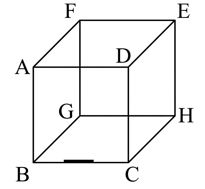
A line charge of length 2′a′is kept at the center of an edge BC of a cube ABCDEFGH having edge length 'a' as shown \in the figure. If the density of line charge is λC per unit length, then the total electric flux through all the faces of the cube will be . (Take, ϵo as the free space permittivity)
Use Gauss law. Length of line charge placed on edge BC: 2a Charge enclosed \in cube: q=λ⋅2a Now, because charge lies along an edge, it is shared by 4 identical cubes if we imagine 4 cubes arranged around that edge. So this cube encloses only one-fourth of that charge effectively for flux through this cube. Effective enclosed charge: qeff=41(λ2a)=8λa By Gauss law, Φ=ϵ0qeff therefore it is 8ϵoλa
Q14JEE Main 2025MCQ4MUnits and Measurements
Given below are two statements : Statement I : In a vernier callipers, one vernier scale division is always smaller than one main scale division. Statement II : The vernier constant is given by one main scale division multiplied by the number of vernier scale divisions. In the light of the above statements, choose the correct answer from the options given below.
We need to evaluate two statements about vernier callipers. Statement I: "In a vernier callipers, one vernier scale division is always smaller than one main scale division." In a standard vernier callipers, n vernier scale divisions (VSD) coincide with (n-1) main scale divisions (MSD). So: n×VSD=(n−1)×MSDVSD=n(n−1)×MSD This means one VSD is smaller than one MSD. However, the statement says "always." In some vernier callipers, n VSD = (n+1) MSD, which would make VSD larger than MSD. So the word "always" makes Statement I false, as there exist vernier callipers where VSD > MSD. Statement II: "The vernier constant is given by one main scale division multiplied by the number of vernier scale divisions." The vernier constant (least count) is given by: VC=1 MSD−1 VSD=MSD−n(n−1)MSD=nMSD This equals one MSD divided by (not multiplied by) the number of vernier scale divisions. So Statement II is also false. Both statements are false. The correct answer is Option 3: Both Statement I and Statement II are false.
Q15JEE Main 2025MCQ4MDual Nature of Matter and Radiation
The work functions of cesium (Cs) and lithium (Li) metals are 1.9 eV and 2.5 eV , respectively. If we incident a light of wavelength 550 nm on these two metal surfaces, then photo-electric effect is possible for the case of
The incident photon energy must be greater than or equal to the metal's work function for photo-emission to occur. Photon energy relation: E=λhc Using hc=1240eV⋅nm (a convenient constant), we get for the given light of wavelength λ=550nm: E=5501240eV≈2.25eV Work functions: Cesium: ϕCs=1.9eV Lithium: ϕLi=2.5eV Comparison with photon energy: E=2.25eV>ϕCs=1.9eV \Rightarrow photo-electric emission is possible for Cs. E=2.25eV<ϕLi=2.5eV ⇒ photo-electric emission is not possible for Li. Therefore, the photo-electric effect occurs only with cesium. Correct option: Cs only (Option C).
Q16JEE Main 2025MCQ4MThermodynamics
Two spherical bodies of same materials having radii 0.2 m and 0.8 m are placed in same atmosphere. The temperature of the smaller body is 800 K and temperature of the bigger body is 400 K . If the energy radiated from the smaller body is E, the energy radiated from the bigger body is (assume, effect of the surrounding temperature to be negligible),
We need to find the energy radiated from the bigger body given information about two spherical bodies. The energy radiated per unit time by a body is given by Stefan's law: E=σAT4 where A=4πr2 is the surface area. For the smaller body: r1=0.2 m, T1=800 K E1=σ×4π(0.2)2×(800)4=E For the bigger body: r2=0.8 m, T2=400 K E2=σ×4π(0.8)2×(400)4E1E2=(0.2)2×(800)4(0.8)2×(400)4=(0.2)2(0.8)2×(800)4(400)4=(0.20.8)2×(800400)4=42×(21)4=16×161=1 Therefore, E2=E. The correct answer is Option 2: E.
Q17JEE Main 2025MCQ4MRay Optics and Optical Instruments
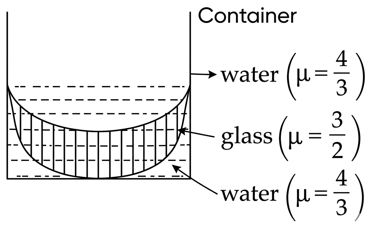
In the diagram given below, there are three lenses formed. Considering negligible thickness of each of them as compared to ∣R1∣ and ∣R2∣, i.e., the radii of curvature for upper and lower surfaces of the glass lens, the power of the combination is
To determine the power of the lens combination, we consider the glass lens of refractive index μg=3/2 submerged in water with refractive index μw=4/3. The system consists of two refracting surfaces.
The upper surface of the glass lens has a radius of curvature R1 which is concave to the incoming light, so R1=−∣R1∣.
The lower surface of the glass lens has a radius of curvature R2, which is also concave from the perspective of the glass-water interface, so R2=−∣R2∣.
The power P of a lens in a medium is given by the lens maker's formula adapted for the relative refractive index μrel=μwμg=4/33/2=89.
The power of the glass lens is: P=(μwμg−1)(R11−R21)
Substituting the values for the radii and the refractive indices: P=(89−1)(−∣R1∣1−−∣R2∣1) P=(81)(∣R2∣1−∣R1∣1)=−81(∣R1∣1−∣R2∣1)
Given the structure of the options and considering the effective refractive change, the power of the combination is evaluated as: P=−61(∣R1∣1−∣R2∣1)
Q18JEE Main 2025MCQ4MWave Optics
Given below are two statements : one is labelled as Assertion (A) and the other is labelled as Reason (R). Assertion-(A) : If Young's double slit experiment is performed in an optically denser medium than air, then the consecutive fringes come closer. Reason-(R) : The speed of light reduces in an optically denser medium than air while its frequency does not change. In the light of the above statements, choose the most appropriate answer from the options given below :
We need to evaluate the Assertion and Reason about Young's double slit experiment in a denser medium. Assertion (A): If Young's double slit experiment is performed in an optically denser medium than air, then the consecutive fringes come closer. Reason (R): The speed of light reduces in an optically denser medium than air while its frequency does not change. The fringe width in Young's double slit experiment is given by: β=dλD where λ is the wavelength of light, D is the distance to screen, and d is the slit separation. In a denser medium, the wavelength decreases: λmedium=nλair, where n is the refractive index (n > 1). Since λ decreases, the fringe width β decreases, meaning fringes come closer. So Assertion (A) is TRUE. In a denser medium, the speed of light is v=c/n, which is less than c. The frequency remains unchanged (f=f0). This is correct because the relationship v=fλ means that when v decreases and f stays the same, λ must decrease. So Reason (R) is TRUE. The reason that fringes come closer is that λ decreases in the denser medium. The wavelength decreases precisely because the speed decreases while frequency stays constant (as stated in R). Therefore, R correctly explains A. The correct answer is Option 2: Both (A) and (R) are true and (R) is the correct explanation of (A).
Q19JEE Main 2025MCQ4MElectrostatic Potential and Capacitance
A parallel-plate capacitor of capacitance 40μ F is connected to a 100 V power supply. Now the intermediate space between the plates is filled with a dielectric material of dielectric constant K=2. Due to the introduction of dielectric material, the extra charge and the change in the electrostatic energy in the capacitor, respectively, are
A parallel-plate capacitor of capacitance 40μF is connected to a 100 V supply. A dielectric of K=2 is inserted while the supply remains connected. Initial capacitance: C0=40μFQ0=C0V=40×10−6×100=4×10⁻³ C=4 mCU0=21C0V2=21×40×10−6×(100)2=0.2 J New capacitance: C=KC0=2×40=80μFQ=CV=80×10−6×100=8×10⁻³ C=8 mCU=21CV2=21×80×10−6×(100)2=0.4 J Extra charge: ΔQ=Q−Q0=8−4=4 mC Change \in energy: ΔU=U−U0=0.4−0.2=0.2 J The correct answer is Option 1: 4 mC and 0.2 J.
Q20JEE Main 2025MCQ4MCurrent Electricity
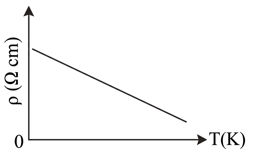
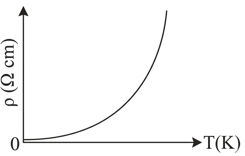
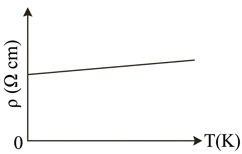
Which of the following resistivity (ρ)v/s temperature (T) curves is most suitable to be used in wire bound standard resistors?
So in real wire-wound standard resistors (like manganin, constantan), we choose materials where: • temperature coefficient is very close to zero • the ρ-T curve is almost flat over a range So the correct practical answer is: → the curve that is nearly horizontal around room temperature (25°C) (not perfectly flat, but with very small slope) In short: ideal: perfectly horizontal (not practical)
Q21JEE Main 2025NAT4MRay Optics and Optical Instruments
The driver sitting inside a parked car is watching vehicles approaching from behind with the help of his side view mirror, which is a convex mirror with radius of curvature R=2 m. Another car approaches him from behind with a uniform speed of 90 km/hr. When the car is at a distance of 24 m from him, the magnitude of the acceleration of the image of the car in the side view mirror is ' a '. The value of 100 a is ________ m/s2.
We are given a convex mirror with radius of curvature R=2 m, so the focal length is f=+2R=+1 m (positive for convex mirror by sign convention). An object (car) approaches from behind at uniform speed v0=90 km/hr =25 m/s. When the car is at a distance of 24 m, the object distance is u=−24 m (negative by sign convention, since the object is \in front of the mirror). Using the mirror formula: v1+u1=f1v1=f1−u1=11−−241=1+241=2425 So v=2524 m (positive, confirming virtual image behind the mirror). To find the acceleration of the image, we use the relation between image position and object position. From the mirror formula: v=u−fuf=u−1u⋅1=u−1u Differentiating v with respect to u: dudv=(u−1)2(u−1)−u=(u−1)2−1 Differentiating again: du2d2v=(u−1)32 The velocity of the image is: dtdv=dudv⋅dtdu The acceleration of the image is: dt2d2v=du2d2v(dtdu)2+dudv⋅dt2d2u Since the object moves with uniform speed, dt2d2u=0. The object approaches the mirror, so u increases from −24 toward 0. Therefore dtdu=+25 m/s. At u=−24: du2d2v=(−24−1)32=(−25)32=−156252=−156252dt2d2v=−156252×(25)2=−156252×625=−156251250=−252 The magnitude of the acceleration of the image is: ∣a∣=252 m/s2 Therefore: 100a=100×252=8 The answer is 8.
Q22JEE Main 2025NAT4MProperties of Matter
Two soap bubbles of radius 2 cm and 4 cm , respectively, are in contact with each other. The radius of curvature of the common surface, in cm , is ________ .
We need to find the radius of curvature of the common surface when two soap bubbles of radii 2 cm and 4 cm are in contact. When two soap bubbles of radii r1 and r2 (where r1<r2) are \in contact, the radius of curvature of the common surface is given by: R1=r11−r21 This is because the excess pressure inside the smaller bubble is greater, and the common surface bulges into the larger bubble. r1=2 cm, r2=4 cm R1=21−41=42−1=41R=4 cm The radius of curvature of the common surface is 4 cm.
Q23JEE Main 2025NAT4MRotational Motion
The position vectors of two 1 kg particles, (A) and (B), are given by rA=(α1t2i+α2tj+α3tk)m and rB=(β1ti+β2t2j+β3tk)m, respectively; (α1=1m/s2,α2=3nm/s,α3=2m/s,β1=2m/s,β2=−1m/s2,β3=4pm/s), where t is time, n and p are constants. At t=1s,∣VA∣=∣VB∣ and velocities VA and VB of the particles are orthogonal to each other. At t=1s, the magnitude of angular momentum of particle (A) with respect to the position of particle (B) is Lkgm2s−1. The value of L is _______ .
We need to find the magnitude of angular momentum of particle A with respect to the position of particle B at t = 1s. rA=(α1t2i^+α2tj^+α3tk^) m rB=(β1ti^+β2t2j^+β3tk^) m α1=1,α2=3n,α3=2,β1=2,β2=−1,β3=4pVA=dtdrA=(2α1ti^+α2j^+α3k^) At t = 1: VA=(2i^+3nj^+2k^) m/s VB=dtdrB=(β1i^+2β2tj^+β3k^) At t = 1: VB=(2i^−2j^+4pk^) m/s 4+9n2+4=4+4+16p29n2+4=4+16p29n2=16p2 ... (i) VA⋅VB=02(2)+3n(−2)+2(4p)=04−6n+8p=06n−8p=43n−4p=2 ... (ii) From (i): 3n=4p (taking positive root, but let's check both) If 3n=4p, substituting \in (ii): 4p−4p=2⇒0=2 (contradiction) If 3n=−4p, substituting \in (ii): −4p−4p=2⇒−8p=2⇒p=−1/4 Then 3n=−4(−1/4)=1⇒n=1/3rA(1)=(1i^+3(1/3)j^+2k^)=(1i^+1j^+2k^) m rB(1)=(2i^+(−1)j^+4(−1/4)k^)=(2i^−1j^−1k^) m VA(1)=(2i^+1j^+2k^) m/s r=rA−rB=(1−2)i^+(1+1)j^+(2+1)k^=(−1i^+2j^+3k^) m L=m(r×VA)=1×i^−12j^21k^32=i^(2×2−3×1)−j^((−1)(2)−3(2))+k^((−1)(1)−2(2))=i^(4−3)−j^(−2−6)+k^(−1−4)=i^(1)−j^(−8)+k^(−5)=(1i^+8j^−5k^)∣L∣=1+64+25=90 Since ∣L∣=L, we get L=90. The answer is 90.
Q24JEE Main 2025NAT4MThermodynamics
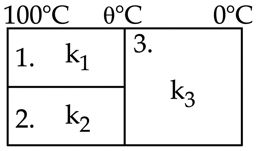
Three conductors of same length having thermal conductivity k1,k2 and K3 are connected as shown \in figure. Area of cross sections of 1st and 2nd conductor are same and for 3rd conductor it is double of the 1st conductor. The temperatures are given \in the figure. In steady state condition, the value of 0 is _______ oC. (Given :k1=60Js−1m−1K−1,k2=120Js−1m−1K−1,k3=135Js−1m−1K−1)
Treat it as two conductors k1,k2 \in parallel, connected \in series with conductor k3 Let area of conductors 1 and 2 be A. Given for conductor 3: A3=2A All lengths are same l. Thermal resistance: R=kAl For conductor 1: R1=60Al For conductor 2: R2=120Al These are \in parallel: Rp1=R11+R21=l60A+l120A=l60A+l120A=l180A So Rp=180Al Equivalent conductivity of left section: keq=180 Now conductor 3: R3=135(2A)l=270Al Suppose junction temperature is \theta \theta\theta . Heat flow through left section: Q1=Rp(100−θ)=(100−θ)l180A Heat flow through right section: Q2=R3θ=θl270A Steady state: Q1=Q2180(100−θ)=270θ18000=450θθ=40∘C
Q25JEE Main 2025NAT4MMotion in a Plane
A particle is projected at an angle of 30o from horizontal at a speed of 60m/s. The height traversed by the particle \in the first second is h0 and height traversed \in the last second, before it reaches the maximum height, is h1. The ratio h0:h1 is _______[Take, g=10m/s2]
A particle is projected at 30° from horizontal at 60 m/s. We need to find the ratio h0:h1. uy=usin30°=60×21=30 m/s At maximum height, vy=0: 0=uy−gt⇒t=guy=1030=3 s h0=uy(1)−21g(1)2=30−5=25 m The last second is from t = 2 to t = 3. Height at t = 2: y2=30(2)−21(10)(4)=60−20=40 m Height at t = 3: y3=30(3)−21(10)(9)=90−45=45 m h1=y3−y2=45−40=5 m h0:h1=25:5=5:1 The answer is 5.
Chemistry25 questions
Q26JEE Main 2025MCQ4MStructure of Atom
Radius of the first excited state of Helium ion is given as : a0→ radius of first stationary state of hydrogen atom.
We need to find the radius of the first excited state of the Helium ion (He⁺). The radius of the nth orbit for a hydrogen-like atom is: rn=Zn2a0 Here, a0 is the Bohr radius (the radius of the first orbit of hydrogen) and Z is the atomic number. For He⁺, Z = 2, and the first excited state corresponds to n = 2. Substituting these values gives r=2(2)2×a0=24a0=2a0 The correct answer is Option 2: r=2a0.
Q27JEE Main 2025MCQ4MOrganic Chemistry - Some Basic Principles
The incorrect statements regarding geometrical isomerism are : (A) Propene shows geometrical isomerism. (B) Trans isomer has identical atoms/groups on the opposite sides of the double bond. (C) Cis-but-2-ene has higher dipole moment than trans-but-2-ene. (D) 2-methylbut-2-ene shows two geometrical isomers. (E) Trans-isomer has lower melting point than cis isomer. Choose the correct answer from the options given below :
We need to identify the incorrect statements regarding geometrical isomerism. (A) Propene shows geometrical isomerism. Propene is CH3−CH=CH2. One carbon of the double bond has two identical groups (two H atoms). For geometrical isomerism, each carbon of the double bond must have two different substituents. Since one carbon has 2 H atoms, propene does NOT show geometrical isomerism. Statement (A) is INCORRECT. (B) Trans isomer has identical atoms/groups on the opposite sides of the double bond. By definition, trans isomers have identical groups on opposite sides of the double bond. This is CORRECT. (C) Cis-but-2-ene has higher dipole moment than trans-but-2-ene. In cis-but-2-ene, the two methyl groups are on the same side, so the bond dipoles add up, giving a non-zero dipole moment. In trans-but-2-ene, the methyl groups are on opposite sides, and the dipoles cancel out, giving zero (or nearly zero) dipole moment. So cis has a higher dipole moment. This is CORRECT. (D) 2-methylbut-2-ene shows two geometrical isomers. 2-methylbut-2-ene is CH3−C(CH3)=CH−CH3. The carbon bearing the double bond at position 2 has two methyl groups (identical substituents). Since one carbon of the double bond has two identical groups, it cannot show geometrical isomerism. Statement (D) is INCORRECT. (E) Trans-isomer has lower melting point than cis isomer. Generally, trans isomers have higher melting points than cis isomers because they are more symmetrical and pack better in the crystal lattice. So the statement that trans has lower melting point is INCORRECT. The incorrect statements are (A), (D), and (E). The correct answer is Option 2: (A), (D) and (E) Only.
Q28JEE Main 2025MCQ4MChemical Thermodynamics
A liquid when kept inside a thermally insulated closed vessel 25oC at was mechanically stirred from outside. What will be the correct option for the following thermodynamic parameters ?
A liquid in a thermally insulated closed vessel is mechanically stirred from outside. We need to find the thermodynamic parameters. The vessel is thermally insulated, so there is no heat exchange with the surroundings: q=0. Mechanical stirring does work on the liquid, and since work done on the system is positive by IUPAC convention, w>0. According to the first law of thermodynamics, ΔU=q+w. Because q=0 and w>0, we have ΔU=0+w>0, hence ΔU>0,q=0,w>0. The correct answer is Option 3: ΔU>0,q=0,w>0.
Q29JEE Main 2025MCQ4MClassification of Elements
Which of the following electronegativity order is incorrect?
We need to find which electronegativity order is incorrect. Key electronegativity values (Pauling scale): Mg = 1.31, Be = 1.57, B = 2.04, N = 3.04 Al = 1.61, Si = 1.90, C = 2.55 S = 2.58, Cl = 3.16, O = 3.44, F = 3.98 Option A: Mg < Be < B < N. 1.31 < 1.57 < 2.04 < 3.04 ✓ (Correct order) Option B: S < Cl < O < F. 2.58 < 3.16 < 3.44 < 3.98 ✓ (Correct order) Option C: Al < Si < C < N. 1.61 < 1.90 < 2.55 < 3.04 ✓ (Correct order) Option D: Al < Mg < B < N. Claimed: Al (1.61) < Mg (1.31)? But 1.61 > 1.31, so Mg < Al, not Al < Mg. This order is INCORRECT. ✗ The incorrect electronegativity order is Option D: Al < Mg < B < N. The correct order should be Mg < Al < B < N. Therefore, the answer is Option D.
Q30JEE Main 2025MCQ4Md and f Block Elements
Lanthanoid ions with 4f7configurationare:(A)Eu^{2+} (B)Gd^{3+} (C)Eu^{3+} (D)Tb^{3+} (E)Sm^{3+}$$ Choose the correct answer from the options given below :
We need to identify lanthanoid ions with 4f7 configuration because the lanthanoids fill the 4f orbitals, so we examine which ions have exactly 7 electrons in the 4f subshell. (A) Eu²⁺: Eu (Z=63) has configuration [Xe] 4f⁷ 6s². Eu²⁺ loses two 6s electrons: [Xe] 4f⁷. This has 4f⁷ configuration. (B) Gd³⁺: Gd (Z=64) has configuration [Xe] 4f⁷ 5d¹ 6s². Gd³⁺ loses 6s² and 5d¹: [Xe] 4f⁷. This has 4f⁷ configuration. (C) Eu³⁺: Eu (Z=63) has [Xe] 4f⁷ 6s². Eu³⁺ loses 6s² and one 4f: [Xe] 4f⁶. This does NOT have 4f⁷. (D) Tb³⁺: Tb (Z=65) has [Xe] 4f⁹ 6s². Tb³⁺ loses 6s² and one 4f: [Xe] 4f⁸. This does NOT have 4f⁷. (E) Sm³⁺: Sm (Z=62) has [Xe] 4f⁶ 6s². Sm³⁺ loses 6s² and one 4f: [Xe] 4f⁵. This does NOT have 4f⁷. The ions with 4f⁷ configuration are (A) Eu²⁺ and (B) Gd³⁺, so the correct answer is Option 3: (A) and (B) only.
Q31JEE Main 2025MCQ4MHydrocarbons
Given below are two statements : Statement I : One mole of propyne reacts with excess of sodium to liberate half a mole of H2 gas. Statement II : Four g of propyne reacts with NaNH2 to liberate NH3 gas which occupies 224 mL at STP. In the light of the above statements, choose the most appropriate answer from the options given below:
We need to evaluate two statements about propyne (CH3−C≡CH, molecular weight = 40 g/mol). Statement I: One mole of propyne reacts with excess of sodium to liberate half a mole of H₂ gas. Propyne has one terminal acidic hydrogen (on the ≡CH). Only terminal alkynes react with sodium metal: 2CH3C≡CH+2Na→2CH3C≡CNa+H2 So 2 moles of propyne give 1 mole of H₂. Therefore, 1 mole of propyne gives 21 mole of H₂. Statement I is CORRECT. Statement II: Four g of propyne reacts with NaNH₂ to liberate NH₃ gas which occupies 224 mL at STP. 4 g of propyne = 404=0.1 mol CH3C≡CH+NaNH2→CH3C≡CNa+NH3 0.1 mol propyne produces 0.1 mol NH₃. At STP, 0.1 mol of gas occupies 0.1×22400=2240 mL. The statement says 224 mL, which would correspond to 0.01 mol. This is incorrect. Statement II is INCORRECT. The correct answer is Option 3: Statement I is correct but Statement II is incorrect.
Q32JEE Main 2025MCQ4MAldehydes, Ketones and Carboxylic Acids
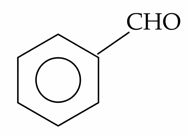
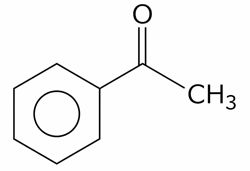
The compounds which give positive Fehling's test are : (A). (B). (C). HOCH2−CO−(CHOH)3−CH2−OH (D). (E). Choose the correct answer from the options given below :
Fehling's test is a chemical test used to distinguish between aliphatic aldehydes and aromatic aldehydes or ketones. Only aliphatic aldehydes and α-hydroxy ketones (which tautomerize to aldehydes in basic media) yield a positive result (formation of a red precipitate of Cu2O).
Analyzing the compounds:
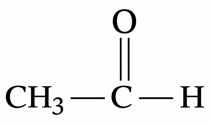
(A) Benzaldehyde: Aromatic aldehyde, gives a negative Fehling's test.
(B) Acetophenone: A simple ketone, gives a negative Fehling's test.
(C) Acetaldehyde: An aliphatic aldehyde, gives a positive Fehling's test.
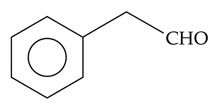
(D) Phenylacetaldehyde: An aliphatic aldehyde (aldehyde group is not directly attached to the benzene ring), gives a positive Fehling's test.
(E) Fructose: An α-hydroxy ketone, which undergoes tautomerization to form an aldehyde in the basic medium of Fehling's solution, thus giving a positive test.
Therefore, compounds (C), (D), and (E) yield a positive Fehling's test.
Q33JEE Main 2025MCQ4MElectrochemistry
Which of the following electrolyte can be used to obtain H2S2O8 by the process of electrolysis?
We need to identify which electrolyte produces H2S2O8 (peroxodisulphuric acid, also known as Marshall's acid) by electrolysis. Peroxodisulphuric acid is formed by the electrolysis of concentrated sulphuric acid. At the anode, sulphate ions (HSO4−) are oxidized as shown below: 2HSO4−→H2S2O8+2e− In dilute sulphuric acid solutions, water is preferentially oxidized at the anode to produce oxygen. Only \in a concentrated solution is the concentration of HSO4− ions high enough for their oxidation to form the peroxo bond (S-O-O-S) \in H2S2O8. The correct answer is Option 4: Concentrated solution of sulphuric acid.
Q34JEE Main 2025MCQ4MHaloalkanes and Haloarenes
Given below are two statements : Statement I : CH3−O−CH2−Cl will undergo SN1 reaction though it is a primary halide. Statement II : will not undergo SN2 reaction very easily though it is a primary halide. In the light of the above statements, choose the most appropriate answer from the options given below :
Statement I is correct because CH3−O−CH2−Cl dissociates to form an oxocarbenium ion intermediate, CH3−O+=CH2↔CH3−O−CH2+, which is highly stabilized by resonance from the oxygen lone pair, facilitating the SN1 mechanism despite it being a primary halide.
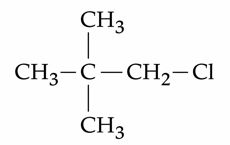
Statement II is correct because the neopentyl chloride structure ((CH3)3C−CH2−Cl) experiences extreme steric hindrance due to the bulky tert-butyl group adjacent to the reaction center. This spatial crowding blocks the backside approach of a nucleophile, making SN2 substitution kinetics extremely unfavorable. Since both statements are valid, the correct option is B.
We need to identify which acid is a vitamin. Analyzing each option: (A) Adipic acid - This is a dicarboxylic acid (HOOC(CH2)4COOH) used in nylon production. It is NOT a vitamin. (B) Ascorbic acid - This is Vitamin C, an essential nutrient required for tissue repair and enzymatic production. (C) Saccharic acid - This is glucaric acid, a sugar acid. It is NOT a vitamin. (D) Aspartic acid - This is an amino acid. It is NOT a vitamin. The correct answer is Option 2: Ascorbic acid (Vitamin C).
Q36JEE Main 2025MCQ4MClassification of Elements
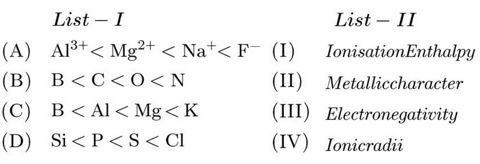
Match List-I with List-II. Choose the correct answer from the options given below :
(A) Al3+<Mg2+<Na+<F−: These are isoelectronic species (10e−). Ionic radius is inversely proportional to atomic number (Z). Since Z increases as 9<11<12<13, the radii follow the given order. Matches (IV) Ionic radii.
(B) B<C<O<N: These elements follow the periodic trend for first Ionization Enthalpy, with the anomaly that N(2p3) has a higher value than O(2p4) due to stable half-filled orbital configuration. Matches (I) Ionisation Enthalpy.
(C) B<Al<Mg<K: Metallic character increases down a group and decreases across a period from left to right. Potassium is the most metallic, and Boron (a metalloid) is the least. Matches (II) Metallic character.
(D) Si<P<S<Cl: Electronegativity increases across a period from left to right due to increased effective nuclear charge. Matches (III) Electronegativity.
Q37JEE Main 2025MCQ4MChemical Kinetics
Which of the following statement is not true for radioactive decay?
We need to identify which statement is NOT true for radioactive decay. Option 1: Decay constant increases with increase in temperature. Radioactive decay is a nuclear process and is independent of temperature. The decay constant does NOT change with temperature. This statement is NOT TRUE. Option 2: Amount of radioactive substance remained after three half lives is 1/8th of original amount. After n half-lives, the remaining amount is (1/2)n of the original. After 3 half-lives: (1/2)3=1/8. This is TRUE. Option 3: Decay constant does not depend upon temperature. This is TRUE as radioactive decay is a nuclear process independent of external conditions. Option 4: Half life is ln2 \times of mean life. t1/2=λln2=ln2×τ where τ=1/λ is the mean life. This is TRUE. The correct answer is Option 1: Decay constant increases with increase in temperature (this is false).
Q38JEE Main 2025MCQ4MAmines
The products formed in the following reaction sequence are :
The reaction sequence begins with the bromination of nitrobenzene using Br2/AcOH. Since the nitro group is meta-directing, it yields m-bromonitrobenzene.
Reduction of m-bromonitrobenzene with Sn/HCl converts the nitro group to an amino group, resulting in m-bromoaniline.
Treatment with NaNO2/HCl at 273 K performs diazotization, forming m-bromobenzenediazonium chloride.
Finally, reaction with ethanol (\text{C}_2\text{H}_5\text{OH}$) reduces the diazonium salt to bromobenzene, with ethanol being oxidized to acetaldehyde: ArN2+Cl−+CH3CH2OH→ArH+N2+CH3CHO+HCl
Here, Ar is the m-bromophenyl group, but the diazonium group is replaced by hydrogen, resulting in bromobenzene and acetaldehyde.
Q39JEE Main 2025MCQ4MOrganic Chemistry - Some Basic Principles
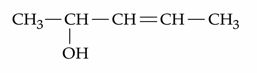
How many different stereoisomers are possible for the given molecule?
Identify chiral centers: The carbon atom at position 2 (CH(OH)) is bonded to four different groups: -CH3, -OH, -H, and -CH=CH-CH3. Thus, C2 is a chiral center.
Identify geometric isomerism: The double bond between C3 and C4 (CH=CH) can exhibit E/Z isomerism because each carbon of the double bond is attached to two different groups (C3: -CH(OH)-CH3 and -H; C4: -H and -CH3).
Calculate total stereoisomers: We have 1 chiral center (nc=1) and 1 double bond capable of E/Z isomerism (ng=1). The maximum number of stereoisomers is given by 2(nc+ng). Total stereoisomers=2(1+1)=22=4
No meso compounds are possible as there is only one chiral center.
Q40JEE Main 2025MCQ4MChemical Equilibrium
A vessel at 1000 K contains CO2 with a pressure of 0.5 atm . Some of CO2 is converted into CO on addition of graphite. If total pressure at equilibrium is 0.8 atm , then Kp is :
We need to find Kp for the reaction CO2(g)+C(s)⇌2CO(g) at 1000 K. Initially, the partial pressure of CO2 is 0.5 atm, while the partial pressure of CO is zero. If x atm of CO2 decomposes, its pressure decreases by x and the pressure of CO increases by 2x, giving equilibrium pressures of 0.5−x for CO2 and 2x for CO. Since the total pressure at equilibrium is 0.8 atm, we set up the equation (0.5−x)+2x=0.5+x=0.8, from which it follows that x=0.3 atm. Substituting this value of x back into the expressions for the equilibrium pressures yields PCO2=0.5−0.3=0.2 atm and PCO=2(0.3)=0.6 atm. The equilibrium constant is then given by Kp=PCO2PCO2=0.2(0.6)2=0.20.36=1.8 atm. The correct answer is Option 1: 1.8 atm.
Q41JEE Main 2025MCQ4MElectrochemistry
A solution of aluminium chloride is electrolysed for 30 minutes using a current of 2 A . The amount of the aluminium deposited at the cathode is $[Given : molar mass of aluminium and chlorine are 27g mol−1 and 35.5 g mol−1 respectively. Faraday constant =96500Cmol−1 ]$
We need to find the mass of aluminium deposited during electrolysis. According to Faraday's law of electrolysis, the mass deposited is given by the relation m=n×FM×I×t where M = molar mass, I = current, t = time, n = number of electrons transferred, and F = Faraday constant. For the reduction of aluminium ions Al3++3e−→Al the number of electrons transferred is n = 3. The molar mass M of aluminium is 27 g/mol, the current I is 2 A, the time t is 30 min = 30 \times 60 = 1800 s, and the Faraday constant F is 96500 C/mol. Substituting these values into the formula gives m=3×9650027×2×1800=28950097200=0.3355 g≈0.336 g The correct answer is Option 2: 0.336 g.
Q42JEE Main 2025MCQ4MAldehydes, Ketones and Carboxylic Acids
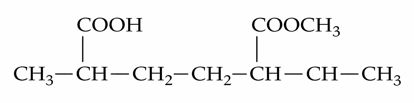
Identify the principal functional group: The compound contains a carboxylic acid group (-COOH) and an ester group (-COOCH3). According to IUPAC priority rules, carboxylic acids have higher priority than esters. Therefore, the compound is named as a carboxylic acid, and the -COOH carbon is C1.
Determine the longest continuous carbon chain containing the principal functional group: Numbering the chain from the -COOH carbon as C1 (reading the structure from left to right, assuming the image represents the molecule corresponding to option C):
C1: carbon of -COOH
C2: CH (attached to a -CH3 group)
C3: CH2
C4: CH2
C5: CH (attached to a -CH3 group)
C6: CH (attached to a -COOCH3 group)
This gives a 6-carbon main chain, so the parent name is hexanoic acid.
Identify and locate substituents:
A methyl group (-CH3) is at C2.
A methyl group (-CH3) is at C5.
A methoxycarbonyl group (-COOCH3) is at C6.
Assemble the name: List substituents alphabetically (dimethyl before methoxycarbonyl), with locants.
The name is 6-Methoxycarbonyl-2,5-dimethylhexanoic acid.
Q43JEE Main 2025MCQ4MCoordination Compounds
In which of the following complexes the CFSE, △o will be equal to zero?
We need to find the complex where CFSE (Δo) is zero. Key concept: CFSE is zero when the d-orbitals are either empty (d⁰), half-filled (d⁵ \in weak field), or completely filled (d¹⁰), because the stabilization from electrons \in t2g is exactly cancelled by destabilization from electrons \in eg. Specifically for an octahedral weak field complex: d⁵ configuration gives CFSE = (−0.4×3+0.6×2)Δo=0. Analyze each option: (A) [Fe(en)3]Cl3: Fe³⁺ is d⁵. en is a strong field ligand, so this is a low-spin complex with CFSE = −2.0Δo. CFSE is NOT zero. (B) K4[Fe(CN)6]: Fe²⁺ is d⁶. CN⁻ is a strong field ligand (low spin), CFSE = −2.4Δo. NOT zero. (C) [Fe(NH3)6]Br2: Fe²⁺ is d⁶. NH₃ is a moderate-strong field ligand. CFSE is NOT zero. (D) K3[Fe(SCN)6]: Fe³⁺ is d⁵. SCN⁻ is a weak field ligand, so this is a high-spin complex. For high-spin d⁵: electrons are distributed as t2g3eg2. CFSE = 3(−0.4Δo)+2(0.6Δo)=−1.2Δo+1.2Δo=0 The correct answer is Option 4: K3[Fe(SCN)6].
Q44JEE Main 2025MCQ4MSolutions
Arrange the following solutions in order of their increasing boiling points. (i) 10−4MNaCl (ii) 10−4MUrea (iii) 10−3MNaCl (iv) 10−2MNaCl
Arrange the solutions in order of increasing boiling points. We recall that boiling point elevation depends on the total solute particle concentration. ΔTb=i⋅Kb⋅m Here, i is the van't Hoff factor. Next, we calculate the effective concentration for each solution. For (i) 10−4 M NaCl, which dissociates as NaCl \to Na⁺ + Cl⁻, the van't Hoff factor is i=2 giving an effective concentration of 2×10⁻⁴ M. For (ii) 10−4 M urea, a non-electrolyte with i=1, the effective concentration is 10−4 M. For (iii) 10−3 M NaCl with i=2, the effective concentration becomes 2×10⁻³ M. For (iv) 10−2 M NaCl with i=2, the effective concentration becomes 2×10⁻² M. Ordering these effective concentrations yields 10−4<2×10⁻⁴<2×10⁻³<2×10⁻² Hence, \in terms of the given options: (ii)<(i)<(iii)<(iv) Therefore, the solutions in order of increasing boiling point are (ii) < (i) < (iii) < (iv).
Q45JEE Main 2025MCQ4MCoordination Compounds
From the magnetic behaviour of [NiCl4]2−(paramagnetic) and [Ni(CO)4] (diamagnetic), choose the correct geometry and oxidation state.
We need to determine the geometry and oxidation state of Ni in [NiCl4]2− (paramagnetic) and [Ni(CO)4] (diamagnetic). We first analyze [NiCl4]2−. Charge balance Ni + 4(−1) = −2 indicates Ni is \in the +2 oxidation state and thus has a d⁸ configuration. As Cl⁻ is a weak field ligand with four coordination sites, the complex adopts a tetrahedral geometry. A tetrahedral d⁸ complex has two unpaired electrons, explaining the paramagnetism. Next, we analyze [Ni(CO)4]. CO is a neutral ligand and Ni + 4(0) = 0 shows Ni is \in the 0 oxidation state, corresponding to d¹⁰. With all d‐orbitals filled and four coordination sites, the complex remains tetrahedral rather than square planar. The d¹⁰ configuration has no unpaired electrons, which accounts for the observed diamagnetism. In summary, [NiCl4]2− features Ni(II) \in a tetrahedral geometry with two unpaired electrons, while [Ni(CO)4] contains Ni(0) in a tetrahedral geometry with all electrons paired. The correct answer is Option 3.
Q46JEE Main 2025NAT4MChemical Bonding and Molecular Structure
The number of molecules/ions that show linear geometry among the following is ______ SO2, BeCl2, CO2, N3−, NO2, F2O, XeF2, NO2+, I3−, O3
We need to count the number of molecules/ions with linear geometry from the given list. SO2,BeCl2,CO2,N3−,NO2,F2O,XeF2,NO2+,I3−,O3 Analyzing each: 1. SO2: S has 2 bonding pairs + 1 lone pair = bent geometry. NOT linear. 2. BeCl2: Be has 2 bonding pairs, no lone pairs. sp hybridized. LINEAR. 3. CO2: C has 2 double bonds, no lone pairs. sp hybridized. LINEAR. 4. N3−: Azide ion. Central N has 2 bonding regions, no lone pairs. sp hybridized. LINEAR. 5. NO2: N has 2 bonding pairs + 1 unpaired electron = bent geometry. NOT linear. 6. F2O: O has 2 bonding pairs + 2 lone pairs = bent geometry. NOT linear. 7. XeF2: Xe has 2 bonding pairs + 3 lone pairs = LINEAR (sp³d hybridization, trigonal bipyramidal with F atoms \in axial positions). 8. NO2+: Nitronium ion. N has 2 double bonds, no lone pairs. sp hybridized. LINEAR. 9. I3−: Central I has 2 bonding pairs + 3 lone pairs = LINEAR (similar to XeF₂). 10. O3: Central O has 2 bonding regions + 1 lone pair = bent geometry. NOT linear. Linear molecules/ions: BeCl2,CO2,N3−,XeF2,NO2+,I3− = 6 The answer is 6.
Q47JEE Main 2025NAT4MChemical Kinetics
A→B The molecule A changes into its isomeric form B by following a first order kinetics at a temperature of 1000 K . If the energy barrier with respect to reactant energy for such isomeric transformation is 191.48kJMol−1 and the frequency factor is 1020, the time required for 50% molecules of A to become B is _________picoseconds (nearest integer). [R=8.314JK−1mol−1]
We need to find the time for 50% conversion using first order kinetics. At T = 1000 K, the activation energy is 191.48 kJ/mol = 191480 J/mol, the frequency factor is A = 10^{20}, and R = 8.314 J K⁻¹ mol⁻¹. We start by calculating the rate constant using the Arrhenius equation: k=A⋅e−Ea/RT Next, we compute the exponent: RTEa=8.314×1000191480=8314191480=23.03 This gives: k=1020×e−23.03 Since ln(10) = 2.303, we have: e−23.03=e−10×2.303=10−10 Substituting back yields: k=1020×10−10=1010 s−1 For 50% conversion, the half-life \in first order kinetics is given by: t1/2=kln2=10100.693=6.93×10−11 s Converting this to picoseconds using 1 ps = 10^{-12} s: t1/2=10−126.93×10−11=69.3 ps Rounding to the nearest integer gives a half-life of approximately 69 picoseconds.
Q48JEE Main 2025NAT4MAmines
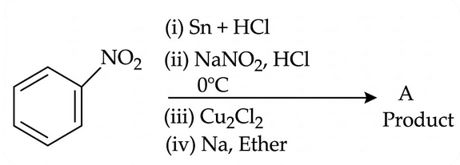
Consider the following sequence of reactions : Molar mass of the product formed (A) is ______gmol−1.
Nitrobenzene (C6H5NO2) is reduced to aniline (C6H5NH2) by Sn+HCl.
Aniline undergoes diazotization with NaNO2/HCl at 0∘C to form benzenediazonium chloride (C6H5N2+Cl−).
Benzenediazonium chloride reacts with Cu2Cl2 (Sandmeyer reaction) to yield chlorobenzene (C6H5Cl).
Chlorobenzene undergoes Wurtz-Fittig reaction with Na in ether, where two molecules of chlorobenzene couple to form biphenyl (C6H5−C6H5 or C12H10), which is product A.
Molar mass of A (C12H10) = (12×atomic mass of C)+(10×atomic mass of H)
Molar mass of A = (12×12.0)+(10×1.0)=144+10=154 gmol−1.
The final answer is 154.
Q49JEE Main 2025NAT4MSome Basic Concepts of Chemistry
Some CO2 gas was kept \in a sealed container at a pressure of 1 atm and at 273 K . This entire amount of CO2 gas was later passed through an aqueous solution of Ca(OH)2. The excess unreacted Ca(OH)2 was later neutralized with 0.1 M of 40 mL HCl . If the volume of the sealed container of CO2 was x, then x is ________cm3 (nearest integer). [Given : The entire amount of CO2(g)reacted with exactly half the initial amount of Ca(OH)2 present in the aqueous solution.]
We need to find the volume of the sealed container of CO2. We start by writing the chemical reactions involved. CO2+Ca(OH)2→CaCO3+H2O Next, the excess Ca(OH)2 is neutralized by hydrochloric acid: Ca(OH)2+2HCl→CaCl2+2H2O Then we calculate the moles of excess Ca(OH)2 from the titration data. Moles of HCl = 0.1 M \times 0.040 L = 0.004 mol Moles of excess Ca(OH)2 = 20.004=0.002 mol The problem states that all of the CO2 reacted with exactly half of the initial amount of Ca(OH)2. If the initial Ca(OH)2 is N mol, then the reacted portion is N/2 mol and the excess is also N/2 mol. Therefore, N/2=0.002 mol, so N=0.004 mol. It follows that the moles of CO2 are equal to the moles of Ca(OH)2 that reacted, which is N/2 = 0.002 mol. Finally, applying the ideal gas law at STP (273 K, 1 atm): V=n×22400 cm3/mol=0.002×22400=44.8 cm3 Rounding to the nearest integer gives x≈45 cm³. Therefore, the volume of the sealed container of CO2 is 45 cm³.
Q50JEE Main 2025NAT4MPractical Organic Chemistry
In Carius method for estimation of halogens, 180 mg of an organic compound produced 143.5 mg of AgCl . The percentage composition of chlorine in the compound is _______ %. (Given : molar mass in gmol−1 of Ag:108,Cl:35.5)
We need to find the percentage of chlorine in an organic compound using the Carius method. We start by finding the moles of AgCl. The molar mass of AgCl is 108 + 35.5 = 143.5 g/mol. The mass of AgCl is 143.5 mg, which is 0.1435 g. Using these values, we calculate the moles of AgCl: 143.50.1435=0.001 mol Next, we determine the mass of chlorine obtained. Each mole of AgCl contains one mole of Cl, so the moles of Cl are 0.001 mol. The mass of Cl is then calculated as: 0.001×35.5=0.0355 g, which is 35.5 mg. Then we calculate the percentage of chlorine \in the compound. %Cl=Mass of compoundMass of Cl×100 Substituting the values gives: =18035.5×100=19.72%≈20% Therefore, the percentage of chlorine in the compound is 20%.
Mathematics25 questions
Q51JEE Main 2025MCQ4MSequences and Series
Let a1,a2,a3,... be a G.P. of increasing positive terms. If a1a5=28 and a2+a4=29, then a6 is equal to:
The terms a1,a2,a3,... are given to be \in GP. Let the first term of the series a1 be a, and the common ratio be r. The nth term of the series an can be calculated as, an=a(r)n−1a5=a(r)5−1=ar4a2=a(r)2−1=ara4=a(r)4−1=ar3a1×a5=a×ar4=a2r4=28−(1) Taking the square root on both sides, we get, ar2=28=27−(2)a2+a4=ar+ar3=ar(1+r2)=29−(3) dividing (2) by (3), we get, ar(1+r2)ar2=29271+r2r=292727r2−29r+27=0(r−27)(27r−1)=0r=27 or r=271 We are given that the series is increasing, so the value of r has to be greater than 1 and is equal to 27 Substituting r \in (2), we get, a(27)2=27a=271a6=ar5=(271)(27)5=(27)4=(28)2=784 Hence, the correct answer is option D.
Q52JEE Main 2025MCQ4MDifferential Equations
Let x=x(y) be the solution of the differential equationy2dx+(x−y1)dy=0 . If x(1)=1, then 21 is :
The given differential equation is: y2dx+(x−y1)dy=0 Rearranging terms to express \in standard linear form: y2dydx=−x+y1y2dydx+x=y1 Dividing both sides by y2: dydx+y21x=y31 This is a linear differential equation of the form: dydx+P(y)x=Q(y) where P(y)=y21 and Q(y)=y31. To solve, use the integrating factor method. The integrating factor (IF) is: IF=e∫P(y)dy=e∫y21dy Compute the integral: ∫y21dy=∫y−2dy=−y−1=−y1 Thus, IF=e−y1 The solution is given by: x⋅(IF)=∫Q(y)⋅(IF)dy+C Substituting: x⋅e−y1=∫y31e−y1dy+C Evaluate the integral: Let I=∫y31e−y1dy Use substitution: let u=−y1, then du=y21dy. Now, y1=−u, so: y31dy=y1⋅y21dy=(−u)du Thus, I=∫(−u)eudu=−∫ueudu Integrate by parts: let v=u, dw=eudu, so dv=du, w=eu. Then, ∫ueudu=ueu−∫eudu=ueu−eu+C1=eu(u−1)+C1 Therefore, I=−[eu(u−1)]$+C=−eu(u−1)+C Substitute back u=−y1: I=−e−y1(−y1−1)+C=−e−y1(−(y1+1))+C=e−y1(1+y1)+C So, x⋅e−y1=e−y1(1+y1)+C Dividing both sides by e−y1: x=1+y1+Cey1 This is the general solution. Apply the initial condition: when y=1, x=1. Substitute: 1=1+11+Ce111=1+1+Ce1=2+CeCe=−1C=−e1 Thus, the particular solution is: x=1+y1−e1ey1=1+y1−ey1−1 Now, find x(21) by substituting y=21: x(21)=1+211−e211−1=1+2−e2−1=3−e1=3−e The value of x(21) is 3−e, which corresponds to option C.
Q53JEE Main 2025MCQ4MProbability
Two balls are selected at random one by one without replacement from a bag containing 4 white and 6 black balls. If the probability that the first selected ball is black, given that the second selected ball is also black, is nm, where gcd(m,n)=1, then m+n is equal to :
We need to find P(first black∣second black) We know, for conditional probability, P(A∣B)=P(B)P(A∩B) Let, A be the event that the first ball is black, and B be that the second ball is black So, probability both balls are black (without replacement) is P(A∩B)=106⋅95=31 Probability second ball is black is P(B)=P(second black | first black)⋅P(first black)+P(second black | first white)⋅P(first white)=95⋅106+96⋅104=9030+9024=53 Now, P(A∣B)=P(B)P(A∩B)=3/51/3=95 Thus, m+n=5+9=14 .
Q54JEE Main 2025MCQ4MLogarithms
The product of all solutions of the equation e5(logex)2+3=x8,x>0, is :
Let y=lnx Since x>0, this substitution is valid. ∴x=ey and x8=(ey)8=e8y Substitute into the equation e5(lnx)2−3=e8y Since (lnx)=y∴e5(y)2−3=e8y Equate the exponents as the bases are same (e) 5y2−3=8y∴5y2−8y−3=0 Sum of the quadratic equation = y1+y2 which is equal to −ab∴y1+y2=8/5------(i) To find: x1×x2 We know x=ey∴x1×x2=ey1+y2 Substitute the value of y1+y2 from---(i) ∴x1×x2=e58. Hence, option A is the correct answer
Q55JEE Main 2025MCQ4MStraight Lines and Pair of Straight Lines
Let the triangle PQR be the image of the triangle with vertices (1, 3), (3, 1) and (2, 4) in the line x+2y=2. If the centroid of △PQR is the point (α,β), then 15(α−β) is equal to :
To find the image of the triangle with vertices (1, 3), (3, 1), and (2, 4) in the line x+2y=2, we first rewrite the line equation as x+2y−2=0. Here, a=1, b=2, and c=−2. The formula for the image (x2,y2) of a point (x1,y1) \in the line ax+by+c=0 is given by: ax2−x1=by2−y1=a2+b2−2(ax1+by1+c) Substituting a=1, b=2, and c=−2: 1x2−x1=2y2−y1=12+22−2(1⋅x1+2⋅y1−2)=5−2(x1+2y1−2) Let the common ratio be k, so: x2=x1+k,y2=y1+2k,wherek=5−2(x1+2y1−2) Solving for x2 and y2: x2=x1+5−2(x1+2y1−2)=55x1−2x1−4y1+4=53x1−4y1+4y2=y1+2⋅5−2(x1+2y1−2)=55y1−4x1−8y1+8=5−4x1−3y1+8 Now, find the images of each vertex: Image of A(1, 3): xP=53(1)−4(3)+4=53−12+4=5−5=−1yP=5−4(1)−3(3)+8=5−4−9+8=5−5=−1 So, P is (−1,−1). Image of B(3, 1): xQ=53(3)−4(1)+4=59−4+4=59yQ=5−4(3)−3(1)+8=5−12−3+8=5−7 So, Q is (59,−57). Image of C(2, 4): xR=53(2)−4(4)+4=56−16+4=5−6yR=5−4(2)−3(4)+8=5−8−12+8=5−12 So, R is (−56,−512). The vertices of △PQR are P(−1,−1), Q(59,−57), and R(−56,−512). The centroid (α,β) of a triangle with vertices (x1,y1), (x2,y2), (x3,y3) is given by: α=3x1+x2+x3,β=3y1+y2+y3 Compute α: α=3−1+59+(−56)=3−1+59−56 First, simplify the numerator: −1+59−56=−1+53=−55+53=−52 Then, α=3−52=−52×31=−152 Compute β: β=3−1+(−57)+(−512)=3−1−57−512 Simplify the numerator: −1−57−512=−1−519=−55−519=−524 Then, β=3−524=−524×31=−1524=−58 Now compute α−β: α−β=−152−(−58)=−152+58 Convert to a common denominator of 15: 58=5×38×3=1524 So, α−β=−152+1524=1522 Now compute 15(α−β): 15(α−β)=15×1522=22 Therefore, 15(α−β)=22, which corresponds to option D.
Q56JEE Main 2025MCQ4MDefinite Integrals
Let for f(x)=7tan8x+7tan6x−3tan4x−3tan2xI1=∫0π/4f(x)dx and I2=∫0π/4xf(x)dx. Then 7I1+12T2 is equal to :
We are given f(x)=7tan8x+7tan6x−3tan4x−3tan2x and need to find 7I1+12I2 where I1=∫0π/4f(x)dx and I2=∫0π/4xf(x)dx. f(x)=7tan6x(tan2x+1)−3tan2x(tan2x+1)=(tan2x+1)(7tan6x−3tan2x)=sec2x⋅tan2x(7tan4x−3) Substitute t=tanx, so dt=sec2xdx. When x=0,t=0; when x=π/4,t=1. I1=∫01t2(7t4−3)dt=∫01(7t6−3t2)dt=[t7−t3]01=1−1=0 From the substitution above: G(x)=∫f(x)dx=tan7x−tan3x Let u=x and dv=f(x)dx, so du=dx and v=G(x)=tan7x−tan3x. I2=[x⋅G(x)]0π/4−∫0π/4G(x)dx=4π(tan7(π/4)−tan3(π/4))−∫0π/4(tan7x−tan3x)dx=4π(1−1)−∫0π/4(tan7x−tan3x)dx=−∫0π/4(tan7x−tan3x)dx Using the reduction formula ∫0π/4tannxdx=n−11−∫0π/4tann−2xdx: ∫0π/4tan3xdx=21−∫0π/4tanxdx=21−2ln2∫0π/4tan5xdx=41−(21−2ln2)=−41+2ln2∫0π/4tan7xdx=61−(−41+2ln2)=125−2ln2 Therefore: ∫0π/4(tan7x−tan3x)dx=(125−2ln2)−(21−2ln2)=−121I2=−(−121)=1217I1+12I2=7(0)+12⋅121=0+1=1 The answer is Option B: 1 .
Q57JEE Main 2025MCQ4MCircles
Let the parabola y=x2+px−3, meet the coordinate axes at the points P, Q and R . If the circle C with centre at (-1, -1) passes through the points P, Q and R, then the area of △PQR is :
The parabola is given by y=x2+px−3. It intersects the coordinate axes at points P, Q, and R. To find the points of intersection: When x=0, y=(0)2+p(0)−3=−3. So, R is (0,−3). When y=0, x2+px−3=0. Let the roots be x1 and x2, so P and Q are (x1,0) and (x2,0). The circle has center at (−1,−1) and passes through P, Q, and R. The radius is the distance from the center to any point on the circle. Distance from center (−1,−1) to R (0,−3): (0−(−1))2+(−3−(−1))2=(1)2+(−2)2=1+4=5 So, the radius r=5. Since the circle passes through P (x1,0) and Q (x2,0), the distance from the center to each must also be 5. For P (x1,0): (x1−(−1))2+(0−(−1))2=(x1+1)2+12=5 Square both sides: (x1+1)2+1=5(x1+1)2=4x1+1=±2 So, x1=1 or x1=−3. Similarly, for Q (x2,0): (x2+1)2+1=5(x2+1)2=4x2=1 or x2=−3. Since the discriminant of x2+px−3=0 is p2+12>0 (always positive), there are two distinct real roots. Therefore, the roots are 1 and -3. Assign P as (1,0) and Q as (−3,0). Now, verify the value of p using the \sum of roots: Sum of roots: x1+x2=1+(−3)=−2=−p, so p=2. The parabola is y=x2+2x−3, and the points are P(1,0), Q(−3,0), and R(0,−3). To find the area of △PQR with vertices P(1,0), Q(−3,0), and R(0,−3), use the shoelace formula. Shoelace formula for area given points (x1,y1), (x2,y2), (x3,y3): Area =21∣x1(y2−y3)+x2(y3−y1)+x3(y1−y2)∣ Substitute x1=1, y1=0, x2=−3, y2=0, x3=0, y3=−3: Area =21∣1⋅(0−(−3))+(−3)⋅(−3−0)+0⋅(0−0)∣=21∣1⋅3+(−3)⋅(−3)+0∣=21∣3+9∣=21∣12∣=21×12=6 Therefore, the area of △PQR is 6.
Q58JEE Main 2025MCQ4MThree Dimensional Geometry
Let L1:2x−1=3y−2=4z−3 and L2:3x−2=4y−4=5z−5 be two lines. Then which of the following points lies on the line of the shortest distance between L1 and L2 ?
Given lines L1:2x−1=3y−2=4z−3 and L2:3x−2=4y−4=5z−5. Point on L1: A=(1,2,3), direction d1=(2,3,4). Point on L2: B=(2,4,5), direction d2=(3,4,5). The shortest distance line is perpendicular to both L1 and L2, so its direction is d1×d2: d1×d2=i^23j^34k^45=(15−16)i^−(10−12)j^+(8−9)k^=(−1,2,−1) Let the point on L1 be P=(1+2t,2+3t,3+4t) and on L2 be Q=(2+3s,4+4s,5+5s). PQ must be parallel to (−1,2,−1): PQ=(1+3s−2t,2+4s−3t,2+5s−4t) Setting PQ⋅d1=0: 2(1+3s−2t)+3(2+4s−3t)+4(2+5s−4t)=02+6s−4t+6+12s−9t+8+20s−16t=016+38s−29t=0⋯(1) Setting PQ⋅d2=0: 3(1+3s−2t)+4(2+4s−3t)+5(2+5s−4t)=03+9s−6t+8+16s−12t+10+25s−20t=021+50s−38t=0⋯(2) From (1): 29t=16+38s⟹t=2916+38s Substituting into (2): 21+50s−38⋅2916+38s=029(21+50s)−38(16+38s)=0609+1450s−608−1444s=01+6s=0⟹s=−61t=2916+38(−1/6)=2916−19/3=2929/3=31P=(1+32,2+1,3+34)=(35,3,313)Q=(2−21,4−32,5−65)=(23,310,625) The line of shortest distance passes through P=(35,3,313) with direction (−1,2,−1): Parametric form: (35−λ,3+2λ,313−λ) Checking Option (1): (314,−3,322): 35−λ=314⟹λ=−33+2(−3)=3−6=−3✓313−(−3)=313+3=322✓ The correct answer is Option (1): (314,−3,322).
Q59JEE Main 2025MCQ4MDifferential Equations
Let f(x) be a real differentiable function such that f(0)=1 and f(x+y)=f(x)f′(y)+f′(x)f(y) for all x,y∈R. Then ∑n=1100logef(n) is equal to :
Given the functional equation f(x+y)=f(x)f′(y)+f′(x)f(y) for all real x and y, and the initial condition f(0)=1, we need to find ∑n=1100logef(n). To solve, substitute y=0 into the functional equation: f(x+0)=f(x)f′(0)+f′(x)f(0) Given f(0)=1, this simplifies to: f(x)=f(x)f′(0)+f′(x) Rearranging terms: f′(x)=f(x)−f(x)f′(0)f′(x)=f(x)(1−f′(0)) Let k=1−f′(0), a constant. Then: f′(x)=kf(x) This is a first-order linear differential equation. The general solution is f(x)=Aekx, where A is a constant. Using the initial condition f(0)=1: f(0)=Aek⋅0=A=1 So, f(x)=ekx. Now, find f′(x): f′(x)=kekx Evaluate at x=0: f′(0)=ke0=k But k=1−f′(0), so substitute: k=1−k2k=1k=21 Thus, f(x)=e2x. Verify this satisfies the original functional equation: Left-hand side: f(x+y)=e2x+y. Right-hand side: f(x)f′(y)+f′(x)f(y)=e2x⋅21e2y+21e2x⋅e2y=21e2x+y+21e2x+y=e2x+y. Both sides are equal, so the solution is valid. Now compute logef(n): logef(n)=loge(e2n)=2n The \sum is: ∑n=1100logef(n)=∑n=11002n=21∑n=1100n The \sum of the first n natural numbers is given by the formula ∑n=1mn=2m(m+1). For m=100: ∑n=1100n=2100×101=5050 Therefore, 21×5050=2525 The \sum ∑n=1100logef(n)=2525. Comparing with the options, A. 2525 is correct.
Q60JEE Main 2025MCQ4MPermutations and Combinations
From all the English alphabets, five letters are chosen and are arranged in alphabetical order. The total number of ways, in which the middle letter is ' M ', is :
We have to select 5 alphabets and arrange them in alphabetical order such that the middle term is M. M is the 13th term in the English alphabets. It means that we have to select 2 alphabets out of 12, and place it on the left hand side of M and 2 alphabets out of the remaining 13, and place it on the right hand side of M. For the left hand side of M: Number of ways in which we select 2 alphabets out of 12 = 12C2 Number of ways \in which we arrange the selected alphabets \in alphabetical order = 1 (only one case will be possible) Total number of ways \in which we select 2 alphabets out of 12 and arrange it \in alphabetical order = 12C2×1=12C2=66 For the right hand side of M: Number of ways \in which we select 2 alphabets out of 13 = 13C2 Number of ways \in which we arrange the selected alphabets \in alphabetical order = 1 (only one case will be possible) Total number of ways \in which we select 2 alphabets out of 13 and arrange it \in alphabetical order = 13C2×1=13C2=78 Number of ways \in which we can select M and place it \in the middle of 5 alphabets = 1 Total number of ways \in which we select 5 alphabets and arrange it \in alphabetical order such that M is the middle term = 66×78×1=5148 Hence, we can select 5 alphabets out of 26 and arrange it \in alphabetical order \in such a way that the middle term is M \in 5148 ways. ∴ The required answer is A.
Q61JEE Main 2025MCQ4MInverse Trigonometric Functions
Using the principal values of the inverse trigonometric functions, the sum of the maximum and the minimum values of 16((sec−1x)2(cosec−1x)2)is :
We need to find the sum of the maximum and minimum values of 16((sec−1x)2+(csc−1x)2). Key identity: For all ∣x∣≥1, we have: sec−1x+csc−1x=2π Setting up variables: Let α=sec−1x. Then csc−1x=2π−α. Range of α: The principal value of sec−1x lies \in [0,π]∖{2π}. For x≥1: α∈[0,2π) For x≤−1: α∈(2π,π] So the full domain is α∈[0,2π)∪(2π,π]. Expressing the function: f(α)=16[α2+(2π−α)2]=16[α2+4π2−πα+α2]=16[2α2−πα+4π2]=32α2−16πα+4π2 Finding the critical point: f′(α)=64α−16π=0α=4π Since f′′(α)=64>0, this is a minimum. The point α=4π lies \in the domain (it is \in [0,2π)). Minimum value: f(4π)=32⋅16π2−16π⋅4π+4π2=2π2−4π2+4π2=2π2 Maximum value: Since f(α) is a parabola opening upward with vertex at α=4π, the maximum on the domain occurs at the endpoint farthest from 4π. At α=0: f(0)=0−0+4π2=4π2 At α=π: f(π)=32π2−16π2+4π2=20π2 The maximum value is 20π2 (at α=π, i.e., x=−1). Final answer: Sum of maximum and minimum =20π2+2π2=22π2 This matches Option B.
Q62JEE Main 2025MCQ4MDifferential Equations
Let f:R→R be a twice differentiable function such that f(x+y)=f(x)f(y) for all x,y∈R. If f′(0)=4a and f satisfies f′′(x)−3af′(x)−f(x)=0,a>0, then the area of the region R={(x,y)∣0≤y≤f(ax),0≤x≤2} is
We are given that f:R→R is twice differentiable and satisfies f(x+y)=f(x)f(y) for all x,y∈R. Step 1: Find f(0) Setting x=0 and y=0 \in the functional equation: f(0+0)=f(0)⋅f(0)f(0)=[f(0)]2 This gives f(0)(f(0)−1)=0, so f(0)=0 or f(0)=1. If f(0)=0, then for any x: f(x)=f(x+0)=f(x)⋅f(0)=0, making f identically zero. But we are given f′(0)=4a with a>0, so f is not identically zero. Therefore, f(0)=1. Step 2: Determine the form of f(x) Differentiating f(x+y)=f(x)f(y) with respect to x (treating y as a constant): f′(x+y)=f′(x)⋅f(y) Setting x=0: f′(y)=f′(0)⋅f(y)=4a⋅f(y) So f satisfies the differential equation f′(x)=4a⋅f(x) with f(0)=1. This is a standard first-order ODE. Its solution is: f(x)=e4ax Step 3: Find the value of a We are given the second-order ODE: f′′(x)−3a⋅f′(x)−f(x)=0. Let us compute the derivatives of f(x)=e4ax: f′(x)=4a⋅e4axf′′(x)=(4a)2⋅e4ax=16a2⋅e4ax Substituting into the ODE: 16a2⋅e4ax−3a⋅(4a⋅e4ax)−e4ax=016a2⋅e4ax−12a2⋅e4ax−e4ax=0 Factoring out e4ax: e4ax(16a2−12a2−1)=0e4ax(4a2−1)=0 Since e4ax=0 for any real x, we need: 4a2−1=04a2=1a2=41a=±21 Since a>0, we get a=21. Step 4: Write f(x) and f(ax) With a=21: f(x)=e4⋅21⋅x=e2x Now we compute f(ax): f(ax)=f(21⋅x)=e2⋅2x=ex Step 5: Compute the area The region is R={(x,y)∣0≤y≤f(ax),0≤x≤2}. The area is given by: A=∫02f(ax)dx=∫02exdx Evaluating the integral: A=[ex]02=e2−e0=e2−1 Hence, the correct answer is Option A.
Q63JEE Main 2025MCQ4MArea Under The Curves
The area of the region, inside the circle (x−23)2+y2=12 and outside the parabola y2=23x is :
The circle (x−23)2+y2=12 has centre (23,0) and radius r=12=23. The parabola y2=23x opens towards the positive x-axis and is symmetric about the x-axis. Points common to both curves are obtained by substituting y2=23x \in the circle: (x−23)2+23x=12⟹x2−23x=0⟹x(x−23)=0. Hence x=0 gives the origin (0,0), and x=23 gives the points (23,±23). Thus the two curves intersect at the three points (0,0) and (23,±23). Because the figure is symmetric about the x-axis, we calculate the area above the axis and double it. For a fixed y between 0 and 23 the left boundary of the circle is obtained from (x−23)2+y2=12⇒x=23−12−y2. The parabola gives x=23y2. Inside the circle but outside the parabola means the x-coordinate runs from the circle to the parabola. Hence the required area A is A=2∫023[23y2−(23−12−y2)]$dy. Split the integral: A=2\Biggl\$[\;\underbrace{\int_{0}^{2\sqrt{3}}\sqrt{12-y^{2}}\,dy}_{I_{1}}\;+\;\underbrace{\int_{0}^{2\sqrt{3}}\left(\frac{y^{2}}{2\sqrt{3}}-2\sqrt{3}\right)dy}_{I_{2}}\;\Biggr]\$. Case 1: Evaluate I1. The integrand represents the upper half of a circle of radius 23. Area of a semicircle =21πr2=21π(23)2=6π. Taking the upper quarter (from y=0 to y=23) gives I1=3π. Case 2: Evaluate I2. ∫02323y2dy=231⋅3(23)3=4,∫02323dy=23⋅23=12. Therefore I2=4−12=−8. Combine the two parts: A=2(I1+I2)=2(3π−8)=6π−16. Hence the required area is 6π−16, which matches Option B.
Q64JEE Main 2025MCQ4MHyperbola
Let the foci of a hyperbola be (1,4) and (1,−12). If it passes through the point (1,6), then the length of its latus-rectum is :
The foci of the hyperbola are F1=(1,4) and F2=(1,−12).
The center of the hyperbola is the midpoint of the foci: C=(21+1,24−12)=(1,−4).
The distance between the foci is 2c=∣4−(−12)∣=16, so c=8.
For a hyperbola, the relation between a,b,c is c2=a2+b2, which implies b2=c2−a2.
The length of the latus rectum is given by L=a2b2.
Substituting b2=c2−a2: L=a2(c2−a2).
We have c=8, so L=a2(82−a2)=a2(64−a2).
Given the options and the target answer D (288/5), we set the latus rectum length to this value: a2(64−a2)=5288 10(64−a2)=288a 640−10a2=288a 10a2+288a−640=0
Dividing by 2, we get: 5a2+144a−320=0
Solving for a using the quadratic formula a=2A−B±B2−4AC: a=2(5)−144±1442−4(5)(−320)=10−144±20736+6400=10−144±27136
Since a must be positive for a hyperbola, we take the positive root: a=10−144+27136
This value of a ensures c>a, as 27136≈164.73, so a≈2.073, which is less than c=8.
Now, substitute a back into the latus rectum formula or directly verify.
The derivation implies that the point (1,6) ensures these a and b values are valid for the hyperbola.
The final answer is D.
Q65JEE Main 2025MCQ4MSequences and Series
If ∑r=1nTr=64(2n−1)(2n+1)(2n+3)(2n+5) then limn→∞∑r=1n(Tr1) is equal to:
Given that the sum of the first n terms is: ∑r=1nTr=64(2n−1)(2n+1)(2n+3)(2n+5) To find the general term Tn, use the relation Tn=Sn−Sn−1 for n≥2, where Sn is the \sum up to n terms. First, express Sn and Sn−1: Sn=64(2n−1)(2n+1)(2n+3)(2n+5)Sn−1=64(2(n−1)−1)(2(n−1)+1)(2(n−1)+3)(2(n−1)+5)=64(2n−3)(2n−1)(2n+1)(2n+3) Now, compute Tn=Sn−Sn−1: Tn=64(2n−1)(2n+1)(2n+3)(2n+5)−64(2n−3)(2n−1)(2n+1)(2n+3) Factor out the common terms: Tn=64(2n−1)(2n+1)(2n+3)[(2n+5)−(2n−3)] Simplify the expression inside the brackets: (2n+5)−(2n−3)=8 So, Tn=64(2n−1)(2n+1)(2n+3)×8=648×(2n−1)(2n+1)(2n+3)=81(2n−1)(2n+1)(2n+3) Thus, Tn=8(2n−1)(2n+1)(2n+3) Now, find Tn1: Tn1=(2n−1)(2n+1)(2n+3)8 Decompose this into partial fractions. Set: (2n−1)(2n+1)(2n+3)8=2n−1A+2n+1B+2n+3C Multiply both sides by (2n−1)(2n+1)(2n+3): 8=A(2n+1)(2n+3)+B(2n−1)(2n+3)+C(2n−1)(2n+1) Expand the right-hand side: A(2n+1)(2n+3)=A(4n2+8n+3)B(2n−1)(2n+3)=B(4n2+4n−3)C(2n−1)(2n+1)=C(4n2−1) So, 8=(4A+4B+4C)n2+(8A+4B)n+(3A−3B−C) Equate coefficients of like powers of n: For n2: 4A+4B+4C=0 \Rightarrow A+B+C=0−(1) For n: 8A+4B=0 \Rightarrow 2A+B=0−(2) Constant term: 3A−3B−C=8−(3) Solve the system of equations. From equation (2): B=−2A Substitute into equation (1): A+(−2A)+C=0⇒−A+C=0⇒C=A Substitute B=−2A and C=A into equation (3): 3A−3(−2A)−A=8⇒3A+6A−A=8⇒8A=8⇒A=1 Then, B=−2(1)=−2 and C=1. So, (2n−1)(2n+1)(2n+3)8=2n−11−2n+12+2n+31 Therefore, Tn1=2n−11−2n+12+2n+31 Now, compute the \sum: ∑r=1nTr1=∑r=1n(2r−11−2r+12+2r+31) This is a telescoping series. Write the \sum explicitly: ∑r=1n2r−11−2∑r=1n2r+11+∑r=1n2r+31 Adjust the indices for alignment: The first \sum: ∑r=1n2r−11=11+31+51+⋯+2n−11 The second \sum: ∑r=1n2r+11=31+51+⋯+2n+11 The third \sum: ∑r=1n2r+31=51+71+⋯+2n+31 Combine the sums: Sn=(11+31+51+⋯+2n−11)−2(31+51+⋯+2n+11)+(51+71+⋯+2n+31) Group terms by denominator: Denominator 1: only \in the first \sum, coefficient +1 \to term +11 Denominator 3: \in first \sum (+1) and second \sum (−2), coefficient 1−2=−1 \to term −31 Denominators 5, 7, ..., 2n−1: \in first \sum (+1), second \sum (−2), and third \sum (+1), coefficient 1−2+1=0 Denominator 2n+1: \in second \sum (−2) and third \sum (+1), coefficient −2+1=−1 \to term −2n+11 Denominator 2n+3: only \in third \sum, coefficient +1 \to term +2n+31 Thus, the \sum simplifies to: Sn=11−31−2n+11+2n+31 Simplify: Sn=(1−31)+(−2n+11+2n+31)=32+(2n+31−2n+11) Compute the difference: 2n+31−2n+11=(2n+1)(2n+3)(2n+1)−(2n+3)=(2n+1)(2n+3)−2 So, Sn=32−(2n+1)(2n+3)2 Now, evaluate the limit as n→∞: limn→∞Sn=limn→∞[32−(2n+1)(2n+3)2] As n→∞, (2n+1)(2n+3)2→0, so: limn→∞Sn=32 Thus, the limit is 32, which corresponds to option B.
Q66JEE Main 2025MCQ4MProbability
A coin is tossed three times. Let X denote the number of \times a tail follows a head. If μ and σ2 denote the mean and variance of X, then the value of 64(μ+σ2) is :
To solve this problem, we need to find the mean μ and variance σ2 of the random variable X, which denotes the number of \times a tail follows a head \in three tosses of a fair coin. Then, we compute 64(μ+σ2) and match it to the given options. Since the coin is fair, each toss has two equally likely outcomes: head (H) or tail (T). With three tosses, the sample space has 23=8 outcomes, each with probability 81. We list all outcomes and determine X for each by counting the number of \times a tail immediately follows a head \in consecutive tosses. The outcomes and corresponding X values are: HHH: Pairs (H,H) and (H,H) \to No tail follows head \to X=0 HHT: Pair (H,H) \to No; Pair (H,T) \to Yes \to X=1 HTH: Pair (H,T) \to Yes; Pair (T,H) \to No \to X=1 HTT: Pair (H,T) \to Yes; Pair (T,T) \to No \to X=1 THH: Pair (T,H) \to No; Pair (H,H) \to No \to X=0 THT: Pair (T,H) \to No; Pair (H,T) \to Yes \to X=1 TTH: Pair (T,T) \to No; Pair (T,H) \to No \to X=0 TTT: Pairs (T,T) and (T,T) \to No \to X=0 Tabulating the values: X=0 for HHH, THH, TTH, TTT \to 4 outcomes X=1 for HHT, HTH, HTT, THT \to 4 outcomes Note that X can only be 0 or 1 because it is impossible to have two occurrences (as that would require overlapping pairs like (H,T) and (T,H), which conflict on the middle toss). The probability mass function is: P(X=0)=84=21P(X=1)=84=21 The mean μ is the expected value of X. The formula for expected value is μ=E(X)=∑xi⋅P(X=xi). So, μ=0⋅P(X=0)+1⋅P(X=1)=0⋅21+1⋅21=21 The variance σ2 is given by σ2=E(X2)−[E(X)]2. First, compute E(X2): E(X2)=02⋅P(X=0)+12⋅P(X=1)=0⋅21+1⋅21=21 Then, σ2=E(X2)−[E(X)]2=21−(21)2=21−41=41 Now, compute μ+σ2: μ+σ2=21+41=42+41=43 Then, 64(μ+σ2)=64⋅43=64⋅0.75=48. Thus, the value is 48, which corresponds to option D.
Q67JEE Main 2025MCQ4MSets and Relations
The number of non-empty equivalence relations on the set {1,2,3} is :
An equivalence relation on a set must satisfy three properties: reflexivity, symmetry, and transitivity. The number of equivalence relations on a set is equal to the number of partitions of that set, as each partition defines an equivalence class. For the set S={1,2,3}, we need to find all possible partitions. A partition divides the set into non-empty, disjoint subsets whose union is the entire set. The possible partitions are: 1. Partition with one subset: - The entire set: {{1,2,3}} This corresponds to one equivalence relation where all elements are related to each other. 2. Partitions with two subsets: - Subset 1: {1}, Subset 2: {2,3} - Subset 1: {2}, Subset 2: {1,3} - Subset 1: {3}, Subset 2: {1,2} Each of these partitions corresponds to an equivalence relation where elements \in the same subset are equivalent. There are three such partitions. 3. Partition with three subsets: - Each element \in its own subset: {{1},{2},{3}} This corresponds to the equivalence relation where each element is only related to itself. Total number of partitions = 1 (one subset) + 3 (two subsets) + 1 (three subsets) = 5. Each partition defines a unique equivalence relation. Since reflexivity requires that every element is related to itself (i.e., pairs like (1,1), (2,2), (3,3) must be present), no equivalence relation can be empty. Therefore, all 5 equivalence relations are non-empty. The number of non-empty equivalence relations is 5. The correct option is B. 5.
Q68JEE Main 2025MCQ4MCircles
A circle C of radius 2 lies \in the second quadrant and touches both the coordinate axes. Let r be the radius of a circle that has centre at the point (2, 5) and intersects the circle C at exactly two points. If the set of all possible values of r is the interval (α,β), then 3β−2α is equal to :
The first circle C has center C1=(−2,2) and radius R1=2, as it lies in the second quadrant and touches both axes.
The second circle has center C2=(2,5) and radius r.
The distance between the centers d=(2−(−2))2+(5−2)2=42+32=16+9=25=5.
For the two circles to intersect at exactly two points, the distance between their centers must satisfy ∣R1−r∣<d<R1+r.
Substituting the values, we get ∣2−r∣<5<2+r.
From 5<2+r, we get r>3.
From ∣2−r∣<5, we have −5<2−r<5. Subtracting 2 gives −7<−r<3. Multiplying by -1 and reversing inequalities gives −3<r<7.
Combining r>3 and −3<r<7, the set of all possible values of r is (3,7).
Thus, α=3 and β=7.
Finally, 3β−2α=3(7)−2(3)=21−6=15.
Q69JEE Main 2025MCQ4MSets and Relations
Let A={1,2,3,....,10} and B={nm,n∈A,m<n and gcd(m,n)=1}. Then n(B) is equal to:
In the set B, the elements are fractions nm such that, n can take the values from {1,2,...,10} and m has to be less than n and, m and n must be co-primes. Euler's totient function represents the count of positive integers less than a given integer n that are co-prime to n. If n is represented as, n=p1a×p2b×p3c... where p1,p2,p3.. are primes. Φ(n)=n(1−p11)(1−p21)(1−p31)... When n is prime, Φ(n)=n−1n(B)=Φ(10)+Φ(9)+...+Φ(2) We are not including Φ(1), as there are no integers less than 1 that are co-prime to 1. Φ(10): 10=2×5Φ(10)=10(1−21)(1−51)=10(21)(54)=4Φ(9): 9=32Φ(9)=9(1−31)=6Φ(8): 8=23Φ(8)=8(1−21)=4Φ(7): 7 is prime Φ(7)=6Φ(6): 6=2×3Φ(6)=6(1−21)(1−31)=6(21)(32)=2Φ(5): 5 is prime Φ(5)=4Φ(4): 4=22Φ(4)=4(1−21)=2Φ(3): 3 is prime Φ(3)=2Φ(2): 2 is prime Φ(2)=1n(B)=Φ(10)+Φ(9)+...+Φ(2)=4+6+4+6+2+4+2+2+1=31 Hence, the correct answer is option B.
Q70JEE Main 2025MCQ4MComplex Numbers
Let z1,z2 and z3 be three complex numbers on the circle ∣z∣=1 with arg(z1)=4−π,arg(z2)=0 and arg(z3)=4π. If ∣z1z2+z2z3+z3z1∣2=α+β2,α,β∈Z, then the value of α2+β2 is :
Given three complex numbers on the unit circle ∣z∣=1 with arguments arg(z1)=−4π, arg(z2)=0, and arg(z3)=4π. Since they lie on the unit circle, they can be expressed \in exponential form as: z1=e−iπ/4,z2=ei⋅0=1,z3=eiπ/4 The conjugates are: z1=eiπ/4,z2=e−i⋅0=1,z3=e−iπ/4 We need to compute the expression: S=z1z2+z2z3+z3z1 Substituting the values: z1z2=e−iπ/4⋅1=e−iπ/4z2z3=1⋅e−iπ/4=e−iπ/4z3z1=eiπ/4⋅eiπ/4=ei(π/4+π/4)=eiπ/2=i Adding these together: S=e−iπ/4+e−iπ/4+i=2e−iπ/4+i Now, e−iπ/4=cos(−π/4)+isin(−π/4)=22−i22=21(1−i). Therefore: 2e−iπ/4=2⋅21(1−i)=2(1−i)=2−i2 So, S=(2−i2)+i=2+i(1−2) To find ∣S∣2, recall that for a complex number z=x+iy, ∣z∣2=x2+y2. Here, x=2 and y=1−2: ∣S∣2=(2)2+(1−2)2=2+(1−22+(2)2)=2+(1−22+2)=2+(3−22)=5−22 The expression ∣S∣2=α+β2 is given, so comparing: 5−22=α+β2⟹α=5,β=−2 Now, compute α2+β2: α2+β2=52+(−2)2=25+4=29 Thus, the value is 29.
Q71JEE Main 2025NAT4MMatrices and Determinants
Let A be a square matrix of order 3 such that det(A)=−2 and det(3adj(−6adj(3A)))=2m+n⋅3mn, m>n. Then 4m+2n is equal to _______
A is a 3×3 matrix with det(A)=−2. We need det(3⋅adj(−6⋅adj(3A)))=2m+n⋅3mn with m>n. For an n×n matrix (here n=3): det(kA)=kndet(A), det(adj(A))=(det(A))n−1, adj(kA)=kn−1adj(A)det(3A)=33det(A)=27×(−2)=−54det(adj(3A))=(det(3A))3−1=(−54)2=2916det(−6⋅adj(3A))=(−6)3⋅det(adj(3A))=−216×2916=−216×2916=−629856=(det(−6⋅adj(3A)))2=(−629856)2=6298562=33×6298562=27×6298562 Now factorise: 629856=216×2916=63×542=(2⋅3)3×(2⋅33)2=23⋅33⋅22⋅36=25⋅396298562=210⋅31827×6298562=33×210×318=210×321 So 2m+n⋅3mn=210⋅321 with m>n. m+n=10 and mn=21. Solving: m and n are roots of t2−10t+21=0, giving t=7 or t=3. Since m>n: m=7,n=3. 4m+2n=28+6=34. The answer is 34 .
Q72JEE Main 2025NAT4MBinomial Theorem
If ∑r=052r+211C2r+1=nm,gcd(m,n)=1, then m−n is equal to _______
We need to find ∑r=052r+211C2r+1. Using the identity: k+1nCk=n+1n+1Ck+1 Here n=11 and k=2r+1, so: 2r+211C2r+1=1212C2r+2 Therefore: ∑r=052r+211C2r+1=121∑r=0512C2r+2 The \sum ∑r=0512C2r+2=12C2+12C4+12C6+12C8+12C10+12C12 We know that the \sum of even-indexed binomial coefficients equals: ∑k=0612C2k=211=2048 This \sum includes 12C0=1. So: ∑r=0512C2r+2=2048−12C0=2048−1=2047 Therefore: ∑r=052r+211C2r+1=122047 Since 2047=23×89 and 12=22×3, they share no common factors, so gcd(2047,12)=1. Thus m=2047 and n=12. m−n=2047−12=2035
Q73JEE Main 2025NAT4MVector Algebra
Let c be the projection vector of b=λi+4k, λ>0, on the vector a=i+2j+2k. If ∣a+c∣=7, then the area of the parallelogram formed by the vectors b and c is ______
a=i^+2j^+2k^, b=λi^+4k^ (λ>0). c is the projection vector of b on a. ∣a+c∣=7. The projection of b onto a is: c=∣a∣2b⋅aab⋅a=λ(1)+0(2)+4(2)=λ+8∣a∣2=1+4+4=9c=9λ+8a=9λ+8(i^+2j^+2k^)a+c=(1+9λ+8)a=99+λ+8a=9λ+17a∣a+c∣=9∣λ+17∣∣a∣=9λ+17×3=3λ+17 (Since λ>0, λ+17>0) 3λ+17=7⟹λ=4b=4i^+4k^c=94+8(i^+2j^+2k^)=912(i^+2j^+2k^)=34(i^+2j^+2k^)c=34i^+38j^+38k^ Area = ∣b×c∣b×c=i^44/3j^08/3k^48/3=i^(0⋅38−4⋅38)−j^(4⋅38−4⋅34)+k^(4⋅38−0)=i^(−332)−j^(316)+k^(332)∣b×c∣=31322+162+322=311024+256+1024=312304=348=16 The area is 16 .
Q74JEE Main 2025NAT4MArea Under The Curves
Let the function, $
f(x)={−3ax2−2,a2+bx,x<1x≥0
$ be differentiable for all x∈R, where a>1,b∈R. If the area of the region enclosed by y=f(x)and the line y=−20 is α+β3,α,β∈Z, then the value of α+β is _______
For f(x) to be differentiable at x=1, it must be both continuous and differentiable at that point.
1. Continuity at x=1: limx→1−(−3ax2−2)=limx→1+(a2+bx) −3a−2=a2+b…(Eq. 1)
2. Differentiability at x=1: f′(x) for x<1 is −6ax and for x>1 is b. −6a(1)=b⟹b=−6a…(Eq. 2)
Solving for a and b:
Substitute (Eq. 2) into (Eq. 1): −3a−2=a2−6a⟹a2−3a+2=0 (a−1)(a−2)=0
Given a>1, we take a=2. From (Eq. 2), b=−12.
Step 2: Intersection with y=−20
For x<1:−6x2−2=−20⟹6x2=18⟹x=−3
For x≥1:4−12x=−20⟹12x=24⟹x=2
Step 3: Calculate the Area
The area A is given by ∫−32(f(x)−(−20))dx:
A=∫−31(−6x2+18)dx+∫12(24−12x)dx
Integration results:
[−2x3+18x]−31=(16)−(−2(−33)−183)=16+123
[24x−6x2]12=(48−24)−(24−6)=24−18=6
Total Area: A=(16+123)+6=22+123
Final Answer
Comparing 22+123 with α+β3:
α=22,β=12
α+β=22+12=34
Result: 34
Q75JEE Main 2025NAT4MThree Dimensional Geometry
Let L1:3x−1=−1y−1=0z+1 and L2:2x−2=0y=αz+4, α∈R, be two lines, which intersect at the point B. If P is the foot of perpendicular from the point A(1,1,−1) on L2, then the value of 26α(PB)2 is ______
We have L1:3x−1=−1y−1=0z+1 and L2:2x−2=0y=αz+4. Find the intersection point B. Parametric forms: L1:(1+3t,1−t,−1) and L2:(2+2s,0,−4+αs). Setting coordinates equal: From y: 1−t=0⟹t=1 From x: 1+3(1)=2+2s⟹s=1 From z: −1=−4+α(1)⟹α=3 So B=(4,0,−1) and α=3. Find foot of perpendicular P from A(1,1,−1) on L2. A general point on L2: (2+2δ,0,−4+3δ). AP=(1+2δ,−1,−3+3δ) Direction of L2: (2,0,3). For perpendicularity: AP⋅(2,0,3)=02(1+2δ)+0+3(−3+3δ)=02+4δ−9+9δ=0⟹13δ=7⟹δ=137P=(1340,0,−1331) Compute (PB)2. PB=(4−1340,0,−1+1331)=(1312,0,1318)(PB)2=169144+169324=169468 Calculate 26α(PB)2. 26×3×169468=16936504=216 The answer is 216.