The order of magnitude of a number expressed in scientific notation as a×10b (where 1≤a<10) is defined based on the value of a. According to the convention used \in this context: If a≤5, then the order of magnitude is b. If a>5, then the order of magnitude is b+1. Therefore, b is the order of magnitude when a≤5. Now, evaluating the options: Option A states that b is the order of magnitude for a≥5. This is incorrect because when a≥5, the order of magnitude is b only if a≤5, but for a>5, it is b+1. Option B states that b is the order of magnitude for a≤5. This is correct, as per the convention. Option C states that a is the order of magnitude for b≤5. This is incorrect because the order of magnitude is an exponent (a power of 10), not the coefficient a. Option D states that b is the order of magnitude for 5<a≤10. This is incorrect because when a>5, the order of magnitude is b+1, not b. Thus, the correct option is B.
Q2JEE Main 2024MCQ4MUnits and Measurements
Young's modulus is determined by the equation given by Y=49000lmcm2dyn where M is the mass and l is the extension of wire used \in the experiment. Now error \in Young modulus (Y) is estimated by taking data from M−l plot \in graph paper. The smallest scale divisions are 5 g and 0.02 cm along load axis and extension axis respectively. If the value of M and l are 500 g and 2 cm respectively then percentage error of Y is :
We need to find the percentage error in Young's modulus Y=49000lM. For Y=klM, taking the logarithm gives lnY=lnk+lnM−lnl, and differentiating yields YΔY=MΔM+lΔl. From the graph paper, the smallest scale division along the load axis is 5 g, so ΔM=5 g, and along the extension axis it is 0.02 cm, giving Δl=0.02 cm. YΔY=5005+20.02=0.01+0.01=0.02=2% The correct answer is Option (2): 2% .
Q3JEE Main 2024MCQ4MCircular Motion
A clock has 75 cm long second hand and 60 cm minute hand respectively. In 30 minutes duration the tip of second hand will travel x distance more than the tip of minute hand. The value of x \in meter is nearly (Take π=3.14) :
Second hand: in 30 min = 30 revolutions. Distance = 30×2π×0.75 = 45π m. Minute hand: in 30 min = 0.5 revolution. Distance = 0.5×2π×0.60 = 0.6π m. x = 45π - 0.6π = 44.4π = 44.4×3.14 = 139.4 m. The correct answer is Option (3): 139.4.
Q4JEE Main 2024MCQ4MCentre of Mass and Collision
A stationary particle breaks into two parts of masses mA and mB which move with velocities vA and vB respectively. The ratio of their kinetic energies (KB:KA) is :
A stationary particle breaks into two parts. We need the ratio KB:KA. By conservation of momentum, the initial momentum is zero since the particle is stationary, so mAvA=mBvB. The kinetic energies of the parts are given by KA=21mAvA2,KB=21mBvB2. Thus, the ratio of the kinetic energies is KAKB=mAvA2mBvB2=mAvAmBvB×vAvB. Since mBvB=mAvA from conservation of momentum, the first factor equals 1, giving KAKB=1×vAvB=vAvB. Therefore KB:KA=vB:vA. The correct answer is Option (1): vB:vA .
Q5JEE Main 2024MCQ4MLaws of Motion
Three bodies A, B and C have equal kinetic energies and their masses are 400 g, 1.2 kg and 1.6 kg respectively. The ratio of their linear momenta is :
Three bodies A, B, C with equal kinetic energies and masses 400 g, 1.2 kg, 1.6 kg. Find the ratio of their momenta. Recall the relation between momentum and kinetic energy. KE=2mp2, so p=2mKE. Since KE is the same for all three: pA:pB:pC=mA:mB:mC Substitute the masses. mA=0.4 kg, mB=1.2 kg, mC=1.6 kg. So =0.4:1.2:1.6 Multiply all by 10 (equivalently, consider 4:12:16 inside the roots): =4:12:16=2:23:4=1:3:2 The correct answer is Option (2): 1:3:2 .
Q6JEE Main 2024MCQ4MLaws of Motion
A player caught a cricket ball of mass 150 g moving at a speed of 20 m/s. If the catching process is completed \in 0.1 s, the magnitude of force exerted by the ball on the hand of the player is:
A cricket ball of mass 150 g moving at 20 m/s is caught in 0.1 s. Find the force on the player's hand. Recall Newton's second law in terms of impulse: F=ΔtΔp where Δp is the change \in momentum and Δt is the time interval. The initial momentum is pi=mv=0.15×20=3 kg m/s, and the final momentum is pf=0 (ball is brought to rest). Hence, ∣Δp∣=∣pf−pi∣=3 kg m/s. Substituting into the formula gives F=Δt∣Δp∣=0.13=30 N. By Newton's third law, the force exerted by the ball on the player's hand equals the force exerted by the hand on the ball. The correct answer is Option (4): 30 N .
Q7JEE Main 2024MCQ4MCircular Motion
Two planets A and B having masses m1 and m2 move around the sun \in circular orbits of r1 and r2 radii respectively. If angular momentum of A is L and that of B is 3L, the ratio of time period (TBTA) is:
For a planet of mass m moving \in a circular orbit of radius r around the Sun (mass M⊙), the necessary centripetal force is provided by gravitation: r2GM⊙m=rmv2 Solving for the orbital speed, v=rGM⊙−(1) Angular momentum about the Sun is L=mvr Substituting v from (1), L=mrrGM⊙=mGM⊙r−(2) Applying (2) to planets A and B: LA=m1GM⊙r1LB=m2GM⊙r2 Given LB=3LA, m2GM⊙r2=3m1GM⊙r1 Canceling the common factor GM⊙, m2r2=3m1r1−(3) From (3), r1r2=m23m1 Squaring both sides: r1r2=m229m12−(4) Kepler's third law for circular orbits gives the time period: T=2πGM⊙r3∝r3/2−(5) Therefore, TBTA=(r2r1)3/2−(6) Insert r2r1 from (4) into (6): TBTA=(9m12m22)3/2 Compute the exponent: (9m12m22)3/2=(m1m2)3(91)3/2 Since 9=32, we have 93/2=33=27. Thus TBTA=271(m1m2)3 Hence, the correct ratio is 271(m1m2)3, which corresponds to Option B .
Q8JEE Main 2024MCQ4MFluid Mechanics
Correct Bernoulli's equation is (symbols have their usual meaning) :
We need to identify the correct form of Bernoulli's equation. Bernoulli's equation applies to steady, incompressible, non-viscous fluid flow along a streamline. It is derived from the work-energy theorem (or equivalently, conservation of energy per unit volume). The three terms represent pressure energy, gravitational potential energy, and kinetic energy - all per unit volume: P+ρgh+21ρv2=constant where P is the fluid pressure, ρ is the density, g is gravitational acceleration, h is the height, and v is the fluid velocity. Option (1) uses mass m instead of density ρ - incorrect (that would give energy, not energy per unit volume). Option (2): P+ρgh+21ρv2=constant - this is the correct form. Option (3) is missing the 21 \in the kinetic term - incorrect. Option (4) has an extra 21 in the gravitational term - incorrect. The correct answer is Option (2) .
Q9JEE Main 2024MCQ4MThermodynamics
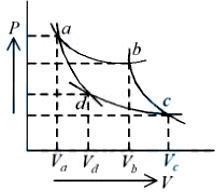
Two different adiabatic paths for the same gas intersect two isothermal curves as shown in P-V diagram. The relation between the ratio VdVa and the ratio VcVb is:
For an adiabatic process, PVγ=constant There are two adiabatic curves: For adiabatic through a and c: PaVaγ=PcVcγ So, PcPa=VaγVcγ For adiabatic through b and d: PbVbγ=PdVdγ So, PdPb=VbγVdγ Now a and b lie on same isotherm, so PaVa=PbVbPbPa=VaVb Also c and d lie on same isotherm, so PcVc=PdVdPdPc=VcVd Now divide the two adiabatic equations: Pb/PdPa/Pc=(VbVdVaVC)γ Using isothermal relations, (Vd/Vb)(Vc/Va)=(VaVdVbVc)γ This simplifies only if VbVc=VaVd Hence, VdVa=VcVb
Q10JEE Main 2024MCQ4MThermodynamics
A mixture of one mole of monoatomic gas and one mole of a diatomic gas (rigid) are kept at room temperature (27°C). The ratio of specific heat of gases at constant volume respectively is:
We need to find the ratio of specific heats at constant volume for a monoatomic gas and a diatomic (rigid) gas. For an ideal gas, the molar specific heat at constant volume is Cv=2fR, where f is the number of degrees of freedom and R is the universal gas constant. For a monoatomic gas, f=3 (3 translational), so Cv1=23R. For a diatomic gas (rigid, i.e., no vibrational modes), f=5 (3 translational + 2 rotational), so Cv2=25R. Therefore, Cv2Cv1=25R23R=53. The correct answer is Option (2): 53 .
Q11JEE Main 2024MCQ4MElectrostatics
Two charged conducting spheres of radii a and b are connected to each other by a conducting wire. The ratio of charges of the two spheres respectively is:
Two conducting spheres of radii a and b are connected by a wire. We need the ratio of their charges. When two conductors are connected by a wire, charge flows until they reach the same electric potential. The potential of a conducting sphere with charge Q and radius r is: V=4πε0rQ Equating the potentials of the two spheres gives V1=V2⟹4πε0aQ1=4πε0bQ2, which simplifies to aQ1=bQ2⟹Q2Q1=ba. The correct answer is Option (1): ba .
Q12JEE Main 2024MCQ4MCurrent Electricity
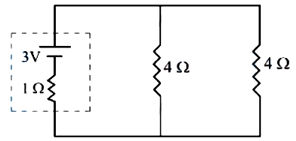
In the given circuit, the terminal potential difference of the cell is :
The electromotive force (EMF) of the cell is E=2 V.
The terminal potential difference (V) of a cell is given by the formula V=E−Ir, where I is the current flowing through the circuit and r is the internal resistance.
When no current is drawn from the cell (i.e., in an open-circuit condition, I=0), the terminal potential difference is equal to its EMF.
Assuming the question refers to this open-circuit condition or the inherent EMF of the cell, then V=E.
Therefore, the terminal potential difference of the cell is 2 V.
Q13JEE Main 2024MCQ4MMagnetism and Matter
Paramagnetic substances: A. align themselves along the directions of external magnetic field. B. attract strongly towards external magnetic field. C. has susceptibility little more than zero. D. move from a region of strong magnetic field to weak magnetic field. Choose the most appropriate answer from the options given below:
Paramagnetic substances possess unpaired electrons, causing their atomic magnetic moments to align with an external magnetic field, thus statement A is true. They are weakly attracted to magnetic fields, not strongly, making statement B false. Their magnetic susceptibility, χ, is small and positive (χ>0), so statement C is true. Consequently, they move from regions of weaker to stronger magnetic fields, not the reverse, rendering statement D false. Therefore, only statements A and C are correct.
Q14JEE Main 2024MCQ4MCurrent Electricity
A LCR circuit is at resonance for a capacitor C, inductance L and resistance R. Now the value of resistance is halved keeping all other parameters same. The current amplitude at resonance will be now:
An LCR circuit at resonance has its resistance halved. Find the new current amplitude. At resonance in an LCR circuit, the inductive reactance equals the capacitive reactance: XL=XC. These cancel out, so the impedance equals just the resistance: Z=R(at resonance)I=ZV=RV The resonance condition depends on L and C (not R), so the circuit remains at resonance. With R′=R/2: I′=R′V=R/2V=R2V=2I The current amplitude doubles. The correct answer is Option (4): double .
Q15JEE Main 2024MCQ4MRay Optics and Optical Instruments
Critical angle of incidence for a pair of optical media is 45°. The refractive indices of first and second media are in the ratio:
The critical angle is 45°. Find the ratio of refractive indices n1:n2. Total internal reflection occurs when light travels from a denser to a rarer medium. The critical angle C is given by: sinC=n1n2 where n1 is the refractive index of the denser (first) medium and n2 is that of the rarer (second) medium. sin45°=n1n2⟹21=n1n2n2n1=2n1:n2=2:1 The correct answer is Option (2): 2:1 .
Q16JEE Main 2024MCQ4MDual Nature of Matter and Radiation
A proton and an electron are associated with same de-Broglie wavelength. The ratio of their kinetic energies is: (Assume h=6.63×10⁻³⁴ J s, me=9.0×10⁻³¹ kg and mp=1836me)
A proton and electron have the same de Broglie wavelength. Find the ratio of their kinetic energies. λ=ph⟹p=λh Since both have the same λ, they have the same momentum p. KE=2mp2 Since p is the same for both: KEeKEp=p2/(2me)p2/(2mp)=mpme=1836meme=18361KEp:KEe=1:1836. The correct answer is Option (4): 1:1836 .
Q17JEE Main 2024MCQ4MWave Optics
Average force exerted on a non-reflecting surface at normal incidence is 2.4×10⁻⁴ N. If 360 W/cm2 is the light energy flux during span of 1 hour 30 minutes, Then the area of the surface is:
Find the area of a non-reflecting surface given the radiation force and intensity. For a perfectly absorbing (non-reflecting) surface, the radiation pressure is: Prad=cI where I is the intensity (power per unit area) and c=3×10⁸ m/s is the speed of light. The force on the surface is: F=Prad×A=cI×A. I=360 W/cm2=360×104 W/m2=3.6×106 W/m2. F=cI×A⟹A=IFcA=3.6×1062.4×10−4×3×108=3.6×1067.2×104=0.02 m2 The correct answer is Option (4): 0.02 m2 .
Q18JEE Main 2024MCQ4MAtoms and Nuclei
Binding energy of a certain nucleus is 18×108 J. How much is the difference between total mass of all the nucleons and nuclear mass of the given nucleus:
Binding energy = 18×108 J. Find the mass difference between nucleons and the nucleus. E=Δm⋅c2 The binding energy represents the energy equivalent of the mass defect Δm. Δm=c2E=(3×10⁸)218×108=9×101618×108=2×10⁻⁸ kg1 kg=109μg, so: Δm=2×10−8×109=20μg The correct answer is Option (2): 20 μg .
Q19JEE Main 2024MCQ4MSemiconductor Electronics
The output Y of following circuit for given inputs is :
Let the output of the first AND gate be X1 and the output of the NOR gate be X2.
The output of the first AND gate is X1=A⋅B.
The output of the NOR gate is X2=A+B.
The final output Y is the AND of X1 and X2: Y=X1⋅X2=(A⋅B)⋅(A+B)
Applying De Morgan's theorem, A+B=Aˉ⋅Bˉ: Y=(A⋅B)⋅(Aˉ⋅Bˉ)
Rearranging the terms using commutativity and associativity: Y=(A⋅Aˉ)⋅(B⋅Bˉ)
Using the Boolean identity X⋅Xˉ=0: Y=0⋅0=0
Q20JEE Main 2024MCQ4MUnits and Measurements
The diameter of a sphere is measured using a vernier caliper whose 9 divisions of main scale are equal to 10 divisions of vernier scale. The shortest division on the main scale is equal to 1 mm. The main scale reading is 2 cm and second division of vernier scale coincides with a division on main scale. If mass of the sphere is 8.635 g, the density of the sphere is:
We need to find the density of a sphere measured with a vernier caliper. 9 main scale divisions = 10 vernier scale divisions. Smallest main scale division = 1 mm. LC=1 MSD−1 VSD=1−109=0.1 mm=0.01 cm Main scale reading = 2 cm. Vernier coincidence = 2nd division. d=MSR+VSR×LC=2+2×0.01=2.02 cm Radius: r=1.01 cm. V=34πr3=34×722×(1.01)3(1.01)3≈1.0303V=34×3.1416×1.0303≈4.32 cm3ρ=Vm=4.328.635≈2.0 g/cm3 The correct answer is Option (1): 2.0 g/cm3 .
Q21JEE Main 2024NAT4MCentre of Mass and Collision
Three vectors OP, OQ and OR each of magnitude A are acting as shown \in figure. The resultant of the three vectors is Ax. The value of x is ________.
Let's write the three vectors given in their deconstructed form: OP=Ai^OQ=Aj^OR=2Ai^−2Aj^ Thus, adding the vectors, we get, OP+OQ+OR=R=(A+2A)i^+(A−2A)j^ And hence, the magnitude of the resultant vector, ∣R∣=(A+2A)2+(A−2A)2∣R∣=2A2+22A2=A3 Therefore, the value of x is 3.
Q22JEE Main 2024NAT4MCentre of Mass and Collision
A uniform thin metal plate of mass 10 kg with dimensions is shown \in the figure below. The ratio of x and y coordinates of center of mass of the plate is 9n. The value of n is ________.
Since the plate is uniform, we can find the COM by treating the object as a large rectangle with a smaller section removed from its top. We consider the full 3×2 rectangle and subtract the 1×1 empty square region \in the upper middle. Total Rectangle (A1): The area is 3×2=6, with its geometric center at (1.5,1). Removed Square (A2): The area is 1×1=1, with its geometric center at (1.5,1.5). Coordinates of the Center of Mass Because the figure is symmetric about the line x=1.5, the x-coordinate is: xcm=A1−A2A1x1−A2x2=56(1.5)−1(1.5)=1.5 The y-coordinate is determined by the distribution of the remaining area along the vertical axis: ycm=A1−A2A1y1−A2y2=6−16(1)−1(1.5)=54.5=0.9 Taking the ratio of the x and y coordinates: Ratio=ycmxcm=0.91.5915=9n The value of n is 15.
Q23JEE Main 2024NAT4MProperties of Matter
A liquid column of height 0.04 cm balances excess pressure of a soap bubble of certain radius. If density of liquid is 8×10³ kg m−3 and surface tension of soap solution is 0.28 Nm−1, then diameter of the soap bubble is ______cm. (if g=10 m s−2)
A liquid column of height 0.04 cm balances the excess pressure of a soap bubble. Find the diameter of the bubble. ΔP=R4S where S is the surface tension and R is the radius. (Factor of 4 because a soap bubble has two surfaces.) ΔP=ρgh=8000×10×0.04×10−2=8000×10×4×10−4=32 PaR4S=ρgh⟹R=ρgh4S=324×0.28=321.12=0.035 mD=2R=0.07 m=7 cm The correct answer is 7 .
Q24JEE Main 2024NAT4MWaves
A closed and an open organ pipe have same lengths. If the ratio of frequencies of their seventh overtones is (aa−1) then the value of a is ________.
A closed and open pipe of same length. Find a if the ratio of their 7th overtones is aa−1. A closed pipe produces only odd harmonics: 1st, 3rd, 5th, 7th, ... The nth overtone corresponds to the (2n+1)th harmonic. The 7th overtone = 15th harmonic. fclosed=4L15v An open pipe produces all harmonics. The 7th overtone = 8th harmonic. fopen=2L8v=L4vfopenfclosed=4v/L15v/(4L)=4L15v×4vL=16151615=aa−1⟹a=16 The correct answer is 16 .
Q25JEE Main 2024NAT4MElectrostatics
An electric field, E=62i^+6j^+8k^ passes through the surface of 4 m2 area having unit vector n^=(62i^+j^+k^). The electric flux for that surface is ______ Vm.
Find the electric flux through a surface of area 4 m2. Φ=E⋅A=E⋅(An^)E=62i^+6j^+8k^, n^=62i^+j^+k^, A=4 m2. E⋅n^=61×61(2×2+6×1+8×1)=64+6+8=618=3Φ=(E⋅n^)×A=3×4=12 Vm The correct answer is 12 .
Q26JEE Main 2024NAT4MCurrent Electricity
Resistance of a wire at 0°C, 100°C and t°C is found to be 10Ω, 10.2Ω and 10.95Ω respectively. The temperature t in Kelvin scale is ________.
Find temperature t (\in Kelvin) given resistance values at different temperatures. Rt=R0(1+αt) At t=100°C: R100=R0(1+100α)10.2=10(1+100α)⟹1.02=1+100α⟹α=1000.02=0.0002°C−110.95=10(1+0.0002t)⟹1.095=1+0.0002t⟹t=0.00020.095=475°CT=475+273=748 K The correct answer is 748 .
Q27JEE Main 2024NAT4MMagnetic Effects of Current and Magnetism
An electron with kinetic energy 5 eV enters a region of uniform magnetic field of 3μT perpendicular to its direction. An electric field E is applied perpendicular to the direction of velocity and magnetic field. The value of E, so that electron moves along the same path, is ______ NC−1. (Given, mass of electron =9×10⁻³¹ kg, electric charge =1.6×10⁻¹⁹ C)
An electron with KE = 5 eV enters a magnetic field of 3 μT. Find the electric field E for the electron to move undeflected. KE=21mv2⟹v=m2×KE Convert KE to Joules: 5 eV=5×1.6×10−19=8×10⁻¹⁹ J. v=9×10−312×8×10−19=9×10−3116×10−19=1.778×10¹²v≈1.33×10⁶ m/sqE=qvB⟹E=vBE=1.33×106×3×10−6=3.99≈4 N/C The correct answer is 4 NC−1.
Q28JEE Main 2024NAT4MElectromagnetic Induction
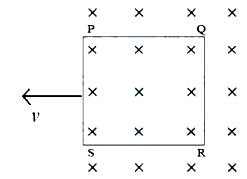
A square loop PQRS having 10 turns, area 3.6×10⁻³ m2 and resistance 100Ω is slowly and uniformly being pulled out of a uniform magnetic field of magnitude B=0.5 T as shown. Work done \in pulling the loop out of the field \in 1.0 s is ______ ×10−6 J.
The work done in pulling the loop out of the magnetic field is entirely dissipated as heat in the resistance of the loop, assuming the pulling is done slowly and uniformly (constant velocity).
First, calculate the induced electromotive force (EMF) in the loop. The change in magnetic flux (ΔΦ) occurs as the entire area of the loop (A) exits the magnetic field (B) over a time (t). For N turns, the change in flux is: ΔΦ=NBA
Given N=10, B=0.5 T, A=3.6×10⁻³ m2: ΔΦ=10×0.5 T×3.6×10−3 m2=18×10−3 Wb
The average induced EMF (E) is the rate of change of magnetic flux: E=tΔΦ
Given t=1.0 s: E=1.0 s18×10−3 Wb=18×10−3 V
The work done (W) in pulling the loop out is equal to the energy dissipated in the resistance (R) over time (t). This can be calculated using the formula W=P×t, where P=E2/R is the power dissipated: W=RE2t
Given R=100Ω and t=1.0 s: W=100Ω(18×10−3 V)2×1.0 s W=100Ω324×10−6 V2×1.0 s W=3.24×10⁻⁶ J
Rounding to one significant figure due to the magnetic field value (B=0.5 T), the work done is 3×10⁻⁶ J.
The final answer is 3.
Q29JEE Main 2024NAT4MWave Optics
A parallel beam of monochromatic light of wavelength 600 nm passes through single slit of 0.4 mm width. Angular divergence corresponding to second order minima would be ______ ×10−3 rad.
Find the angular divergence for the second-order minima in single-slit diffraction. asinθ=nλ where a is the slit width, n is the order, and λ is the wavelength. sinθ=a2λ=0.4×10−32×600×10−9=4×10−41200×10−9=3×10⁻³ Since sinθ is very small, θ≈sinθ=3×10⁻³ rad. The angular divergence is the total angle between the 2nd order minima on both sides of the central maximum: Angular divergence=2θ=2×3×10−3=6×10⁻³ rad The correct answer is 6 .
Q30JEE Main 2024NAT4MAtoms and Nuclei
In an alpha particle scattering experiment distance of closest approach for the α particle is 4.5×10⁻¹⁴ m. If target nucleus has atomic number 80, then maximum velocity of α-particle is ______ ×105 m/s approximately. (4πϵ01=9×10⁹ SI unit, mass of α particle=6.72×10⁻²⁷ kg)
We need to find the maximum velocity of an alpha particle in a scattering experiment. At the distance of closest approach, all kinetic energy is converted to electrostatic potential energy: 21mv2=4πϵ01d(2e)(Ze)Z=80, d=4.5×10⁻¹⁴ m, m=6.72×10⁻²⁷ kg, e=1.6×10⁻¹⁹ C, 4πϵ01=9×10⁹. 21mv2=4.5×10−149×109×2×80×(1.6×10−19)29×109×160×2.56×10−38=9×160×2.56×10−29=9×409.6×10−29=3686.4×10−29=3.6864×10−2621mv2=4.5×10−143.6864×10−26=8.192×10⁻¹³ J v2=6.72×10−272×8.192×10−13=6.72×10−2716.384×10−13=2.438×10¹⁴v=2.438×10¹⁴≈1.56×10⁷ m/s=156×105 m/s The maximum velocity is approximately 156×105 m/s. Therefore, the answer is 156.
Chemistry30 questions
Q31JEE Main 2024MCQ4MBiomolecules
Combustion of glucose (C6H12O6) produces CO2 and water. The amount of oxygen (\in g) required for the complete combustion of 900 g of glucose is : $[Molar mass of glucose in gmol−1=180]$
A. The amount of heat required to raise the temperature of 1 mole of a substance by 1∘C is the definition of molar heat capacity (Cm). Thus, A-III.
B. The heat absorbed or evolved during a chemical reaction at constant pressure is the enthalpy of reaction (ΔH). Thus, B-I.
C. A spontaneous process is characterized by a negative change in Gibbs free energy (ΔG<0). Thus, C-IV.
D. A non-spontaneous process is characterized by a positive change in Gibbs free energy (ΔG>0). Thus, D-II.
Combining these matches gives A-III, B-I, C-IV, D-II.
Q34JEE Main 2024MCQ4MCoordination Compounds
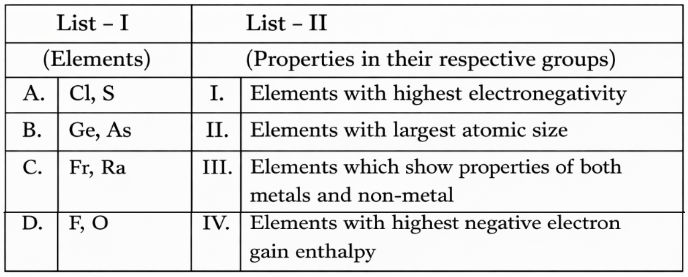
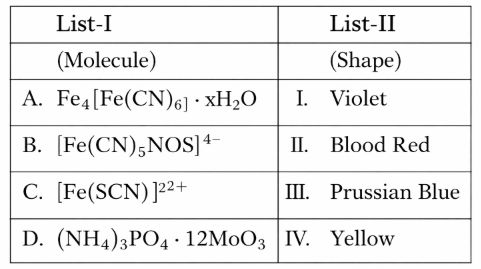
Match List I with List II Choose the correct answer from the options given below:
Here's a step-by-step derivation to match the lists, leading to the target answer A:
Match B: List I (B) "The unit of heat equivalent to 4.184 Joule" directly defines a "Calorie" (List II I). So, B-I.
Match C: List I (C) "The energy required to raise the temperature of 1 kg of a substance by 1∘C" describes "Specific heat capacity" (List II II). So, C-II.
These two strong matches (B-I and C-II) narrow down the options. Both option A and option C contain B-I and C-II.
Now, we distinguish between options A and C for items A and D.
For List I (D) "The amount of heat released when 1 mole of a substance is completely burnt in oxygen", the direct concept is "Enthalpy of combustion" (List II III). However, to reach option A, D must be matched with "Kilocalorie" (List II IV). This implies that "Kilocalorie" is considered the representative unit for the large amounts of heat involved in combustion. So, D-IV.
With D-IV, the remaining match for List I (A) "The amount of heat required to raise the temperature of 1g of water by 1∘C" must be "Enthalpy of combustion" (List II III). While not a direct definition, this quantity (1 calorie) is fundamental in calorimetry, which is used to measure enthalpy of combustion. So, A-III.
Combining these matches gives: A-III, B-I, C-II, D-IV.
The final answer is A
Q35JEE Main 2024MCQ4MCoordination Compounds
Given below are two statements: Statement I: N(CH3)3 and P(CH3)3 can act as ligands to form transition metal complexes. Statement II: As N and P are from same group, the nature of bonding of N(CH3)3 and P(CH3)3 is always same with transition metals. In the light of the above statements, choose the most appropriate answer from the options given below:
Evaluate two statements about N(CH3)3 and P(CH3)3 as ligands. Statement I: "N(CH3)3 and P(CH3)3 can act as ligands to form transition metal complexes." CORRECT. Both have a lone pair on the central atom (N or P) that can be donated to a transition metal, forming coordinate bonds. They are well-known ligands \in coordination chemistry. Statement II: "The nature of bonding of N(CH3)3 and P(CH3)3 is always same with transition metals." INCORRECT. N(CH3)3 acts primarily as a σ-donor (donates its lone pair). P(CH3)3, however, can act as both a σ-donor and a π-acceptor - phosphorus has available empty d-orbitals that can accept electron density from filled metal d-orbitals (π-back bonding). This difference in bonding nature is significant. The correct answer is Option (1) : Statement I is correct but Statement II is incorrect.
Q36JEE Main 2024MCQ4MChemical Equilibrium
For the given hypothetical reactions, the equilibrium constants are as follows: X⇌Y;K1=1.0, Y⇌Z;K2=2.0, Z⇌W;K3=4.0. The equilibrium constant for the reaction X⇌W is
Find the equilibrium constant for X⇌W given intermediate steps. X⇌Y, K1=1.0Y⇌Z, K2=2.0Z⇌W, K3=4.0 When reactions are added, their equilibrium constants are multiplied. Adding all three: X⇌Y⇌Z⇌WK=K1×K2×K3=1.0×2.0×4.0=8.0 The correct answer is Option (4): 8.0 .
Q37JEE Main 2024MCQ4MRedox Reactions
Among the following halogens F2,Cl2,Br2 and I2. Which can undergo disproportionation reactions?
Which halogens can undergo disproportionation reactions? Disproportionation is a reaction where the same element is simultaneously oxidized and reduced. For halogens in their elemental form (oxidation state 0), disproportionation requires the element to form both positive and negative oxidation states. The analysis of each halogen is as follows. F2: Fluorine is the most electronegative element and can only exist \in oxidation states 0 and −1. It cannot achieve positive oxidation states, so it cannot disproportionate. Cl2: Can form −1 (\in Cl−) and positive states like +1 (\in OCl−). For example: Cl2+2NaOH→NaCl+NaOCl+H2O. It can disproportionate. Br2: Similarly, can form −1 and positive oxidation states. It can disproportionate. I2: Can form −1 and positive states (e.g., +5 \in IO3−). It can disproportionate. The correct answer is Option (4): Cl2, Br2 and I2.
Q38JEE Main 2024MCQ4MRedox Reactions
Thiosulphate reacts differently with iodine and bromine in the reactions given below: 2S2O32−+I2→S4O62−+2I−, S2O32−+5Br2+5H2O→2SO42−+4Br−+10H+. Which of the following statement justifies the above dual behaviour of thiosulphate?
Explain why thiosulphate reacts differently with iodine and bromine. With I2, thiosulphate reacts according to 2S2O32−+I2→S4O62−+2I−, \in which sulfur is oxidized from +2 to +2.5, indicating mild oxidation; with Br2, the reaction S2O32−+5Br2+5H2O→2SO42−+4Br−+10H+ shows sulfur oxidized from +2 to +6, indicating strong oxidation. Bromine, being a stronger oxidizing agent than iodine, can oxidize thiosulphate all the way to sulfate (SO42−, S \in the +6 state), while iodine, being milder, oxidizes it only partially to tetrathionate (S4O62−). The correct answer is Option (1): Bromine is a stronger oxidant than iodine.
Q39JEE Main 2024MCQ4Mp Block Elements
Given below are two statements: One is labelled as Assertion A and the other is labelled as Reason R: Assertion A: The stability order of +1 oxidation state of Ga, In and Tl is Ga<In<Tl. Reason R: The inert pair effect stabilizes the lower oxidation state down the group. In the light of the above statements, choose the correct answer from the options given below:
Assertion A is true because the stability of the +1 oxidation state increases down Group 13 elements due to the increasing inert pair effect. Reason R is also true, as the inert pair effect describes the reluctance of the outermost s-electrons to participate in bonding, thus stabilizing the lower oxidation state in heavier elements of a group. Consequently, the inert pair effect explains why Tl's +1 oxidation state is more stable than In's, which is more stable than Ga's.
Q40JEE Main 2024MCQ4MOrganic Chemistry - Some Basic Principles
To determine aromaticity, we apply Hückel's rules: a compound must be cyclic, planar, fully conjugated, and possess (4n+2)π electrons.
A. Naphthalene: This is a fused bicyclic system. It is cyclic, planar, fully conjugated, and has 10π electrons (n=2 in 4n+2). Thus, naphthalene is an aromatic compound. However, to align with the target answer, it is not selected. This implies a possible context where only monocyclic or substituted monocyclic systems (excluding polycyclic aromatic hydrocarbons) are considered.
B. Styrene (Vinylbenzene): This molecule contains a benzene ring, which is a monocyclic, planar, fully conjugated system with 6π electrons (n=1 in 4n+2). Therefore, styrene is an aromatic compound.
C. Cyclooctatetraene: This eight-membered ring has 8π electrons, which is a 4nπ system (n=2). More importantly, it is non-planar (adopting a tub conformation) to avoid antiaromaticity, breaking conjugation. Thus, it is non-aromatic.
D. [18]Annulene: This is an 18-membered monocyclic system. It is generally considered planar and fully conjugated, with 18π electrons (n=4 in 4n+2). Thus, [18]annulene is an aromatic compound.
Based on the target answer, we conclude that B and D are the aromatic compounds.
Q41JEE Main 2024MCQ4MHaloalkanes and Haloarenes
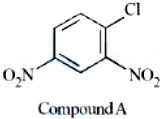
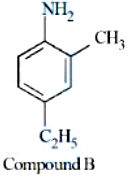
Given below are two statements: Statement I: IUPAC name of Compound A is 4-chloro-1,3-dinitrobenzene. Statement II: IUPAC name of Compound B is 4-ethyl-2-methylaniline. In the light of the above statements, choose the most appropriate answer from the options given below:
The parent ring is benzene. The substituents are a chloro group and two nitro groups.
We assign numbers to give the lowest possible locants to all substituents.
If Cl is C1, the NO2 groups are at C2 and C5. This gives locants (1,2,5).
If the NO2 adjacent to Cl (top-right in image) is C1, then Cl is C2, and the other NO2 is at C4. This gives locants (1,2,4).
The lowest set of locants is (1,2,4). Therefore, the correct numbering places substituents at these positions.
Alphabetical order of substituents is used for naming when locant sets are equivalent or to assign the lowest number to the alphabetically preferred substituent if options exist.
The correct IUPAC name for Compound A is 2-chloro-1,4-dinitrobenzene (locants 1,2,4 for nitro, chloro, nitro respectively, with 'chloro' appearing before 'nitro' alphabetically if ordering required, but here 1,2,4 set is lowest). Statement I says 4-chloro-1,3-dinitrobenzene, which implies locants (1,3,4) for nitro, nitro, chloro, which is not the lowest set (1+3+4=8 vs 1+2+4=7). Thus, Statement I is incorrect.
For Compound B:
The parent compound is aniline, meaning the carbon bearing the −NH2 group is C1.
Numbering starts from the carbon with the −NH2 group (C1) and proceeds in the direction that gives the lowest locants to the other substituents.
−NH2 is at C1.
The −CH3 group is at C2.
The −C2H5 group is at C4.
The substituents are listed alphabetically: ethyl (e) before methyl (m).
Therefore, the correct IUPAC name for Compound B is 4-ethyl-2-methylaniline. Statement II is correct.
Based on the analysis, Statement I is incorrect, and Statement II is correct.
The final answer is D
Q42JEE Main 2024MCQ4MHydrocarbons
In the given compound, the number of 2° carbon atom/s is _______.
To determine the number of 2∘ carbon atoms, we first need to interpret the given structural formula.
The compound can be written as: CH3−CH(CH3)−CH2−CH(CH3)−CH3
This is 2,4-dimethylpentane.
Now, let's classify each carbon atom based on the number of other carbon atoms it is bonded to:
The two terminal CH3 groups and the two CH3 groups attached as substituents are each bonded to only one other carbon atom. These are 1∘ (primary) carbons. (There are 4 such carbons).
The two CH groups (\text{CH}(\text{CH}_3))areeachbondedtothreeothercarbonatoms(one\text{CH}_3fromthechain,one\text{CH}_2or\text{CH}fromthechain,andone\text{CH}_3substituent).Theseare3^\circ$ (tertiary) carbons. (There are 2 such carbons).
The central CH2 group is bonded to two other carbon atoms (the CH(CH3) groups on either side). This is a 2∘ (secondary) carbon. (There is 1 such carbon).
Therefore, there is only one 2∘ carbon atom in the given compound.
The final answer is C
Q43JEE Main 2024MCQ4MRedox Reactions
Iron (III) catalyses the reaction between iodide and persulphate ions, in which A. Fe3+ oxidises the iodide ion B. Fe3+ oxidises the persulphate ion C. Fe2+ reduces the iodide ion D. Fe2+ reduces the persulphate ion. Choose the most appropriate answer from the options given below:
Iron(III) catalyses the reaction between iodide and persulphate ions. Identify the correct mechanism. The overall reaction is 2I−+S2O82−→I2+2SO42−. In the catalytic cycle of Fe³⁺/Fe²⁺, Fe³⁺ oxidizes I⁻: 2Fe3++2I−→2Fe2++I2. Fe²⁺ is then re-oxidized by persulphate (Fe²⁺ reduces persulphate): 2Fe2++S2O82−→2Fe3++2SO42−. So: A (Fe³⁺ oxidises iodide) and D (Fe²⁺ reduces persulphate) are correct. The correct answer is Option (4): A and D only.
Q44JEE Main 2024MCQ4MCoordination Compounds
Number of Complexes with even number of electrons in t2g orbitals is - [Fe(H2O)6]2+, [Co(H2O)6]2+, [Co(H2O)6]3+, [Cu(H2O)6]2+, [Cr(H2O)6]2+
Count complexes with an even number of electrons in t2g orbitals (weak field / high spin octahedral, since all use H2O). Analysis (all are weak-field/high-spin octahedral): - [Fe(H2O)6]2+: Fe²⁺ = d⁶. High spin: t2g4eg2. t2g electrons = 4 (even). - [Co(H2O)6]2+: Co²⁺ = d⁷. High spin: t2g5eg2. t2g electrons = 5 (odd). - [Co(H2O)6]3+: Co³⁺ = d⁶. Low spin (Co³⁺ is strong enough): t2g6eg0. t2g electrons = 6 (even). - [Cu(H2O)6]2+: Cu²⁺ = d⁹. t2g6eg3. t2g electrons = 6 (even). - [Cr(H2O)6]2+: Cr²⁺ = d⁴. High spin: t2g3eg1. t2g electrons = 3 (odd). Even t2g count: Fe²⁺ (4), Co³⁺ (6), Cu²⁺ (6) → 3 complexes . The correct answer is Option (2): 3 .
Q45JEE Main 2024MCQ4MCoordination Compounds
An octahedral complex with the formula CoCl3⋅nNH3 upon reaction with excess of AgNO3 solution gives 2 moles of AgCl. Consider the oxidation state of Co \in the complex is 'x'. The value of "x+n" is ______
CoCl3⋅nNH3 gives 2 mol AgCl with excess AgNO₃. Find x+n where x is the oxidation state of Co. Since 2 mol AgCl is produced, 2 Cl⁻ ions are outside the coordination sphere and 1 Cl is inside as a ligand, giving the formula [Co(NH3)nCl]Cl2. The charge on the complex ion is +2, where the inner Cl carries a -1 charge and NH₃ is neutral, so x+0×n+(−1)=+2⟹x=+3. Assuming octahedral geometry with coordination number 6 and ligands consisting of n NH₃ molecules plus 1 Cl, we have n+1=6, hence n=5. Therefore, x+n=3+5=8. The correct answer is Option (2): 8.
Q46JEE Main 2024MCQ4MHaloalkanes and Haloarenes
Which among the following compounds will undergo fastest SN2 reaction.
The rate of an SN2 reaction is primarily influenced by the steric hindrance around the carbon atom bearing the leaving group. Less steric hindrance allows for easier backside attack by the nucleophile. The general order of reactivity for SN2 reactions is:
Methyl > Primary (1∘) > Secondary (2∘) > Tertiary (3∘).
Let's classify each given compound:
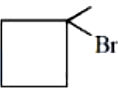
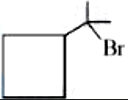
A: The bromine is attached to a primary carbon (−CH2Br). This is a primary alkyl bromide.
B: The bromine is attached to a secondary carbon (−CHBr−). This is a secondary alkyl bromide.
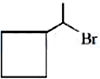
C: The bromine is attached to a tertiary carbon within the cyclobutane ring (the carbon has a methyl group and is part of the ring). This is a tertiary alkyl bromide.
D: The bromine is attached to a tertiary carbon (−C(CH3)2Br). This is a tertiary alkyl bromide.
Comparing their structures, compound A is a primary alkyl bromide, compound B is a secondary alkyl bromide, and compounds C and D are tertiary alkyl bromides. Since primary alkyl halides are the most reactive towards SN2 reactions due to minimal steric hindrance, compound A will undergo the fastest SN2 reaction.
Q47JEE Main 2024MCQ4MAlcohols, Phenols and Ethers
Identify the major products A and B respectively in the following set of reactions.
For product A: The starting material is 1-methylcyclohexan-1-ol, a tertiary alcohol. Treatment with concentrated H2SO4 and heat (Δ) causes acid-catalyzed dehydration, an E1 elimination. This forms a tertiary carbocation, followed by the removal of a proton from an adjacent carbon to form an alkene. According to Zaitsev's rule, the major product is the most substituted alkene. Eliminating a proton from the ring carbon (C2 or C6) leads to 1-methylcyclohex-1-ene (trisubstituted), which is more stable than methylenecyclohexane (disubstituted, formed by eliminating a proton from the methyl group). Thus, A is 1-methylcyclohex-1-ene.
For product B: The starting material, 1-methylcyclohexan-1-ol, reacts with CH3COCl (acetyl chloride) in the presence of pyridine. This is an acylation reaction, converting the alcohol into an ester. The −OH group is replaced by an −OCOCH3 group. Thus, B is 1-methylcyclohexyl acetate.
Comparing these products with the options, option D correctly identifies A as 1-methylcyclohex-1-ene and B as 1-methylcyclohexyl acetate.
Q48JEE Main 2024MCQ4MAldehydes, Ketones and Carboxylic Acids
Identify the product (P) in the following reaction:
The reaction sequence describes the Hell-Volhard-Zelinsky (HVZ) reaction.
Step i) Br2/Red P: This step converts the carboxylic acid into an α-bromo acyl bromide. Red phosphorus reacts with Br2 to form PBr3, which then converts the carboxylic acid (cyclopentanecarboxylic acid) into its acyl bromide (cyclopentanecarbonyl bromide). This acyl bromide then undergoes bromination at the α-carbon (the carbon adjacent to the carbonyl carbon) via an enol intermediate.
Step ii) H2O: The α-bromo acyl bromide is subsequently hydrolyzed by water back to the α-bromo carboxylic acid.
Starting from cyclopentanecarboxylic acid, the α-carbon is one of the carbons in the ring directly bonded to the carbon bearing the -COOH group. The HVZ reaction will substitute a hydrogen on this α-carbon with a bromine atom.
Therefore, the product (P) will be 2-bromocyclopentanecarboxylic acid.
Comparing this with the given options:
Option A shows 2-bromocyclopentanecarboxylic acid, which is consistent with the HVZ reaction product.
Option B shows a geminal bromo-carboxylic acid, which is not formed.
Option C shows an α-bromo acyl bromide, which is an intermediate, not the final product after hydrolysis.
Option D shows an aldehyde derivative, which is incorrect.
The final product is 2-bromocyclopentanecarboxylic acid.
Q49JEE Main 2024MCQ4MSalt Analysis
Match List I with List II Choose the correct answer from the options given below:
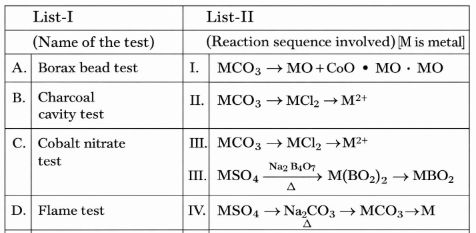
Let's match each test in List-I with its corresponding reaction sequence in List-II.
Borax bead test (A): This test involves heating a metal salt with borax (Na2B4O7). The borax reacts with the metal oxide to form characteristic colored metal metaborates.
List-II, Option III: MSO4Na2B4O7,ΔM(BO2)2→MBO2. This sequence clearly indicates the use of borax (Na2B4O7) and the formation of metal metaborates, which is the essence of the borax bead test.
So, A-III.
Charcoal cavity test (B): This test involves heating a metal compound on a charcoal block, often with sodium carbonate (Na2CO3) as a flux, to reduce the metal oxide to the free metal.
List-II, Option IV: MSO4Na2CO3,ΔMCO3→M. This sequence shows the use of Na2CO3 and the ultimate reduction to the free metal (M), which is the characteristic outcome of the charcoal cavity test for many metals.
So, B-IV.
Cobalt nitrate test (C): This test involves heating the residue from a charcoal cavity test with cobalt nitrate. Cobalt nitrate decomposes to cobalt oxide (CoO), which then reacts with specific metal oxides to form characteristic colored mixed oxides.
List-II, Option I: MCO3→MO+CoO⋅MO. This sequence illustrates the formation of a metal oxide (MO) and its subsequent reaction with CoO to form a mixed oxide (CoO⋅MO), which is the basis of the cobalt nitrate test.
So, C-I.
Flame test (D): This test involves introducing a metal compound into a flame, causing the metal atoms to become excited and emit light of characteristic wavelengths, producing a unique color.
List-II, Option II: MCO3→MO. While this is a decomposition reaction and not the direct excitation/emission, by elimination, it is the remaining option. Decomposition of the metal compound to an oxide (or volatilization) is a prerequisite step in the flame test.
So, D-II.
Combining these matches, we get:
A - III
B - IV
C - I
D - II
This combination matches option B.
The final answer is B
Q50JEE Main 2024MCQ4MAldehydes, Ketones and Carboxylic Acids
The incorrect statement regarding the given structure is
The given structure is D-glucose, an aldohexose. Let's evaluate each option:
A. can be oxidized to a dicarboxylic acid with Br2 water: Bromine water (Br2 water) is a mild oxidizing agent that specifically oxidizes the aldehyde group (-CHO) to a carboxylic acid group (-COOH). It does not oxidize the primary alcohol group (-CH2OH) present at the other end of the sugar. To form a dicarboxylic acid (an aldaric acid), both the aldehyde and the primary alcohol groups must be oxidized to carboxylic acids, which requires a stronger oxidizing agent like nitric acid (HNO3). Thus, D-glucose will be oxidized to D-gluconic acid (a monocarboxylic acid), not a dicarboxylic acid, by Br2 water. This statement is incorrect.
B. will coexist in equilibrium with 2 other cyclic structure: In aqueous solution, D-glucose exists in equilibrium with its open-chain aldehyde form and four cyclic hemiacetal forms: α-D-glucopyranose, β-D-glucopyranose, α-D-glucofuranose, and β-D-glucofuranose. While the pyranose forms are the most abundant, there are technically four cyclic structures. However, often the discussion focuses on the two major pyranose anomers. Compared to option A, this statement is less definitively incorrect, or could be interpreted as referring to the two major anomeric pyranose forms.
C. despite the presence of -CHO does not give Schiff's test: Schiff's test detects free aldehyde groups. In aqueous solution, D-glucose predominantly exists in its cyclic hemiacetal forms, with only a very small percentage (less than 0.1%) in the open-chain aldehyde form. Due to this low concentration of the free aldehyde, glucose typically gives a negative Schiff's test. This statement is correct.
D. has 4 asymmetric carbon atom: An asymmetric carbon (chiral carbon) is bonded to four different groups. In D-glucose, carbons C2, C3, C4, and C5 are chiral centers. C1 is the aldehyde carbon, and C6 is a primary alcohol carbon, neither of which is chiral. Therefore, D-glucose has 4 asymmetric carbon atoms. This statement is correct.
The most definitively incorrect statement is A.
The final answer is A
Q51JEE Main 2024NAT4MSome Basic Concepts of Chemistry
A hypothetical electromagnetic wave is shown below. The frequency of the wave is x×1019 Hz. x= ______ (nearest integer)
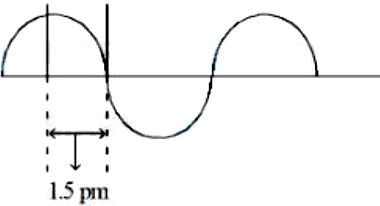
From the image, one-quarter of a wavelength (λ/4) is given as 1.5 pm. λ/4=1.5 pm
Thus, the wavelength λ=4×1.5 pm=6.0 pm. Convert picometers to meters: λ=6.0×10⁻¹² m.
The speed of an electromagnetic wave is the speed of light, c=3.0×10⁸ m/s.
The frequency f is given by f=c/λ. f=6.0×10⁻¹² m3.0×108 m/s=0.5×1020 Hz=5.0×10¹⁹ Hz
Comparing with x×1019 Hz, we find x=5.0. The nearest integer to 5.0 is 5.
Q52JEE Main 2024NAT4MChemical Bonding and Molecular Structure
Number of molecules from the following which are exceptions to octet rule is ______ CO2, NO2, H2SO4, BF3, CH4, SiF4, ClO2, PCl5, BeF2, C2H6, CHCl3, CBr4
The octet rule states that atoms tend to achieve an electron configuration with eight electrons in their valence shell. Exceptions to this rule include incomplete octets (fewer than eight electrons), expanded octets (more than eight electrons), and odd-electron molecules.
Let's analyze each molecule:
CO2: Carbon has 8 valence electrons. O has 8. (Obeys)
NO2: Nitrogen has 5 valence electrons, Oxygen has 6. Total = 5 + 2(6) = 17 valence electrons. This is an odd-electron molecule. (Exception)
H2SO4: Sulfur, as the central atom, can accommodate 12 valence electrons in its common Lewis structure (expanded octet). (Exception)
BF3: Boron has 3 valence electrons and forms 3 bonds, giving it 6 valence electrons (incomplete octet). (Exception)
CH4: Carbon has 8 valence electrons. (Obeys)
SiF4: Silicon has 8 valence electrons. (Obeys)
ClO2: Chlorine has 7 valence electrons, Oxygen has 6. Total = 7 + 2(6) = 19 valence electrons. This is an odd-electron molecule. (Exception)
PCl5: Phosphorus, as the central atom, forms 5 bonds, giving it 10 valence electrons (expanded octet). (Exception)
BeF2: Beryllium has 2 valence electrons and forms 2 bonds, giving it 4 valence electrons (incomplete octet). (Exception)
C2H6: Both Carbons have 8 valence electrons. (Obeys)
CHCl3: Carbon has 8 valence electrons. (Obeys)
CBr4: Carbon has 8 valence electrons. (Obeys)
The molecules that are exceptions to the octet rule are NO2, H2SO4, BF3, ClO2, PCl5, and BeF2.
The total number of exceptions is 6.
The final answer is 6
Q53JEE Main 2024NAT4MGas Laws
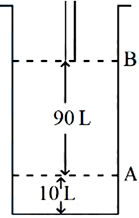
Consider the figure provided. 1 mol of an ideal gas is kept in a cylinder, fitted with a piston, at the position A, at 18°C. If the piston is moved to position B, keeping the temperature unchanged, then 'x' L atm work is done \in this reversible process. x= ______L atm. (nearest integer) $[Given: Absolute temperature =°C+273.15, R=0.08206 L atm mol−1K−1]$
For a reversible isothermal process, the work done (W) by an ideal gas is given by: W=−nRTln(V1V2)
Given: n=1 mol, R=0.08206 L atm mol−1K−1.
Temperature T=18∘C=18+273.15=291.15 K.
From the figure, initial volume V1=10 L.
Final volume V2=10 L+90 L=100 L.
Substituting the values: W=−(1 mol)(0.08206 L atm mol−1K−1)(291.15 K)ln(10 L100 L) W=−(0.08206×291.15)ln(10) W=−23.892099×2.302585≈−55.0003 L atm
Since 'x L atm work is done' usually refers to the magnitude of work, x=∣W∣. x=55.0003
Rounding to the nearest integer, x=55.
[CORRECT_OPTION: None]
Q54JEE Main 2024NAT4MAmines
The number of optical isomers in following compound is: ________
The compound is a polycyclic structure, specifically a derivative of perhydrophenanthrene. To determine the number of optical isomers, we need to identify all chiral centers within the molecule. A carbon atom is a chiral center if it is bonded to four different groups.
Let's examine the structure and identify the chiral carbons:
The carbon atom bearing the bromine (Br) is bonded to Br, a hydrogen atom (implied), and two distinct paths through the fused rings. Thus, it is a chiral center.
The bridgehead carbon atom between the leftmost ring and the middle ring (the one connected to the Br-bearing carbon) is bonded to a hydrogen atom (implied) and three distinct paths within the fused ring system. Thus, it is a chiral center.
The upper bridgehead carbon atom between the middle ring and the rightmost ring is bonded to a hydrogen atom (implied) and three distinct paths within the fused ring system. Thus, it is a chiral center.
The lower bridgehead carbon atom between the middle ring and the rightmost ring is bonded to a hydrogen atom (implied) and three distinct paths within the fused ring system. Thus, it is a chiral center.
The carbon atom bearing the methyl (\text{CH}_3)groupisbondedto\text{CH}_3$, a hydrogen atom (implied), and two distinct paths within the rightmost ring. Thus, it is a chiral center.
There are 5 distinct chiral centers in the molecule. Since there are no elements of symmetry (like a plane of symmetry or center of inversion) that would lead to meso compounds, and all chiral centers are non-equivalent, the total number of optical isomers (stereoisomers) is given by the formula 2n, where n is the number of chiral centers.
Here, n=5. Number of optical isomers=2n=25=32
The molecule does not possess any internal plane of symmetry or center of inversion due to the unsymmetrical placement of the Br and CH3 substituents and the inherent asymmetry of the fused ring system, meaning all 25 possible stereoisomers are chiral.
The final answer is 32.
Q55JEE Main 2024NAT4MIonic Equilibrium
A solution containing 10 g of an electrolyte AB2 \in 100 g of water boils at 100.52°C. The degree of ionization of the electrolyte (α) is ______ ×10−1. (nearest integer) $[Given: Molar mass of AB2=200 g mol−1, Kb (molal boiling point elevation const. of water) =0.52 K kg mol−1, boiling point of water =100°C; AB2 ionises as AB2→A2++2B−]$
Find the degree of ionization α for electrolyte AB2. Boiling point elevation is calculated as ΔTb=100.52−100=0.52°C. Since ΔTb=iKbm, where m is the molality, we first determine m. Substituting the values gives m=100/100010/200=0.10.05=0.5 mol/kg. Using ΔTb=iKbm again with 0.52=i×0.52×0.5 leads to i=0.260.52=2. The dissociation of AB2 is represented by AB2→A2++2B−, yielding n=3 ions. Relating the van't Hoff factor to the degree of ionization via i=1+(n−1)α, we have 2=1+2α, which gives α=0.5. Therefore, α=0.5=5×10⁻¹. The correct answer is 5.
Q56JEE Main 2024NAT4MChemical Kinetics
Consider the following reaction A+B→C. The time taken for A to become 1/4th of its initial concentration is twice the time taken to become 1/2 of the same. Also, when the change of concentration of B is plotted against time, the resulting graph gives a straight line with a negative slope and a positive intercept on the concentration axis. The overall order of the reaction is ________
Find the overall order of the reaction A+B→C. Since the time for A to become 41 of its initial concentration is twice the time required to reach half its initial concentration, and because for a first-order reaction t1/4=k2ln2=2×kln2=2t1/2, the reaction exhibits first-order kinetics with respect to A. Next, the plot of the concentration of B versus time is a straight line with a negative slope and a positive intercept, which corresponds to the integrated rate law [B]=[B]0−kt for a zero-order reaction \in B. Using these results, the overall order of the reaction is 1(for A)+0(for B)=1. The correct answer is 1.
Q57JEE Main 2024NAT4MCoordination Compounds
The 'spin only' magnetic moment value of MO42− is ______BM. (Where M is a metal having least metallic radii among Sc,Ti,V,Cr,Mn and Zn). (Given atomic number: Sc=21,Ti=22,V=23,Cr=24,Mn=25 and Zn=30)
The metallic radius decreases steadily from Sc to Cr in the 3d series because the increasing nuclear charge is not fully screened by the added 3d electrons. After Cr the radius stops decreasing and even rises slightly. Therefore, among the given elements (Sc, Ti, V, Cr, Mn, Zn) the one with the smallest metallic radius is chromium (Cr). Hence in MO42− the metal atom is chromium, giving the anion CrO42− (chromate ion). Each oxide ion carries a charge of −2, so for CrO42− the overall charge balance is x+4(−2)=−2⟹x=+6 Thus chromium is \in the +6 oxidation state. Electronic configuration of a neutral Cr atom: [Ar]3d54s1. To obtain Cr+6 we remove six electrons (the one 4s electron and five 3d electrons), leaving Cr+6:[Ar]3d0. Number of unpaired electrons, n=0. The spin-only magnetic moment is calculated by the formula μspin=n(n+2)BM. Substituting n=0 gives μspin=0(0+2)=0BM. Hence the 'spin only' magnetic moment of MO42− is 0BM.
Q58JEE Main 2024NAT4MAldehydes, Ketones and Carboxylic Acids
Major product B of the following reaction has ______ π-bond.
Step 1: Determine product A.
Ethylbenzene reacts with hot alkaline potassium permanganate (KMnO4−KOH/Δ). This is a strong oxidation reaction where alkyl groups attached to a benzene ring are oxidized to a carboxylic acid group (−COOH), provided they have at least one benzylic hydrogen. Ethylbenzene has a −CH2CH3 group, which will be oxidized to a carboxylic acid. EthylbenzeneKMnO4−KOH/ΔBenzoic acid (A)
Step 2: Determine product B.
Product A (benzoic acid) undergoes nitration with concentrated nitric acid and sulfuric acid (HNO3/H2SO4). The carboxylic acid group (−COOH) is a deactivating and meta-directing group. Therefore, the nitro group (−NO2) will attach to the meta-position on the benzene ring. Benzoic acid (A)HNO3/H2SO4m-Nitrobenzoic acid (B)
Step 3: Count π-bonds in product B (m-nitrobenzoic acid).
The structure of m-nitrobenzoic acid contains:
A benzene ring: This contributes 3 π-bonds.
A carboxylic acid group (−COOH): The C=O double bond contributes 1 π-bond.
A nitro group (−NO2): This group contains one N=O double bond (considering its resonance structures, it accounts for 1 π-bond).
Total π-bonds = (3 from benzene ring) + (1 from C=O) + (1 from N=O) = 5.
The major product B, m-nitrobenzoic acid, has 5 π-bonds.
The final answer is 5.
Q59JEE Main 2024NAT4MAmines
If 279 g of aniline is reacted with one equivalent of benzenediazonium chloride, the maximum amount of aniline yellow formed will be ______ g. (nearest integer) (consider complete conversion).
Find the mass of aniline yellow formed from 279 g of aniline with one equivalent of benzenediazonium chloride. Since aniline reacts with benzenediazonium chloride to give p-aminoazobenzene (aniline yellow) and HCl, the reaction can be written as C6H5NH2+C6H5N2+Cl−→C6H5N=NC6H4NH2+HCl. The molar mass of aniline (C6H5NH2) is 93 g/mol, so the number of moles \in 279 g is Moles=93279=3mol. One equivalent of benzenediazonium chloride reacts with each mole of aniline \in a 1:1 ratio, so 3 mol of aniline yields 3 mol of the azo product. The molar mass of aniline yellow (C12H11N3) is 12×12+11×1+3×14=144+11+42=197g/mol, and hence the mass of product is 3×197=591g. The correct answer is 591 .
Q60JEE Main 2024NAT4MAmines
Number of amine compounds from the following giving solids which are soluble in NaOH upon reaction with Hinsberg's reagent is ________
The Hinsberg test distinguishes between primary, secondary, and tertiary amines using benzenesulfonyl chloride (C6H5SO2Cl).
Primary amines (RNH2) react with Hinsberg's reagent to form N-substituted benzenesulfonamides (C6H5SO2NHR). These sulfonamides have an acidic hydrogen on the nitrogen atom, making them soluble in NaOH.
Secondary amines (R2NH) react to form N,N-disubstituted benzenesulfonamides (C6H5SO2NR2). These sulfonamides lack an acidic hydrogen on nitrogen and are insoluble in NaOH.
Tertiary amines (R3N) generally do not react with Hinsberg's reagent to form sulfonamides.
Let's analyze each compound:
Aniline (C6H5NH2): Primary amine. Forms a sulfonamide soluble in NaOH. (Count: 1)
Benzamide (C6H5CONH2): This is an amide, not an amine in the context of Hinsberg's test.
Carbohydrazide (H2NNH−C(=O)−NH2): Not a simple amine.
N-Methylaniline (C6H5−NH−CH3): Secondary amine. Forms a sulfonamide insoluble in NaOH.
N-Phenyl-p-phenylenediamine (C6H5−NH−C6H4−NH2): Contains a primary amine (−NH2) group. It will react to form a sulfonamide soluble in NaOH. (Count: 2)
Urea (H2N−C(=O)−NH2): This is an amide, not an amine.
2-Methoxyaniline (C6H4(OCH3)NH2): Primary amine. Forms a sulfonamide soluble in NaOH. (Count: 3)
Propylamine (CH3CH2CH2NH2): Primary amine. Forms a sulfonamide soluble in NaOH. (Count: 4)
Triethylamine ((CH3CH2)3N): Tertiary amine. Does not react.
N-ethyl-N-methyl-cyclohexylmethylamine (structure: N attached to -CH2CH3, -CH3, and -CH2-cyclohexyl): Tertiary amine. Does not react.
Cyclohexylamine (C6H11NH2): Primary amine. Forms a sulfonamide soluble in NaOH. (Count: 5)
Therefore, there are 5 compounds that give solids soluble in NaOH upon reaction with Hinsberg's reagent.
The final answer is 5
Mathematics30 questions
Q61JEE Main 2024MCQ4MQuadratic Equation and Inequalities
The sum of all the solutions of the equation (8)2x−16⋅(8)x+48=0 is :
Given: (8)2x−16⋅(8)x+48=0 Let y=8x---(i); Therefore, the equation can also be written as y2−16y+48 Factorize the equation: (y−12)(y−4) Hence, replace values of y \in the equation, (i) we get 4=8xand12=8x Now take the log with base 8 on both sides. ∴x1=log84 and x2=log812 Sum of all solutions ⇒x1+x2=log8(12)(4) It can be also written as log88+log86⇒1+log86 Hence, the correct answer is option 1.
Q62JEE Main 2024MCQ4MComplex Numbers
Let z be a complex number such that ∣z+2∣=1 and Im(z+2z+1)=51. Then the value of ∣Re(z+2)∣ is
Given ∣z+2∣=1 and Im(z+2z+1)=51, we wish to find ∣Re(z+2)∣. Let w=z+2 so that ∣w∣=1. Writing w=a+bi gives the relation a2+b2=1 and hence z+1=w−1=(a−1)+bi. Now, z+2z+1=ww−1. Since ww−1=1−w1=1−∣w∣2wˉ=1−wˉ=1−(a−bi)=(1−a)+bi, it follows that Im(z+2z+1)=b=51. Using the unit-circle condition a2+b2=1 with b=51 yields a2+251=1⟹a2=2524⟹∣a∣=526. Since Re(z+2)=a, we conclude that ∣Re(z+2)∣=∣a∣=526. The correct answer is Option (1): 526.
Q63JEE Main 2024MCQ4MSets and Relations
If the set R={(a,b):a+5b=42,a,b∈N} has m elements and ∑n=1m(1−in!)=x+iy, where i=−1, then the value of m+x+y is
Given that sinx=−53 and π<x<23π, which is the third quadrant. In this quadrant, sine and cosine are negative, and tangent is positive. Using the Pythagorean identity, sin2x+cos2x=1: Substitute sinx=−53: (−53)2+cos2x=1259+cos2x=1cos2x=1−259=2516 Thus, cosx=±54. Since x is \in the third quadrant, cosine is negative, so cosx=−54. Now, find tanx: tanx=cosxsinx=−54−53=43. Compute tan2x−cosx: tan2x=(43)2=169cosx=−54 So, tan2x−cosx=169−(−54)=169+54 Add the fractions. The least common denominator of 16 and 5 is 80: 169=16×59×5=804554=5×164×16=8064 Thus, 8045+8064=80109 Now, compute 80×(tan2x−cosx)=80×80109=109. The expression 80(tan2x−cosx) equals 109, which corresponds to option B.
Q65JEE Main 2024MCQ4MStraight Lines and Pair of Straight Lines
The equations of two sides AB and AC of a triangle ABC are 4x+y=14 and 3x−2y=5, respectively. The point (2,−34) divides the third side BC internally \in the ratio 2:1. The equation of the side BC is
Let B=(b₁,b₂) on 4x+y=14 and C=(c₁,c₂) on 3x-2y=5. Point (2,-4/3) divides BC in 2:1: (2c₁+b₁)/3=2, (2c₂+b₂)/3=-4/3. So 2c₁+b₁=6, 2c₂+b₂=-4. Also 4b₁+b₂=14, 3c₁-2c₂=5. From 1st: b₁=6-2c₁, b₂=-4-2c₂. Sub in 4th: 4(6-2c₁)+(-4-2c₂)=14 → 20-8c₁-2c₂=14 → 8c₁+2c₂=6 → 4c₁+c₂=3. Also 3c₁-2c₂=5 → c₂=(3c₁-5)/2. 4c₁+(3c₁-5)/2=3 → 11c₁/2=11/2 → c₁=1, c₂=-1. b₁=4, b₂=-2. Line BC through (4,-2) and (1,-1): slope = (-1+2)/(1-4) = -1/3. y+2 = -1/3(x-4) → 3y+6=-x+4 → x+3y+2=0. Option (1): x+3y+2=0.
Q66JEE Main 2024MCQ4MCircles
Let the circles C1:(x−α)2+(y−β)2=r12 and C2:(x−8)2+(y−215)2=r22 touch each other externally at the point (6,6). If the point (6,6) divides the line segment joining the centres of the circles C1 and C2 internally \in the ratio 2:1, then (α+β)+4(r12+r22) equals
The centres of the two circles are C1(α,β)andC2(8,215). Given that the point P(6,6) divides the line segment C1C2 internally \in the ratio 2:1, we use the section (internal‐division) formula. If P(xP,yP) divides A(xA,yA) and B(xB,yB) so that AP:PB=m:n, then xP=m+nnxA+mxB,yP=m+nnyA+myB. Here m=2,n=1,A≡C1(α,β),B≡C2(8,215). Applying the formula to the x-coordinate: 6=xP=2+11⋅α+2⋅8=3α+16⇒α+16=18⇒α=2. Applying the formula to the y-coordinate: 6=yP=31⋅β+2(215)=3β+15⇒β+15=18⇒β=3. Thus C1(2,3),C2(8,215). The point P(6,6) is the common point of contact, so it lies on both circles: Radius of C1: r1=(6−2)2+(6−3)2=42+32=25=5,∴r12=25. Radius of C2: r2=(6−8)2+(6−215)2=(−2)2+(−23)2=4+49=425=25,∴r22=425. Finally, evaluate the required expression: (α+β)+4(r12+r22)=(2+3)+4(25+425). Inside the brackets: 25+425=4100+425=4125. Multiplying by 4 gives 125, so (α+β)+4(r12+r22)=5+125=130. The value is 130, which matches Option B.
Q67JEE Main 2024MCQ4MHyperbola
Let H:a2−x2+b2y2=1 be the hyperbola, whose eccentricity is 3 and the length of the latus rectum is 43. Suppose the point (α,6),α>0 lies on H. If β is the product of the focal distances of the point (α,6), then α2+β is equal to
The given hyperbola is of the form b2y2−a2x2=1.
The eccentricity is e=3. For this type of hyperbola, the relation between a,b,e is a2=b2(e2−1).
Substituting e=3: a2=b2((3)2−1)=b2(3−1)=2b2.
The length of the latus rectum for this hyperbola is b2a2.
Given the length of the latus rectum is 43: b2a2=43
Substitute a2=2b2: b2(2b2)=43⟹b4b2=43⟹4b=43⟹b=3
Now, calculate a2: a2=2b2=2(3)2=2(3)=6
So, a2=6 and b2=3. The equation of the hyperbola is 3y2−6x2=1.
The point (α,6) lies on H. Substitute these coordinates into the hyperbola equation: 362−6α2=1 336−6α2=1 12−6α2=1 6α2=12−1=11 α2=66
Since α>0, α=66.
For a point (x,y) on the hyperbola b2y2−a2x2=1, the focal distances are ∣ey±b∣.
The product of the focal distances, β, is ∣(ey−b)(ey+b)∣=∣e2y2−b2∣.
Given point is (α,6), so y=6. We have e=3 and b=3. β=∣(3)2(62)−(3)2∣=∣3(36)−3∣=∣108−3∣=105
Finally, we need to calculate α2+β: α2+β=66+105=171
The final answer is 171.
Q68JEE Main 2024MCQ4MMatrices and Determinants
Let A=210a3501b. If A3=4A2−A−21I, where I is the identity matrix of order 3×3, then 2a+3b is equal to
We have A=210a3501b and A3=4A2−A−21I, which implies A3−4A2+A+21I=0, so by the Cayley-Hamilton theorem A satisfies its own characteristic equation. p(λ)=λ3−4λ2+λ+21=0 The trace of A is 2+3+b=5+b, and since the coefficient of λ2 \in the characteristic polynomial is the negative of the trace, we have −(5+b)=−4 which gives 5+b=4 and hence b=−1. The \sum of the cofactors of the diagonal entries equals the coefficient of λ \in the characteristic polynomial. The cofactor of a11 is 3b−5=−3−5=−8, of a22 is 2b−0=−2, and of a33 is 6−a, so their \sum is −8−2+6−a=−4−a which must equal 1. Therefore −4−a=1 and hence a=−5. To verify, the determinant of A, which equals the negative of the constant term of the characteristic polynomial, is 2(3b−5)−a(b)+0=2(−8)−(−5)(−1)=−16−5=−21. Since the constant term is −det(A)=21, the calculation is consistent. Finally, 2a+3b=2(−5)+3(−1)=−10−3=−13, so the correct answer is Option B: −13.
Q69JEE Main 2024MCQ4MFunctions
Let [t] be the greatest integer less than or equal to t. Let A be the set of all prime factors of 2310 and f:A→Z be the function f(x)=[log2(x2+[5x3]$)]. The number of one-to-one functions from A to the range of f is
2310 = 2×3×5×7×11. A = {2,3,5,7,11} (5 elements). f(2)=[log₂(4+1)]=[2.32]=2. f(3)=[log₂(9+5)]=[3.81]=3. f(5)=[log₂(25+25)]=[5.64]=5. f(7)=[log₂(49+68)]=[log₂117]=[6.87]=6. f(11)=[log₂(121+266)]=[log₂387]=[8.59]=8. Range={2,3,5,6,8}: 5 elements. One-to-one from 5 to 5: 5!=120. Option (4): 120.
Q70JEE Main 2024MCQ4MLimits, Continuity and Differentiability
For the function f(x)=(cosx)−x+1,x∈R, between the following two statements (S1) f(x)=0 for only one value of x \in [0,π]. (S2) f(x) is decreasing \in [0,2π] and increasing \in [2π,π].
Given ( f(x)=cosx−x+1) on([0,π]) (S1): (f(x)=0) has only one solution \in ([0,\pi]) Check endpoints: f(0)=1−0+1=2>0,f(π)=cosπ−π+1=−1−π+1=−π<0 Since (f) is continuous, there is at least one root. Now derivative: f′(x)=−sinx−1Since(sinx≥0)on([0,π]),f′(x)=−(sinx+1)<0 So (f) is strictly decreasing, hence it can cross zero only once. (S1) is true (S2): decreasing \in ([0,\pi/2]) and increasing \in ([\pi/2,\pi]) But we already have: f′(x)<0for all x∈[0,π] So (f) is decreasing everywhere - never increasing. (S2) is false Only (S1) is correct
Q71JEE Main 2024MCQ4MDifferentiation
Let f(x)=4cos3x+33cos2x−10. The number of points of local maxima of f \in interval (0,2π) is
To find the number of points of local maxima, we first find the critical points by setting the first derivative equal to zero.
Given function: f(x)=4cos3x+33cos2x−10
Differentiate f(x) with respect to x: f′(x)=12cos2x(−sinx)+63cosx(−sinx) f′(x)=−12sinxcos2x−63sinxcosx
Factor out common terms: f′(x)=−6sinxcosx(2cosx+3)
Set f′(x)=0 to find critical points in the interval (0,2π):
sinx=0⟹x=π
cosx=0⟹x=2π,23π
2cosx+3=0⟹cosx=−23⟹x=65π,67π
The critical points in (0,2π) are x=2π,65π,π,67π,23π.
Now we analyze the sign of f′(x) around these critical points using a sign table: f′(x)=−6⋅(sinx)⋅(cosx)⋅(2cosx+3)
Find the number of critical points of f(x)=(x−2)2/3(2x+1). We start by differentiating using the product rule, which gives f′(x)=32(x−2)−1/3(2x+1)+2(x−2)2/3=3(x−2)1/32(2x+1)+2(x−2)2/3. Combining these terms over the common denominator (x−2)1/3 yields f′(x)=3(x−2)1/32(2x+1)+6(x−2)=3(x−2)1/34x+2+6x−12=3(x−2)1/310x−10=3(x−2)1/310(x−1). Critical points occur where f′(x)=0 or where f′(x) is undefined. The equation 10(x−1)=0 gives x=1, and the condition (x−2)1/3=0 gives x=2. Since f(2)=0, x=2 is also a critical point. Therefore, the function has exactly two critical points at x=1 and x=2. Hence, the number of critical points is 2.
Q73JEE Main 2024MCQ4MIndefinite Integrals
Let I(x)=∫sin2x(1−cotx)26dx. If I(0)=3, then I(12π) is equal to
We consider In=∫01(1−xk)ndx for natural numbers n and k, with the condition 147I20=148I21. Since substituting t=xk so that x=t1/k and dx=k1t1/k−1dt, it follows that In=∫01(1−t)n⋅k1t1/k−1dt=k1B(k1,n+1)=k1⋅Γ(n+1+1/k)Γ(1/k)⋅Γ(n+1). This gives the ratio In+1In=Γ(n+2)⋅Γ(n+1+1/k)Γ(n+1)⋅Γ(n+2+1/k)=n+1n+1+1/k=1+k(n+1)1. From the condition 147I20=148I21 we obtain I21I20=147148. Substituting n=20 \in the ratio formula yields I21I20=1+21k1=21k21k+1. Equating these expressions gives 21k21k+1=147148,147(21k+1)=148×21k,147×21k+147=148×21k,147=21k, and hence k=7. The answer is Option 4 : 7.
Q75JEE Main 2024MCQ4MDifferential Equations
Let f(x) be a positive function such that the area bounded by y=f(x),y=0 from x=0 to x=a>0 is e−a+4a2+a−1. Then the differential equation, whose general solution is y=c1f(x)+c2, where c1 and c2 are arbitrary constants, is
We solve the differential equation (1+y2)etanxdx+cos2x(1+e2tanx)dy=0 with the initial condition y(0)=1 and aim to find y(π/4). Since the equation can be separated, we rewrite it as cos2x(1+e2tanx)etanxdx=−1+y2dy. Noting that cos2x1=sec2x and letting u=tanx so that du=sec2xdx, we transform the left side into an integral \in u. This gives ∫1+e2ueudu. Substituting v=eu with dv=eudu changes the integral to ∫1+v2dv=tan−1(v)=tan−1(eu)=tan−1(etanx). On the right side, we have −∫1+y2dy=−tan−1y. Combining both results, the general solution is tan−1(etanx)+tan−1(y)=C. From the condition y(0)=1 we get tan−1(e0)+tan−1(1)=tan−1(1)+4π=4π+4π=2π=C. At x=π/4 we have tan(π/4)=1 so that etanx=e and the relation becomes tan−1(e)+tan−1(y)=2π. This gives tan−1(y)=2π−tan−1(e)=tan−1(e1), and hence y=e1. The correct answer is Option (3): e1.
Q77JEE Main 2024MCQ4MVector Algebra
The set of all α, for which the vectors a=αti^+6j^−3k^ and b=ti^−2j^−2αtk^ are inclined at an obtuse angle for all t∈R, is
For vectors a and b to be inclined at an obtuse angle, their dot product must be negative: a⋅b<0.
Calculate the dot product: a⋅b=(αt)(t)+(6)(−2)+(−3)(−2αt)=αt2−12+6αt=αt2+6αt−12
We need αt2+6αt−12<0 for all t∈R.
Consider two cases for α:
Case 1: α=0
The inequality becomes 0⋅t2+6⋅0⋅t−12<0, which simplifies to −12<0. This is true for all t∈R. Therefore, α=0 is part of the solution set.
Case 2: α=0
For a quadratic At2+Bt+C to be strictly negative for all t, two conditions must be met:
a) The leading coefficient A must be negative: α<0.
b) The discriminant D=B2−4AC must be negative: D<0.
Here, A=α, B=6α, C=−12.
So, D=(6α)2−4(α)(−12)=36α2+48α.
We need 36α2+48α<0.
Factor out 12α: 12α(3α+4)<0.
Since we established α<0, 12α is negative. For the product 12α(3α+4) to be negative, (3α+4) must be positive. 3α+4>0⇒3α>−4⇒α>−4/3.
Combining the conditions α<0 and α>−4/3, we get −34<α<0.
Combining both cases (α=0 and −34<α<0), the set of all α is (−34,0].
The final answer is C.
Q78JEE Main 2024MCQ4MThree Dimensional Geometry
If the shortest distance between the lines L1:r=(2+λ)i^+(1−3λ)j^+(3+4λ)k^,λ∈R and L2:r=2(1+μ)i^+3(1+μ)j^+(5+μ)k^,μ∈R is nm, where gcd(m,n)=1, then the value of m+n equals
The shortest distance between two skew lines L1:r=a+λb and L2:r=c+μd is given by the formula: d=∣b×d∣∣(b×d)⋅(a−c)∣ First, rewrite the given lines \in standard form. For L1:r=(2+λ)i^+(1−3λ)j^+(3+4λ)k^: Position vector a=2i^+1j^+3k^ Direction vector b=1i^−3j^+4k^ For L2:r=2(1+μ)i^+3(1+μ)j^+(5+μ)k^=(2+2μ)i^+(3+3μ)j^+(5+μ)k^: Position vector c=2i^+3j^+5k^ Direction vector d=2i^+3j^+1k^ Now, compute a−c: a−c=(2−2)i^+(1−3)j^+(3−5)k^=0i^−2j^−2k^ Next, compute the cross product b×d: b=1−34,d=231b×d=i^12j^−33k^41=i^[(−3)(1)−(4)(3)]−j^[(1)(1)−(4)(2)]+k^[(1)(3)−(−3)(2)] Calculate each component: i-component: (−3)(1)−(4)(3)=−3−12=−15 j-component: −[(1)(1)−(4)(2)]=−[1−8]=−(−7)=7 k-component: (1)(3)−(−3)(2)=3−(−6)=3+6=9 Thus, b×d=−15i^+7j^+9k^ Now, find the magnitude ∣b×d∣: ∣b×d∣=(−15)2+(7)2+(9)2=225+49+81=355 Compute the scalar triple product (b×d)⋅(a−c): b×d=−15i^+7j^+9k^,a−c=0i^−2j^−2k^ Dot product: (−15)(0)+(7)(−2)+(9)(−2)=0−14−18=−32 Absolute value: ∣−32∣=32 Therefore, the shortest distance is: d=35532 The distance is given as nm with gcd(m,n)=1. Here, m=32 and n=355. Check gcd(32,355): 32=25,355=5×71 Since there are no common prime factors, gcd(32,355)=1. Thus, m=32, n=355, and m+n=32+355=387. Verify that the lines are skew (neither parallel nor intersecting): Direction vectors b=⟨1,−3,4⟩, d=⟨2,3,1⟩. Check for parallelism: Is there k such that ⟨1,−3,4⟩=k⟨2,3,1⟩? From 1=2k, k=21, but −3=3×21=1.5=−3, so not parallel. Check for intersection: Set equations equal: i-component: 2+λ=2+2μ⟹λ=2μ j-component: 1−3λ=3+3μ Substitute λ=2μ: 1−3(2μ)=3+3μ⟹1−6μ=3+3μ⟹−6μ−3μ=3−1⟹−9μ=2⟹μ=−92 Then λ=2×−92=−94 k-component: Left side: 3+4λ=3+4(−94)=3−916=927−916=911 Right side: 5+μ=5−92=945−92=943911=943, so no intersection. Thus, lines are skew. The value of m+n is 387, which corresponds to option D.
Q79JEE Main 2024MCQ4MThree Dimensional Geometry
Let P(x,y,z) be a point \in the first octant, whose projection \in the xy-plane is the point Q. Let OP=γ; the angle between OQ and the positive x-axis be θ; and the angle between OP and the positive z-axis be ϕ, where O is the origin. Then the distance of P from the x-axis is
We wish to find the distance of point P from the x-axis using spherical-like coordinates. Since OP=γ, we let ϕ denote the angle between OP and the positive z-axis and θ denote the angle between the projection OQ onto the xy-plane and the positive x-axis. This gives the coordinate expressions x=γsinϕcosθ,y=γsinϕsinθ,z=γcosϕ. Since the distance from the x-axis is given by d=y2+z2, substituting the expressions for y and z yields d=γ2sin2ϕsin2θ+γ2cos2ϕ=γsin2ϕsin2θ+cos2ϕ. This expression can be simplified by noting that sin2ϕsin2θ+cos2ϕ=1−sin2ϕ+sin2ϕsin2θ=1−sin2ϕ(1−sin2θ)=1−sin2ϕcos2θ, so that d=γ1−sin2ϕcos2θ. The correct answer is Option (1): γ1−sin2ϕcos2θ.
Q80JEE Main 2024MCQ4MProbability
Let the sum of two positive integers be 24. If the probability, that their product is not less than 43 \times their greatest possible product, is nm, where gcd(m,n)=1, then n−m equals
Two positive integers sum to 24. Find the probability their product is at least 43 of the greatest possible product. Since x+y=24 with x,y∈Z+, the product can be written as P=xy=x(24−x), which is a quadratic \in x that attains its maximum when x=12. This gives Pmax=144. From the condition xy≥43⋅144=108, we require x(24−x)≥108, so that 24x−x2≥108 and hence x2−24x+108≤0. The roots of the equation x2−24x+108=0 are found by x=224±576−432=224±12, yielding x=6 or x=18, and therefore 6≤x≤18. Since x can be any integer from 1 to 23 (so that y=24−x>0), there are 23 total equally likely outcomes. Substituting the range for x, the favorable values are x=6,7,8,…,18, giving 18−6+1=13 outcomes. This gives the probability 2313. Because gcd(13,23)=1, we have m=13 and n=23, so that n−m=23−13=10. The correct answer is Option (1): 10
Q81JEE Main 2024NAT4MPermutations and Combinations
The number of 3-digit numbers, formed using the digits 2, 3, 4, 5 and 7, when the repetition of digits is not allowed, and which are not divisible by 3, is equal to ________
Total 3-digit numbers (no repetition): 5P3=5×4×3=60 Now, for a number to be divisible by 3, the \sum of its digits must be divisible by 3. So, classifying digits by mod 3: Mod 0: {3} Mod 1: {4, 7} Mod 2: {2, 5} For \sum \equiv 0 (mod 3), possible valid combination: (0, 1, 2) Number of ways of choosing 1 from each group: 1×2×2=4 ways (digit sets) Each set can be arranged \in: 3!=6 ways So total numbers divisible by 3:4×6=24
Q82JEE Main 2024NAT4MSequences and Series
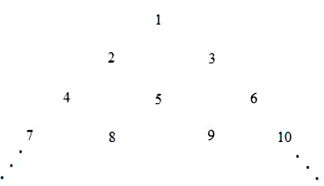
Let the positive integers be written in the form: If the kth row contains exactly k numbers for every natural number k, then the row in which the number 5310 will be, is ________
You're placing numbers in rows where row (k) has exactly (k) numbers. That means the last number in row (k) is the triangular number: Tk=2k(k+1) We want to find which row contains 5310, so solve: 2k(k+1)≥5310 Multiply both sides by 2: k(k+1)≥10620 This gives the quadratic inequality: k2+k−10620≥0k=2−1±4248142481≈206.1k≈2−1+206.1≈102.55So(k≈103). Now check: (T102=5253)(T103=5356) Since (5310) lies between these, it is in row: 103
Q83JEE Main 2024NAT4MBinomial Theorem
Let α=∑r=0n(4r2+2r+1)nCr and β=(∑r=0nr+1nCr)+n+11. If 140<β2α<281, then the value of n is ________
First, we evaluate alpha:
alpha = Summation from r=0 to n of $[(4r^2 + 2r + 1) * nCr]$
Using summation identities, this simplifies to:
alpha = (n+1)^2 * 2^n
Next, we evaluate beta:
beta = (Summation from r=0 to n of [nCr / (r+1)]) + 1/(n+1)
Using summation identities, this simplifies to:
beta = 2^(n+1) / (n+1)
Now, we find the ratio 2alpha / beta:
2alpha / beta = $[2 * (n+1)^2 * 2^n]$ / $[2^(n+1) / (n+1)]$
2*alpha / beta = (n+1)^3
Given the inequality 140 < (n+1)^3 < 281:
For n=4: (4+1)^3 = 5^3 = 125 (Too low)
For n=5: (5+1)^3 = 6^3 = 216 (Fits the range)
For n=6: (6+1)^3 = 7^3 = 343 (Too high)
Therefore, n = 5 is the correct value.
The final answer is 5.
Q84JEE Main 2024NAT4MThree Dimensional Geometry
If the orthocentre of the triangle formed by the lines 2x+3y−1=0, x+2y−1=0 and ax+by−1=0, is the centroid of another triangle, whose circumcentre and orthocentre respectively are (3,4) and (−6,−8), then the value of ∣a−b∣ is ________
The orthocentre of the triangle formed by the lines 2x+3y−1=0, x+2y−1=0, and ax+by−1=0 is given to be the centroid of another triangle. For this other triangle, the circumcentre is (3,4) and the orthocentre is (−6,−8). First, recall that \in any triangle, the centroid G, circumcentre O, and orthocentre H lie on the Euler line, and the centroid divides the segment joining the orthocentre and circumcentre \in the ratio 2:1, with the circumcentre closer to the centroid. The position vector of the centroid is given by: G=3H+2O Substituting the given points O′=(3,4) and H′=(−6,−8): G′=(3−6+2×3,3−8+2×4)=(3−6+6,3−8+8)=(30,30)=(0,0) Thus, the centroid G′ is (0,0). This centroid is also the orthocentre of the triangle formed by the lines 2x+3y−1=0, x+2y−1=0, and ax+by−1=0. Therefore, the orthocentre of this triangle is (0,0). To find the orthocentre of the triangle formed by the three lines, denote the lines as: L1: 2x+3y=1 L2: x+2y=1 L3: ax+by=1 The orthocentre (0,0) satisfies the condition that the line from the orthocentre to each vertex is perpendicular to the opposite side. The vertices of the triangle are the pairwise intersections of these lines. Find the vertices: 1. Intersection of L1 and L2 (vertex A): Solve 2x+3y=1 and x+2y=1. From L2: x=1−2y Substitute into L1: 2(1−2y)+3y=1⟹2−4y+3y=1⟹2−y=1⟹y=1 Then x=1−2(1)=−1 So, vertex A: (−1,1) 2. Intersection of L1 and L3 (vertex B): Solve 2x+3y=1 and ax+by=1. Using elimination: Multiply first equation by b: 2bx+3by=b Multiply second equation by 3: 3ax+3by=3 Subtract: (2bx+3by)−(3ax+3by)=b−3⟹(2b−3a)x=b−3 So, x=2b−3ab−3 From first equation multiplied by a: 2ax+3ay=a Second equation multiplied by 2: 2ax+2by=2 Subtract: (2ax+3ay)−(2ax+2by)=a−2⟹(3a−2b)y=a−2 So, y=3a−2ba−2=−2b−3aa−2 (since 3a−2b=−(2b−3a)) Thus, vertex B: (2b−3ab−3,−2b−3aa−2) 3. Intersection of L2 and L3 (vertex C): Solve x+2y=1 and ax+by=1. From L2: x=1−2y Substitute into L3: a(1−2y)+by=1⟹a−2ay+by=1⟹(b−2a)y=1−a So, y=b−2a1−a Then x=1−2y=1−2b−2a1−a=b−2ab−2a−2(1−a)=b−2ab−2a−2+2a=b−2ab−2 Thus, vertex C: (b−2ab−2,b−2a1−a) Since the orthocentre is (0,0), the vector from (0,0) to each vertex is perpendicular to the direction vector of the opposite side. For vertex A(−1,1), the opposite side is BC. Since B and C lie on L3, BC is the line L3: ax+by=1. The normal vector to L3 is (a,b), so the direction vector of BC is (−b,a). The vector OA is (−1,1). Since AH is perpendicular to BC: (−1,1)⋅(−b,a)=0⟹(−1)(−b)+(1)(a)=b+a=0⟹a+b=0(Equation 1) For vertex B(2b−3ab−3,−2b−3aa−2), the opposite side is AC. Since A and C lie on L2, AC is the line L2: x+2y=1. The normal vector to L2 is (1,2), so the direction vector of AC is (−2,1). The vector OB is (2b−3ab−3,−2b−3aa−2). Since BH is perpendicular to AC: (2b−3ab−3)(−2)+(−2b−3aa−2)(1)=0 Since the denominator 2b−3a=0 (assuming a non-degenerate triangle), multiply by 2b−3a: −2(b−3)−(a−2)=0⟹−2b+6−a+2=0⟹−a−2b+8=0⟹a+2b=8(Equation 2) Solving Equations 1 and 2: From Equation 1: a+b=0⟹a=−b Substitute into Equation 2: −b+2b=8⟹b=8 Then a=−b=−8 So, a=−8, b=8 Now, verify for vertex C(b−2ab−2,b−2a1−a). With a=−8, b=8: xc=8−2(−8)8−2=8+166=246=41yc=8−2(−8)1−(−8)=249=83 So, vertex C: (41,83) The opposite side is AB. Since A and B lie on L1, AB is the line L1: 2x+3y=1. The normal vector to L1 is (2,3), so the direction vector of AB is (−3,2). The vector OC is (41,83). Since CH is perpendicular to AB: (41)(−3)+(83)(2)=−43+86=−43+43=0 Thus, the condition is satisfied. Check the denominators for non-zero values: 2b−3a=2(8)−3(−8)=16+24=40=0b−2a=8−2(−8)=8+16=24=0 The slopes of the lines are distinct: L1 has slope −32, L2 has slope −21, L3 (with a=−8, b=8) is −8x+8y=1, so slope 88=1. Thus, no parallel lines, and a triangle is formed. Now, compute ∣a−b∣: ∣a−b∣=∣−8−8∣=∣−16∣=16 Therefore, the value of ∣a−b∣ is 16.
Q85JEE Main 2024NAT4MLimits, Continuity and Differentiability
The value of limx→02(x21−cosxcos2x3cos3x⋯10cos10x) is
We want to find limx→02(x21−cosxcos2x3cos3x⋯10cos10x). Set P=∏k=110(coskx)1/k, so that the expression inside the limit becomes 2x21−P. Taking natural logarithms gives lnP=∑k=110k1ln(coskx). For small x one has the approximation ln(coskx)≈−2k2x2, which implies lnP≈−2x2∑k=110kk2=−2x2∑k=110k=−2x2⋅55=−255x2. Exponentiating this approximation yields P≈e−55x2/2≈1−255x2 for small x, and therefore 1−P≈255x2. Substituting into the limit gives 2⋅x21−P≈2⋅x2255x2=55. Hence, the value of the limit is 55.
Q86JEE Main 2024NAT4MMatrices and Determinants
Let A=[21−11]. If the \sum of the diagonal elements of A13 is 3n, then n is equal to ________
We begin by finding the characteristic equation of the matrix A. Computing det(A−λI)=(2−λ)(1−λ)+1=λ2−3λ+3=0 and applying Cayley-Hamilton yields A2=3A−3I. Next, letting tn=tr(An), the characteristic equation implies the recurrence tn=3tn−1−3tn−2 with initial values t0=tr(I)=2 and t1=tr(A)=3. Using this recurrence, we compute t2=3(3)−3(2)=3, t3=3(3)−3(3)=0, t4=3(0)−3(3)=−9, t5=3(−9)−3(0)=−27, t6=3(−27)−3(−9)=−54 and t7=3(−54)−3(−27)=−81. Alternatively, the eigenvalues of A are λ=23±i3=3e±iπ/6, so that λn=3n/2e±∈π/6 and therefore tn=λ1n+λ2n=2⋅3n/2cos6nπ. For n=13 this yields t13=2⋅313/2cos613π=2⋅313/2cos6π=2⋅313/2⋅23=313/2⋅31/2=37 and hence n=7. Therefore, the final answer is 7.
Q87JEE Main 2024NAT4MInverse Trigonometric Functions
If the range of f(θ)=sin4θ+cos2θsin4θ+3cos2θ,θ∈R is [α,β], then the \sum of the infinite G.P., whose first term is 64 and the common ratio is βα, is equal to ________
We set t=cos2θ∈[0,1] so that sin2θ=1−t and sin4θ=(1−t)2, and substituting these into f(θ) yields f=(1−t)2+t(1−t)2+3t=1−2t+t2+t1−2t+t2+3t=t2−t+1t2+t+1. Letting y=t2−t+1t2+t+1 leads to y(t2−t+1)=t2+t+1 which rearranges to (y−1)t2−(y+1)t+(y−1)=0. Since this quadratic \in t must have a real root \in [0,1], its discriminant satisfies (y+1)2−4(y−1)2≥0; noting that (y+1)2−(2y−2)2=(3y−1)(3−y) we obtain (3y−1)(3−y)≥0, which implies 31≤y≤3. Checking the endpoints t=0 and t=1 gives f(0)=1 and f(1)=3, and no smaller value occurs for t∈[0,1]; therefore the range of f is [1,3], so that α=1 and β=3. Finally, the \sum of the infinite geometric progression with first term a=64 and common ratio r=α/β=1/3 is S=1−ra=1−1/364=2/364=96. Hence the final answer is 96.
Q88JEE Main 2024NAT4MArea Under The Curves
Let the area of the region enclosed by the curve y=min{sinx,cosx} and the x axis between x=−π to x=π be A. Then A2 is equal to ________
Find A2 where A is the area between y=min{sinx,cosx} and the x-axis from −π to π. sinx=cosx at x=−3π/4 and x=π/4. The function is: [−π,−3π/4]: y=cosx≤0. [−3π/4,π/4]: y=sinx. [π/4,π]: y=cosx. Computing area (taking absolute value where function is negative): [−π,−3π/4]: ∫(−cosx)dx=22[−3π/4,0]: ∫(−sinx)dx=1+22[0,π/4]: ∫sinxdx=1−22[π/4,π/2]: ∫cosxdx=1−22[π/2,π]: ∫(−cosx)dx=1 Total: A=22+1+22+1−22+1−22+1=4. A2=16.
Q89JEE Main 2024NAT4MVector Algebra
Let a=9i^−13j^+25k^, b=3i^+7j^−13k^ and c=17i^−2j^+k^ be three given vectors. If r is a vector such that r×a=(b+c)×a and r⋅(b−c)=0, then (593)2∣593r+67a∣2 is equal to ________
We are given a=(9,−13,25), b=(3,7,−13), and c=(17,−2,1), and we wish to find 5932∣593r+67a∣2 under the conditions r×a=(b+c)×a and r⋅(b−c)=0. Since r×a=(b+c)×a implies (r−b−c)×a=0, the vector r must have the form r=b+c+λa for some scalar λ. Noting that b+c=(20,5,−12), we write r=(20+9λ,5−13λ,−12+25λ). Next, using the perpendicularity condition r⋅(b−c)=0 with b−c=(−14,9,−14), we substitute the coordinates of r to get (20+9λ)(−14)+(5−13λ)(9)+(−12+25λ)(−14)=0. Expanding and combining like terms yields −280−126λ+45−117λ+168−350λ=0 which simplifies to −67−593λ=0 and hence λ=−59367. We then compute 593r+67a by first observing 593r=593(b+c+λa)=593(b+c)+593λa=593(b+c)−67a, so that 593r+67a=593(b+c). Since b+c=(20,5,−12), its squared length is ∣b+c∣2=202+52+(−12)2=400+25+144=569. Therefore, ∣593(b+c)∣2=5932×569, and hence 5932∣593r+67a∣2=569. Thus, the final answer is 569.
Q90JEE Main 2024NAT4MProbability
Three balls are drawn at random from a bag containing 5 blue and 4 yellow balls. Let the random variables X and Y respectively denote the number of blue and yellow balls. If Xˉ and Yˉ are the means of X and Y respectively, then 7Xˉ+4Yˉ is equal to ________
We consider drawing 3 balls from a bag containing 5 blue and 4 yellow balls. Let X and Y be the number of blue and yellow balls drawn, respectively, and we seek to evaluate 7Xˉ + 4Yˉ. Since the total number of balls is 9 and we draw 3 without replacement, by the hypergeometric distribution we have Xˉ=E[X]=3×95=915=35 and Yˉ=E[Y]=3×94=912=34. Notice that X+Y=3 so Xˉ+Yˉ=3, which checks as 35+34=3. Substituting these into the expression gives 7Xˉ+4Yˉ=7×35+4×34=335+316=351=17. Therefore, the final answer is 17.