Q1JEE Main 2021MCQ4MProperties of MatterFour identical hollow cylindrical columns of mild steel support a big structure of mass 50×103kg50 \times 10^{3} {\text{kg}}50×103kg. The inner and outer radii of each column are 50cm50 {\text{cm}}50cm and 100cm100 {\text{cm}}100cm, respectively. Assuming, uniform local distribution, calculate the compressionstrain of each column. $[Use, Y=2.0×10¹¹Pa,g=9.8m/s2\text{Y}=2.0 × 10^{11} {\text{Pa}}, g=9.8 {\text{m}} / {\text{s}}^{2}Y=2.0×10¹¹Pa,g=9.8m/s2]$.A. 3.60×10−83.60 \times 10^{-8}3.60×10⁻⁸B. 2.60×10−72.60 \times 10^{-7}2.60×10⁻⁷C. 1.87×10−31.87 \times 10^{-3}1.87×10⁻³D. 7.07×10−47.07 \times 10^{-4}7.07×10⁻⁴Show Answer🚀 Solve in Practice Mode📖 ExplanationLet inner and outer radii of hollow cylindrical column are r and R, respectively. Given that, r = 50 cm, R = 100 cm Mass supported on four columns, M=50×103kg\text{M}=50 \times 10^{3} {\text{kg}}M=50×103kg Mass supported on each column, m=M4m=\frac{\text{M}}{4}m=4M ⇒m=50×1034=12.5×10³kg\Rightarrow m=\frac{50 \times 10^{3}}{4}=12.5\times 10^{3} {\text{kg}}⇒m=450×103=12.5×10³kg Now, weight, w=mg=12.5×9.8×103N=1225×105Nw=m g=12.5 \times 9.8 \times 10^{3} {\text{N}}=1225 \times 10^{5} {\text{N}}w=mg=12.5×9.8×103N=1225×105N Area of cross-section of each column A=π(R2−r2)\text{A}=\pi(\text{R}^{2}-r^{2})A=π(R2−r2) =3.14{(100)2−(50)2}×10−4m2=2.35m2=3.14\{(100)^{2}-(50)^{2}\} \times 10^{-4} {\text{m}}^{2}=2.35 {\text{m}}^{2}=3.14{(100)2−(50)2}×10−4m2=2.35m2 Young's modulus, Y=2.0×10¹¹Pa\text{Y}=2.0 \times 10^{11} {\text{Pa}}Y=2.0×10¹¹Pa By using Hooke's law, Stress = Y × Strain ∴ Compressive strain =Stress/Y=WAY={{ \text{Stress} }}/{\text{Y}}=\frac{\text{W}}{\text{AY}}=Stress/Y=AYW Substituting the values, we get Compressive strain =1.225×1052.35×2.0×1011=2.60×10−7=\frac{1.225 \times 10^{5}}{2.35 \times 2.0 \times 10^{11}}=2.60 \times 10^{-7}=2.35×2.0×10111.225×105=2.60×10⁻⁷
Q2JEE Main 2021MCQ4MMagnetic Effects of Current and MagnetismA current of 1.5A1.5 {\text{A}}1.5A is flowing through a triangle, of side 9cm9 {\text{cm}}9cm each. The magnetic field at the centroid of the triangle is (Assume that, the current is flowing in the clockwise direction.)A. 3×10⁻⁷T3 \times 10^{-7} {\text{T}}3×10⁻⁷T, outside the plane of triangleB. 23×10−7T2 \sqrt{3} \times 10^{-7} {\text{T}}23×10−7T, outside the plane of triangleC. 23×10−5T2 \sqrt{3} \times 10^{-5} {\text{T}}23×10−5T, inside the plane of triangleD. 3×10⁻⁵T3 \times 10^{-5} {\text{T}}3×10⁻⁵T, inside the plane of triangleShow Answer🚀 Solve in Practice Mode📖 ExplanationGiven, electric current, I = 1.5 A Side of triangle, l=9cm=9×10⁻²ml=9 {\text{cm}}=9 \times 10^{-2} {\text{m}}l=9cm=9×10⁻²m Let OD = OE = OF = r AD=l2\text{AD}=\frac{l}{2}AD=2l InΔAOD,ODAD=tan30°{\text{In}} \Delta\text{AOD}, \frac{\text{OD}}{\text{AD}}=\tan 30°InΔAOD,ADOD=tan30° OD=ADtan30°\text{OD}=\text{AD} \tan 30°OD=ADtan30° r=OD=l2×13=l23r=\text{OD}=\frac{l}{2} \times \frac{1}{\sqrt{3}}=\frac{l}{2 \sqrt{3}}r=OD=2l×31=23l Magnetic field due to AB at O, B1=μ0I4\pir[sin60°+sin60°]=μ0I4\pir×232\text{B}_{1}=\frac{\mu{0}^\text{I}}{4 \pir}[\sin 60°+\sin 60°]=\frac{\mu{0}^\text{I}}{4 \pir} \times \frac{2 \sqrt{3}}{2}B1=4\pirμ0I[sin60°+sin60°]=4\pirμ0I×223 ⇒B1=μ0d34\pir\Rightarrow \text{B}_{1}=\frac{\mu_{0} d \sqrt{3}}{4 \pir}⇒B1=4\pirμ0d3 (perpendicular inward) Now, total magnetic field at O due to all sides, B=3B1=μ04\pir33\text{B}=3 \text{B}_{1}=\frac{\mu_{0}}{4 \pir} 3 \sqrt{3}B=3B1=4\pirμ033 By substituting the values, we get B=10−7×1.5×33×239×10−2=3×10⁻⁵T\text{B}=\frac{10^{-7} \times 1.5 \times 3 \sqrt{3} \times 2 \sqrt{3}}{9 \times 10^{-2}}=3 \times 10^{-5} {\text{T}}B=9×10−210−7×1.5×33×23=3×10⁻⁵T (inside the plane of triangle)
Q3JEE Main 2021MCQ4MRotational MotionA system consists of two identical spheres each of mass 1.5kg1.5 {\text{kg}}1.5kg and radius 50cm50 {\text{cm}}50cm at the end of light rod. The distance between the centres of the two spheres is 5m5 {\text{m}}5m. What will be the moment of inertia of the system about an axis perpendicular to the rod passing through its mid-point?A. 18.75kgm218.75 {\text{kgm}}^{2}18.75kgm2B. 1.905×10⁵kgm21.905 \times 10^{5} {\text{kgm}}^{2}1.905×10⁵kgm2C. 19.05kgm219.05 {\text{kgm}}^{2}19.05kgm2D. 1.875×10⁵kgm21.875 \times 10^{5} {\text{kgm}}^{2}1.875×10⁵kgm2Show Answer🚀 Solve in Practice Mode📖 ExplanationGiven, mass of each sphere, M= 1.5 kg Radius of each sphere, R=50cm=50×10−2m\text{R}=50 {\text{cm}}=50 \times 10^{-2} {\text{m}}R=50cm=50×10−2m Distance between centre of spheres, l = 5 m By using parallel axis theorem, moment of inertia of system is I=2[25MR2+Ml24]\text{I}=2[\frac{2}{5} \text{MR}^{2}+\frac{\text{Ml}^{2}}{4}]I=2[52MR2+4Ml2] I=2M[25R2+l24]\text{I}=2 \text{M}[\frac{2}{5} \text{R}^{2}+\frac{\text{l}^{2}}{4}]I=2M[52R2+4l2] Substituting the values, we get I=2×1.5[25×(50×10−2)2+(5)24]\text{I}=2 \times 1.5[\frac{2}{5} \times (50 \times 10^{-2})^{2}+\frac{(5)^{2}}{4}]I=2×1.5[52×(50×10−2)2+4(5)2] =19.05kg−m2=19.05 {\text{kg}}-{\text{m}}^{2}=19.05kg−m2
Q4JEE Main 2021MCQ4MLaws of MotionStatement I Two forces (P+Q)({\text{P}}+{\text{Q}})(P+Q) and (P−Q)({\text{P}}-{\text{Q}})(P−Q) where P⊥Q{\text{P}} ⊥{\text{Q}}P⊥Q, when act at an angle θ1\theta_{1}θ1 to each other, the magnitude of their resultant is 3(P2+Q2)\sqrt{3(\text{P}^{2}+\text{Q}^{2})}3(P2+Q2), when they act at an angle θ2\theta_{2}θ2, the magnitude of their resultant becomes 2(P2+Q2)\sqrt{2(\text{P}^{2}+\text{Q}^{2})}2(P2+Q2). This is possible only when θ1<θ2\theta_{1}<\theta_{2}θ1<θ2. Statement II In the situation given above. θ1=60°\theta_{1}=60°θ1=60° and θ2=90°.\theta_{2}=90°.θ2=90°. In the light of the above statements, choose the most appropriate answer from the options given below.A. Statement I is false but statement II is true.B. Both statement I and statement II are true.C. Statement I is true but statement II is false.D. Both statement I and statement II are false.Show Answer🚀 Solve in Practice Mode📖 ExplanationGiven, force vectors P⊥Q{\text{P}} \perp {\text{Q}}P⊥Q, i.e. θ=90°\theta=90°θ=90° Let resultant of P + Q = x and resultant of P − Q = y ∴x2=P2+Q2+2PQcos90°=P2+Q2\therefore x^{2}=\text{P}^{2}+\text{Q}^{2}+2 \text{PQ} \cos 90°=\text{P}^{2}+\text{Q}^{2}∴x2=P2+Q2+2PQcos90°=P2+Q2 ...(i) y2=P2+Q2−2PQcos90°=P2+Q2y^{2}=\text{P}^{2}+\text{Q}^{2}-2 \text{PQ} \cos 90°=\text{P}^{2}+\text{Q}^{2}y2=P2+Q2−2PQcos90°=P2+Q2 ...(ii) When θ1\theta_1θ1 is the angle between (P + Q) and (P − Q), then, their resultant is given by ∣x+y∣=3(P2+Q2)|{x}+{y}|=\sqrt{3(\text{P}^{2}+\text{Q}^{2})}∣x+y∣=3(P2+Q2) ∴x2+y2+2xycosθ1=3P2+3Q2\therefore \sqrt{x^{2}+y^{2}+2 x y \cos \theta_{1}}=\sqrt{3 \text{P}^{2}+3 \text{Q}^{2}}∴x2+y2+2xycosθ1=3P2+3Q2 ...(iii) Substituting the values of x2x^{2}x2 and y2y^{2}y2 in Eq. (iii), we get P2+Q2+P2+Q2+2P2+Q2P2+Q2cosθ1=3P2+3Q2\text{P}^{2}+\text{Q}^{2}+\text{P}^{2}+\text{Q}^{2}+2 \sqrt{\text{P}^{2}+\text{Q}^{2}} \sqrt{\text{P}^{2}+\text{Q}^{2}} \cos \theta_{1}=3 \text{P}^{2}+3 \text{Q}^{2}P2+Q2+P2+Q2+2P2+Q2P2+Q2cosθ1=3P2+3Q2 2P2+2Q2+(2P2+2Q2)cosθ1=3P2+3Q22 \text{P}^{2}+2 \text{Q}^{2}+(2 \text{P}^{2}+2 \text{Q}^{2}) \cos \theta_{1}=3 \text{P}^{2}+3 \text{Q}^{2}2P2+2Q2+(2P2+2Q2)cosθ1=3P2+3Q2 ⇒cosθ1=P2+Q22(P2+Q2)=12\Rightarrow \cos \theta_{1}=\frac{\text{P}^{2}+\text{Q}^{2}}{2(\text{P}^{2}+\text{Q}^{2})}=\frac{1}{2}⇒cosθ1=2(P2+Q2)P2+Q2=21 ∴θ1=60°\therefore \theta_{1}=60°∴θ1=60° When θ2\theta_2θ2 is the angle between (P + Q) and (P − Q), then the magnitude of their resultant is given by ∣x+y∣=2(P2+Q2)|{x}+{y}|=\sqrt{2(\text{P}^{2}+\text{Q}^{2})}∣x+y∣=2(P2+Q2) x2+y2+2xycosθ2=2P2+2Q2x^{2}+y^{2}+2 x y \cos \theta_{2}=2 \text{P}^{2}+2 \text{Q}^{2}x2+y2+2xycosθ2=2P2+2Q2 ...(iv) Substituting the values, we get P2+Q2+P2+Q2+2(P2+Q2)cosθ2\text{P}^{2}+\text{Q}^{2}+\text{P}^{2}+\text{Q}^{2}+2(\text{P}^{2}+\text{Q}^{2}) \cos \theta_{2}P2+Q2+P2+Q2+2(P2+Q2)cosθ2 =2P2+2Q2=2 \text{P}^{2}+2 \text{Q}^{2}=2P2+2Q2 cos θ2=0\theta_2 = 0θ2=0 ⇒θ2=90°\Rightarrow \theta_2 = 90°⇒θ2=90° So, θ1=60°\theta_{1}=60°θ1=60° and θ2=90°\theta_{2}=90°θ2=90° and θ1<θ2\theta_{1}<\theta_{2}θ1<θ2 Hence, both statement I and statement II are true.
Q5JEE Main 2021MCQ4MAtoms and NucleiA free electron of 2.6eV2.6 {\text{eV}}2.6eV energy collides with aH+{a} {\text{H}}^{+}aH+ ion. This results in the formation of a hydrogen atom in the first excited state and a photon is released. Find the frequency of the emitted photon. (h=6.6×10⁻³⁴Js)(h=6.6 \times 10^{-34} {\text{Js}})(h=6.6×10⁻³⁴Js)A. 1.45×10¹⁶MHz1.45 \times 10^{16} {\text{MHz}}1.45×10¹⁶MHzB. 0.19×10¹⁵MHz0.19 \times 10^{15} {\text{MHz}}0.19×10¹⁵MHzC. 1.45109MHz1.45 10^{9} {\text{MHz}}1.45109MHzD. 9.0×1027MHz9.0 \times 10^{27} {\text{MHz}}9.0×1027MHzShow Answer🚀 Solve in Practice Mode📖 ExplanationGiven that, energy of free electron, E1=2.6eV\text{E}_{1}=2.6 {\text{eV}}E1=2.6eV We know that, the energy of H-atom in its first excited state (n = 2), E2=−13.622=−13.64eV\text{E}_{2}=\frac{-13.6}{2^{2}}=-\frac{13.6}{4}{\text{eV}}E2=22−13.6=−413.6eV Now, the energy of emitted photons will be the difference ofthese two energies E1\text{E}_{1}E1 and E2\text{E}_{2}E2. ΔE=E1−E2\Delta\text{E}=\text{E}_{1}-\text{E}_{2}ΔE=E1−E2 ∴hv=[2.6−(−13.64)]eV\therefore \text{hv}=[2.6-(-\frac{13.6}{4})] {\text{eV}}∴hv=[2.6−(−413.6)]eV ⇒V=(10.4+13.6)×1.6×10−194×6.6×10−34=1.45×10⁹MHz\Rightarrow {\text{V}}=\frac{(10.4+13.6) \times 1.6 \times 10^{-19}}{4 \times 6.6 \times 10^{-34}}=1.45 \times 10^{9} {\text{MHz}}⇒V=4×6.6×10−34(10.4+13.6)×1.6×10−19=1.45×10⁹MHz
Q6JEE Main 2021MCQ4MProperties of MatterTwo thin metallic spherical shells of radii r1r_{1}r1 and r2(r1<r2)r_{2}(r_{1} < r_{2})r2(r1<r2) are placed with their centres coinciding. A material of thermal conductivity K is filled in the space between the shells. The inner shell is maintained at temperature θ1\theta_{1}θ1 and the outer shell at temperature θ2(θ+1<θ2)\theta_{2}(\theta+{1} < \theta_{2})θ2(θ+1<θ2). The rate at which heat flows radially through the material isA. 4πKr1r2(θ2−θ1)r2−r1\frac{4 \pi\text{Kr}_{1} r_{2}(\theta_{2}-\theta_{1})}{r_{2}-r_{1}}r2−r14πKr1r2(θ2−θ1)B. \pir1r2(θ2−θ1)r2−r1\frac{\pir_{1} r_{2}(\theta_{2}-\theta_{1})}{r_{2}-r_{1}}r2−r1\pir1r2(θ2−θ1)C. K(θ2−θ1)r2−r1\frac{\text{K}(\theta_{2}-\theta_{1})}{r_{2}-r_{1}}r2−r1K(θ2−θ1)D. K(θ2−θ1)(r2−r1)4\pir1r2\frac{\text{K}(\theta_{2}-\theta_{1})(r_{2}-r_{1})}{4 \pir_{1} r_{2}}4\pir1r2K(θ2−θ1)(r2−r1)Show Answer🚀 Solve in Practice Mode📖 ExplanationGiven that, r1r_{1}r1 and r2r_{2}r2 be the radii of inner and outer shells. A material of thermal conductivity (K) is filled between region. Consider an elementary sphere of radius r and thickness dr. Now, thermal resistance of elementary sphere dR=drK4\pir2\text{dR}=\frac{\text{dr}}{\text{K} 4 \pir^{2}}dR=K4\pir2dr $[\because inner surface area,A=4\pir2\text{A}=4 \pir^{2}A=4\pir2]$ So, total thermal resistance, R=∫dR=∫r1r2dr4\piKr2=−14πK[1r]r1r2R=\int\text{dR}=\int^{r_2}_{r_1} \frac{d r}{4 \piK r^{2}}=-\frac{1}{4 \pi\text{K}}[\frac{1}{r}]_{r_{1}}^{r_{2}}R=∫dR=∫r1r24\piKr2dr=−4πK1[r1]r1r2 R=r2−r14πKr1r2\text{R}=\frac{r_{2}-r_{1}}{4 \pi\text{K} r_{1} r_{2}}R=4πKr1r2r2−r1 Hence, heat current (or the rate of flow of heat) dQdt=ΔθR=(θ2−θ1)/(r2−r1)4πKr1r2=4πKr1r2(θ2−θ1)r2−r1\frac{\text{dQ}}{d t}=\frac{\Delta\theta}{\text{R}}={(\theta_{2}-\theta_{1})}/{\frac{(r_{2}-r_{1})}{4 \pi\text{K} r_{1} r_{2}}}=\frac{4 \pi\text{K} r_{1} r_{2}(\theta_{2}-\theta_{1})}{r_{2}-r_{1}}dtdQ=RΔθ=(θ2−θ1)/4πKr1r2(r2−r1)=r2−r14πKr1r2(θ2−θ1)
Q7JEE Main 2021MCQ4MSemiconductor ElectronicsIf VA\text{V}_{\text{A}}VA and VB\text{V}_{\text{B}}VB are the input voltages (either 5V5 \text{V}5V or OV) and V0\text{V}_{0}V0 is the output voltage then the two gates represented in the following circuit (A) and (B) areA. AND and OR gateB. OR and NOT gateC. NAND and NOR gateD. AND and NOT gateShow Answer🚀 Solve in Practice Mode📖 ExplanationIn figure A,VA\text{A}, \text{V}_{\text{A}}A,VA and VB\text{V}_{\text{B}}VB are two input voltages (either 5V5 {\text{V}}5V or 0V0 {\text{V}}0V) When VA=0,VB=0\text{V}_{\text{A}}=0, \text{V}_{\text{B}}=0VA=0,VB=0 Both D1\text{D}_{1}D1 and D2\text{D}_{2}D2 are OFF, so V0=0\text{V}_{0}=0V0=0, When VA=1\text{V}_{\text{A}}=1VA=1 i.e. 5V,VB=05 {\text{V}}, \text{V}_{\text{B}}=05V,VB=0 i.e. 0V0 {\text{V}}0V D1\text{D}_{1}D1 is ON but D2\text{D}_{2}D2 is OFF So, V0=1\text{V}_{0}=1V0=1 i.e. 5V5 {\text{V}}5V When VA=0\text{V}_{\text{A}}=0VA=0 i.e. 0V,VB=10 {\text{V}}, \text{V}_{\text{B}}=10V,VB=1 i.e. 5V5 {\text{V}}5V D1\text{D}_{1}D1 is OFF and D2\text{D}_{2}D2 is ON So, V0=1\text{V}_{0}=1V0=1 i.e. 5V.5 {\text{V}}.5V. Similarly, when VA=VB=1\text{V}_{\text{A}}=\text{V}_{\text{B}}=1VA=VB=1 Both D1\text{D}_{1}D1 and D2\text{D}_{2}D2 are ON So, V0=1\text{V}_{0}=1V0=1 i.e. 5V.5 {\text{V}}.5V. We get the final truth table on the basis of inputs and their corresponding output. A B Y 0 0 0 0 1 1 1 0 1 1 1 1 ∴ The given circuit (A) is an OR gate. In figure B, it is a transistor in common emitter configuration which gives high output at low input and low output at high input. Hence, this circuit behaves as NOT Gate.
Q8JEE Main 2021MCQ4MDual Nature of Matter and RadiationConsider two separate ideal gases of electrons and protons having same number of particles. The temperature of both the gases are same. The ratio of the uncertainty in determining the position of an electron to that of a proton is proportional toA. (mpme)32(\frac{m_{p}}{m_{e}})^{\frac{3}{2}}(memp)23B. memp\sqrt{\frac{m_{e}}{m_{p}}}mpmeC. mpme\sqrt{\frac{m_{p}}{m_{e}}}mempD. mpme\frac{m_{p}}{m_{e}}mempShow Answer🚀 Solve in Practice Mode📖 ExplanationAt same temperature kinetic energy of proton and electron are same KEp=KEe{\text{KE}}_{p}={\text{KE}}_{e}KEp=KEe ⇒pp22mp=pe22me\Rightarrow \frac{p_{p}^{2}}{2 m_{p}}=\frac{p_{e}^{2}}{2 m_{e}}⇒2mppp2=2mepe2 pp2pe2=mpme\frac{p_{p}^{2}}{p_{e}^{2}}=\frac{m_{p}}{m_{e}}pe2pp2=memp ...(i) Using uncertainty in determining the position, \Deltax≈h\Deltap\Deltax \approx \frac{h}{\Deltap}\Deltax≈\Deltaph Ratio,∴\Deltaxe\Deltaxp=\Deltapp\Deltape=mpme\therefore \frac{\Deltax_{e}}{\Deltax_{p}}=\frac{\Deltap_{p}}{\Deltap_{e}}=\sqrt{\frac{m_{p}}{m_{e}}}∴\Deltaxp\Deltaxe=\Deltape\Deltapp=memp [from Eq. (i)]
Q9JEE Main 2021MCQ4MOscillationsA bob of mass m suspended by a thread of length l undergoes simple harmonic oscillations with time period T. If the bob is immersed in a liquid that has density 1/41 / 41/4 times that of the bob and the length of the thread is increased by 1/3rd1 / 3\text{rd}1/3rd of the original length, then the time period of the simple harmonic oscillations will beA. TB. 32T\frac{3}{2} \text{T}23TC. 34T\frac{3}{4} \text{T}43TD. 43T\frac{4}{3} \text{T}34TShow Answer🚀 Solve in Practice Mode📖 ExplanationGiven that, a bob of mass m suspended by a thread of length l undergoes SHM with time period, T1=T=2πlg\text{T}_{1}=\text{T}=2 \pi\sqrt{\frac{l}{g}}T1=T=2πgl ...(i) In liquid, effective gravity, geff=g(σ−ρσ)g_{{\text{eff} }}=g(\frac{\sigma-\rho }{\sigma})geff=g(σσ−ρ) where, ρ = density of liquid and sigma = density of body (bob). Given, ρ=σ4\rho =\frac{\sigma}{4}ρ=4σ ⇒σ=4ρ\Rightarrow \sigma=4 \rho ⇒σ=4ρ Substituting this value, we get geff=g(4ρ−ρ4ρ)=3g4g_{{\text{eff}}}=g(\frac{4 \rho -\rho }{4 \rho })=\frac{3 g}{4}geff=g(4ρ4ρ−ρ)=43g Now, the new time period of pendulum in liquid is T′=2πl′/geff\text{T}'=2 \pi\sqrt{{\text{l}'}/{g_{{\text{eff}}}}}T′=2πl′/geff ...(ii) Here,l′=l+l3=4I3l'=l+\frac{l}{3}=\frac{4 \text{I}}{3}l′=l+3l=34I Substituting the values in Eq. (ii), we get T′=2π4l3×43g\text{T}'=2 \pi\sqrt{\frac{4 l}{3} \times \frac{4}{3 g}}T′=2π34l×3g4 =(2πlg)43=(2 \pi\sqrt{\frac{l}{g}}) \frac{4}{3}=(2πgl)34 ⇒T′=4T3\Rightarrow \text{T}'=\frac{4 \text{T}}{3}⇒T′=34T [from Eq. (i)]
Q10JEE Main 2021MCQ4MLaws of MotionStatement I If three forces F1.F2{\text{F}}_{1} .{\text{F}}_{2}F1.F2 and F3{\text{F}}_{3}F3 are represented by three sides of a triangle and F1+F2=−F3{\text{F}}_{1}+{\text{F}}_{2}=-{\text{F}}_{3}F1+F2=−F3, then these three forces are concurrent forces and satisfy the condition for equilibrium. Statement II A triangle made up of three forces F1,F2{\text{F}}_{1}, {\text{F}}_{2}F1,F2 and F3{\text{F}}_{3}F3 as its sides taken in the same order, satisfy the condition for translatory equilibrium. In the light of the above statements, choose the most appropriate answer from the options given below.A. Statement I is false but statement II is true.B. Statement I is true but statement II is false.C. Both statement I and statement II are false.D. Both statement I and statement II are true.Show Answer🚀 Solve in Practice Mode📖 ExplanationThree forces F1,F2\text{F}_{1}, \text{F}_{2}F1,F2 and F3\text{F}_{3}F3 are acting on a body and if this body is in equilibrium, then resultant of these three forces must be zero i.e. Fnet=F1+F2+F3=0{\text{F}}_{ {\text{net} }}={\text{F}}_{1}+{\text{F}}_{2}+{\text{F}}_{3}=0Fnet=F1+F2+F3=0 ⇒F1+F2=−F3\Rightarrow {\text{F}}_{1}+{\text{F}}_{2}=-{\text{F}}_{3}⇒F1+F2=−F3 This situation can be shown graphically by three concurrent forces at 120° with each others. or, by three forces in the same order along three sides of a triangle. Hence, both statement I and statement II are true.
Q11JEE Main 2021MCQ4MUnits and MeasurementsIf velocity [v], time [T] and force [F] are choosen as the base quantities, the dimensions of the mass will beA. [FT−1v−1][\text{FT}^{-1} \text{v}^{-1}][FT−1v−1]B. [FTv−1][\text{FTv}^{-1}][FTv−1]C. [FT2v][\text{FT}^{2} \text{v}][FT2v]D. [FvT−1][\text{FvT}^{-1}][FvT−1]Show Answer🚀 Solve in Practice Mode📖 ExplanationWhen the velocity (v), time (T) and force (F) are chosen as base quantities. Then, mass is given by m\proptovxTyFzm \proptov^{x} \text{T}^{y} \text{F}^{z}m\proptovxTyFz ...(i) Using dimensional formula of all quantities, [{\text{ML}}^{0} {\text{T}}^{0}]=\[{\text{LT}}^{-1}]^{{x}}[{\text{T}}]^{{y}}$[{\text{MLT}}^{-2}]^{{z}} [\text{M}^{1} \text{L}^{0} \text{T}^{0}]=[\text{M}^{\text{Z}} \text{L}^{x+z} \text{T}^{-x+y-2 z}]Comparingthepowersofdimensionsonbothsides,wegetz=1Comparing the powers of dimensions on both sides, we get z = 1Comparingthepowersofdimensionsonbothsides,wegetz=1x+z=0andandand-x+y-2 z=0 \Rightarrow x+1=0 \Rightarrow x=-1andandand-(-1)+y-2(1)=0 \Rightarrow 1+y-2=0 \Rightarrow y=1SubstitutingthesevaluesinEq.(i),wegetSubstituting these values in Eq. (i), we getSubstitutingthesevaluesinEq.(i),wegetm \propto v^{-1} \text{T}^{1} \text{F}^{1} \Rightarrow m=[\text{FTv}^{-1}]$
Q12JEE Main 2021MCQ4MElectromagnetic WavesThe magnetic field vector of an electromagnetic wave is given by B=B0i^+j^2cos(kz−\omegat)T{\text{B}}=\text{B}_{0} \frac{\hat{i}+\hat{j}}{\sqrt{2}} \cos (k z-\omegat) \text{T}B=B02i^+j^cos(kz−\omegat)T where i^,j^\hat{i}, \hat{j}i^,j^ represents unit vector along X and Y-axis respectively. At t=0t=0t=0, two electric charges q1q_{1}q1of 4πC4 \pi {\text{C}}4πC and q2q_{2}q2 of 2π2 \pi2π C located at (0,0,πk)(0,0, \frac{\pi}{k})(0,0,kπ) and (0,0,3πk)(0,0, \frac{3 \pi}{k})(0,0,k3π) respectively, have the same velocity of 0.5ci^0.5 c \hat{i}0.5ci^. (where, c is the velocity of light). The ratio of the force acting on charge q1q_{1}q1 to q2q_{2}q2 isA. 22:12\sqrt2:122:1B. 1:21:\sqrt21:2C. 2:12:12:1D. 2:1\sqrt2:12:1Show Answer🚀 Solve in Practice Mode📖 ExplanationThe equation of magnetic field vector of an electromagnetic field is B=B02(i^+j^)cos(kz−\omegat)T{\text{B}}=\frac{\text{B}_{0}}{\sqrt{2}}(\hat{i}+\hat{j}) \cos (k z-\omegat) {\text{T}}B=2B0(i^+j^)cos(kz−\omegat)T Electric charges q1q_{1}q1 at P(0,0,πk)=4πC\text{P}(0,0, \frac{\pi}{k})=4 \pi\text{C}P(0,0,kπ)=4πC q2q_{2}q2 at Q(0,0,3πk)=2πC\text{Q}(0,0, \frac{3 \pi}{k})=2 \pi\text{C}Q(0,0,k3π)=2πC At t=0t=0t=0 and P(0,0,πk)\text{P}(0,0, \frac{\pi}{k})P(0,0,kπ), where z=πkz=\frac{\pi}{k}z=kπ Magnetic field vector, B=B02(i^+j^)cos(kπk−0)T{\text{B}}=\frac{\text{B}_{0}}{\sqrt{2}}(\hat{i}+\hat{j}) \cos (k \frac{\pi}{k}-0) {\text{T}}B=2B0(i^+j^)cos(kkπ−0)T =B02(i^+j^)cosπT=−B02(i^+j^)T=\frac{\text{B}_{0}}{\sqrt{2}}(\hat{i}+\hat{j}) \cos \pi{\text{T}}=-\frac{\text{B}_{0}}{\sqrt{2}}(\hat{i}+\hat{j}) {\text{T}}=2B0(i^+j^)cosπT=−2B0(i^+j^)T and at t=0t=0t=0 and Q(0,0,3πk)\text{Q}(0,0, \frac{3 \pi}{k})Q(0,0,k3π), where z=3πk.z=\frac{3 \pi}{k} .z=k3π. Magnetic field vector, B=B02(i^+j^)cos(k3πk−0){\text{B}}=\frac{\text{B}_{0}}{\sqrt{2}}(\hat{i}+\hat{j}) \cos (k \frac{3 \pi}{k}-0)B=2B0(i^+j^)cos(kk3π−0) =−B02(i^+j^)T=-\frac{\text{B}_{0}}{\sqrt{2}}(\hat{i}+\hat{j}) {\text{T}}=−2B0(i^+j^)T [\because Using cos pi = cos 3pi = − 1] Velocity of charges q1q_{1}q1 and q2,v=0.5ci^q_{2}, {v}=0.5 c \hat{i}q2,v=0.5ci^ We know that, force on charge in magnetic field is given by F=q(v×B){\text{F}}=q({v} \times {\text{B}})F=q(v×B) ∴ For q1,F1=4π[0.5ci^×{−B02(i^+j^)}]Nq_{1}, {\text{F}}_{1}=4 \pi[0.5 c \hat{i} \times \{-\frac{\text{B}_{0}}{\sqrt{2}}(\hat{i}+\hat{j})\}] {\text{N}}q1,F1=4π[0.5ci^×{−2B0(i^+j^)}]N F1=−2\picB02k^N{\text{F}}_{1}=-\frac{2 \pic \text{B}_{0}}{\sqrt{2}} \hat{k} {\text{N}}F1=−22\picB0k^N Similarly, for q2q_{2}q2 ⇒F2=2π[0.5ci^×{−B02(i^+j^)}]N\Rightarrow {\text{F}}_{2}=2 \pi[0.5 c \hat{i} \times \{-\frac{\text{B}_{0}}{\sqrt{2}}(\hat{i}+\hat{j})\}] {\text{N}}⇒F2=2π[0.5ci^×{−2B0(i^+j^)}]N ⇒F2=−\picB02k^N\Rightarrow {\text{F}}_{2}=-\frac{\pic \text{B}_{0}}{\sqrt{2}} \hat{k} {\text{N}}⇒F2=−2\picB0k^N Hence, ratio of magnitudes of F1{\text{F}}_{1}F1 to F2{\text{F}}_{2}F2 F1F2=2\picB02/\picB02=21\frac{\text{F}_{1}}{\text{F}_{2}}={\frac{2 \pic \text{B}_{0}}{\sqrt{2}}}/{\frac{\pic \text{B}_{0}}{\sqrt{2}}}=\frac{2}{1}F2F1=22\picB0/2\picB0=12 ⇒F1:F2=2:1\Rightarrow \text{F}_{1}: \text{F}_{2}=2: 1⇒F1:F2=2:1
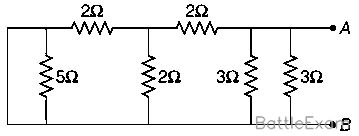
Q13JEE Main 2021MCQ4MCurrent ElectricityThe equivalent resistance of the given circuit between the terminals A and B isA. 0B. 3ΩC. 9/2Ω9/2\Omega9/2ΩD. 1ΩShow Answer🚀 Solve in Practice Mode📖 ExplanationIn the given circuit, 5 Ω resistance is shorted. So, it can be discarded. Now, we get a resolved circuit as shown below In parallel, R1=2×22+2=1Ω\text{R}_{1}=\frac{2 \times 2}{2+2}=1 \OmegaR1=2+22×2=1Ω In series, R2=R1+2=1+2=3Ω\text{R}_{2}=\text{R}_{1}+2=1+2=3 \OmegaR2=R1+2=1+2=3Ω Here, all the three resistances(3Ω) are parallel. ∴ Equivalent resistance across A and B, 1/Req=13+13+13=1{1}/{\text{R}_{{\text{eq}}}}=\frac{1}{3}+\frac{1}{3}+\frac{1}{3}=11/Req=31+31+31=1 ⇒Req=1Ω\Rightarrow \text{R}_{{\text{eq} }}=1 \Omega⇒Req=1Ω
Q14JEE Main 2021MCQ4MElectrostaticsChoose the incorrect statement. A. The electric lines of force entering into a Gaussian surface provide negative flux. B. A charge q is placed at the centre of a cube. The flux through all the faces will be the same. C. In a uniform electric field net flux through a closed Gaussian surface containing no net charge is zero. D. When electric field is parallel to a Gaussian surface, it provides a finite non-zero flux. Choose the most appropriate answer from the options given below.A. (C) and (D)B. (B) and (D)C. Only (D)D. (A) and (C)Show Answer🚀 Solve in Practice Mode📖 ExplanationIn the given statements (a), (b) and (c) are correct. Only (d) is wrong. Since, if electric field lines of force (or electric field) is parallel to Gaussian surface, then angle between normal to surface and electric field is theta = 90°. ∴ By equation of electric flux phi = EA cos theta = EA cos 90° = 0 Hence, electric flux will be zero in this situation. Hence, option (c) is the correct.
Q15JEE Main 2021MCQ4MThermodynamicsA mixture of hydrogen and oxygen has volume 500cm3500 {\text{cm}}^{3}500cm3, temperature 300K300 {\text{K}}300K, pressure 400kPa400 {\text{kPa}}400kPa and mass 0.76g0.76 {\text{g}}0.76g. The ratio of masses of oxygen to hydrogen will beA. 3:83: 83:8B. 3:163: 163:16C. 16:316: 316:3D. 8:38: 38:3Show Answer🚀 Solve in Practice Mode📖 ExplanationGiven, Volume, V=500cm3=5×102×10−6m3\text{V}=500 {\text{cm}}^{3}=5 \times 10^{2} \times 10^{-6} {\text{m}}^{3}V=500cm3=5×102×10−6m3 =5×10⁻⁴m3=5 \times 10^{-4} {\text{m}}^{3}=5×10⁻⁴m3 Pressure, p=400kPa=4×10⁵Pap=400 {\text{kPa}}=4 \times 10^{5} {\text{Pa}}p=400kPa=4×10⁵Pa Temperature, T = 300 K Total mass, m = 0.76 g We know that, Molar mass of hydrogen, M1\text{M}_1M1= 2 g Molar mass of oxygen, M2\text{M}_2M2 = 32 g Let n1n_1n1 and n2n_2n2 be the number of moles of hydrogen and oxygen, respectively. Total number of moles of mixture, n=n1+n2n=n_{1}+n_{2}n=n1+n2 By using ideal gas equation, pV = nRT Substituting the values, we get 4×105×5×10−4=n×8.314×3004 \times 10^{5} \times 5 \times 10^{-4}=n \times 8.314 \times 3004×105×5×10−4=n×8.314×300 n= 0.08 mol Then,n1+n2=0.08n_{1}+n_{2}=0.08n1+n2=0.08 Let mass of hydrogen in mixture = m1m_1m1 and mass of oxygen in oxygen = m2m_2m2 n1M1+n2M2=mn_{1} \text{M}_{1}+n_{2} \text{M}_{2}=mn1M1+n2M2=m [∵n=mM⇒m=nM][\because n=\frac{m}{\text{M}} \Rightarrow m=n \text{M}][∵n=Mm⇒m=nM] Substituting the values, we get 2n1+32n2=0.762 n_{1}+32 n_{2}=0.762n1+32n2=0.76 n1+16n2=0.38n_{1}+16 n_{2}=0.38n1+16n2=0.38 ...(ii) Solving Eqs. (i) and (ii), we get n1=0.06n_{1}=0.06n1=0.06 and n2=0.02n_{2}=0.02n2=0.02 ∴ Ratio of masses, m2m1=n2M2n1M1=0.02×320.06×2=163\frac{m_{2}}{m_{1}}=\frac{n_{2} \text{M}_{2}}{n_{1} \text{M}_{1}}={0.02 \times 32}{0.06 \times 2}=\frac{16}{3}m1m2=n1M1n2M2=0.02×320.06×2=316 i.e. m2:m1=16:3m_{2}: m_{1}=16: 3m2:m1=16:3
Q16JEE Main 2021MCQ4MCentre of Mass and CollisionA block moving horizontally on a smooth surface with a speed of 40m/s40 {\text{m}} / {\text{s}}40m/s splits into two parts with masses in the ratio of 1:21: 21:2. If the smaller part moves at 60m/s60 {\text{m}}/ {\text{s}}60m/s in the same direction, then the fractional change in kinetic energy isA. 1/31 / 31/3B. 2/32 / 32/3C. 1/81 / 81/8D. 1/41 / 41/4Show Answer🚀 Solve in Practice Mode📖 ExplanationLet a block of mass M splits into two masses m1m_1m1 and m2m_2m2 in ratio 1: 2. Then, mass of smaller part, m1=M1+2=M3m_{1}=\frac{\text{M}}{1+2}=\frac{\text{M}}{3}m1=1+2M=3M Mass of bigger part, m2=2M/3m_{2}=2 \text{M} / 3m2=2M/3 Given, speed of mass M, v = 40 m/s Speed of mass m1,v1=60m/sm_{1}, v_{1}=60 {m} / {s}m1,v1=60m/s Let speed of mass m2,v2=vm_{2}, v_{2}=vm2,v2=v Using conservation of linear momentum, pi=pf{p}_{i}={p}_{\text{f}}pi=pf Mv=m1v1+m2v2\text{M} {v}=m_{1} {v}_{1}+m_{2} {v}_{2}Mv=m1v1+m2v2 M×40=M3×60+2M3×v\text{M} \times 40=\frac{\text{M}}{3} \times 60+\frac{2 \text{M}}{3} \times vM×40=3M×60+32M×v \Rightarrow = 30 m/s ∴ The fractional change in kinetic energy, ΔKK=Kf−Ki/Ki=Kf/Ki−1\frac{\Delta\text{K}}{\text{K}}={\text{K}_{\text{f}}-\text{K}_{i}}/{\text{K}_{i}}={\text{K}_{\text{f}}}/{\text{K}_{i}}-1KΔK=Kf−Ki/Ki=Kf/Ki−1 =12m1v12+12m2v2212Mv2−1=\frac{\frac{1}{2} m_{1} v_{1}^{2}+\frac{1}{2} m_{2} v_{2}^{2}}{\frac{1}{2} \text{M} v^{2}}-1=21Mv221m1v12+21m2v22−1 ={\frac{1}{2}\[\frac{\text{M}}{3} × (60)^{2}+\frac{2 \text{M}}{3}× (30)^{2}]$}/{\frac{1}{2} \text{M} \times (40)^{2}}-1=\frac{9}{8}-1=\frac{1}{8}$
Q17JEE Main 2021MCQ4MElectromagnetic InductionA coil is placed in a magnetic field B as shown below. A current is induced in the coil because B isA. outward and decreasing with timeB. parallel to the plane of coil and decreasing with timeC. outward and increasing with timeD. parallel to the plane of coil and increasing with timeShow Answer🚀 Solve in Practice Mode📖 ExplanationIn the given figure, the magnetic field is outward, means N-pole is formed on outward face and S-pole is formed on inward (back) face. As the induced current is anti-clockwise which is also making N-pole on outward face. According to the Lenz's law, the induced current always opposes the nature by which it is produced. Hence, induced current is in the direction, so the strength of N-pole is maintained as it is decreasing.
Q18JEE Main 2021MCQ4MOscillationsFor a body executing SHM A. potential energy is always equal to its kinetic energy. B. average potential and kinetic energy over any given time interval are always equal. C. sum of the kinetic and potential energy at any point of time is constant. D. average kinetic energy in one time period is equal to average potential energy in one time period. Choose the most appropriate option from the options given below.A. (C) and (D)B. Only (C)C. (B) and (C)D. Only (B)Show Answer🚀 Solve in Practice Mode📖 ExplanationAs we know that, for a body executing SHM the average kinetic energy is equal to average potential energy over a complete time period i.e. KEav=PEav=14mω2a2{\text{KE}}_{{\text{av}}}={\text{PE}}_{{\text{av}}}=\frac{1}{4} m \omega^{2} {a}^{2}KEav=PEav=41mω2a2 ∴ Total mechanical energy at any time = Sum of kinetic and potential energy =12mω2a2==\frac{1}{2} m \omega^{2} a^{2}==21mω2a2= constant. where, m = mass of body executing SHM, omega = angular frequency and a = amplitude of SHM. Hence, (c) and (d) are true.
Q19JEE Main 2021MCQ4MSemiconductor ElectronicsStatement I To get a steady DC output from the pulsating voltage received from a full wave rectifier we can connect a capacitor across the output parallel to the load RL\text{R}_{\text{L}}RL. Statement II To get a steady DC output from the pulsating voltage received from a full wave rectifier we can connect an inductor in series with RL\text{R}_{\text{L}}RL. In the light of the above statements, choose the most appropriate answer from the options given below.A. Statement I is true but statement II is false.B. Statement I is false but statement II is true.C. Both statement I and statement II are false.D. Both statement I and statement II are true.Show Answer🚀 Solve in Practice Mode📖 ExplanationAccording to statement I and II, full wave rectifier with capacitor and inductor are as shown in figure. In figure (A), the capacitor is connected in parallel to load resistance (RL)(\text{R}_{\text{L}})(RL), as it can block DC current. ∴ DC current can pass only through RL\text{R}_\text{L}RL which gives DC output. In figure (B), as the AC current is time varying current which can produce an opposition in current due to inductor that cancel the effect of AC in the load resistance (\text{R}\text{L}).Hence,pureDCoutputisobtainedacross). Hence, pure DC output is obtained across ).Hence,pureDCoutputisobtainedacross\text{R}{\text{L}}$. Hence, statement I and statement II are true.
Q20JEE Main 2021MCQ4MGravitationIf RE\text{R}_{\text{E}}RE be the radius of Earth, then the ratio between the acceleration due to gravity at a depth r below and a height r above the Earth surface is (Given, r<REr < \text{R}_{\text{E}}r<RE)A. 1−r/RE−r2/RE2−r3/RE31-{r}/{\text{R}_{\text{E}}}-{r^{2}}/{\text{R}_{\text{E}}^{2}}-{r^{3}}/{\text{R}_{\text{E}}^{3}}1−r/RE−r2/RE2−r3/RE3B. 1+r/RE+r2/RE2+r3/RE31+{r}/{\text{R}_{\text{E}}}+{r^{2}}/{\text{R}_{\text{E}}^{2}}+{r^{3}}/{\text{R}_{\text{E}}^{3}}1+r/RE+r2/RE2+r3/RE3C. 1+r/RE−r2/RE2+r3/RE31+{r}/{\text{R}_{\text{E}}}-{r^{2}}/{\text{R}_{\text{E}}^{2}}+{r^{3}}/{\text{R}_{\text{E}}^{3}}1+r/RE−r2/RE2+r3/RE3D. 1+r/RE−r2/RE2−r3/RE31+{r}/{\text{R}_{\text{E}}}-{r^{2}}/{\text{R}_{\text{E}}^{2}}-{r^{3}}/{\text{R}_{\text{E}}^{3}}1+r/RE−r2/RE2−r3/RE3Show Answer🚀 Solve in Practice Mode📖 ExplanationGiven that, radius of Earth =RE=\text{R}_{\text{E}}=RE Height above Earth's surface, h = r Depth below Earth surface, d = r We know that, acceleration due to gravity at height (r) and depth (r) is (for r<REr < \text{R}_{\text{E}}r<RE) gh=g(RE/RE+h)2=g(RE/RE+r)2g_{h}=g({\text{R}_{\text{E}}}/{\text{R}_{\text{E}}+h})^{2}=g({\text{R}_{\text{E}}}/{\text{R}_{\text{E}}+r})^{2}gh=g(RE/RE+h)2=g(RE/RE+r)2 ...(i) andgd=g(RE−d/RE)=g(RE−r/RE)g_{d}=g({\text{R}_{\text{E}}-d}/{\text{R}_{\text{E}}})=g({\text{R}_{\text{E}}-r}/{\text{R}_{\text{E}}})gd=g(RE−d/RE)=g(RE−r/RE) ...(ii) ∴gdgh=g(RE−r/RE)/g(RE/RE+r)2\therefore \frac{g_{d}}{g_{h}}={g({\text{R}_{\text{E}}-r}/{\text{R}_{\text{E}}})}/{g({\text{R}_{\text{E}}}/{\text{R}_{\text{E}}+r})^{2}}∴ghgd=g(RE−r/RE)/g(RE/RE+r)2 [from Eqs. (i) and (ii)] ⇒gdgh=(RE−r)(RE+r)2/R3=RE3+RE2r−REr2−r3/RE3\Rightarrow \frac{g_{d}}{g_{h}}={(\text{R}_{\text{E}}-r)(\text{R}_{\text{E}}+r)^{2}}/{\text{R}^{3}}={\text{R}_{\text{E}}^{3}+\text{R}_{\text{E}}^{2} r-\text{R}_{\text{E}} r^{2}-r^{3}}/{\text{R}_{\text{E}}^{3}}⇒ghgd=(RE−r)(RE+r)2/R3=RE3+RE2r−REr2−r3/RE3 1+r/RE−r2/RE2−r3/RE31+{r}/{\text{R}_{\text{E}}}-{r^{2}}/{\text{R}_{\text{E}}^{2}}-{r^{3}}/{\text{R}_{\text{E}}^{3}}1+r/RE−r2/RE2−r3/RE3
Q21JEE Main 2021NAT4MElectromagnetic WavesSection B : Numerical Type Questions A{\text{A}}A bandwidth of 6MHz6 {\text{MHz}}6MHz is available for AM{\text{AM}}AM transmission. If the maximum audio signal frequency used for modulating the carrier wave is not to exceed 6kHz6 {\text{kHz}}6kHz. The number of stations that can be broadcasted within this band simultaneously without interfering with each other will be ............ .Show Answer🚀 Solve in Practice Mode📖 ExplanationGiven, maximum frequency of audio signal = 6 kHz Available bandwidth = 6 MHz Bandwidth of each station =2 × Maximum frequency of audio signal =2×6×103Hz=12×103Hz=2 \times 6 \times 10^{3} {\text{Hz}}=12 \times 10^{3} {\text{Hz}}=2×6×103Hz=12×103Hz Number of stations that can be broadcasted within the bandwidth of 6MHz=6×10612×103=5006 {\text{MHz}}=\frac{6 \times 10^{6}}{12 \times 10^{3}}=5006MHz=12×1036×106=500 Thus, the correct answer is 500.
Q22JEE Main 2021NAT4MElectrostatic Potential and CapacitanceA parallel plate capacitor of capacitance 200μF200 \mu{\text{F}}200μF is connected to a battery of 200V200 {\text{V}}200V. A dielectric slab of dielectric constant 2 is now inserted into the space between plates of capacitor while the battery remain connected. The change in the electrostatic energy in the capacitor will be ......... J.Show Answer🚀 Solve in Practice Mode📖 ExplanationGiven, capacity of capacitor, C = 200µF EMF of battery = Potential difference across capacitor, V = 200 V Dielectric constant of slab, K = 2 U1=12CV2=12×200×(200)2μJ=4J\text{U}_{1}=\frac{1}{2} \text{CV}^{2}=\frac{1}{2} \times 200 \times (200)^{2} \mu\text{J}=4 \text{J}U1=21CV2=21×200×(200)2μJ=4J New capacity with dielectric slab, C′ = KC = 200 × 2 = 400µF Since, the battery remains connected. Then, V′ = V = 200 V Now, electrostatic energy in capacitor with dielectric U2=12C′V′=12×400×(200)2μJ\text{U}_{2}=\frac{1}{2} \text{C} '\text{V}'=\frac{1}{2} \times 400 \times (200)^{2} \mu\text{J}U2=21C′V′=21×400×(200)2μJ = 8 J Hence, change in the electrostatic energy, ΔU=U2−U1=8−4=4J\Delta\text{U}=\text{U}_{2}-\text{U}_{1}=8-4=4 {\text{J}}ΔU=U2−U1=8−4=4J Thus, the correct answer is 4.
Q23JEE Main 2021NAT4MMagnetism and MatterA long solenoid with 1000 turns/m has a core material with relative permeability 500 and volume 103cm310^{3} {\text{cm}}^{3}103cm3. If the core material is replaced by another material having relative permeability of 750 with same volume maintaining same current of 0.75A0.75 {\text{A}}0.75A in the solenoid, the fractional change in the magnetic moment of the core would be approximately (χ499)(\frac{\chi }{499})(499χ). Find the value of χ.Show Answer🚀 Solve in Practice Mode📖 ExplanationGiven, number of turns, n=1000m−1n=1000 {\text{m}}^{-1}n=1000m−1 Electric current, i = 0.75 A Relative permeability of 1st material μ1=500\mu_{1}=500μ1=500 Relative permeability of 2nd material μ2=750\mu_{2}=750μ2=750 we know that μr=1+χ⇒χ\mu_{r}=1+\chi \Rightarrow \chi μr=1+χ⇒χ =μr−1=\mu_{r}-1=μr−1 For 1st and 2nd material, χ1=χ1−1=500−1=499\chi _{1}=\chi _{1}-1=500-1=499χ1=χ1−1=500−1=499 and χ2=μ2−1=750−1=749\chi _{2}=\mu_{2}-1=750-1=749χ2=μ2−1=750−1=749 Now, magnetic intensity, M = ni Let M1\text{M}_{1}M1 and M2\text{M}_{2}M2 be the magnetisation and m1m_{1}m1 and m2m_{2}m2 be the magnetic moments of material 1st and 2nd. Using, I1M=χ1\frac{\text{I}_{1}}{\text{M}}=\chi _{1}MI1=χ1 ...(i) and I2M=χ2\frac{\text{I}_{2}}{\text{M}}=\chi _{2}MI2=χ2 ...(ii) Dividing Eqs. (i) and (ii), I1I2=χ1χ2\frac{\text{I}_{1}}{\text{I}_{2}}=\frac{\chi _{1}}{\chi _{2}}I2I1=χ2χ1 ...(iii) We also know that, Magnetisation=Dipolemoment∈corematerial/Volume\text{Magnetisation}={{ \text{Dipole} \text{moment} \in \text{core} \text{material} }}/{ { \text{Volume} }}Magnetisation=Dipolemoment∈corematerial/Volume i.e I=mV\text{I}=\frac{m}{\text{V}}I=Vm I1I2=m1m2\frac{\text{I}_{1}}{\text{I}_{2}}=\frac{m_{1}}{m_{2}}I2I1=m2m1 ...(iv) From Eqs. (iii) and (iv), we get m1m2=χ1χ2=499749\frac{m_{1}}{m_{2}}=\frac{\chi _{1}}{\chi _{2}}=\frac{499}{749}m2m1=χ2χ1=749499 Hence, fraction change in magnetic moment, \Deltamm1=m2−m1m1=(m2m1−1)\frac{\Deltam}{m_{1}}=\frac{m_{2}-m_{1}}{m_{1}}=(\frac{m_{2}}{m_{1}}-1)m1\Deltam=m1m2−m1=(m1m2−1) =(749499−1)=250499=(\frac{749}{499}-1)=\frac{250}{499}=(499749−1)=499250 Thus, value of χ is 250.
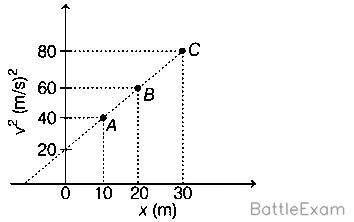
Q24JEE Main 2021NAT4MMotion in a Straight LineA particle is moving with constant acceleration a. Following graph shows v2v^{2}v2 versus x (displacement) plot. The acceleration of the particle is ........ m/s2{\text{m}} / {\text{s}}^{2}m/s2Show Answer🚀 Solve in Practice Mode📖 ExplanationAv2\text{Av}^2Av2 versus x graph is shown below. Using equation of motion, v2=u2+2axv^{2}=u^{2}+2 a xv2=u2+2ax ...(i) We know that, the equation of straight line. y = mx + c ...(ii) Comparing Eqs. (i) and (ii), Slope,m=2a=80−2030−0=6030=2m=2 a=\frac{80-20}{30-0}=\frac{60}{30}=2m=2a=30−080−20=3060=2 Now, the acceleration, a=22=1m/s2a=\frac{2}{2}=1 {\text{m}} / {\text{s}}^{2}a=22=1m/s2
Q25JEE Main 2021NAT4MWave OpticsIn a Young's double slit experiment, the slits are separated by 0.3mm0.3 {\text{mm}}0.3mm and the screen is 1.5m1.5 {\text{m}}1.5m away from the plane of slits. Distance between fourth bright fringes on both sides of central bright is 2.4cm2.4 {\text{cm}}2.4cm. The frequency of light used is.......... ×1014Hz\times 10^{14} {\text{Hz}}×1014Hz.Show Answer🚀 Solve in Practice Mode📖 ExplanationGiven, slit separation, d=0.3mm=0.3×10⁻³md=0.3 {\text{mm}}=0.3 \times 10^{-3} {\text{m}}d=0.3mm=0.3×10⁻³m Distance between slit and screen, D = 1.5 m Distance between 4th bright fringes =2Y4=2.4cm=2 \text{Y}_{4}=2.4 {\text{cm}}=2Y4=2.4cm Position of 4th fringe, Y4=2.42=1.2cm=1.2×10⁻²m\text{Y}_{4}=\frac{2.4}{2}=1.2 {\text{cm}}=1.2 \times 10^{-2} {\text{m}}Y4=22.4=1.2cm=1.2×10⁻²m Using equation, Yn=nλDd\text{Y}_{n}=\frac{n \lambda\text{D}}{d}Yn=dnλD For n = 4 1.2×10−2=4×λ×1.50.3×10−31.2 \times 10^{-2}=\frac{4 \times \lambda\times 1.5}{0.3 \times 10^{-3}}1.2×10−2=0.3×10⁻³⁴×λ×1.5 ∴ Wavelength, λ=6×10⁻⁷m\lambda=6 \times 10^{-7} {\text{m}}λ=6×10⁻⁷m Using c = lambdaf ⇒f=cλ=3×1086×10−7=5×10¹⁴Hz\Rightarrow \text{f}=\frac{c}{\lambda}=\frac{3 \times 10^{8}}{6 \times 10^{-7}}=5 \times 10^{14} {\text{Hz}}⇒f=λc=6×10−73×108=5×10¹⁴Hz Hence, the frequency of light is 5×10¹⁴Hz5 \times 10^{14} {\text{Hz}}5×10¹⁴Hz. So, correct answer is 5.
Q26JEE Main 2021NAT4MUnits and MeasurementsThe diameter of a spherical bob is measured using a Vernier callipers. 9 divisions of the main scale, in the vernier calipers, are equal to 10 divisions of vernier scale. One main scale division is 1mm1 {\text{mm}}1mm. The main scale reading is 10mm10 {\text{mm}}10mm and 8thdivision of vernier scale was found to coincide exactly with one of the main scale division. If the given vernier callipers has positive zero error of 0.04 cm, then the radius of the bob is .......... ×10−2cm\times 10^{-2} {\text{cm}}×10−2cm.Show Answer🚀 Solve in Practice Mode📖 ExplanationGiven, 9 divisions of main scale are equal to 10 divisions of Vernier scale. i.e. 9 MSD = 10 VSD ⇒VSD=910MSD\Rightarrow {\text{VSD}}=\frac{9}{10} {\text{MSD}}⇒VSD=109MSD ...(i) Size of 1 main scale division, 1 MSD = 1 mm Now, least count, LC = 1MSD − 1VSD ...(ii) Using Eqs. (i) and (ii), we get LC=1MSD−910MSD=110MSD=110mm{\text{LC}}=1 {\text{MSD}}-\frac{9}{10} {\text{MSD}}=\frac{1}{10} {\text{MSD}}=\frac{1}{10} {\text{mm}}LC=1MSD−109MSD=101MSD=101mm While measuring the diameter of bob. Main Scale Reading, MSR = 10 mm Vernier Scale Reading, VSR = 8 Zero error, e = 0.04 cm Now, diameter, d=[MSR+LC×VSR]−ed=[{\text{MSR}}+{\text{LC}} \times {\text{VSR}}]-{e}d=[MSR+LC×VSR]−e =(10mm+110×8mm)−0.04cm=(10 {\text{mm}}+\frac{1}{10} \times 8 {\text{mm}})-0.04 {\text{cm}}=(10mm+101×8mm)−0.04cm =(10.8)mm−0.04cm=(10.8) {\text{mm}}-0.04 {\text{cm}}=(10.8)mm−0.04cm =1.08cm−0.04cm=1.04cm=1.08 {\text{cm}}-0.04 {\text{cm}}=1.04 {\text{cm}}=1.08cm−0.04cm=1.04cm Radius, r=d2=1.042cm=0.52cm=52×10−2cmr=\frac{d}{2}=\frac{1.04}{2} {\text{cm}}=0.52 {\text{cm}}=52 \times 10^{-2} {\text{cm}}r=2d=21.04cm=0.52cm=52×10−2cm ∴ Correct answer is 52.
Q27JEE Main 2021NAT4MThermodynamicsA sample of gas with γ=1.5\gamma=1.5γ=1.5 is taken through an adiabatic process in which the volume is compressed from 1200cm31200 {\text{cm}}^{3}1200cm3 to 300cm3300 {\text{cm}}^{3}300cm3. If the initial pressure is 200kPa200 {\text{kPa}}200kPa. The absolute value of the work done by the gas in the process is ......... J.Show Answer🚀 Solve in Practice Mode📖 ExplanationGiven, sample of an ideal gas with (gamma = 1.5) is taken through adiabatic process, where Initial volume, V1=1200cm3=12×10−4m3\text{V}_{1}=1200 {\text{cm}}^{3}=12 \times 10^{-4} {\text{m}}^{3}V1=1200cm3=12×10−4m3 Final volume, V2=300cm3=3×10⁻⁴m\text{V}_{2}=300 {\text{cm}}^{3}=3 \times 10^{-4} {\text{m}}V2=300cm3=3×10⁻⁴m Initial pressure, p1=200kPa=2×10⁵×Pap_{1}=200 {\text{kPa}}=2 \times 10^{5} \times {\text{Pa}}p1=200kPa=2×10⁵×Pa Let final pressure = p2p_2p2 Using equation of adiabatic process, p1V1γ=ρ2V2γp_{1} \text{V}_{1}^{\gamma}=\rho _{2} \text{V}_{2}^{\gamma}p1V1γ=ρ2V2γ p2=p1(V1V2)γ=2×10⁵(12×10−43×10−4)1.5p_{2}=p_{1}(\frac{\text{V}_{1}}{\text{V}_{2}})^{\gamma}=2 \times 10^{5}(\frac{12 \times 10^{-4}}{3 \times 10^{-4}})^{1.5}p2=p1(V2V1)γ=2×10⁵(3×10−412×10−4)1.5 =16×105Pa=16 \times 10^{5} {\text{Pa}}=16×105Pa Work done in adiabatic process, W=p1V1−p2V2γ−1\text{W}=\frac{p_{1} \text{V}_{1}-p_{2} \text{V}_{2}}{\gamma-1}W=γ−1p1V1−p2V2 Substituting the values, we get W=2×105×12×10−4−16×105×3×10−41.5−1\text{W}=\frac{2 \times 10^{5} \times 12 \times 10^{-4}-16 \times 10^{5} \times 3 \times 10^{-4}}{1.5-1}W=1.5−12×105×12×10−4−16×105×3×10−4 =−480J=-480 {\text{J}}=−480J Hence, work done in adiabatic compression is 480 J.
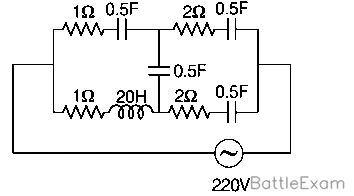
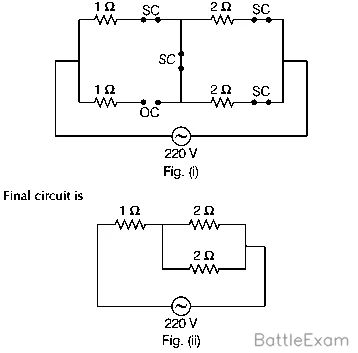
Q28JEE Main 2021NAT4MAlternating CurrentAt very high frequencies, the effective impedance of the given circuit will be ............Ω.Show Answer🚀 Solve in Practice Mode📖 ExplanationWe know that, at very high frequency capacitive reactance becomes negligible i.e. short circuit (SC) and inductive reactance becomes very large i.e. open circuit (OC). i.e. XC→0\text{X}_{\text{C}} \to 0XC→0 and XL→infty\text{X}_{\text{L}} \to \\infty XL→infty. Now, the circuit can be rearranged as shown in figure. Hence, equivalent resistance, Req=1+2×22+2=2Ω\text{R}_{{\text{eq}}}=1+\frac{2 \times 2}{2+2}=2 \OmegaReq=1+2+22×2=2Ω Thus, correct answer is 2.
Q29JEE Main 2021NAT4MRay Optics and Optical InstrumentsCross-section view of a prism is the equilateral triangle ABC in the figure. The minimum deviation is observed using this prism when the angle of incidence is equal to the prism angle. The time taken by light to travel from P (mid-point of BC) to A is.....×10−10s.....\times 10^{-10} {\text{s}}.....×10−10s. (Given, speed of light in vacuum =3×10⁸m/s=3 \times 10^{8} {\text{m}} / {\text{s}}=3×10⁸m/s and cos30°=32)\cos 30°=\frac{\sqrt{3}}{2})cos30°=23)Show Answer🚀 Solve in Practice Mode📖 ExplanationGiven, the base of a prism is equilateral triangle of side 10 cm as shown in figure. At minimum deviation, Angle of incident = Angle of prism i.e. i = A = 60° Angle of refraction, r=A2=60°2=30°r=\frac{\text{A}}{2}={60°}{2}=30°r=2A=60°2=30° Let µ be the refractive index. Then, by Snell's law of refraction, μ=sinisinr=sin60°sin30°=32/12=3\mu=\frac{\sin i}{\sin r}=\frac{\sin 60°}{\sin 30°}= {\frac{\sqrt{3}}{2}}/{\frac{1}{2}}=\sqrt{3}μ=sinrsini=sin30°sin60°=23/21=3 Now, in \Delta ABP, AP = AB cos 30° =1032=53cm=\frac{10 \sqrt{3}}{2}=5 \sqrt{3} {\text{cm}}=2103=53cm =53×10−2m=5 \sqrt{3} \times 10^{-2} {\text{m}}=53×10−2m i.e. optical distance travelled by light along AP, d=μ×AP=3×53×10−2=15×10−2md=\mu\times \text{AP}=\sqrt{3} \times 5 \sqrt{3} \times 10^{-2}=15 \times 10^{-2} {\text{m}}d=μ×AP=3×53×10−2=15×10−2m Now, the time taken by light (c=3×10⁸m/s)(c=3 \times 10^{8} {\text{m}} / {\text{s}})(c=3×10⁸m/s) to travel from P to A, t=dC=15×10−23×108s=5×10⁻¹⁰st=\frac{d}{\text{C}}=\frac{15 \times 10^{-2}}{3 \times 10^{8}} {\text{s}}=5 \times 10^{-10} {\text{s}}t=Cd=3×10815×10−2s=5×10⁻¹⁰s Thus, correct answer is 5.
Q30JEE Main 2021NAT4MCurrent ElectricityA resistor dissipates 192 J of energy in 1 s when a current of 4A4 {\text{A}}4A is passed through it. Now, when the current is doubled, the amount of thermal energy dissipated in 5 s is ........ J.Show Answer🚀 Solve in Practice Mode📖 ExplanationGiven that, initial current, I1=4A\text{I}_{1}=4 {\text{A}}I1=4A Final current, I2=2I1=8A\text{I}_{2}=2 \text{I}_{1}=8 {\text{A}}I2=2I1=8A Initial heat dissipated, H1=192J\text{H}_{1}=192 {\text{J}}H1=192J Initial time, t1=1st_{1}=1 {\text{s}}t1=1s Final time, t2=5st_{2}=5 {\text{s}}t2=5s Let final heat dissipated = H2\text{H}_2H2 By Joule's law of heating, H∝I2RT\text{H} \propto \text{I}^2\text{RT}H∝I2RT Since resistance remains same at initial and final condition, ∴H2H1=I22Rt2I12Rt1=I22t2I12t1\therefore \frac{\text{H}_{2}}{\text{H}_{1}}=\frac{\text{I}_{2}^{2} \text{R} t_{2}}{\text{I}_{1}^{2} \text{R} t_{1}}=\frac{\text{I}_{2}^{2} t_{2}}{\text{I}_{1}^{2} t_{1}}∴H1H2=I12Rt1I22Rt2=I12t1I22t2 Substituting the given values, we get H2192=(84)2×51\frac{\text{H}_{2}}{192}=(\frac{8}{4})^{2} \times \frac{5}{1}192H2=(48)2×15 ⇒H2\Rightarrow \text{H}_2⇒H2 = 3840 J
Q31JEE Main 2021MCQ4MHydrocarbonsArrange the following conformational isomers of n -butane in order of their increasing potential energyA. II < IIIB. I < IV < III < IIC. II < IV < III < ID. I < III < IV < IIShow Answer🚀 Solve in Practice Mode📖 ExplanationThe order of potential energy of above conformations is The fully eclipsed form is least stable due to repulsion between bulky (−CH3)(-{\text{CH}}_{3})(−CH3) methyl group at front and rear carbon atom. ∴ It has maximum potential energy. While the repulsion in anti form is minimum. ∴ It has minimum potential energy.
Q32JEE Main 2021MCQ4Md and f Block ElementsThe Eu2+{\text{Eu}}^{2+}Eu2+ ion is a strong reducing agent in spite of its ground state electronic configuration (outermost): [Atomic number of Eu=63{\text{Eu}}=63Eu=63]A. 4f76s24 f^{7} 6 s^{2}4f76s2B. 4f64 f^{6}4f6C. 4f74 f^{7}4f7D. 4f66s24 f^{6} 6 s^{2}4f66s2Show Answer🚀 Solve in Practice Mode📖 ExplanationThe electronic configuration of Eu and Eu2+{\text{Eu}}^{2+}Eu2+ ion is as follows : Eu(Z=63)=[Xe]4f76s2{\text{Eu}}(\text{Z}=63)=[{\text{Xe}}] 4 \text{f}^{7} 6 s^{2}Eu(Z=63)=[Xe]4f76s2 Eu2+(Z=63)=[Xe]4f7{\text{Eu}}^{2+}(\text{Z}=63)=[{\text{Xe}}] 4 \text{f}^{7}Eu2+(Z=63)=[Xe]4f7
Q33JEE Main 2021MCQ4MAldehydes, Ketones and Carboxylic AcidsThe structures of A and B formed in the following reaction are : [Ph=−C6H5][{\text{Ph}}=-{\text{C}}_{6} {\text{H}}_{5}][Ph=−C6H5]A.B.C.D.Show Answer🚀 Solve in Practice Mode📖 ExplanationThe given reaction is Friedel Craft acylation which involves addition of acyl group to an aromatic ring.The ketone in A is reduced to CH2I{\text{CH}}_{2} {\text{I}}CH2I by Clemmenson reduction to form B.
Q34JEE Main 2021MCQ4MRedox ReactionsIn which one of the following sets all species show disproportionation reactionA. ClO2−,F2,MnO42−{\text{ClO}}_{2}^{-}, {\text{F}}_{2}, {\text{MnO}}_{4}^{2-}ClO2−,F2,MnO42− and Cr2O72−{\text{Cr}}_{2} {\text{O}}_{7}^{2-}Cr2O72−B. Cr2O72−,MnO4−,ClO2−{\text{Cr}}_{2} {\text{O}}_{7}^{2-}, {\text{MnO}}_{4}^{-}, {\text{ClO}}_{2}^{-}Cr2O72−,MnO4−,ClO2−and Cl2{\text{Cl}}_{2}Cl2C. ClO2−,Cl2{\text{ClO}}_{2}^{-}, {\text{Cl}}_{2}ClO2−,Cl2 and Mn3+{\text{Mn}}^{3+}Mn3+D. ClO4−,MnO42−,ClO2−{\text{ClO}}_{4}^{-}, {\text{MnO}}_{4}^{2-}, {\text{ClO}}_{2}^{-}ClO4−,MnO42−,ClO2−and F2{\text{F}}_{2}F2Show Answer🚀 Solve in Practice Mode📖 ExplanationDisproportionation reactions are redox reaction in which a compound undergoes oxidation as well as reduction. The element of reacting species is in an intermediate oxidation state and simultaneously gets oxidised and reduced. 3 {{\text{Cl}}}^{+3} {\text{O}}_{2}^{-} \to {\text{Cl}}^{-}^{-1}+2 {\text{Cl}}^{+5} {\text{O}}_{3}^{-} {{\text{Cl}}_{2}}^0{}+{\text{OH}}^{-} \to {\text{Cl}}^{-}^{-1}+{\text{ClO}}_{3}^{-}^{+5}+{\text{H}}_{2} {\text{O}} 2Mn3++2H2O→Mn2++MnO2+4+4H+2 {\text{Mn}}^{3+}+2 {\text{H}}_{2} {\text{O}} \to {\text{Mn}}^{2+}+{\text{MnO}}_{2}^{+4}+4 {\text{H}}^{+}2Mn3++2H2O→Mn2++MnO2+4+4H+ But MnO4−{\text{MnO}}_{4}^{-}MnO4− does not get disproportonated. Hence, option (c) is the correct answer.
Q35JEE Main 2021MCQ4MSalt AnalysisMatch List-I with List-II. List-I (Parameter) List-II (Unit) A. Cell constant 1.Scm2mol−11.{\text{S}} {\text{cm}}^{2} {\text{mol}}^{-1}1.Scm2mol−1 B. Molar conductivity 2. Dimensionless C. Conductivity 3.m−13.\text{m}^{-1}3.m−1 D. Degree of dissociation of electrolyte 4.Ω−1m−14.\Omega^{-1} \text{m}^{-1}4.Ω−1m−1 Choose the most appropriate answer from the options given belowA. A-3 B-1 C-4 D-2B. A-3 B-1 C-2 D-4C. A-1 B-4 C-3 D-2D. A-2 B-1 C-3 D-4Show Answer🚀 Solve in Practice Mode📖 Explanation(A) Cell constant =IAm−1=\frac{\text{I}}{\text{A}} {\text{m}}^{-1}=AIm−1 (B) Molar conductivity (λm)=\κ×1000/molarityScm2mol−1(\lambda_{{\text{m}}})={\κ\times 1000}/{{ \text{molarity} }} {\text{Scm}}^{2} {\text{mol}}^{-1}(λm)=\κ×1000/molarityScm2mol−1 (C) Conductivity (\κ)=1ρ=1RAΩ−1m−1(\κ)=\frac{1}{\rho }=\frac{1}{\text{RA}} \Omega^{-1} {\text{m}}^{-1}(\κ)=ρ1=RA1Ω−1m−1 (D) Degree of dissociation of electrolyte = Number of moles dissociated out of one mole. It is a ratio. Hence, it is dimensionless. Thus, the correct match is A → 3, B → 1, C → 4, D → 2.
Q36JEE Main 2021MCQ4MAminesThe major products A and B formed in the following reaction sequence areA.B.C.D.Show Answer🚀 Solve in Practice Mode📖 ExplanationAniline reacts with acetic anhydride to give acetanilide. The acetic acid part is removed and N-acylation takes place by nucleophilic substitution reaction. Acetanilide is brominated with bromine/acetic acid. As −NHCOCH3-{\text{NHCOCH}}_{3}−NHCOCH3 is ortho/para directing group (since lone pair on N activates the ring). Bromine attached to para position is the major product losse.
Q37JEE Main 2021MCQ4MBiomoleculesWhich of the following is not an example of fibrous protein ?A. KeratinB. AlbuminC. CollagenD. MyosinShow Answer🚀 Solve in Practice Mode📖 ExplanationInsulin and albumin are globular protein. Fibrous proteins are generally composed of long and narrow strands and have structural role while globular proteins generally have more compact and rounded shape and involved in metabolic functions.
Q38JEE Main 2021MCQ4Mp Block ElementsThe depositions of X and Y on ground surfaces is referred to as wet and dry depositions, respectively. X and Y areA. X = Ammonium salts, Y=CO2\text{Y}={\text{CO}}_{2}Y=CO2B. X=SO2,Y=\text{X}={\text{SO}}_{2}, \text{Y}=X=SO2,Y= Ammonium saltsC. X = Ammonium salts, Y=SO2\text{Y}={\text{SO}}_{2}Y=SO2D. X=CO2,Y=SO2\text{X}={\text{CO}}_{2}, \text{Y}={\text{SO}}_{2}X=CO2,Y=SO2Show Answer🚀 Solve in Practice Mode📖 ExplanationOxides of nitrogen and sulphur are acidic and settle down on ground as dry deposition. Ammonium salts in rain drops result in wet deposition. ∴ X = Ammonium salts Y=SO2\text{Y} = \text{SO}_2Y=SO2
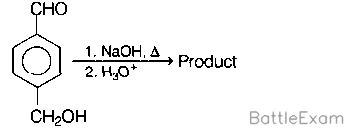
Q39JEE Main 2021MCQ4MAldehydes, Ketones and Carboxylic AcidsFor the reaction given below. The compound which is not formed as a product in the reaction is aA. compound with both alcohol and acid functional groupsB. monocarboxylic acidC. dicarboxylic acidD. diolShow Answer🚀 Solve in Practice Mode📖 ExplanationIn this reaction, one compound having alcohol and acid functional group and another one having two alcohol groups are formed. ∴ Dicarboxylic acid not formed as a product.
Q40JEE Main 2021MCQ4MCoordination CompoundsSpin only magnetic moment in BM of [Fe(CO)4(C2O4)]+[{\text{Fe}}({\text{CO}})_{4}({\text{C}}_{2} {\text{O}}_{4})]^{+}[Fe(CO)4(C2O4)]+isA. 5.92B. 0C. 1D. 1.73Show Answer🚀 Solve in Practice Mode📖 ExplanationIn [Fe(CO)4(C2O4)]+[{\text{Fe}}({\text{CO}})_{4}({\text{C}}_{2} {\text{O}}_{4})]^{+}[Fe(CO)4(C2O4)]+, oxidation number of Fe=+3{\text{Fe}}=+3Fe=+3 {x+4×0+(−2)=1}\{x+4 \times 0+(-2)=1\}{x+4×0+(−2)=1} ∴ x = 3 Fe3+=[Ar]3d54s0{\text{Fe}}^{3+}=[{\text{Ar}}] 3 d^{5} 4 s^{0}Fe3+=[Ar]3d54s0 CO is a strong field ligand, so pairing is favoured Fe3+=t2g2,2,1,eg0,0{\text{Fe}}^{3+}=t_{2 g}^{2,2,1}, {e}_{g}^{0,0}Fe3+=t2g2,2,1,eg0,0 Number of unpaired electron (n) = 1 μ=n(n+2)BM\mu=\sqrt{n(n+2)} {\text{BM}}μ=n(n+2)BM =1(1+2)=3=1.73BM=\sqrt{1(1+2)}=\sqrt{3}=1.73 {\text{BM}}=1(1+2)=3=1.73BM
Q41JEE Main 2021MCQ4MClassification of ElementsGiven below are two statements : One is labelled as Assertion (A) and the other is labelled as Reason (R). Assertion (A) Lithium salts are hydrated. Reason (R) Lithium has higher polarising power than other alkali metal group members. In the light of the above statements, choose the most appropriate answer from the options given belowA. Both (A) and (R) are true but (R) is not the correct explanation of (A).B. (A) is true but (R) is not trueC. (A) is false but (R) is true.D. Both (A) and (R) are true (R) is the correct explanation of (A).Show Answer🚀 Solve in Practice Mode📖 ExplanationBoth Assertion and Reason are true but Reason is not the correct explanation of Assertion. Lithium ions have smaller size as compared to other ions of the group. Hence, it has greater value of charge to radius ratio and polarising power. Among alkali metals ions, Li has smallest size due to which it can easily polarise water molecule. LiCl contains 2 water molecules per mole. However, due to bigger size of other alkali metals, they cannot easily polarise water molecules.
Q42JEE Main 2021MCQ4MChemical ThermodynamicsThe incorrect expression among the following isA. ΔGSystem/ΔSTotal=−T{\Delta\text{G}_{{\text{System} }}}/{\Delta\text{S}_{{\text{Total} }}}=-\text{T}ΔGSystem/ΔSTotal=−T (at constant p)B. lnk=ΔH°−TΔS°RT\ln k=\frac{\Delta\text{H}°-\text{T} \Delta\text{S}°}{\text{RT}}lnk=RTΔH°−TΔS°C. k=e−ΔG°RTk=e^{-\frac{\Delta\text{G}°}{\text{RT}}}k=e−RTΔG°D. For isothermal process, Wreversible=−nRTlnVf/Vi\text{W}_{{\text{reversible} }}=-\text{nRT} \ln {\text{V}_{\text{f}}}/{\text{V}_{i}}Wreversible=−nRTlnVf/ViShow Answer🚀 Solve in Practice Mode📖 ExplanationAll the expression of thermodynamics are correct except lnk=ΔH°−TΔS°RT\ln k=\frac{\Delta\text{H}°-\text{T} \Delta\text{S}°}{\text{RT}}lnk=RTΔH°−TΔS° As we know, ΔG=ΔH−TΔS°\Delta\text{G}=\Delta\text{H}-\text{T} \Delta\text{S}°ΔG=ΔH−TΔS° ...(i) Also ΔG=−RTlnK\Delta\text{G}=-\text{RT} \ln \text{K}ΔG=−RTlnK ...(ii) ∴ From (i) and (ii) −RTlnK=ΔH−TΔS°-\text{RT} \ln {\text{K}}=\Delta\text{H}-\text{T} \Delta\text{S}°−RTlnK=ΔH−TΔS° ∴lnK=−ΔHR+ΔS°R\therefore \ln \text{K}=\frac{-\Delta\text{H}}{\text{R} }+\frac{\Delta\text{S}°}{\text{R}}∴lnK=R−ΔH+RΔS° The corect expression is lnK=−ΔH°RT+ΔS°R=ΔH°−TΔS°RT\ln \text{K}=\frac{-\Delta\text{H}°}{\text{RT}}+\frac{\Delta\text{S}°}{\text{R}}=\frac{\Delta\text{H}°-\text{T} \Delta\text{S}°}{\text{RT}}lnK=RT−ΔH°+RΔS°=RTΔH°−TΔS°
Q43JEE Main 2021MCQ4MSome Basic Concepts of ChemistryWhich one of the following statements is incorrect?A. Atomic hydrogen is produced when H2{\text{H}}_{2}H2 molecules at a high temperature are irradiated with UV radiation.B. At around 2000K2000 {\text{K}}2000K, the dissociation of dihydrogen into its atoms is nearly 8.1%8.1 \%8.1%.C. Bond dissociation enthalpy of H2{\text{H}}_{2}H2 is highest among diatomic gaseous molecules which contain a single bonD. Dihydrogen is produced on reacting zinc with HCl{\text{HCl}}HCl as well as NaOH(aq){\text{NaOH}}(a q)NaOH(aq).Show Answer🚀 Solve in Practice Mode📖 ExplanationStatement (b) is incorrect. The corrected statement is : At around 2000 K, the dissociation of dihydrogen into its atoms is only ~ 0.081%. Bond dissociation enthalpy of H2\text{H}_2H2 molecule is highest due to very strong attraction between the atoms. Zn+2HCl→H2+ZnCl2{\text{Zn}}+2 {\text{HCl}} \to {\text{H}}_{2}+{\text{ZnCl}}_{2}Zn+2HCl→H2+ZnCl2 Zn+NaOH→Na2ZnO2+H2{\text{Zn}}+{\text{NaOH}} \to {\text{Na}}_{2} {\text{ZnO}}_{2}+{\text{H}}_{2}Zn+NaOH→Na2ZnO2+H2 H-H bond dissociate by increasing temperature and shining UV light.
Q44JEE Main 2021MCQ4MOrganic Chemistry - Some Basic PrinciplesWhich among the following is not a polyester ?A. NovolacB. PHBVC. DacronD. GlyptalShow Answer🚀 Solve in Practice Mode📖 ExplanationThe structure of the given polymers are as follows ∵ Novolac does not contain any ester group. ∴ It is not a polyester.
Q45JEE Main 2021MCQ4Mp Block ElementsWhich one of the following correctly represents the order of stability of oxides, X2O(X=halogen)\text{X}_2\text{O}(\text{X}=\text{halogen})X2O(X=halogen) ?A. Br > Cl > IB. Br > I > ClC. Cl > I > BrD. I > Cl > BrShow Answer🚀 Solve in Practice Mode📖 ExplanationIodine oxygen bond is stable due to greater polarity of bond. Stability of chlorine oxygen bond is due to multiple bond formation of oxygen with d-orbital of chlorine atom. Bromine lacks both these characteristics. So, the stability order of oxide is I > Cl > Br.
Q46JEE Main 2021MCQ4MSalt AnalysisMatch List-I with List-II. List-I(Metal ion) List-II(Group in qualitative analysis) A.Mn2+\text{A}.{\text{Mn}}^{2+}A.Mn2+ 1. Group-III B.As3+\text{B}.{\text{As}}^{3+}B.As3+ 2. Group - IIA C.Cu2+\text{C}.{\text{Cu}}^{2+}C.Cu2+ 3. Group - IV D.Al3+\text{D}.{\text{Al}}^{3+}D.Al3+ 4. Group - IIB Choose the most appropriate answer from the options given below.A. A-1 B-2 C-3 D-4B. A-3 B-4 C-2 D-1C. A-1 B-4 C-2 D-3D. A-4 B-2 C-3 D-1Show Answer🚀 Solve in Practice Mode📖 Explanation(A) IVth group cations −Zn2+,Mn2+,Ni2+,Co2+-{\text{Zn}}^{2+}, {\text{Mn}}^{2+}, {\text{Ni}}^{2+}, {\text{Co}}^{2+}−Zn2+,Mn2+,Ni2+,Co2+ (B) II B group cations −As3+,Sb3+,Sn2+-{\text{As}}^{3+}, {\text{Sb}}^{3+}, {\text{Sn}}^{2+}−As3+,Sb3+,Sn2+ (C) II A group cations −Hg2+,Pb2+,Bi3+,Cu2+,Cd2+-{\text{Hg}}^{2+}, {\text{Pb}}^{2+}, {\text{Bi}}^{3+}, {\text{Cu}}^{2+}, {\text{Cd}}^{2+}−Hg2+,Pb2+,Bi3+,Cu2+,Cd2+ (D) Illrd group cations −Al3+,Cr3+,Fe3+-{\text{Al}}^{3+}, {\text{Cr}}^{3+}, {\text{Fe}}^{3+}−Al3+,Cr3+,Fe3+ So, the correct match is (A)─(3),(B)─(4),(C)─(2),(D)─(1).({\text{A}})─(3),({\text{B}})─(4),({\text{C}})─(2),({\text{D}})─(1) .(A)─(3),(B)─(4),(C)─(2),(D)─(1).
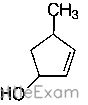
Q47JEE Main 2021MCQ4MHaloalkanes and HaloarenesThe major product of the following reaction isA.B.C.D.Show Answer🚀 Solve in Practice Mode📖 ExplanationIn the given reaction E2\text{E}_2E2 elimination reaction takes place in which two substituents are removed from a molecule to form double bond (alkene).
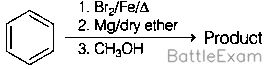
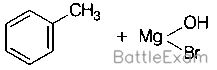
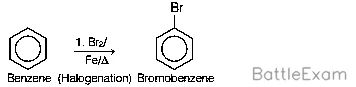
Q48JEE Main 2021MCQ4MHaloalkanes and HaloarenesFor the followingA.B.C.D.Show Answer🚀 Solve in Practice Mode📖 ExplanationBenzene on reaction with Br2\text{Br}_2Br2 /Fe give 5 bromo benzene as follows Bromobenzene on reaction with Mg / dry ether and CH3OH\text{CH}_3\text{OH}CH3OH gives benzene as follows
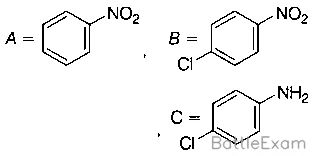
Q49JEE Main 2021MCQ4MAminesIdentify correct A, B and C in the reaction sequence given below.A.B.C.D.Show Answer🚀 Solve in Practice Mode📖 ExplanationBenzene undergoes nitration on reaction with conc. HNO3{\text{HNO}}_{3}HNO3 and conc. H2SO4{\text{H}}_{2} {\text{SO}}_{4}H2SO4.Nitrobenzene on reaction with Cl2/{\text{Cl}}_{2} /Cl2/ anhyd. AlCl3{\text{AlCl}}_{3}AlCl3 undergoes electrophilic substitution reaction to give 1 -chloro- 3 -nitro benzene, which on reaction with Fe/HCl{\text{Fe}} / {\text{HCl}}Fe/HCl gives chloroaniline.
Q50JEE Main 2021MCQ4MChemical Bonding and Molecular StructureThe number of S=O\text{S}=\text{O}S=O bonds present in sulphurous acid, peroxodisulphuric acid and pyrosulphuric acid, respectively areA. 2,3 and 4B. 1,4 and 3C. 2,4 and 3D. 1,4 and 4Show Answer🚀 Solve in Practice Mode📖 ExplanationThe structure of various acid of sulphur are as follows
Q51JEE Main 2021NAT4MSolutionsSection B : Numerical Type Questions CH4{\text{CH}}_{4}CH4 is adsorbed on 1g1 {\text{g}}1g charcoal at 0°C0° {\text{C}}0°C following the Freundlich adsorption isotherm. 10.0mL10.0 {\text{mL}}10.0mL of CH4{\text{CH}}_{4}CH4 is adsorbed at 100mm100 {\text{mm}}100mm of Hg, whereas 15.0mL15.0 {\text{mL}}15.0mL is adsorbed at 200mm200 {\text{mm}}200mm of Hg{\text{Hg}}Hg. The volume of CH4{\text{CH}}_{4}CH4adsorbed at 300mm300 {\text{mm}}300mm of Hg{\text{Hg}}Hg is 10xmL10^{x} {\text{mL}}10xmL. The value of x is ........×10−2........ \times 10^{-2}........×10−2. (Nearest integer) [Uselog102=0.3010,log103=0.4771][ \text{Use} \log _{10} 2=0.3010, \log _{10} 3=0.4771][Uselog102=0.3010,log103=0.4771]Show Answer🚀 Solve in Practice Mode📖 ExplanationAccording to Freundlich isotherm, xm=kp1n\frac{x}{m}=k p^{\frac{1}{n}}mx=kpn1 (Using, amount of adsorbate ∝ Volume of absorbate) 101=k×(100)1n\frac{10}{1}=k \times (100)^{\frac{1}{n}}110=k×(100)n1 ...(i) 151=k×(200)1n\frac{15}{1}=k \times (200)^{\frac{1}{n}}115=k×(200)n1 ...(ii) v1=k×(300)1n\frac{v}{1}=k \times (300)^{\frac{1}{n}}1v=k×(300)n1 ...(iii) Divide Eq. (ii) by (i) 1510=21x\frac{15}{10}=2^{\frac{1}{x}}1015=2x1 ⇒log(32)=1nlog2\Rightarrow \log (\frac{3}{2})=\frac{1}{n} \log 2⇒log(23)=n1log2 1n=log3−log2log2=0.4771−0.30100.3010\frac{1}{n}=\frac{\log 3-\log 2}{\log 2}=\frac{0.4771-0.3010}{0.3010}n1=log2log3−log2=0.30100.4771−0.3010 1n=0.585\frac{1}{n}=0.585n1=0.585 Divide Eq. (iii) by (i) v10=31n\frac{v}{10}=3^{\frac{1}{n}}10v=3n1 log(v10)=1nlog3\log (\frac{v}{10})=\frac{1}{n} \log 3log(10v)=n1log3 log(v10)=0.585×0.4771=0.2791\log (\frac{v}{10})=0.585 \times 0.4771=0.2791log(10v)=0.585×0.4771=0.2791 v10=100.2791\frac{v}{10}=10^{0.2791}10v=100.2791 ⇒v=10×100.2791\Rightarrow v=10 \times 10^{0.2791}⇒v=10×100.2791 =101.279=10x=10^{1.279}=10^{x}=101.279=10x x = 1.279 x=128×10−2x=128 \times 10^{-2}x=128×10−2
Q52JEE Main 2021NAT4MSolutions1.22g1.22 {\text{g}}1.22g of an organic acid is separately dissolved in 100g100 {\text{g}}100g of benzene (Kb=2.6Kkgmol−1)(\text{K}_{b}=2.6 {\text{K}} {\text{kg}} {\text{mol}}^{-1})(Kb=2.6Kkgmol−1) and 100g100 {\text{g}}100g of acetone (Kb=1.7Kkgmol−1)(\text{K}_{b}=1.7 {\text{Kkg}} {\text{mol}}^{-1})(Kb=1.7Kkgmol−1). The acid is known to dimerise in benzene but remain as a monomer in acetone.The boiling point of the solution in acetone increases by 0.17°C0.17° {\text{C}}0.17°C. The increase in boiling point of solution in benzene in °C° {\text{C}}°C is x×10−2x \times 10^{-2}x×10−2. The value of x is....... (Nearest integer) [Atomic mass: C=12.0,H=1.0,O=16.0{\text{C}}=12.0, {\text{H}}=1.0, {\text{O}}=16.0C=12.0,H=1.0,O=16.0]Show Answer🚀 Solve in Practice Mode📖 ExplanationWith benzene as solvent, RCOOH dimerises. 2RCOOH⇌(RCOOH)22\text{RCOOH} ⇌(\text{RCOOH})_{2}2RCOOH⇌(RCOOH)2 ∴i=12\therefore i=\frac{1}{2}∴i=21 ΔTb=i×Kb×m\Delta\text{T}_{b}=i \times \text{K}_{b} \times mΔTb=i×Kb×m where, ΔTb=\Delta\text{T}_{b}=ΔTb= boiling point elevation, Kb=K_{b}=Kb= ebulliscopic constant m = molality i = van't Hoff factor ΔTb=12×2.6×1.22/MW/100/1000\Delta\text{T}_{b}=\frac{1}{2} \times 2.6 \times {1.22 / \text{M}_{\text{W}}}/{100 / 1000}ΔTb=21×2.6×1.22/MW/100/1000 ...(i) With acetone as solvent, no dimerisation. ∴ i = 1 ΔTb=i×Kb×m\Delta\text{T}_{b}=i \times \text{K}_{b} \times mΔTb=i×Kb×m 0.17=1×1.7×1.22/MW/100/10000.17=1 \times 1.7 \times {1.22 / \text{M}_{\text{W}}}/{100 / 1000}0.17=1×1.7×1.22/MW/100/1000 ...(ii) Eq. (i) divide by Eq. (ii), ΔTb0.17=12×2.6×1.22/Mw100/1000/1×1.7×1.22/Mw100/1000\frac{\Delta\text{T}_{b}}{0.17}={\frac{1}{2} \times 2.6 \times \frac{1.22 / \text{M}_{w}}{100 / 1000}}/{1 \times 1.7 \times \frac{1.22 / \text{M}_{w}}{100 / 1000}}0.17ΔTb=21×2.6×100/10001.22/Mw/1×1.7×100/10001.22/Mw ⇒ΔTb=0.262=13×10−2\Rightarrow \Delta\text{T}_{b}=\frac{0.26}{2}=13 \times 10^{-2}⇒ΔTb=20.26=13×10−2 x = 13
Q53JEE Main 2021NAT4MStructure of AtomThe value of magnetic quantum number of the outermost electron of Zn+{\text{Zn}}^{+}Zn+ ion isShow Answer🚀 Solve in Practice Mode📖 ExplanationThe configuration of Zn+=1s22s22p63s23p63d104s1{\text{Zn}}^{+}=1 s^{2} 2 s^{2} 2 p^{6} 3 s^{2} 3 p^{6} 3 d^{10} 4 s^{1}Zn+=1s22s22p63s23p63d104s1 The outermost electron is in s-orbital. For s-orbital, azimuthal quantum number (l) = 0 Magnetic quantum number, m = − l to + l For l = 0, m = 0
Q54JEE Main 2021NAT4MSolid StateThe empirical formula for a compound with a cubic close packed arrangement of anions and with cations occupying all the octahedral sites in AxB\text{A}_{x} \text{B}AxB . The value of x is ....... (Integer answer)Show Answer🚀 Solve in Practice Mode📖 ExplanationlnAxB\ln \text{A}_{x} \text{B}lnAxB Effective number of B atom = 4 (in ccp) Effective number of A atom = 4 (octahedral void) So, formula of compound =A4B4= \text{A}_4\text{B}_4=A4B4 ⇒ AB ∴ x = 1
Q55JEE Main 2021NAT4MElectrochemistryIn the electrolytic refining of blister copper, the total number of main impurities from the following, removed as anode mud is ....... Pb, Sb, Se, Te, Ru, Ag, Au and PtShow Answer🚀 Solve in Practice Mode📖 ExplanationImpurities from blister copper deposited as anode mud contain antimony, selenium, tellurium, silver, gold and platinum. These are basically less active metals which cannot be oxidised at anode.
Q56JEE Main 2021NAT4MIonic EquilibriumThe pH of a solution obtained by mixing 50mL50 {\text{mL}}50mL of 1MHCl1 {\text{M}} {\text{HCl}}1MHCl and 30mL30 {\text{mL}}30mL of 1MNaOH1 {\text{M}} {\text{NaOH}}1MNaOH is x×10−4x \times 10^{-4}x×10−4. The value of x is ........ (Nearest integer) [log2.5=0.3979][\log 2.5=0.3979][log2.5=0.3979]Show Answer🚀 Solve in Practice Mode📖 ExplanationMilliequivalents of HCl(NaVa)=50×1=50{\text{HCl}}(\text{N}_{a} \text{V}_{a})=50 \times 1=50HCl(NaVa)=50×1=50 Milliequivalents of NaOH(NbVb)=30×1=30{\text{NaOH}}(\text{N}_{b} \text{V}_{b})=30 \times 1=30NaOH(NbVb)=30×1=30 Since, NaVa>NbNb\text{N}_{a} \text{V}_{a}>\text{N}_{b} \text{N}_{b}NaVa>NbNb and they neutralise each other [H+]=NaVa−NbVb/Va+Vb[{\text{H}}^{+}]={{\text{N}}_{a} \text{V}_{a}-{\text{N}}_{b} \text{V}_{b}}/{\text{V}_{a}+\text{V}_{b}}[H+]=NaVa−NbVb/Va+Vb =50−3080=0.25=2.5×10−1=\frac{50-30}{80}=0.25=2.5 \times 10^{-1}=8050−30=0.25=2.5×10⁻¹ {\text{pH}}=-\log \[{\text{H}}^{+}]$=-\log (2.5 \times 10^{-1}) =1-0.3979=0.6021 {\text{pH}} \times 10^{4}=0.6021 \times 10^{4}=6021$ ∴ x = 6021
Q57JEE Main 2021NAT4MChemical KineticsFor the reaction A → B, the rate constant k (in S−1{\text{S}}^{-1}S−1) is given by log10k=20.35−(2.47×10³)T\log _{10} k=20.35-\frac{(2.47 \times 10^{3})}{\text{T}}log10k=20.35−T(2.47×10³).The energy of activation in kJmol−1{\text{kJ}} {\text{mol}}^{-1}kJmol−1 is.......(Nearest integer) $[Given : R=8.314JK−1mol−1\text{R}=8.314 {\text{J}} {\text{K}}^{-1} {\text{mol}}^{-1}R=8.314JK−1mol−1]$Show Answer🚀 Solve in Practice Mode📖 ExplanationAccording to Arrhenius theory, logk=logA−Ea2.303RT\log k=\log \text{A} \frac{-\text{E}_{a}}{2.303 \text{RT}}logk=logA2.303RT−Ea ...(i) log10k=20.35−2.47×10³T\log _{10} k=20.35-\frac{2.47 \times 10^{3}}{\text{T}}log10k=20.35−T2.47×103 ...(ii) −2.47×10³T=−Ea2.303RT\frac{-2.47 \times 10^{3}}{\text{T}}=-\frac{\text{E}_{a}}{2.303 \text{RT}}T−2.47×103=−2.303RTEa Comparing Eqs. (i) and (ii), Ea=2.47×2.303×8.314\text{E}_{a}=2.47 \times 2.303 \times 8.314Ea=2.47×2.303×8.314 =47.29kJ/mol≃47kJ/mol=47.29 {\text{kJ}} / {\text{mol}} ≃ 47 {\text{kJ}} / {\text{mol}}=47.29kJ/mol≃47kJ/mol
Q58JEE Main 2021NAT4MSolutionsSodium oxide reacts with water to produce sodium hydroxide. 20.0g20.0 {\text{g}}20.0g of sodium oxide is dissolved in 500mL500 {\text{mL}}500mL of water. Neglecting the change in volume, the concentration of the resulting NaOH{\text{NaOH}}NaOH solution is ......×10−1M......\times 10^{-1} {\text{M}}......×10−1M.(Nearest integer) [Atomic mass: Na=23.0,O=16.0,H=1.0{\text{Na}}=23.0, {\text{O}}=16.0, {\text{H}}=1.0Na=23.0,O=16.0,H=1.0]Show Answer🚀 Solve in Practice Mode📖 ExplanationFor the reaction, {\text{Na}}_{2} {\text{O}}_{1 \text{mol}}_{20/62 \text{mol}}+{\text{H}}_{2} {\text{O}} \to 2 {\text{NaOH}}_{2\text{mol}}_{x\text{mol}} Moles of NaOH formed ⇒x=2062×2\Rightarrow x=\frac{20}{62} \times 2⇒x=6220×2 Concentration of NaOH=MolesofNaOH/Volumeofsolution(∈litre){\text{NaOH}}={{ \text{Moles} \text{of} } {\text{NaOH}}}/{{ \text{Volume} \text{of} \text{solution} (\in \text{litre}) }}NaOH=MolesofNaOH/Volumeofsolution(∈litre) =2062×25001000=1.29M=13×10−1M=\frac{\frac{20}{62} \times 2}{\frac{500}{1000}}=1.29 {\text{M}}=13 \times 10^{-1} {\text{M}}=10005006220×2=1.29M=13×10−1M
Q59JEE Main 2021NAT4MChemical Bonding and Molecular StructureAccording to molecular orbital theory, the number of unpaired electron(s) in O22−{\text{O}}_{2}^{2-}O22− is .......Show Answer🚀 Solve in Practice Mode📖 ExplanationIn O22−,18{\text{O}}_{2}^{2-}, 18O22−,18 electrons are present. Configuration is given by σ1s2,σ∗1s2,σ2s2,σ∗2s2,σ2pz2,π2px2\sigma1 s^{2}, \sigma* 1 s^{2}, \sigma2 s^{2}, \sigma* 2 s^{2}, \sigma2 p_{z}^{2}, \pi2 p_{x}^{2}σ1s2,σ∗1s2,σ2s2,σ∗2s2,σ2pz2,π2px2 =π2py2=\pi2 p_{y}^{2}=π2py2 π∗2px2=π∗2py2,σ∗2pz0\pi* 2 p_{x}^{2}=\pi* 2 p_{y}^{2}, \sigma* 2 p_{z}^{0}π∗2px2=π∗2py2,σ∗2pz0 So, number of unpaired electrons in O22−=0{\text{O}}_{2}^{2-}=0O22−=0.
Q60JEE Main 2021NAT4MPractical Organic ChemistryThe transformation occurring in Duma's method is given below C2H7N+(2x+y/2)CuO→xCO2+y/2H2O+z/2N2+(2x+y/2)Cu\text{C}_2\text{H}_7\text{N}+(2x+y/2)\text{CuO}\to x\text{CO}_2+y/2\text{H}_2\text{O}+z/2\text{N}_2+(2x+y/2)\text{Cu}C2H7N+(2x+y/2)CuO→xCO2+y/2H2O+z/2N2+(2x+y/2)CuThe value of y is ........ . (Integer answer)Show Answer🚀 Solve in Practice Mode📖 ExplanationFor the reaction C2H7N+(2x+y/2)CuO→xCO2+y/2H2O+z/2N2+(2x+y/2)Cu\text{C}_2\text{H}_7\text{N}+(2x+y/2)\text{CuO}\to x\text{CO}_2+y/2\text{H}_2\text{O}+z/2\text{N}_2+(2x+y/2)\text{Cu}C2H7N+(2x+y/2)CuO→xCO2+y/2H2O+z/2N2+(2x+y/2)CuOn reactant side number of H-atom = 7 On product side number of H-atom =y2×2=\frac{y}{2} \times 2=2y×2 7=y2×27=\frac{y}{2} \times 27=2y×2 ∴ y = 7
Q61JEE Main 2021MCQ4MMatrices and DeterminantsIf α+β+γ=2π\alpha+\beta+\gamma=2 \piα+β+γ=2π, then the system of equations x+(cosγ)y+(cosβ)z=0x+(\cos \gamma) y+(\cos \beta) z=0x+(cosγ)y+(cosβ)z=0 (cosγ)x+y+(cosα)z=0(\cos \gamma) x+y+(\cos \alpha) z=0(cosγ)x+y+(cosα)z=0 (cosβ)x+(cosα)y+z=0(\cos \beta) x+(\cos \alpha) y+z=0(cosβ)x+(cosα)y+z=0 has :A. no solutionB. infinitely many solutionC. exactly two solutionsD. a unique solutionShow Answer🚀 Solve in Practice Mode📖 ExplanationGiven α+β+γ=2π\alpha+\beta+\gamma=2 \piα+β+γ=2π Δ=∣1cosγcosβcosγ1cosαcosβcosα1∣\Delta=\begin{vmatrix}1 & \cos\gamma & \cos\beta \\ \cos\gamma & 1 & \cos\alpha \\ \cos\beta & \cos\alpha & 1\end{vmatrix}Δ=1cosγcosβcosγ1cosαcosβcosα1 =1−cos2α−cosγ(cosγ−cosαcosβ)+cosβ(cosαcosγ−cosβ)=1-\cos ^{2} \alpha-\cos \gamma(\cos \gamma-\cos \alpha\cos \beta)+\cos \beta(\cos \alpha\cos \gamma-\cos \beta)=1−cos2α−cosγ(cosγ−cosαcosβ)+cosβ(cosαcosγ−cosβ) =1−cos2α−cos2β−cos2γ+2cosαcosβcosγ=1-\cos ^{2} \alpha-\cos ^{2} \beta-\cos ^{2} \gamma+2 \cos \alpha\cos \beta\cos \gamma=1−cos2α−cos2β−cos2γ+2cosαcosβcosγ =−cos(α+β)cos(α−β)−cosγ(cos(2π−(α+β))−2cosαcosβ)=-\cos (\alpha+\beta) \cos (\alpha-\beta)-\cos \gamma (\cos (2 \pi-(\alpha+\beta))-2 \cos \alpha\cos \beta)=−cos(α+β)cos(α−β)−cosγ(cos(2π−(α+β))−2cosαcosβ) =−cos(2π−γ)cos(α−β)−cosγ(cos(α+β)−2cosαcosβ)=-\cos (2 \pi-\gamma) \cos (\alpha-\beta)-\cos \gamma (\cos (\alpha+\beta)-2 \cos \alpha\cos \beta)=−cos(2π−γ)cos(α−β)−cosγ(cos(α+β)−2cosαcosβ) =−cosγcos(α−β)+cosγ(cosαcosβ+sinαsinβ)=-\cos \gamma\cos (\alpha-\beta)+\cos \gamma(\cos \alpha\cos \beta+\sin \alpha\sin \beta)=−cosγcos(α−β)+cosγ(cosαcosβ+sinαsinβ) =−cosγcos(α−β)+cosγcos(α−β)=-\cos \gamma\cos (\alpha-\beta)+\cos \gamma\cos (\alpha-\beta)=−cosγcos(α−β)+cosγcos(α−β) = 0
Q62JEE Main 2021MCQ4MVector AlgebraLet a, b andc be three vectors mutually perpendicular to each other and have same magnitude. If a vector r satisfies. a × {(r - b) × a} + b × {(r - c) × b} + c × {(r - a) × c} = 0, then r is equel toA. 1/31/31/3 (a + b + c)B. 1/31/31/3 (2a + b - c)C. 1/21/21/2 (a + b + c)D. 1/21/21/2 (a + b + 2c)Show Answer🚀 Solve in Practice Mode📖 Explanationa × [(r - b) × a] + b × [(r - c) × b] + c × [(r - a) × c] = 0 ⇒ a . a (r - b) - (a . (r - b)) a + b . b (r - c) - (b . (r - c)) b + c . c (r - a) - (c . (r - a)) c = 0 ⇒∣a∣2(r−b)−(r.a)a+∣b∣2(r−c)−(r.b)b+∣c∣2(r−a)−(r.c)c=0\Rightarrow |{a}|^{2}({r}-{b})-({r} .{a}) {a}+|{b}|^{2}({r}-{c})-({r} .{b}) {b} +|{c}|^{2}({r}-{a})-({r} .{c}) {c}={0}⇒∣a∣2(r−b)−(r.a)a+∣b∣2(r−c)−(r.b)b+∣c∣2(r−a)−(r.c)c=0 [\because a b, c are mutually perpendicular; ∴ a . b = b . c = c . a = 0] ⇒∣a∣2[3r−(a+b+c)]−[(r.a)a+(r.b)b+(r.c)c]=0\Rightarrow |{a}|^{2}[3 {r}-({a}+{b}+{c})]-[({r} .{a}) {a}+({r} .{b}) {b}+({r} .{c}) {c}]={0}⇒∣a∣2[3r−(a+b+c)]−[(r.a)a+(r.b)b+(r.c)c]=0 [\because |a| = |b| = |c|] ⇒∣a∣2[3r−(a+b+c)−r]=0\Rightarrow |{a}|^{2}[3 {r}-({a}+{b}+{c})-r]=0⇒∣a∣2[3r−(a+b+c)−r]=0 ∴ 3r - (a + b + c) - r = 0 ⇒r=a+b+c2\Rightarrow {r}=\frac{{a}+{b}+{c}}{2}⇒r=2a+b+c
Q63JEE Main 2021MCQ4MInverse Trigonometric FunctionsThe domain of the function f(x)=sin−1(3x2+x−1(x−1)2)+cos−1(x−1x+1)f(x)=\sin ^{-1}(\frac{3 x^{2}+x-1}{(x-1)^{2}})+\cos ^{-1}(\frac{x-1}{x+1})f(x)=sin−1((x−1)23x2+x−1)+cos−1(x+1x−1) isA. [0,14][0, \frac{1}{4}][0,41]B. [−2,0]∪[14,12][-2,0] \cup[\frac{1}{4}, \frac{1}{2}][−2,0]∪[41,21]C. [14,12]∪{0}[\frac{1}{4}, \frac{1}{2}] \cup\{0\}[41,21]∪{0}D. [0,12][0, \frac{1}{2}][0,21]Show Answer🚀 Solve in Practice Mode📖 Explanationf(x)=sin−1(3x2+x−1(x−1)2)+cos−1(x−1x+1)\text{f}(x)=\sin ^{-1}(\frac{3 x^{2}+x-1}{(x-1)^{2}})+\cos ^{-1}(\frac{x-1}{x+1})f(x)=sin−1((x−1)23x2+x−1)+cos−1(x+1x−1) −1≤x−1x+1≤1-1 \le \frac{x-1}{x+1} \le 1−1≤x+1x−1≤1 ⇒−1−1≤x−1x+1−1≤1−1\Rightarrow -1-1 \le \frac{x-1}{x+1}-1 \le 1-1⇒−1−1≤x+1x−1−1≤1−1 ⇒−2≤−2x+1≤0\Rightarrow -2 \le \frac{-2}{x+1} \le 0⇒−2≤x+1−2≤0 ⇒0≤1x+1≤1\Rightarrow 0 \le \frac{1}{x+1} \le 1⇒0≤x+11≤1 ⇒1≤x+1<infty\Rightarrow 1 \le x+1< \\infty ⇒1≤x+1<infty ⇒0≤x<infty\Rightarrow 0 \le x < \\infty ⇒0≤x<infty \Rightarrow x \in\[0, \∞ )...(i)...(i)...(i)\text{and} -1 ≤ \frac{3 x^{2}+x-1}{(x-1)^{2}} ≤ 1 \Rightarrow -(x-1)^{2} ≤ 3 x^{2}+x-1 ≤ (x-1)^{2}, x ≠ 1 \Rightarrow -(x^{2}-2 x+1) ≤ 3 x^{2}+x-1 \text{and} 3 x^{2}+x-1 ≤ x^{2}-2 x+1 \Rightarrow 4 x^{2}-x ≥ 0 \text{and} 2 x^{2}+3 x-2 ≤ 0 \Rightarrow x(4 x-1) ≥ 0 \text{and} (x+2)(2 x-1) ≤ 0 \Rightarrow x \in(-\∞ , 0]$ \cup[\frac{1}{4}, \infty )andandandx \in[-2, \frac{1}{2}] \Rightarrow x \in(-2,0] \cup[\frac{1}{4}, \frac{1}{2}]...(ii)DomainoffinEq.(i)capEq.(ii)...(ii) Domain of f in Eq. (i) cap Eq. (ii)...(ii)DomainoffinEq.(i)capEq.(ii)\therefore x \in{0} \cup[\frac{1}{4}, \frac{1}{2}]$
Q64JEE Main 2021MCQ4MProbabilityLet S={1,2,3,4,5,6}\text{S}=\{1,2,3,4,5,6\}S={1,2,3,4,5,6}. Then, the probability that a randomly chosen onto function g from S to S satisfies g(3)=2g(1)g(3)=2 g(1)g(3)=2g(1) isA. 110\frac{1}{10}101B. 115\frac{1}{15}151C. 15\frac{1}{5}51D. 130\frac{1}{30}301Show Answer🚀 Solve in Practice Mode📖 Explanation∵ g : S → S where S={1,2,3,4,5,6}\text{S}=\{1,2,3,4,5,6\}S={1,2,3,4,5,6} Total number of onto function = 6 ! Given condition g(3)=2g(1)g(3)=2 g(1)g(3)=2g(1) If g(1)=1g(1)=1g(1)=1, then g(3)=2g(3)=2g(3)=2 g(1)=2g(1)=2g(1)=2, then g(3)=4g(3)=4g(3)=4 and g(1)=3g(1)=3g(1)=3, then g(3)=6g(3)=6g(3)=6 There are only 3 possible cases Number onto functions = 3 × 4 ! Required probability =3×4!6!=110=\frac{3 \times 4 !}{6 !}=\frac{1}{10}=6!3×4!=101
Q65JEE Main 2021MCQ4MFunctionsLet f:N→N\text{f}: {\text{N}} \to {\text{N}}f:N→N be a function such that f(m+n)=f(m)+f(n)\text{f}(m+n)=\text{f}(m)+\text{f}(n)f(m+n)=f(m)+f(n) for every m,n∈Nm, n \in{\text{N}}m,n∈N. If f(6)=18\text{f}(6)=18f(6)=18, then f(2).f(3)\text{f}(2) .\text{f}(3)f(2).f(3) is equal toA. 6B. 54C. 18D. 36Show Answer🚀 Solve in Practice Mode📖 Explanationf(m+n)=f(m)+f(n),m,n∈N\text{f}(m+n)=\text{f}(m)+\text{f}(n), m, n \in\text{N}f(m+n)=f(m)+f(n),m,n∈N ∴f(3+3)=f(3)+f(3)\therefore \text{f}(3+3)=\text{f}(3)+\text{f}(3)∴f(3+3)=f(3)+f(3) ⇒f(6)=2f(3)=18\Rightarrow \text{f}(6)=2 \text{f}(3)=18⇒f(6)=2f(3)=18 ⇒f(3)=9\Rightarrow \text{f}(3)=9⇒f(3)=9 [∵f(6)=18][\because \text{f}(6)=18][∵f(6)=18] Also f(3)=f(2+1)=f(2)+f(1)\text{f}(3)=\text{f}(2+1)=\text{f}(2)+\text{f}(1)f(3)=f(2+1)=f(2)+f(1) =f(1+1)+f(1)=\text{f}(1+1)+\text{f}(1)=f(1+1)+f(1) f(3)=f(1)+f(1)+f(1)\text{f}(3)=\text{f}(1)+\text{f}(1)+\text{f}(1)f(3)=f(1)+f(1)+f(1) ⇒9=3f(1)\Rightarrow 9=3 \text{f}(1)⇒9=3f(1) ⇒f(1)=3\Rightarrow \text{f}(1)=3⇒f(1)=3 ∴f(2)=f(1+1)=f(1)+f(1)=3+3=6\therefore \text{f}(2)=\text{f}(1+1)=\text{f}(1)+\text{f}(1)=3+3=6∴f(2)=f(1+1)=f(1)+f(1)=3+3=6 Hence, f(2).f(3)=6.9=54\text{f}(2) .\text{f}(3)=6 .9=54f(2).f(3)=6.9=54
Q66JEE Main 2021MCQ4MThree Dimensional GeometryThe distance of the point (−1,2,−2)(-1,2,-2)(−1,2,−2) from the line of intersection of the planes 2x+3y+2z=02 x+3 y+2 z=02x+3y+2z=0 and x−2y+z=0x-2 y+z=0x−2y+z=0 isA. 12\frac{1}{\sqrt{2}}21B. 52\frac{5}{2}25C. 422\frac{\sqrt{42}}{2}242D. 342\frac{\sqrt{34}}{2}234Show Answer🚀 Solve in Practice Mode📖 ExplanationLet L be the line of intersection of 2x+3y+2z=02 x+3 y+2 z=02x+3y+2z=0 and x−2y+z=0x-2 y+z=0x−2y+z=0 If z=0z=0z=0, then x=y=0x=y=0x=y=0 The line L is parallel to r1×r2{r}_{1} \times {r}_{2}r1×r2, where r1=2i^+3j^+2k^{r}_{1}=2 \hat{i}+3 \hat{j}+2 \hat{k}r1=2i^+3j^+2k^ and r2=i^−2j^+k^{r}_{2}=\hat{i}-2 \hat{j}+\hat{k}r2=i^−2j^+k^ ∣i^j^k^2321−21∣=7i^−7k^\begin{vmatrix}\hat{i} & \hat{j} & \hat{k} \\ 2 & 3 & 2 \\ 1 & -2 & 1\end{vmatrix}=7\hat{i}-7\hat{k}i^21j^3−2k^21=7i^−7k^ DR's of is (1,0,−1)(1,0,-1)(1,0,−1) and equation of L is x1=y0=z−1=λ\frac{x}{1}=\frac{y}{0}=\frac{z}{-1}=\lambda1x=0y=−1z=λ Let PQ be the distance from the point P(−1,2,−2)\text{P}(-1,2,-2)P(−1,2,−2) to the line L. DRs of PQ=λ+1,−2,2−λ{\text{PQ}}=\lambda+1,-2,2-\lambdaPQ=λ+1,−2,2−λ ∴ PQ ⊥ r ⇒(λ+1)(1)+(−2)(0)+(2−λ)(−1)=0\Rightarrow (\lambda+1)(1)+(-2)(0)+(2-\lambda)(-1)=0⇒(λ+1)(1)+(−2)(0)+(2−λ)(−1)=0 ⇒λ+1−2+λ=0\Rightarrow \lambda+1-2+\lambda=0⇒λ+1−2+λ=0 ⇒λ=1/2\Rightarrow \lambda = 1/2⇒λ=1/2 Coordinate of Q is (12,0,−12)(\frac{1}{2}, 0, \frac{-1}{2})(21,0,2−1) ⇒PQ=(−1−12)2+(2−0)2+(−2+12)2\Rightarrow \text{PQ}=\sqrt{(-1-\frac{1}{2})^{2}+(2-0)^{2}+(-2+\frac{1}{2})^{2}}⇒PQ=(−1−21)2+(2−0)2+(−2+21)2 =94+4+94=342=\sqrt{\frac{9}{4}+4+\frac{9}{4}}=\frac{\sqrt{34}}{2}=49+4+49=234
Q67JEE Main 2021MCQ4MSets and RelationsNegation of the statement (p∨q)⇒(q∨r)(p \vee q) \Rightarrow (q \vee r)(p∨q)⇒(q∨r) isA. p∧ q∧ rp \wedge ~ q \wedge ~ rp∧ q∧ rB. pwedgeq∧ r~ p \\wedge q \wedge ~ r pwedgeq∧ rC. p∧q∧r~ p \wedge q \wedge r p∧q∧rD. p∧q∧rp \wedge q \wedge rp∧q∧rShow Answer🚀 Solve in Practice Mode📖 ExplanationNegative of (p∨q)⇒(q∨r)(p \vee q) \Rightarrow (q \vee r)(p∨q)⇒(q∨r) = ((p∨r)⇒(q∨r))= ~ ((p \vee r) \Rightarrow (q \vee r))= ((p∨r)⇒(q∨r)) =(pveer)wedge((˜qveer))=(p \\vee r) \\wedge (\~(q \\vee r))=(pveer)wedge((˜qveer)) =(pveer)wedge(q˜wedger˜)=(p \\vee r) \\wedge (\~q \\wedge \~r)=(pveer)wedge(q˜wedger˜) =(pveer)wedger˜)wedgeq˜=(p \\vee r) \\wedge \~r) \\wedge \~q=(pveer)wedger˜)wedgeq˜ =((pwedger˜))vee(rwedger˜)wedgeq˜=((p \\wedge \~r)) \\vee (r \\wedge \~r) \\wedge \~q=((pwedger˜))vee(rwedger˜)wedgeq˜ =(pwedger˜)wedgef)wedgeq˜=(p \\wedge \~r) \\wedge \text{f}) \\wedge \~q=(pwedger˜)wedgef)wedgeq˜ =(pwedger˜)wedge(q˜)=(p \\wedge \~r) \\wedge (\~q)=(pwedger˜)wedge(q˜) =pwedgeq˜wedger˜=p \\wedge \~q \\wedge \~r=pwedgeq˜wedger˜
Q68JEE Main 2021MCQ4MLimits, Continuity and DifferentiabilityIf α=limx→π/4tan3x−tanxcos(x+π4)\alpha=\lim_{x\to \pi/4} \frac{\tan ^{3} x-\tan x}{\cos (x+\frac{\pi}{4})}α=limx→π/4cos(x+4π)tan3x−tanx andβ=limx→0(cosx)cotx\beta=\lim_{x\to 0}(\cos x)^{\cot x}β=limx→0(cosx)cotx are the roots of the equation, ax2+bx−4=0a x^{2}+b x-4=0ax2+bx−4=0, then the ordered pair (a, b) isA. (1,−3)(1,-3)(1,−3)B. (−1,3)(-1,3)(−1,3)C. (−1,−3)(-1,-3)(−1,−3)D. (1,3)(1,3)(1,3)Show Answer🚀 Solve in Practice Mode📖 Explanationα=limx→π/4tan3x−tanxcos(x+π4)\alpha=\lim_{x\to \pi/4} \frac{\tan ^{3} x-\tan x}{\cos (x+\frac{\pi}{4})}α=limx→π/4cos(x+4π)tan3x−tanx =limx→π/4tanx(tanx+1)(tanx−1)cos(x+π4)=\lim_{x\to \pi/4} \frac{\tan x(\tan x+1)(\tan x-1)}{\cos (x+\frac{\pi}{4})}=limx→π/4cos(x+4π)tanx(tanx+1)(tanx−1) =limx→π/4sinxcosx.(sinx−cosxcosx)(sinx+cosxcosx)/12(cosx−sinx)=\lim_{x\to \pi/4} {\frac{\sin x}{\cos x} .(\frac{\sin x-\cos x}{\cos x})(\frac{\sin x+\cos x}{\cos x})}/{\frac{1}{\sqrt{2}}(\cos x-\sin x)}=limx→π/4cosxsinx.(cosxsinx−cosx)(cosxsinx+cosx)/21(cosx−sinx) =limx→π/4−2sinx(sinx+cosx)cos3x=\lim_{x\to \pi/4} \frac{-\sqrt{2} \sin x(\sin x+\cos x)}{\cos ^{3} x}=limx→π/4cos3x−2sinx(sinx+cosx) =−2×12×2/122=−4={-\sqrt{2} \times \frac{1}{\sqrt{2}} \times \sqrt{2}}/{\frac{1}{2 \sqrt{2}}}=-4=−2×21×2/221=−4 andβ=limx→0(cosx)cotx\beta=\lim_{x\to 0}(\cos x)^{\cot x}β=limx→0(cosx)cotx =elimx→0cosx−1tanx=elimx→0−sinxsec2x=e0=1=e^{\lim_{x\to 0} {\cos x-1}{\tan x}}=e^{\lim_{x\to 0}-\frac{\sin x}{\sec ^{2} x}}=e^{0}=1=elimx→0cosx−1tanx=elimx→0−sec2xsinx=e0=1 Equation whose roots are alpha and beta, is x2+3x−4=0x^{2}+3 x-4=0x2+3x−4=0 ∴ a = 1, b = 3
Q69JEE Main 2021MCQ4MEllipseThe locus of mid-points of the line segments joining (−3,−5)(-3,-5)(−3,−5) and the points on the ellipse x24+y29=1\frac{x^{2}}{4}+\frac{y^{2}}{9}=14x2+9y2=1 isA. 9x2+4y2+18x+8y+145=09 x^{2}+4 y^{2}+18 x+8 y+145=09x2+4y2+18x+8y+145=0B. 36x2+16y2+90x+56y+145=036 x^{2}+16 y^{2}+90 x+56 y+145=036x2+16y2+90x+56y+145=0C. 36x2+16y2+108x+80y+145=036 x^{2}+16 y^{2}+108 x+80 y+145=036x2+16y2+108x+80y+145=0D. 36x2+16y2+72x+32y+145=036 x^{2}+16 y^{2}+72 x+32 y+145=036x2+16y2+72x+32y+145=0Show Answer🚀 Solve in Practice Mode📖 ExplanationLet (2sinθ,3cosθ)(2 \sin \theta, 3 \cos \theta)(2sinθ,3cosθ) be the point on ellipse x24+y29=1\frac{x^{2}}{4}+ \frac{y^{2}}{9}=14x2+9y2=1 and let mid -point of the line segments joining (−3,−5)(-3,-5)(−3,−5) and (2sinθ,3cosθ)(2 \sin \theta, 3 \cos \theta)(2sinθ,3cosθ) will be (h,k)(h, k)(h,k). Then, 2sinθ−32=h,3cosθ−52=k\frac{2 \sin \theta-3}{2}=h, \frac{3 \cos \theta-5}{2}=k22sinθ−3=h,23cosθ−5=k ⇒sinθ=2h+32,cosθ=2k+53\Rightarrow \sin \theta=\frac{2 h+3}{2}, \cos \theta=\frac{2 k+5}{3}⇒sinθ=22h+3,cosθ=32k+5 ∴sin2θ+cos2θ=1\therefore \sin ^{2} \theta+\cos ^{2} \theta=1∴sin2θ+cos2θ=1 ⇒(2h+32)2+(2k+53)2=1\Rightarrow (\frac{2 h+3}{2})^{2}+(\frac{2 k+5}{3})^{2}=1⇒(22h+3)2+(32k+5)2=1 ⇒(4h2+9+12h)4+(4k2+25+20k)9=1\Rightarrow \frac{(4 h^{2}+9+12 h)}{4}+\frac{(4 k^{2}+25+20 k)}{9}=1⇒4(4h2+9+12h)+9(4k2+25+20k)=1 36h2+16k2+108h+80k+145=036 h^{2}+16 k^{2}+108 h+80 k+145=036h2+16k2+108h+80k+145=0 LOCUS of (h,k)(h, k)(h,k) 36x2+16y2+108x+80y+145=036 x^{2}+16 y^{2}+108 x+80 y+145=036x2+16y2+108x+80y+145=0
Q70JEE Main 2021MCQ4MDifferential EquationsIf dydx=2xy+2y.2x2x+2x+yloge2,y(0)=0\frac{d y}{d x}=\frac{2^{x} y+2^{y} .2^{x}}{2^{x}+2^{x+y} \log _{e} 2}, y(0)=0dxdy=2x+2x+yloge22xy+2y.2x,y(0)=0, then for y=1y=1y=1 , the value of x lies in the intervalA. (1,2)(1,2)(1,2)B. (12,1](\frac{1}{2}, 1](21,1]C. (2,3)(2,3)(2,3)D. (0,12](0, \frac{1}{2}](0,21]Show Answer🚀 Solve in Practice Mode📖 Explanationdydx=2xy+2y.2x2x+2x+yloge2,y(0)=0\frac{d y}{d x}=\frac{2^{x} y+2^{y} .2^{x}}{2^{x}+2^{x+y} \log _{e} 2}, y(0)=0dxdy=2x+2x+yloge22xy+2y.2x,y(0)=0 ⇒dydx=y+2y1+2yloge2\Rightarrow \frac{d y}{d x}=\frac{y+2^{y}}{1+2^{y} \log _{e} 2}⇒dxdy=1+2yloge2y+2y ⇒∫1+2y.loge2dyy+2y=\intdx\Rightarrow \int\frac{1+2^{y} .\log _{e} 2 d y}{y+2^{y}}=\intd x⇒∫y+2y1+2y.loge2dy=\intdx ⇒log∣y+2y∣=x+C\Rightarrow \log |y+2^{y}|=x+\text{C}⇒log∣y+2y∣=x+C ∵y(0)=0\because y(0)=0∵y(0)=0 \Rightarrow C = 0 ∴ln∣y+2y∣=x\therefore \ln |y+2^{y}|=x∴ln∣y+2y∣=x For y = 1 x=ln∣1+2∣=ln3x=\ln |1+2|=\ln 3x=ln∣1+2∣=ln3 ⇒ x in(1, 2)
Q71JEE Main 2021MCQ4MApplication of DerivativesAn angle of intersection of the curves, x2a2+y2b2=1\frac{x^{2}}{a^{2}}+\frac{y^{2}}{b^{2}}=1a2x2+b2y2=1 and x2+y2=ab,a>bx^{2}+y^{2}=a b, a > bx2+y2=ab,a>b, isA. tan−1(a+bab)\tan ^{-1}(\frac{a+b}{\sqrt{a b}})tan−1(aba+b)B. tan−1(a−b2ab)\tan ^{-1}(\frac{a-b}{2 \sqrt{a b}})tan−1(2aba−b)C. tan−1(a−bab)\tan ^{-1}(\frac{a-b}{\sqrt{a b}})tan−1(aba−b)D. tan−1(2ab)\tan ^{-1}(2 \sqrt{a b})tan−1(2ab)Show Answer🚀 Solve in Practice Mode📖 ExplanationGiven curves x2a2+y2b2=1\frac{x^{2}}{a^{2}}+\frac{y^{2}}{b^{2}}=1a2x2+b2y2=1 ...(i) and x2+y2=abx^{2}+y^{2}=a bx2+y2=ab ...(ii) From Eqs. (ii) y2=ab−x2y^{2}=a b-x^{2}y2=ab−x2 From Eq. (i), b2x2+a2(ab−x2)=a2b2b^{2} x^{2}+a^{2}(a b-x^{2})=a^{2} b^{2}b2x2+a2(ab−x2)=a2b2 (b2−a2)x2=a2b(b−a)(b^{2}-a^{2}) x^{2}=a^{2} b(b-a)(b2−a2)x2=a2b(b−a) ⇒x2=a2ba+b\Rightarrow x^{2}=\frac{a^{2} b}{a+b}⇒x2=a+ba2b y2=ab−a2ba+b=ab2a+by^{2}=a b-\frac{a^{2} b}{a+b}=\frac{a b^{2}}{a+b}y2=ab−a+ba2b=a+bab2 Point of intersection (a2ba+b,ab2a+b)(\sqrt{\frac{a^{2} b}{a+b}}, \sqrt{\frac{a b^{2}}{a+b}})(a+ba2b,a+bab2) Now, differentiating Eq. (i) w.r.t. x, we have dydx=−b2xa2y=m1\frac{d y}{d x}=-\frac{b^{2} x}{a^{2} y}=m_{1}dxdy=−a2yb2x=m1 (Let) and differentiating Eq. (ii) w.r.t. x, dydx=−xy=m2\frac{d y}{d x}=\frac{-x}{y}=m_{2}dxdy=y−x=m2 (Let) Let angle be theta, Then, tanθ=∣m1−m21+m1m2∣=∣−b2xa2y+xy/1+b2x2a2y2∣\tan \theta=|\frac{m_{1}-m_{2}}{1+m_{1} m_{2}}|=|{\frac{-b^{2} x}{a^{2} y}+{x}{y}}/{1+\frac{b^{2} x^{2}}{a^{2} y^{2}}}|tanθ=∣1+m1m2m1−m2∣=∣a2y−b2x+xy/1+a2y2b2x2∣ =∣xy(a2−b2)a2b2∣=∣a3b3(a+b)2.(a2−b2)a2b2∣=|\frac{x y(a^{2}-b^{2})}{a^{2} b^{2}}|=|\sqrt{\frac{a^{3} b^{3}}{(a+b)^{2}}} .\frac{(a^{2}-b^{2})}{a^{2} b^{2}}|=∣a2b2xy(a2−b2)∣=∣(a+b)2a3b3.a2b2(a2−b2)∣ =∣a−bab∣=|\frac{a-b}{\sqrt{a b}}|=∣aba−b∣ ⇒θ=tan−1(a−bab)\Rightarrow \theta=\tan ^{-1}(\frac{a-b}{\sqrt{a b}})⇒θ=tan−1(aba−b)
Q72JEE Main 2021MCQ4MDifferential EquationsIf y \frac{d y}{d x}=x\[\frac{y^{2}}{x^{2}}+{\phi(\frac{y^{2}}{x^{2}})}/{\phi'(\frac{y^{2}}{x^{2}})}]$, x > 0, \phi > 0,and, and ,andy(1)=-1,then, then,then\phi(\frac{y^{2}}{4})$ is equal toA. 4 phi (2)B. 4 phi (1)C. 2 phi (1)D. phi (1)Show Answer🚀 Solve in Practice Mode📖 ExplanationGiven, ydydx=x[y2x2+ϕ(y2x2)/ϕ′(y2x2)]y \frac{d y}{d x}=x[\frac{y^{2}}{x^{2}}+{\phi(\frac{y^{2}}{x^{2}})}/{\phi'(\frac{y^{2}}{x^{2}})}]ydxdy=x[x2y2+ϕ(x2y2)/ϕ′(x2y2)] ...(i) Let t=yxt=\frac{y}{x}t=xy ⇒y=xt\Rightarrow y=x t⇒y=xt ⇒dydx=t+xdtdx\Rightarrow \frac{d y}{d x}=t+x \frac{d t}{d x}⇒dxdy=t+xdxdt ∴ Eq. (i) becomes t(t+xdtdx)=(t2+ϕ(t2)ϕ′(t2))t(t+x \frac{d t}{d x})=(t^{2}+\frac{\phi(t^{2})}{\phi'(t^{2})})t(t+xdxdt)=(t2+ϕ′(t2)ϕ(t2)) ⇒xtdtdx=ϕ(t2)ϕ′(t2)\Rightarrow x t \frac{d t}{d x}=\frac{\phi(t^{2})}{\phi'(t^{2})}⇒xtdxdt=ϕ′(t2)ϕ(t2) ⇒tϕ′(t2)ϕ(t2)dt=dxx\Rightarrow \frac{t \phi'(t^{2})}{\phi(t^{2})} d t=\frac{d x}{x}⇒ϕ(t2)tϕ′(t2)dt=xdx Integrating both sides ∫tϕ′(t2)\phit2)dt=∫dxx\int\frac{t \phi'(t^{2})}{\phit^{2)}} {d t}=\int\frac{d x}{x}∫\phit2)tϕ′(t2)dt=∫xdx Let ϕ(t2)=u\phi(t^{2})=uϕ(t2)=u ⇒tϕ′(t2)dt=du2\Rightarrow t \phi'(t^{2}) d t=\frac{d u}{2}⇒tϕ′(t2)dt=2du ∴12∫duu=∫dxx\therefore \frac{1}{2} \int\frac{d u}{u}=\int\frac{d x}{x}∴21∫udu=∫xdx ⇒12lnu=lnx+C\Rightarrow \frac{1}{2} \ln u=\ln x+\text{C}⇒21lnu=lnx+C ⇒12lnϕ(t2)=lnx+C\Rightarrow \frac{1}{2} \ln \phi(t^{2})=\ln x+\text{C}⇒21lnϕ(t2)=lnx+C ⇒12ln(ϕ(y2x2))=lnx+C\Rightarrow \frac{1}{2} \ln (\phi(\frac{y^{2}}{x^{2}}))=\text{lnx}+\text{C}⇒21ln(ϕ(x2y2))=lnx+C If x=1,y=−1x=1, y=-1x=1,y=−1, then C=12ln(ϕ(1))\text{C}=\frac{1}{2} \ln (\phi(1))C=21ln(ϕ(1)) ∴12ln(ϕ(y2x2))=lnx+2ln(ϕ(1))\therefore \frac{1}{2} \ln (\phi(\frac{y^{2}}{x^{2}}))=\ln x+2 \ln (\phi(1))∴21ln(ϕ(x2y2))=lnx+2ln(ϕ(1)) If x=2x=2x=2, then ln(ϕ(y24))=ln4+ln[ϕ(1)]\ln (\phi(\frac{y^{2}}{4}))=\ln 4+\ln [\phi(1)]ln(ϕ(4y2))=ln4+ln[ϕ(1)] Or ϕ(y24)=4ϕ(1)\phi(\frac{y^{2}}{4})=4 \phi(1)ϕ(4y2)=4ϕ(1)
Q73JEE Main 2021MCQ4MLogarithmsThe sum of the roots of the equation x+1−2log2(3+2x)+2log4(10−2−x)=0x+1-2 \log _{2}(3+2^{x})+2 \log _{4}(10-2^{-x})=0x+1−2log2(3+2x)+2log4(10−2−x)=0 isA. log214\log _{2} 14log214B. log211\log _{2} 11log211C. log212\log _{2} 12log212D. log213\log _{2} 13log213Show Answer🚀 Solve in Practice Mode📖 Explanationx+1−2log2(3+2x)+2log4(10−2−x)=0x+1-2 \log _{2}(3+2^{x})+2 \log _{4}(10-2^{-x})=0x+1−2log2(3+2x)+2log4(10−2−x)=0 ⇒x+1−2log2(3+2x)+log2(10.2x−12x)=0\Rightarrow x+1-2 \log _{2}(3+2^{x})+\log _{2}(\frac{10 .2^{x}-1}{2^{x}}) =0⇒x+1−2log2(3+2x)+log2(2x10.2x−1)=0 ⇒x+1−2log2(3+2x)+log2(10.2x−1)−x=0\Rightarrow x+1-2 \log _{2}(3+2^{x})+\log _{2}(10 .2^{x}-1)-x =0⇒x+1−2log2(3+2x)+log2(10.2x−1)−x=0 ⇒1+log2(10.2x−1(3+2x)2)=0\Rightarrow 1+\log _{2}(\frac{10 .2^{x}-1}{(3+2^{x})^{2}})=0⇒1+log2((3+2x)210.2x−1)=0 ⇒10.2x−19+(2x)2+6.2x=12\Rightarrow \frac{10 .2^{x}-1}{9+(2^{x})^{2}+6 .2^{x}}=\frac{1}{2}⇒9+(2x)2+6.2x10.2x−1=21 ⇒(2x)2−14.2x+11=0\Rightarrow (2^{x})^{2}-14 .2^{x}+11=0⇒(2x)2−14.2x+11=0 Let 2x=y2^{x}=y2x=y ⇒y2−14y+11=0\Rightarrow y^{2}-14 y+11=0⇒y2−14y+11=0 y=14pm1522=7pm1522y=\frac{14 \\pm \sqrt{152}}{2}=7 \\pm \frac{\sqrt{152}}{2}y=214pm152=7pm2152 y1=7+1522,y2=7−1522y_{1}=7+\frac{\sqrt{152}}{2}, y_{2}=7-\frac{\sqrt{152}}{2}y1=7+2152,y2=7−2152 ⇒2x1=7+1522\Rightarrow 2^{x_{1}}=7+\frac{\sqrt{152}}{2}⇒2x1=7+2152 2x2=7−15222^{x_{2}}=7-\frac{\sqrt{152}}{2}2x2=7−2152 ⇒x1=log2(7+1522)\Rightarrow x_{1}=\log _{2}(7+\frac{\sqrt{152}}{2})⇒x1=log2(7+2152) x2=log2(7−1522)x_{2}=\log _{2}(7-\frac{\sqrt{152}}{2})x2=log2(7−2152) ∴ Sum of roots =x1+x2=log2(49−1524)=log211=x_{1}+x_{2}=\log _{2}(49-\frac{152}{4})=\log _{2} 11=x1+x2=log2(49−4152)=log211
Q74JEE Main 2021MCQ4MComplex NumbersIf z is a complex number such that z−iz−1\frac{z-i}{z-1}z−1z−i is purely imaginary, then the minimum value of ∣z−(3+3i)∣|z-(3+3 i)|∣z−(3+3i)∣ isA. 22−12 \sqrt{2}-122−1B. 323 \sqrt{2}32C. 626 \sqrt{2}62D. 222 \sqrt{2}22Show Answer🚀 Solve in Practice Mode📖 ExplanationLet z=x+iyz=x+i yz=x+iy z−iz−1=x+i(y−1)(x−1)+iy×(x−1)−iy(x−1)−iy\frac{z-i}{z-1}=\frac{x+i(y-1)}{(x-1)+i y} \times \frac{(x-1)-i y}{(x-1)-i y}z−1z−i=(x−1)+iyx+i(y−1)×(x−1)−iy(x−1)−iy =x(x−1)+y(y−1)(x−1)2+y2+i[(x−1)(y−1)−xy(x−1)2+y2]=\frac{x(x-1)+y(y-1)}{(x-1)^{2}+y^{2}}+i[\frac{(x-1)(y-1)-x y}{(x-1)^{2}+y^{2}}]=(x−1)2+y2x(x−1)+y(y−1)+i[(x−1)2+y2(x−1)(y−1)−xy] As z−iz−1\frac{z-i}{z-1}z−1z−i is purely imaginary, x2+y2−x−y=0x^{2}+y^{2}-x-y=0x2+y2−x−y=0 (x−12)2+(y−12)2=0(x-\frac{1}{2})^{2}+(y-\frac{1}{2})^{2}=0(x−21)2+(y−21)2=0 This is a circle with centre (12,12)(\frac{1}{2}, \frac{1}{2})(21,21), radius =12=\frac{1}{2}=21 which passes through origin as shown in the figure. Minimum ∣z−(3+3i)∣=OP−OA|z-(3+3 i)|=\text{OP}-\text{OA}∣z−(3+3i)∣=OP−OA (3−0)2+(3−0)2−(12−0)2+(12−0)2=32−2=22\sqrt{(3-0)^{2}+(3-0)^{2}}-\sqrt{(\frac{1}{2}-0)^{2}+(\frac{1}{2}-0)^{2}}=3 \sqrt{2}-\sqrt{2}=2 \sqrt{2}(3−0)2+(3−0)2−(21−0)2+(21−0)2=32−2=22
Q75JEE Main 2021MCQ4MSequences and SeriesLet a1,a2,a3........a_{1}, a_{2}, a_{3} ........a1,a2,a3........ be an A.P. If a1+a2+...+a10a1+a2+...+ap=100p2,pne10\frac{a_{1}+a_{2}+...+a_{10}}{a_{1}+a_{2}+...+a_{p}}=\frac{100}{p^{2}}, p \\ne 10a1+a2+...+apa1+a2+...+a10=p2100,pne10, then a11a10\frac{a_{11}}{a_{10}}a10a11 is equal toA. 19/2119/2119/21B. 100/121100/121100/121C. 21/1921/1921/19D. 121/100121/100121/100Show Answer🚀 Solve in Practice Mode📖 Explanationa1+a2+...+a10a1+a2+...+ap=100p2\frac{a_{1}+a_{2}+...+a_{10}}{a_{1}+a_{2}+...+a_{p}}=\frac{100}{p^{2}}a1+a2+...+apa1+a2+...+a10=p2100 ⇒S10Sp=100p2\Rightarrow \frac{\text{S}_{10}}{\text{S}_{p}}=\frac{100}{p^{2}}⇒SpS10=p2100 ⇒Sp=S10.p2100\Rightarrow \text{S}_{p}=\frac{\text{S}_{10} .p^{2}}{100}⇒Sp=100S10.p2 a11a10=S11−S10S10−S9=S10.121100−S10S10−S10.81100=121100−11−81100=2119\frac{a_{11}}{a_{10}}=\frac{\text{S}_{11}-\text{S}_{10}}{\text{S}_{10}-S_{9}}=\frac{\text{S}_{10} .\frac{121}{100}-\text{S}_{10}}{\text{S}_{10}-\text{S}_{10} .\frac{81}{100}}={\frac{121}{100}-1}{1-\frac{81}{100}}=\frac{21}{19}a10a11=S10−S9S11−S10=S10−S10.10081S10.100121−S10=100121−11−10081=1921
Q76JEE Main 2021MCQ4MStraight Lines and Pair of Straight LinesLet A be the set of all points (α,β)(\alpha, \beta)(α,β) such that the area of triangle formed by the points (5,6),(3,2)(5,6),(3,2)(5,6),(3,2) and (α,β)(\alpha, \beta)(α,β) is 12 sq units. Then, the least possible length of a line segment joining the origin to a point in A, isA. 45{4}{\sqrt{5}}45B. 165\frac{16}{\sqrt{5}}516C. 85\frac{8}{\sqrt{5}}58D. 125\frac{12}{\sqrt{5}}512Show Answer🚀 Solve in Practice Mode📖 ExplanationArea = 12 sq unitts ⇒∣αβ1561321∣=±24\Rightarrow \begin{vmatrix}\alpha & \beta & 1 \\ 5 & 6 & 1 \\ 3 & 2 & 1\end{vmatrix}=\pm 24⇒α53β62111=±24 ⇒4α−2β−8=pm24\Rightarrow 4 \alpha-2 \beta-8=\\pm 24⇒4α−2β−8=pm24 ⇒4α−2β=32,4α−2β+16=0\Rightarrow 4 \alpha-2 \beta=32,4 \alpha-2 \beta+16=0⇒4α−2β=32,4α−2β+16=0 ⇒2α−β−16=0,2α−β+8=0\Rightarrow 2 \alpha-\beta-16=0,2 \alpha-\beta+8=0⇒2α−β−16=0,2α−β+8=0 Distance from origin when β=2α+8\beta=2 \alpha+8β=2α+8 is D=α2+(2α+8)2=5α2+32α+64\text{D}=\sqrt{\alpha^{2}+(2 \alpha+8)^{2}}=\sqrt{5 \alpha^{2}+32 \alpha+64}D=α2+(2α+8)2=5α2+32α+64 ⇒D2=5α2+32α+64\Rightarrow \text{D}^{2}=5 \alpha^{2}+32 \alpha+64⇒D2=5α2+32α+64 Now,ddα(D2)=0\frac{d}{d \alpha}(\text{D}^{2})=0dαd(D2)=0 ⇒10α+32=0\Rightarrow 10 \alpha+32=0⇒10α+32=0 α=−165\alpha=-\frac{16}{5}α=−516 ⇒β=−325+8=85\Rightarrow \beta=-\frac{32}{5}+8=\frac{8}{5}⇒β=−532+8=58 ∴D=(−165)2+(85)2=855=85\therefore \text{D}=\sqrt{(\frac{-16}{5})^{2}+(\frac{8}{5})^{2}}=\frac{8}{5} \sqrt{5}=\frac{8}{\sqrt{5}}∴D=(5−16)2+(58)2=585=58 Similarly, if β=2α−16\beta=2 \alpha-16β=2α−16 D=165\text{D}=\frac{16}{\sqrt{5}}D=516 So, least possible length of line segment =8/5=8 / \sqrt{5}=8/5.
Q77JEE Main 2021MCQ4MTrigonometric Ratios and IdentitiesThe number of solutions of the equation 32tan2x+32sec2x=81,0≤x≤π432^{\tan ^{2} x}+32^{\sec ^{2} x}=81,0 \le x \le \frac{\pi}{4}32tan2x+32sec2x=81,0≤x≤4π isA. 3B. 1C. 0D. 2Show Answer🚀 Solve in Practice Mode📖 Explanation32tan2x+32sec2x=8132^{\tan ^{2} x}+32^{\sec ^{2} x}=8132tan2x+32sec2x=81 ⇒32tan2x+321+tan2x=81\Rightarrow 32^{\tan ^{2} x}+32^{1+\tan ^{2} x}=81⇒32tan2x+321+tan2x=81 ⇒33×32tan2x=81\Rightarrow 33 \times 32^{\tan ^{2} x}=81⇒33×32tan2x=81 ⇒32tan2x=2711\Rightarrow 32^{\tan ^{2} x}=\frac{27}{11}⇒32tan2x=1127 ⇒tan2x=ln32(2711)\Rightarrow \tan ^{2} x=\ln _{32}(\frac{27}{11})⇒tan2x=ln32(1127) tanx=ln32(2711)∈(0,1)\tan x=\sqrt{\ln _{32}(\frac{27}{11})} \in(0,1)tanx=ln32(1127)∈(0,1) \Rightarrow One solution in [0,π4][0, \frac{\pi}{4}][0,4π]
Q78JEE Main 2021MCQ4MApplication of DerivativesLet f be any continuous function on [0,2][0,2][0,2] and twice differentiable on (0,2)(0,2)(0,2). If f(0)=0f(0)=0f(0)=0 ,f(1)=1f(1)=1f(1)=1 and f(2)=2f(2)=2f(2)=2, thenA. f′′(x)=0f''(x)=0f′′(x)=0 for all x∈(0,2)x \in(0,2)x∈(0,2)B. f′′(x)=0f''(x)=0f′′(x)=0 for some x∈(0,2)x \in(0,2)x∈(0,2)C. f′(x)=0f'(x)=0f′(x)=0 for some x∈[0,2]x \in[0,2]x∈[0,2]D. f′′(x)>0f''(x)>0f′′(x)>0 for all x∈(0,2)x \in(0,2)x∈(0,2)Show Answer🚀 Solve in Practice Mode📖 Explanationf(0)=0,f(1)=1f(0)=0, f(1)=1f(0)=0,f(1)=1 and f(2)=2f(2)=2f(2)=2 Let h(x)=f(x)−xh(x)=f(x)-xh(x)=f(x)−x Clearly h(x)h(x)h(x) is continuous and twice differentiable on (0,2)(0,2)(0,2) Also, h(0)=h(1)=h(2)=0h(0)=h(1)=h(2)=0h(0)=h(1)=h(2)=0 ∴h(x)\therefore h(x)∴h(x) satisfies all the condition of Rolle's theorem. ∴ there exist C1∈(0,1)\text{C}_{1} \in(0,1)C1∈(0,1) such that h′(c1)=0h'(c_{1})=0h′(c1)=0 ⇒f′(c1)−1=0\Rightarrow f'(c_{1})-1=0⇒f′(c1)−1=0 ⇒f′(C1)=1\Rightarrow f'(\text{C}_{1})=1⇒f′(C1)=1 also there exist c2∈(1,2)c_{2} \in(1,2)c2∈(1,2) such that h′(c2)=0h'(c_{2})=0h′(c2)=0 ⇒f′(c2)=1\Rightarrow f'(c_{2})=1⇒f′(c2)=1 Now, using Rolle's theorem on [c1,c2][c_{1}, c_{2}][c1,c2] for f′(x)f'(x)f′(x) We have f′′(c)=0,c∈(c1,c2)f''(c)=0, c \in(c_{1}, c_{2})f′′(c)=0,c∈(c1,c2) Hence, f′′(x)=0f''(x)=0f′′(x)=0 for some x∈(0,2)x \in(0,2)x∈(0,2).
Q79JEE Main 2021MCQ4MDefinite IntegralsIf [x] is the greatest integer lex\\le xlex, then π2∫02(sinπx2)(x−∣x∣)[x]dx\pi^{2} \int^{2}_{0}(\sin \frac{\pi x}{2})(x-|x|)^{[x]} d xπ2∫02(sin2πx)(x−∣x∣)[x]dx is equal toA. 2(π−1)2(\pi-1)2(π−1)B. 4(π−1)4(\pi-1)4(π−1)C. 4(π+1)4(\pi+1)4(π+1)D. 2(π+1)2(\pi+1)2(π+1)Show Answer🚀 Solve in Practice Mode📖 Explanationπ2∫02sin(πx2)(x−∣x∣)[x]dx\pi^{2} \int^{2}_{0}\sin (\frac{\pi x}{2})(x-|x|)^{[x]} d xπ2∫02sin(2πx)(x−∣x∣)[x]dx =π2∫01sin(πx2)x0dx+π2∫12sin(πx2)(x−1)dx=\pi^{2} \int_{0}^{1} \sin (\frac{\pi x}{2}) x^{0} d x+\pi^{2} \int_{1}^{2} \sin (\frac{\pi x}{2})(x-1) d x=π2∫01sin(2πx)x0dx+π2∫12sin(2πx)(x−1)dx =π2[−2πcosπx2]01+π2[(x−1)2π(−cosπx2)]12+π2∫122πcosπx2dx=\pi^{2}[\frac{-2}{\pi} \cos \frac{\pi x}{2}]_{0}^{1}+\pi^{2}[(x-1) \frac{2}{\pi}(-\cos \frac{\pi x}{2})]_{1}^{2} +\pi^{2} \int_{1}^{2} \frac{2}{\pi} \cos \frac{\pi x}{2} d x=π2[π−2cos2πx]01+π2[(x−1)π2(−cos2πx)]12+π2∫12π2cos2πxdx =π2(2π)+2π2π(1−0)+2π.2π(sinπx2)∣12=\pi^{2}(\frac{2}{\pi})+\frac{2 \pi^{2}}{\pi}(1-0)+2 \pi.\frac{2}{\pi}(\sin \frac{\pi x}{2})|_{1} ^{2}=π2(π2)+π2π2(1−0)+2π.π2(sin2πx)∣12 =2π+2π+4(0−1)=4π−4=4(π−1)=2 \pi+2 \pi+4(0-1)=4 \pi-4=4(\pi-1)=2π+2π+4(0−1)=4π−4=4(π−1)
Q80JEE Main 2021MCQ4MStatisticsThe mean and variance of 7 observations are 8 and 16 respectively. If two observations are 6 and 8 , then the variance of the remaining 5 observations isA. 92/592/592/5B. 134/5134/5134/5C. 536/25536/25536/25D. 112/5112/5112/5Show Answer🚀 Solve in Practice Mode📖 ExplanationLet a, b, c, d and e are 5 remaining observations n = 7, Mean = 8, Variance = 16 Sum of observations =7×8=56=7 \times 8=56=7×8=56 Mean of remaining observations =56−8−65=425=\frac{56-8-6}{5}=\frac{42}{5}=556−8−6=542 and Variance =\Σx2n−(\ovx)2=\frac{\Σx^{2}}{n}-(\ov {x})^{2}=n\Σx2−(\ovx)2 16=\Σx27−6416=\frac{\Σx^{2}}{7}-6416=7\Σx2−64 ⇒\Σx2=560\Rightarrow \Σx^{2}=560⇒\Σx2=560 ⇒a2+b2+c2+d2+e2=560−82−62\Rightarrow a^{2}+b^{2}+c^{2}+d^{2}+e^{2}=560-8^{2}-6^{2}⇒a2+b2+c2+d2+e2=560−82−62 =460=460=460 Variance of 5 remaining observations =4605−(425)2=53625=\frac{460}{5}-(\frac{42}{5})^{2}=\frac{536}{25}=5460−(542)2=25536
Q81JEE Main 2021NAT4MBinomial TheoremIf the coefficient of a7b8a^{7} b^{8}a7b8 in the expansion of (a+2b+4ab)10(a+2 b+4 a b)^{10}(a+2b+4ab)10 is k.216k .2^{16}k.216, then kkk is equal toShow Answer🚀 Solve in Practice Mode📖 Explanation(a+2b+4ab)10=a10b10(1b+2a+4)10(a+2 b+4 a b)^{10}=a^{10} b^{10}(\frac{1}{b}+\frac{2}{a}+4)^{10}(a+2b+4ab)10=a10b10(b1+a2+4)10 Generalterm =a10b1010!(1b)r1(2a)r2410−r1−r2/r1!.r2!(10−r1−r2)!=a^{10} b^{10} {10 !(\frac{1}{b})^{r_{1}}(\frac{2}{a})^{r_{2}} 4^{10-r_{1}-r_{2}}}/{r_{1} ! .r_{2} !(10-r_{1}-r_{2}) !}=a10b1010!(b1)r1(a2)r2410−r1−r2/r1!.r2!(10−r1−r2)! So, r1=2,r2=3r_{1}=2, r_{2}=3r1=2,r2=3 Coefficient of a7b8=10!.23.410−2−32!3!(10−2−3)!a^{7} b^{8}=\frac{10 ! .2^{3} .4^{10-2-3}}{2 ! 3 !(10-2-3) !}a7b8=2!3!(10−2−3)!10!.23.410−2−3 =\frac\frac{2^{13} .10 !}{2 ! 3 ! 5 !}=2^{16} .315 ∴ k = 315
Q82JEE Main 2021NAT4MThree Dimensional GeometrySuppose the line x−2α+y−2−5=z+22\frac{x-2}{\alpha}+\frac{y-2}{-5}=\frac{z+2}{2}αx−2+−5y−2=2z+2 lies on the plane x+3y−2z+β=0x+3 y-2 z+\beta=0x+3y−2z+β=0. Then, (α+β)(\alpha+\beta)(α+β) is equal toShow Answer🚀 Solve in Practice Mode📖 ExplanationGiven equation of line x−2α=y−2−5=z+22\frac{x-2}{\alpha}=\frac{y-2}{-5}=\frac{z+2}{2}αx−2=−5y−2=2z+2 ...(i) and plane x+3y−2z+β=0x+3 y-2 z+\beta=0x+3y−2z+β=0 ...(ii) Line (i) pases through (2,2,−2)(2,2,-2)(2,2,−2) which lies on plane (ii). ∴2+6+4+β=0\therefore 2+6+4+\beta=0∴2+6+4+β=0 \Rightarrow beta = −12 Also, given line is perpendicular to normal of the plane α(1)−5(3)+2(−2)=0\alpha(1)-5(3)+2(-2)=0α(1)−5(3)+2(−2)=0 \Rightarrow alpha = 19 ∴α+β=7\therefore \alpha+\beta=7∴α+β=7
Q83JEE Main 2021NAT4MPermutations and CombinationsThe number of 4-digit numbers which are neither multiple of 7 nor multiple of 3 isShow Answer🚀 Solve in Practice Mode📖 ExplanationTotal 4-digit number =9×10×10×10=9000=9 \times 10 \times 10 \times 10=9000=9×10×10×10=9000 4 -digit number divisible by 7 1001, 1008, ..., 9996 Number of 4-digit number divisible by 7 =9996−10017+1=1286=\frac{9996-1001}{7}+1=1286=79996−1001+1=1286 4 -digit number divisible by 3 1002, 1005, ..., 9999 Number of 4-digit number divisible by 3 =9999−10023+1=3000=\frac{9999-1002}{3}+1=3000=39999−1002+1=3000 4 digit number divisible by 21 1008, 1031, ..., 9996 Number of 4- digit number divisible by 21 =9996−100821+1=429=\frac{9996-1008}{21}+1=429=219996−1008+1=429 ∴ Number of 4- digit numbers neither divisible by 7 nor 3 =9000−1286−3000+429=9000-1286-3000+429=9000−1286−3000+429 = 5143
Q84JEE Main 2021NAT4MIndefinite IntegralsIf ∫sinxsin3x+cos3xdx=α loge∣1+tanx∣+β loge∣1−tanx+tan2x∣+γ tan−1(2tanx−13)+C,\int\frac{\sin x}{\sin ^{3} x+\cos ^{3} x} d x= \alpha \;\log _{e}|1+\tan x|+\beta\;\log _{e}|1-\tan x+\tan ^{2} x| +\gamma\;\tan ^{-1}(\frac{2 \tan x-1}{\sqrt{3}})+\text{C},∫sin3x+cos3xsinxdx=αloge∣1+tanx∣+βloge∣1−tanx+tan2x∣+γtan−1(32tanx−1)+C, when C is constant of integration, then the value of 18(α+β+γ2)18(\alpha+\beta+\gamma^{2})18(α+β+γ2) isShow Answer🚀 Solve in Practice Mode📖 ExplanationLetI=∫sinxsin3x+cos3xdx=\text{Let} \text{I}=\int\frac{\sin x}{\sin ^{3} x+\cos ^{3} x} d x=LetI=∫sin3x+cos3xsinxdx= =tanxsec2xtan3x+1dx=\frac{\tan x \sec ^{2} x}{\tan ^{3} x+1} d x=tan3x+1tanxsec2xdx Put tan x = t ⇒sec2xdx=dt\Rightarrow \sec ^{2} x d x=d t⇒sec2xdx=dt I=∫tdtt3+1=∫t(t+1)(t2−t+1)dtI=\int\frac{t d t}{t^{3}+1}=\int\frac{t}{(t+1)(t^{2}-t+1)} d tI=∫t3+1tdt=∫(t+1)(t2−t+1)tdt Now, t(t+1)(t2−t+1)=At+1+Bt+Ct2−t+1\frac{t}{(t+1)(t^{2}-t+1)}=\frac{\text{A}}{t+1}+{\text{B} t+\text{C}}{t^{2}-t+1}(t+1)(t2−t+1)t=t+1A+Bt+Ct2−t+1 ⇒t=A(2−t+1)+(Bt+C)(t+1)\Rightarrow t=\text{A}({ }^{2}-t+1)+(\text{B} t+\text{C})(t+1)⇒t=A(2−t+1)+(Bt+C)(t+1) Comparing coefficients to both the sides and solving them for A, B, C, we have A=−13,B=13,C=13\text{A}=-\frac{1}{3}, \text{B}=\frac{1}{3}, \text{C}=\frac{1}{3}A=−31,B=31,C=31 Hence, I=−13∫1t+1dt+13∫t+1t2−t+1dt\text{I}=-\frac{1}{3} \int\frac{1}{t+1} d t+\frac{1}{3} \int\frac{t+1}{t^{2}-t+1} d tI=−31∫t+11dt+31∫t2−t+1t+1dt =−13ln(t+1)+13∫12(2t−1)+32t2−t+1dt=-\frac{1}{3} \ln (t+1)+\frac{1}{3} \int\frac{\frac{1}{2}(2 t-1)+\frac{3}{2}}{t^{2}-t+1} d t=−31ln(t+1)+31∫t2−t+121(2t−1)+23dt =−13ln(t+1)+16ln(t2−t+1)+12∫dt/(t−12)2+(32)2=-\frac{1}{3} \ln (t+1)+\frac{1}{6} \ln (t^{2}-t+1)+\frac{1}{2} \int{d t}/{(t-\frac{1}{2})^{2}+(\frac{\sqrt{3}}{2})^{2}}=−31ln(t+1)+61ln(t2−t+1)+21∫dt/(t−21)2+(23)2 =−13ln(t+1)+16ln(t2−t+1)+12.23tan−1(2t−13)+C=-\frac{1}{3} \ln (t+1)+\frac{1}{6} \ln (t^{2}-t+1) +\frac{1}{2} .\frac{2}{\sqrt{3}} \tan ^{-1}(\frac{2 t-1}{\sqrt{3}})+\text{C}=−31ln(t+1)+61ln(t2−t+1)+21.32tan−1(32t−1)+C =−13ln(tanx+1)+16ln(tan2x−tanx+1)+13tan−1(2tanx−13)+C=-\frac{1}{3} \ln (\tan x+1)+\frac{1}{6} \ln (\tan ^{2} x-\tan x+1) +\frac{1}{\sqrt{3}} \tan ^{-1}(\frac{2 \tan x-1}{\sqrt{3}})+\text{C}=−31ln(tanx+1)+61ln(tan2x−tanx+1)+31tan−1(32tanx−1)+C ⇒α=−13,β=16,γ=13\Rightarrow \alpha=\frac{-1}{3}, \beta=\frac{1}{6}, \gamma=\frac{1}{\sqrt{3}}⇒α=3−1,β=61,γ=31 So, 18(α+β+γ2)=18(−13+16+13)=318(\alpha+\beta+\gamma^{2})=18(\frac{-1}{3}+\frac{1}{6}+\frac{1}{3})=318(α+β+γ2)=18(3−1+61+31)=3
Q85JEE Main 2021NAT4MParabolaA tangent line L is drawn at the point (2,−4)(2,-4)(2,−4) on the parabola y2=8xy^{2}=8 xy2=8x . If the line L is also tangent to the circle x2+y2=ax^{2}+y^{2}=ax2+y2=a, then a is equal toShow Answer🚀 Solve in Practice Mode📖 ExplanationEquation of tangent to parabola y2=8xy^{2}=8 xy2=8x at (2,−4)(2,-4)(2,−4) is −4y=4(x+2)-4 y=4(x+2)−4y=4(x+2) ⇒x+y+2=0\Rightarrow x+y+2=0⇒x+y+2=0 ...(i) Center and radius of circle x2+y2=ax^{2}+y^{2}=ax2+y2=a is (0,0)(0,0)(0,0) and a\sqrt{a}a respectively. \because Eq. (i) is tangent to the circle. \Rightarrow Perpendicular distance of Eq. (i) from center (0,0)=a(0,0)=\sqrt{a}(0,0)=a ⇒∣0+0+22∣=a\Rightarrow |\frac{0+0+2}{\sqrt{2}}|=\sqrt{a}⇒∣20+0+2∣=a ⇒ a = 2
Q86JEE Main 2021NAT4MSequences and SeriesIf S=75+952+1353+1954+....\text{S}=\frac{7}{5}+\frac{9}{5^{2}}+\frac{13}{5^{3}}+\frac{19}{5^{4}}+....S=57+529+5313+5419+...., then 160 S is equal toShow Answer🚀 Solve in Practice Mode📖 ExplanationS=75+952+1353+1954+....+infty\text{S}=\frac{7}{5}+\frac{9}{5^{2}}+\frac{13}{5^{3}}+\frac{19}{5^{4}}+....+\\infty S=57+529+5313+5419+....+infty ...(i) S5=752+953+1354+1955+....infty\frac{\text{S}}{5}=\frac{7}{5^{2}}+\frac{9}{5^{3}}+\frac{13}{5^{4}}+\frac{19}{5^{5}}+....\\infty 5S=527+539+5413+5519+....infty ...(ii) Subtracting Eq. (ii) from Eq. (i), 4S5=75+252+453+654+855+...infty\frac{4 \text{S}}{5}=\frac{7}{5}+\frac{2}{5^{2}}+\frac{4}{5^{3}}+\frac{6}{5^{4}}+\frac{8}{5^{5}}+...\\infty 54S=57+522+534+546+558+...infty 4S5−75=252+453+654+855+...infty=K\frac{4 \text{S}}{5}-\frac{7}{5}=\frac{2}{5^{2}}+\frac{4}{5^{3}}+\frac{6}{5^{4}}+\frac{8}{5^{5}}+...\\infty =\text{K}54S−57=522+534+546+558+...infty=K ...(iii) K5=253+454+655+856+...infty\frac{\text{K}}{5}=\frac{2}{5^{3}}+\frac{4}{5^{4}}+\frac{6}{5^{5}}+\frac{8}{5^{6}}+...\\infty 5K=532+544+556+568+...infty ...(iv) Subtracting Eq. (iv) from Eq (iii), 4K5=252+253+254+255+...infty\frac{4 \text{K}}{5}=\frac{2}{5^{2}}+\frac{2}{5^{3}}+\frac{2}{5^{4}}+\frac{2}{5^{5}}+...\\infty 54K=522+532+542+552+...infty 4K5=225(11−1/5)=110\frac{4 \text{K}}{5}=\frac{2}{25}(\frac{1}{1-1 / 5})=\frac{1}{10}54K=252(1−1/51)=101 ⇒K=18\Rightarrow \text{K}=\frac{1}{8}⇒K=81 From Eq. (iii), 4S5−75=18\frac{4 \text{S}}{5}-\frac{7}{5}=\frac{1}{8}54S−57=81 S=6132\text{S}=\frac{61}{32}S=3261 Now, 106S=160×6132=305106 S=160 \times \frac{61}{32}=305106S=160×3261=305
Q87JEE Main 2021NAT4MMatrices and DeterminantsThe number of elements in the set {tableA=(tablea,b;0,b):a,bandd∈{−1,0,1};and (I−A)3=I−A3}\{\text{table} \text{A}=(\text{table} a,b;0,b): a{,} b \text{and} d \in \{-1, 0, 1\} ;\text{and} \;(\text{I}-\text{A})^3=\text{I}-\text{A}^3\}{tableA=(tablea,b;0,b):a,bandd∈{−1,0,1};and(I−A)3=I−A3} where I is 2 × 2 identity matrix, isShow Answer🚀 Solve in Practice Mode📖 Explanation(I−A)3=I−A3(\text{I}-\text{A})^{3}=\text{I}-\text{A}^{3}(I−A)3=I−A3 ⇒I−A3−3A+3A2=1−A3\Rightarrow \text{I}-\text{A}^{3}-3 \text{A}+3 \text{A}^{2}=1-\text{A}^{3}⇒I−A3−3A+3A2=1−A3 ⇒3A2−3A=0\Rightarrow 3 \text{A}^{2}-3 \text{A}=0⇒3A2−3A=0 ⇒3A(A−I)=0\Rightarrow 3 \text{A}(\text{A}-\text{I})=0⇒3A(A−I)=0 ⇒A2=A\Rightarrow \text{A}^{2}=\text{A}⇒A2=A [ab0d][ab0d]=[ab0d]\begin{bmatrix}a & b \\ 0 & d\end{bmatrix} \begin{bmatrix}a & b \\ 0 & d\end{bmatrix}=\begin{bmatrix}a & b \\ 0 & d\end{bmatrix}[a0bd][a0bd]=[a0bd] \Rightarrow \\begin{bmatrix}a^2 & ab+bd \ 0 & d^2\end{bmatrix}$=\begin{bmatrix}a & b \ 0 & d\end{bmatrix} \Rightarrow a^{2}=a⇒a=0,1⇒ a = 0, 1⇒a=0,1d^{2}=d⇒d=0,1\Rightarrow d = 0, 1⇒d=0,1b(a+d)=b \Rightarrow b=0, a+d=1IfIfIfb=0 \Rightarrow (a, d) \equiv (1,0)(0,0),(1,1),(0,1)IfIfIfa+d=1 \Rightarrow (1,0),(0,1)andandandb=\pm 1TotalTotalTotal=4+4=8$ ways
Q88JEE Main 2021NAT4MArea Under The CurvesIf the line y=mxy=m xy=mx bisects the area enclosed by the lines x=0x=0x=0 and y=0,x=32y=0, x=\frac{3}{2}y=0,x=23 and the curve y=1+4x−x2y=1+4 x-x^{2}y=1+4x−x2, then 12m12 {\text{m}}12m is equal toShow Answer🚀 Solve in Practice Mode📖 ExplanationAccording to the question, 12∫03/2(1+4x−x2)dx=∫03/2mxdx\frac{1}{2} \int_{0}^{3 / 2}(1+4 x-x^{2}) d x=\int_{0}^{3 / 2} m x d x21∫03/2(1+4x−x2)dx=∫03/2mxdx \Rightarrow \frac{1}{2}\[(x+2 x^{2}-\frac{x^{3}}{3})]{0}^{3 / 2}=\frac{m}{2}[x]{0}^{3 / 2} \Rightarrow \frac{3}{2}+\frac{9}{2}-\frac{9}{8}=\frac{9 m}{4} \Rightarrow m=\frac{39}{18} \Rightarrow 12 m=26$
Q89JEE Main 2021NAT4MCirclesLet B be the centre of the circle x2+y2−2x+4y+1=0x^{2}+y^{2}-2 x+4 y+1=0x2+y2−2x+4y+1=0 . Let the tangents at two points P and Q on the circle intersect at the point A(3,1)\text{A}(3,1)A(3,1). Then 8(areaΔAPQ/areaΔBPQ)8({{ \text{area} } \Delta\text{APQ}}/{{ \text{area} } \Delta\text{BPQ}})8(areaΔAPQ/areaΔBPQ) is equal toShow Answer🚀 Solve in Practice Mode📖 ExplanationRadius =1+4−1=2=\sqrt{1+4-1}=2=1+4−1=2 AB=32+22=13\text{AB}=\sqrt{3^{2}+2^{2}}=\sqrt{13}AB=32+22=13 In \Delta ABP AP2=AB2−BP2=13−4=9\text{AP}^{2}=\text{AB}^{2}-\text{BP}^{2}=13-4=9AP2=AB2−BP2=13−4=9 AP = 3 AQ = AP = 3 Let ∠ABP=θ,∠BAP=90−θ\angle \text{ABP}=\theta, \angle \text{BAP}=90-\theta∠ABP=θ,∠BAP=90−θ In DeltaABP,tanθ=32\\Delta \text{ABP}, \tan \theta=\frac{3}{2}DeltaABP,tanθ=23 sinθ=313,cosθ=213\sin \theta=\frac{3}{\sqrt{13}}, \cos \theta=\frac{2}{\sqrt{13}}sinθ=133,cosθ=132 In \Delta ARP, cos(90−θ)=ARAP\cos (90-\theta)=\frac{\text{AR}}{\text{AP}}cos(90−θ)=APAR ⇒AR=3sinθ\Rightarrow \text{AR}=3 \sin \theta⇒AR=3sinθ In \Delta BRP cosθ=BRBP\cos \theta=\frac{\text{BR}}{\text{BP}}cosθ=BPBR ⇒BR=2cosθ\Rightarrow \text{BR}=2 \cos \theta⇒BR=2cosθ =Area(ΔAPQ)/Area(ΔBPQ)=12×PQ×AR12×PQ×BR={{ \text{Area} }(\Delta\text{APQ})}/{{ \text{Area} }(\Delta\text{BPQ})}=\frac{\frac{1}{2} \times \text{PQ} \times \text{AR}}{\frac{1}{2} \times \text{PQ} \times \text{BR}}=Area(ΔAPQ)/Area(ΔBPQ)=21×PQ×BR21×PQ×AR =ARRB=3sinθ2cosθ=94=\frac{\text{AR}}{\text{RB}}=\frac{3 \sin \theta}{2 \cos \theta}=\frac{9}{4}=RBAR=2cosθ3sinθ=49 ⇒8(Area(ΔAPQ)/Area(ΔBPQ))=18\Rightarrow 8({{ \text{Area} }(\Delta\text{APQ})}/{{ \text{Area} }(\Delta\text{BPQ})})=18⇒8(Area(ΔAPQ)/Area(ΔBPQ))=18
Q90JEE Main 2021NAT4MApplication of DerivativesLet f(x)f(x)f(x) be a cubic polynomial with f(1)=−10f(1)=-10f(1)=−10 , f(−1)=6f(-1)=6f(−1)=6, and has a local minima at x=1x=1x=1 , and f′(x)f'(x)f′(x) has a local minima at x=−1x=-1x=−1. Then f(3)f(3)f(3) is equal to.Show Answer🚀 Solve in Practice Mode📖 Explanation let f(x)=ax3+bx2+cx+d\;\text{ let }\; f(x)=a x^{3+}b x^{2+}c x+d let f(x)=ax3+bx2+cx+d ∵ and (1)=−10 and f(−1)=6\because \;\text{ and }\;(1)=-10 \;\text{ and }\; f(-1)=6∵ and (1)=−10 and f(−1)=6 ∴a+b+c+d=−10\therefore a+b+c+d=-10∴a+b+c+d=−10 and −a+b−c+d=6\;\text{ and }\;-a+b-c+d=6 and −a+b−c+d=6 ∵f(x) has a local minima at x=1\because f(x) \;\text{ has a local minima at }\; x=1∵f(x) has a local minima at x=1 ∴f′(1)=0\therefore f^{'}(1)=0∴f′(1)=0 and f′(x) has a local minima at x=−1\;\text{ and }\; f^{'}(x) \;\text{ has a local minima at }\; x=-1 and f′(x) has a local minima at x=−1 \therefore f^{' '}(-1)=0 ∵f(x)=ax3+bx2+cx+d\because f(x)=a x^{3+}b x^{2+}c x+d∵f(x)=ax3+bx2+cx+d ∴f′(x)=3ax2+2bx+c\therefore f^{'}(x)=3 a x^{2+}2 b x+c∴f′(x)=3ax2+2bx+c f^{' '}(x)=6 a x+2 b \because f^{' '}(-1)=0 =−6a+2b=0=-6 a+2 b=0=−6a+2b=0 =b=3a...(3)=b=3 a . . .(3)=b=3a...(3) also f′(1)=0\;\text{ also }\; f^{'}(1)=0 also f′(1)=0 =3a+2b+c=0=3 a+2 b+c=0=3a+2b+c=0 =c=−9a . =c=-9 a \;\text{. }\;=c=−9a. By adding (1) and (2), we get2b+2d=−42 b+2 d=-42b+2d=−4 =b+d=−2=b+d=-2=b+d=−2 =3a+d=−2=3 a+d=-2=3a+d=−2 =d=−2−3a.=d=-2-3 a .=d=−2−3a.Put b=3a,c=−9ab=3 a, c=-9 ab=3a,c=−9a and d=−2−3ad=-2-3 ad=−2−3a in (1) we geta+3a−9a−2−3a=−10a+3 a-9 a-2-3 a=-10a+3a−9a−2−3a=−10 =−8a=−10+2=−8=-8 a=-10+2=-8=−8a=−10+2=−8 a= −8−8=1a=\;\frac{-8}{-8}=1a=−8−8=1 ∴b=3,c=−9 and d=−2−3=−5\therefore b=3, c=-9 \;\text{ and }\; d=-2-3=-5∴b=3,c=−9 and d=−2−3=−5 ∴f(x)=x3+3x2−9x−5\therefore f(x)=x^{3+}3 x^{2-}9 x-5∴f(x)=x3+3x2−9x−5 ∴f(3)=33+3.32−9×3−5\therefore f(3)=3^{3+}3.3^{2-}9 \times 3-5∴f(3)=33+3.32−9×3−5 =27+27−27−5=27+27-27-5=27+27−27−5 =27−5=27-5=27−5 =22=22=22