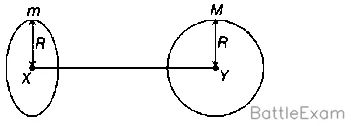
Find the gravitational force of attraction between the ring and sphere as shown in the figure, where the plane of the ring is perpendicular to the line joining the centres. If 8R is the distance between the centres of a ring (of mass m ) and a sphere (of mass M ), where both have equal radius R.
Given, distance between centre of ring and sphere, d=8R Since, gravitational field at the axis of ring, E=(d2+R2)3/2Gmd Here, G is the gravitational constant. ⇒E=(8R2+R2)3/2GmR8=(3R)3GmR8⇒E=27R3GmR8=27R2Gm8 Force between ring and sphere, F=ME . . . (i) Substituting the value of E in Eq. (i), we get F=278R2GmM
Q2JEE Main 2021MCQ4MElectrostatic Potential and Capacitance
Consider the combination of two capacitors C1 and C2, with C2>C1, when connected in parallel, the equivalent capacitance is 15/4 time the equivalent capacitance of the same connected in series. Calculate the ratio of capacitors C1C2.
(∗) Let, equivalent capacitance of two capacitors C1 and C2 connected in parallel be Ca and equivalent capacitance of same, when connected in series be Cb. According to given data, Ca=415Cb . . . (i) Since, equivalent capacitance in parallel combination, Ceq=C1+C2Ca=C1+C2 . . . (ii) and equivalent capacitance in series combination, 1/Ceq′=C11+C21Cb1=C11+C21=C1C2C2+C1Cb=C1+C2C1C2. . . (iii) Substituting Eqs. (ii) and (iii) in Eq. (i), we get C1+C2=415C1C1C2+C24(C1+C2)2=15C1C2⇒4C12+4C22+8C1C2=15C1C2⇒4C12+4C22−7C1C2=0 On dividing both sides by C12, we get 4+4(C1C2)2−7C1C2=0 or 4(C1C2)2−7(C1C2)+4=0 If C1C2=x, then 4x2−7x+4=0 By using the concept of quadratic equation, x=−b±b2−4ac/2a⇒x=87±49−64⇒x=C1C2=87±−15=87±15i
Q3JEE Main 2021MCQ4MUnits and Measurements
In a typical combustion engine, the work done by a gas molecule is given W=α2βekT−βx2, where x is the displacement, k is the Boltzmann constant and T is the temperature. If α and β are constants, dimensions of α will be
Given, work done by gas molecule, W=α2βe−βx2/kT Here, x is displacement, k is Boltzmann constant, α and β are constants and T is temperature. Dimensional formula of [W]=[ML2T−2]∴ Dimensions of [α2β]=[ML2T−2]\Rightarrow \;\; \alpha=\[;\frac{M L^{2} T^{-2}}{beta}]^{1 / 2}...(i)Theterm[ {e}^{-beta x^{2} / k T}]shouldbedimensionless,i.e.[ {M}^{0} {L}^{0} {T}^{0}].\Rightarrow ;; $[;\frac{\beta x^{2}}{k T}]$=[ {M}^{0} {L}^{0} {T}^{0}]\Rightarrow ;; [beta]=;\frac{[k][T]}{[x^{2}]$}...(ii);\text{ Energy of gaseous molecule };(E)=;\frac{7}{2} k T[k]=[E] /[T]=[ {ML}^{2} {T}^{-2} {K}^{-1}]SubstitutingthevalueofkinEq.(ii),weget[\beta]=;\frac{[M L^{2} T^{-2} K^{-1}]$[K]}{[L^{2}]$}=[M T^{-2}]Substitutingthevalueof\betainEq.(i),weget[\alpha]={;\frac{[ {ML}^{2} {T}^{-2}]$}{[ {MT}^{-2}]$}}^{1 / 2}=[ {M} {L}^{1} {T}^{0}]$
Q4JEE Main 2021MCQ4MAtoms and Nuclei
If λ1 and λ2 are the wavelengths of the third member of Lyman and first member of the Paschen series respectively, then the value of λ1:λ2 is
By using Rydberg's formula, λ1=R[n221−n121] where, R is Rydberg constant. For wavelength of third member of Lyman series n2=1 and n1=4. \therefore \;\; \;\frac{1}{\lambda_{1}}=R\[;\frac{1}{1^{2}}-;\frac{1}{4^{2}}]$=R[;\frac{1}{1}-;\frac{1}{16}]...(i)ForwavelengthoffirstmemberofPaschenseries,n_{2}=3andn_{1}=4\therefore ;; ;\frac{1}{\lambda_{2}}=R$[;\frac{1}{3^{2}}-;\frac{1}{4^{2}}]$=R[;\frac{1}{9}-;\frac{1}{16}]...(ii)OndividingEq.(ii)byEq.(i),weget;\frac{\lambda_{1}}{\lambda_{2}}=;\frac{[\frac{1}{9}-\frac{1}{16}]}{[;\frac{1}{1}-;\frac{1}{16}]}=;\frac{7}{9 \times 15}=;\frac{7}{135}$
Q5JEE Main 2021MCQ4MRay Optics and Optical Instruments
A short straight object of height 100cm lies before the central axis of a spherical mirror, whose focal length has absolute value f=40cm. The image of object produced by the mirror is of height 25cm and has the same orientation of the object. One may conclude from the information.
Given, height of object, ho=100cm Focal length of mirror, f=40cm Height of image, hi=25cm Nature of image is erect means virtual. As, hi is less than ho, so mirror used is convex mirror. Hence, (d) is correct option, i.e. image is virtual, opposite and is convex.
Q6JEE Main 2021MCQ4MOscillations
Assume that a tunnel is dug along a chord of the earth, at a perpendicular distance (2R) from the earth's centre, where R is the radius of the earth. The wall of the tunnel is frictionless. If a particle is released in this tunnel, it will execute a simple harmonic motion with a time period?
Given, radius of earth =R Distance of chord from centre of earth =2R Let x1 be the radius of inner circle and M be the mass of earth. ∴m′( effective mass of earth )=34πR3M⋅34πx13⇒m′=R3Mx13 If F is the gravitational force exerted by earth on particle at position x and ω be the angular velocity in time period T, then F=x12Gm′m=x12Gm⋅R3Mx13⇒mω2x1=R3GMmx1⇒ω=R3GMF=x12Gm′m=x12Gm⋅R3x13⇒mω2x1=R3GMmx1⇒ω=R3GM Since, ω=T2π and GM=gR2 Substituting the above values in Eq. (i), we get 1⇒T2π=R3gR2⇒T=2πgR
Q7JEE Main 2021MCQ4MAlternating Current
An alternating current is given by the equation i=i1sinωt+i2cosωt. The rms current will be
Given, i=i1sinωt+i2cosωt Let Irms be the rms current. ∴Irms=(2i12+i22)1/2⇒Irms=21(i12+i22)1/2
Q8JEE Main 2021MCQ4MProperties of Matter
The normal density of a material is ρ and its bulk modulus of elasticity is K. The magnitude of increase in density of material, when a pressure p is applied uniformly on all sides, will be
Given, density of material =ρ Bulk modulus of elasticity =K and applied pressure =p Let change in volume and density be ΔV and Δρ respectively and initial volume and density be V and ρ. Since, K=−VΔVp . . . (i) and density (ρ)= volume (V)mass(m)∴ρΔρ=−VΔV Substituting it in Eq. (i), we get V−ΔV=Kp=ρΔρ∴Δρ=Kpρ
Q9JEE Main 2021MCQ4MCircular Motion
A particle is moving with uniform speed along the circumference of a circle of radius R under the action of a central fictitious force F which is inversely proportional to R3. Its time period of revolution will be given by
Given, radius of circle =R Central fictitious force is, F∝R31. Let T be the time period of revolution, m,ω be the mass and angular velocity of Earth. ∵F=mω2R∝R31⇒ω2∝R41⇒ω=T2π∝R21⇒T∝R2
Q10JEE Main 2021MCQ4MGravitation
A planet revolving in elliptical orbit has I. a constant velocity of revolution II. has the least velocity when it is nearest to the Sun III. its areal velocity is directly proportional to its velocity IV. areal velocity is inversely proportional to its velocity. V. to follow a trajectory such that the areal velocity is constant. Choose the correct answer from the options given below.
According to Kepler's second law of planetary motion, areal velocity of every planet moving around the sun should remain constant in elliptical orbit.
Q11JEE Main 2021MCQ4MCentre of Mass and Collision
Given below are two statements : one is labelled as Assertion A and the other is labelled as Reason R. Assertion A Body P having mass M moving with speed u has head-on collision elastically with another body Q having mass m initially at rest. If m≪M , body Q will have a maximum speed equal to 2u after collision. Reason R During elastic collision, the momentum and kinetic energy are both conserved. In the light of the above statements, choose the most appropriate answer from the options given below.
Let v1 and v2 are the speed of P and Q after collision. By using law of conservation of mementum, m1u1+m2u2=m1v1+m2v2Mu+m⋅0=Mv1+mv2⇒mM(u−v1)=v2 and by using law of conservation of energy, 21m1u12+21m2u22=21m1v12+21m2v22⇒Mu2+0=Mv12+mv22⇒M(u2−v12)=mv22⇒M(u−v1)(u+v1)/m=v2221m1u12+21m2u22=21m1v12Mu2+0=Mv12+mv2⇒M(u2−v12)=mv22⇒M(u−v1)(u+v1)/m=v22 Substituting the value of Mm(u−v1) from Eq. (i) \in Eq. (ii), we get v2(u+v1)=v22u+v1=v2⇒M≫mv1=uv2=2u Eq. (ii), we get v2(u+v1)=v22u+v1=v2M>>mv1=uv2=2u Hence, option (c) is the correct.
Q12JEE Main 2021MCQ4MRotational Motion
Four identical solid spheres each of mass m and radius a are placed with their centres on the four corners of a square of side b. The moment of inertia of the system about one side of square, where the axis of rotation is parallel to the plane of the square is
Given, mass of solid sphere =m Radius of solid sphere =a Side of square =b Let Inet be the net moment of inertia of system. Moment of inertia of sphere, Is=52ma2 Axis of rotation is BC. ∴ Moment of inertia of any body at distance, (∵d=b)d=md2=mb2∴Inet =4(52ma2)+2(mb2)∴net =4(52ma2)+2(mb2)⇒Inet =58ma2+2mb2
Q13JEE Main 2021MCQ4MWave Optics
In a Young's double slit experiment, two slits are separated by 2mm and the screen is placed one metre away. When a light of wavelength 500nm is used, the fringe separation will be
Given, in YDSE, the separation between two slits, d=2mm=2×10⁻³m Distance between slit and screen, D=1m Wavelength of light, λ=500nm=500×10−9m Let B will be the fringe width ∴B=dλD=2×10−3500×10−9×1=250×10−6=0.25mm
Q14JEE Main 2021MCQ4MElectrostatics
Find the electric field at point P (as shown in figure) on the perpendicular bisector of a uniformly charged thin wire of length L carrying a charge Q. The distance of the point P from the centre of the rod is a=23L
Given, length of conductor =L Charge on conductor =Q According to figure, OP=a=23L,OQ=2LLet PQ=r=OP2+OQ2⇒PQ=(23L)2+(2L)2=43L2+4L=L and E be the electric field at point P. Since, E (due to finite wire) =akλ(sinφ1+sinφ2). . . (i) where, k= Coulomb's constant =4πϵ01λ= linear charge density =LQ and sinφ=sinφ2=LL/2=21 Substituting the above value in Eq. (i), we get E=akλ=4πϵ01Q/L⋅23L=23πϵ0L21
Q15JEE Main 2021MCQ4MOscillations
If two similar springs each of spring constant K1 are joined in series, the new spring constant and time period would be changed by a factor
Let series equivalent of spring constant =keq and T be the time period. In series arrangement, keq1=k11+k21⇒1/keq=k11+k11=k12⇒keq=2k1 As, T=2πk1m where, m is mass of body connected with spring. ⇒T∝k11 and T′∝k12⇒T′=2T
Q16JEE Main 2021MCQ4MThermodynamics
The temperature θ at the junction of two insulating sheets, having thermal resistances R1 and R2 as well as top and bottom temperatures θ1 and θ2 (as shown in figure) is given by
Let, Q= heat current, k= thermal conductivity, A = area, I= length of capacitor and Δθ= change in temperature . ∴Q=lkAΔθ=RΔθ(∵R=kAl)⇒R2θ2−θ=R1θ−θ1⇒R1θ2−R1θ=R2θ−R2θ1⇒θ=R1+R2R1θ2+R2θ1
Q17JEE Main 2021MCQ4MDual Nature of Matter and Radiation
Given below are two statements: One is labelled as Assertion A and the other is labelled as Reason R. Assertion A An electron microscope can achieve better resolving power than an optical microscope. Reason R The de-Broglie's wavelength of theelectrons emitted from an electron gun is much less than wavelength of visible light. In the light of the above statements, choose the correct answer from the options given below.
As we know that, Resolving power of microscope =Δθ1=λ2usinθ i.e. resolving power ∝λ1 and since, wavelength of electron emitted (λe)< wavelength of visible light (λv)∴ Resolving power of electron microscope > Resolving power of optical microscope. Hence, option (b) is the correct.
Q18JEE Main 2021MCQ4MSemiconductor Electronics
LED is constructed from GaAsP semiconducting material. The energy gap of this LED is 1.9eV. Calculate the wavelength of light emitted and its colour. [h=6.63×10⁻³⁴Js and c=3×10⁸ms−1 ]
Given, energy gap of LED, E=1.9eV Speed of light in free space, C=3×10⁸ms−1 Planck's constant, h=6.63×10⁻³⁴J−s As we know that, E=λhc⇒λ=Ehc⇒λ=19×1.6×10−196.63×10−34×3×108=654×10−9m=654nm As, wavelength of red light is 600nm. ∴ Required wavelength will be of red colour.
Q19JEE Main 2021MCQ4MProperties of Matter
A large number of water drops, each of radius r, combine to have a drop of radius R. If the surface tension is T and mechanical equivalent of heat is J, the rise in heat energy per unit volume will be
Given, radius of small drop =r Radius of big drop =R Surface tension =T and mechanical equivalent of heat =J As, small drops combine to form big drop. ∴ Volume of big drop (VB)=n× Volume of small drop (VS)⇒34πR3=n⋅34πr3⇒nr3=R3⇒r=n1/3R. . . (i) Surface energy of small drop (ES)= Surface tension (T)× Area (A)⇒ES=n×4πr2T and EB=4πR2T Now, change in energy will be ΔE=EB−ES=4πT(nr2−R2)∴ Heat energy per unit volume =VΔE=J×34πR34πT(nr2−R2)=J3T(R3nr2−R1)=J3T(nn2/3R3R2−R1)=\;\frac{3 T}{J}\[;\frac{n^{1 / 3}}{R}-;\frac{1}{R}]$;;[fromEq.(i)]=;\frac{3 T}{J}[;\frac{1}{r}-;\frac{1}{R}]$
Q20JEE Main 2021MCQ4MCurrent Electricity
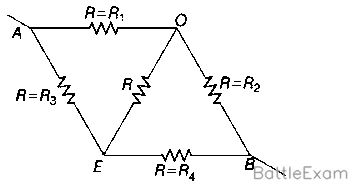
Five equal resistances are connected in a network as shown in figure. The net resistance between the points A and B is
Given all resistances have same resistance R. Now, we can redraw the circuit as belowLet resistances be R1,R2,R3 and R4. ∵R3R1=R4R2 So, circuit will behave as a Wheatstone bridge and no current will flow through midthle resistor. ∴Req=(R1+R2)+(R3+R4)(R1+R2)(R3+R4)=(R+R)+(R+R)(R+R)(R+R)=R
Q21JEE Main 2021NAT4MLaws of Motion
A person standing on a spring balance inside a stationary lift measures 60kg. The weight of that person, if the lift descends with uniform downward acceleration of 1.8m/s2 will be ........... N. [g=10m/s2]
Given, mass of man(m)=60kg Downward acceleration of lift, a=1.8ms−2 Let T be the tension in the rope connected with lift, g be the acceleration due to gravity (10ms−2). As, lift is moving in downward direction ∴mg−T=ma⇒T=mg−ma=m(g−a)=60(10−1.8)=60×8.2=492N Hence, the weight of the man during downward acceleration is 492N.
Q22JEE Main 2021NAT4MCurrent Electricity
In an electrical circuit, a battery is connected to pass 20C of charge through it in a certain given time. The potential difference between two plates of the battery is maintained at 15V. The work done by the battery is ......... J.
Given, charge passing through circuit, q=20C Potential difference between two plates, V=15V Let W be the amount of work done by battery. ∴W=qV=20×15=300J
Q23JEE Main 2021NAT4MSemiconductor Electronics
The circuit contains two diodes each with a forward resistance of 50Ω and with infinite reverse resistance. If the battery voltage is 6V, the current through the 120Ω resistance is ......... mA.
Given, forward resistance, R1=50Ω Reverse resistance, R2= infinity Battery voltage =6V According to circuit diagram, In this case, diode D1 is forward biased, whereas diode D2 is reverse biased. So, D2 will act as open circuit. By using Kirchhoff's voltage law, ⇒6−50I−130I−120I=0⇒6=300I⇒I=3006=501=1002=0.02A=20mA Hence, current through 120Ω=20mA
Q24JEE Main 2021NAT4MElectromagnetic Waves
A radiation is emitted by 1000W bulb and it generates an electric field and magnetic field at P, placed at a distance of 2m. The efficiency of the bulb is 1.25%. The value of peak electric field at P is x×10−1V/m. Value of x is .......... (Rounded-off to the nearest integer) [Take, ϵ0=8.85×10⁻¹²C2N−1m−2, c=3×10⁸ms−1]
Given, power of bulb, P=1000WDistance d=2mEfficiency of bulb =1.25%,ϵ0=8.854×10⁻¹²C2N−1m−1,c=3×10⁸ms−1∴ Intensity, (I)=Area(A)Power(P)=21ϵ0E2c⇒1001.25×4π(2)21000=21×8.854×10−12⇒E=16π12.5×8.854×10−4×32×108=13.7NC−1=137×10−1NC−1 or Vm−1∴x=137
Q25JEE Main 2021NAT4MMotion in a Plane
A boy pushes a box of mass 2kg with a force F=(20i+10j^)N on a frictionless surface. If the box was initially at rest, then ........ m is displacement along the X-axis after 10s.
Given, mass of box, m=2kg Force, F=20i^+10j^N Initial speed of box, u=0ms−1 Time, t=10s Let acceleration of box is a and displacement along X-axis after 10s is Sx. As, F=ma\Rightarrow \;\; a=F / m=\;{20 \hat{i}+10 \frac\hat{j}}{2}=(10 \hat{i}+5 \hat{j}) {ms}^{-2} By second equation of motion along X-axis, sx=uxt+21axt2sx=0+21×10×(10)2=500m Hence, displacement along X-axis after 10s is 500m.
Q26JEE Main 2021NAT4MLaws of Motion
As shown in the figure, a block of mass 3kg is kept on a horizontal rough surface of coefficient of friction 1/33. The critical force to be applied on the vertical surface as shown at an angle 60∘ with horizontal such that it does not move, will be 3x. The value of x will be ...........[g=10ms−2;sin60∘=23cos60∘=21]
Given, mass of block, m=3kg Coefficient of friction, μ=1/33 According to diagram,Let F be the force applied on the body, w be the weight (=mg), N be the normal reaction. Friction force f=μN For no movement of body along X-axis, net force along X-axis should be zero. If, Fy be the net force along y-axis then it will also be zero because body is not accelerating at all. ∴N=Fsin60∘+mg⇒N=23F+103 . . . (i) ∴N=Fsin60∘⇒N=23F+1 Similarly, Fx=Fcos60∘−μN=0 From Eq. (i), we get ⇒2F−331(23F+103)=0⇒2F=6F+310⇒2F−6F=310⇒F=10N Given, F=3x⇒x=310=3.33
Q27JEE Main 2021NAT4MThermodynamics
A container is divided into two chambers by a partition. The volume of first chamber is 4.5L and second chamber is 5.5L. The first chamber contain 3.0mol of gas at pressure 2.0atm and second chamber contain 4.0mol of gas at pressure 3.0atm. After the partition is removed and the mixture attains equilibrium, then the common equilibrium pressure existing in the mixture is x×10−1 atm. Value of x is .......... .
Given, volume of 1 st chamber, V1=4.5L Volume of 2 nd chamber, V2=5.5Ln1=3molp1=2atmn2=4molp2=3atm By using ideal gas equation, pV=nRT∴p1V1+p2V2=p(V1+V2)⇒2×4.5+3×5.5=p×10⇒9+16.5=10p⇒1025.5=p∴p=25.5×10⁻¹atm Hence, x=25.5atm
Q28JEE Main 2021NAT4MWaves
The mass per unit length of a uniform wire is 0.135g/cm. A transverse wave of the form y=−0.21sin(x+30t) is produced in it, where x is in metre and t is in second. Then, the expected value of tension in the wire is x×10−2N. Value of x is ......... (Round-off to the nearest integer)
Given, mass per unit length, μ=0.135g/cm Transverse wave equation, y=−0.21sin(x+30t) From given equation, ω=30rad/s,k=1 Speed of wave, v=kω=130=30ms−1 Also, v=μT⇒T=v2μT=(30)2×10−20.135×10−3=900×0.0135=12.15N=1215×10−2N Hence, x=1215
Q29JEE Main 2021NAT4MAlternating Current
In a series L−C−R resonant circuit, the quality factor is measured as 100 . If the inductance is increased by two fold and resistance is decreased by two fold, then the quality factor after this change will be ......... .
Given, initial quality factor (Qi)=100 Let initial inductance (xLi)=x Final inductance (xLf)=2x and initial resistance (Ri)=R Final resistance (Rf)=2R Final quality factor =Qf Since, Qi=RXL and Qf=R/22XL⇒Qf=R4XL=4Qi=4×100 Hence, final quality factor will be 400 .
Q30JEE Main 2021NAT4MElectromagnetic Waves
The maximum and minimum amplitude of an amplitude modulated wave is 16V and 8V, respectively. The modulation index for this amplitude modulated wave is ×10−2. The value of x is .......... .
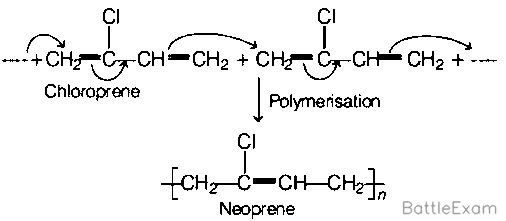
The given reaction take place as follows (i) Ammonia (NH3) reacts with H2O and CO2 to give ammonium carbonate [(NH4)2CO3]. NH3+H2O(A)+CO2⟶(NH4)2CO3 (ii) Ammonium carbonate react with water (H2O) and CO2 to give ammonium hydrogen carbonate (NH4HCO3). (NH4)2CO3+H2O+CO2(B)⟶2NH4HCO3 (iii) Ammonium hydrogen carbonate reacts with sodium chloride (NaCl) to give ammonium chloride (NH4Cl) along with sodium bicarbonate (NaHCO3). NH4HCO3+NaCl⟶NH4Cl+NaHCO (O 3 So, A−H2O,B−CO2;C−NaHCO3.
Q33JEE Main 2021MCQ4MSome Basic Concepts of Chemistry
Ozone is a strong oxidising agent like NO2. In troposphere both O3 and NO2 react with the unburnt hydrocarbons to produce the chemical components of photochemical smog, like formaldehyde (HCHO), acrolein (CH2=CH−CHO) and PAN or peroxyacetyl nitrate ( {CH}_{3}- {C}_{||}_{\text{O}}- {O}- {O}- {NO}_{2}) Hence, in troposphere, the presence of ozone generates photochemical smog.
Q34JEE Main 2021MCQ4MClassification of Elements
Match List-I with List-II. List-I(Electronicconfiguration ofelements) List-II (Δi in kJmol−1) A. 1s22s2 (i) 801 B. 1s22s22p4 (ii) 899 C. 1s22s22p3 (iii) 1314 D. 1s22s22p1 (iv) 1402Choose the most appropriate answer from the options given below.
Here, (B), (C) and (D) are p-block elements of the 2 nd period. (D) ⟶p1 configuration → B of group 13 (C) ⟶p3 configuration →N of group 15 (B) ⟶p4 configuration → O of group 16 We know, ionisation enthalpy (ΔiH)∝ stability of the subshell concerned. Therefore, half-filled subshell is more stable than partially filled. ∴ΔiH order is c>b>>d (A) is a s-block element (group 2) of 2nd period with s2-configuration → Be of group 2 [fully-filled; stable] So, the correct order of IE, or ΔiH1 (in kJmol−1 ) of the 2 nd period elements will beThe correct matching is (A)-(ii), (B)-(iii), (C)-(iv), (D)-(i) Note The order of IE, or ΔiH1 of 2 nd period elements is Li<B<Be<C<O<N<F<Ne
Q35JEE Main 2021MCQ4MChemical Bonding and Molecular Structure
Given below are two statements: One is labelled as Assertion (A) and the other is labelled as Reason (R). Assertion (A) Dipole-dipole interactions are the only non-covalent interactions, resulting in hydrogen bond formation. Reason (R) Fluorine is the mostelectronegative element and hydrogenbonds in HF are symmetrical. In the light of the above statements, choose the most appropriate answer from the options given below.
Assertion is false but Reason is true. Corrected Assertion Diple-dipole interactions are purely covalent interactions of dipolar covalent bonds. Ends of dipoles of a polar covalent bonds possess partial charges ( δ+ and δ−) which are less than unit electronic charge, e=1.6×10⁻¹⁹C.
Q36JEE Main 2021MCQ4MStructure of Atom
Statements about heavy water are given below. A. Heavy water is used in exchange reactions for the study of reaction mechanisms. B. Heavy water is prepared by exhaustive electrolysis of water. C. Heavy water has higher boiling point than ordinary water. D. Viscosity of H2O is greater than D2O. Whic oc the given statement are correct.
Statement A is true. Heavy water (D2O) is used in exchange reactions as a tracer compound for the study of reaction mechanisms. e.g. NaOH+D2O⟶NaOD+HDO Statement B is true. Heavy water is prepared by prolonged exhaustive (multi-stage ) electrolysis of ordinary water (H2O) containing NaOH. Statement C is true. Heavy water has higher boiling point (374.4K) than ordinary water (373K). Statement D is false. Because viscosity (in centipoise) of D2O is greater (1.107) than H2O(0.8903). So, statements A,B and C are correct (option-a).
Q37JEE Main 2021MCQ4MStructure of Atom
The orbital having two radial as well as two angular nodes is
Number of radial nodes =(n−I−1) [ n= principal quantum number, I= az imuthal quantum number] Number of angular nodes =1 (a) 3p(n=3,I=1)⇒11 (b) 4f(n=4,I=3)⇒03 (c) 4d(n=4,I=2)⇒12 (d) 5d(n=5,I=2)⇒22 So, 5d-orbital has two radial as well as two angular nodes (option-d). Note I=0 for s-orbital, I=1 for p-orbital, I=2 for d-orbital and I=3 for f−orbital.
Q38JEE Main 2021MCQ4Mp Block Elements
Match List-I with List-II. List-I(Ore) List-II(Element present) AKernite (i) Tin B. Cassiterite (ii)Boron C. Calamine (iii) Fluorine D. Cryolite (iv) Zinc Choose the most appropriate answer from the options given below.
(A) Kernite (Na2B4O7⋅4H2O) is sodium tetraborate tetrahydrate. It is also called rasovite. Kernite is also written as Na2B4O6(OH)2⋅3H2O It is an ore of boron (ii). (B) Cassiterite (SnO2) is the oxide. It is an ore of tin (i). (C) Calamine (ZnCO3) is zinc carbonate. It is also called smith sonite. It is an ore of zinc (iv). (D) Cryolite (Na3AlF6) is sodium hexafluoroaluminate. It is an ore of fluorine (iii). So, correct match is (A)-(ii), (B)-(i), (C)-(iv), (D)-(iii).
Q39JEE Main 2021MCQ4MAlcohols, Phenols and Ethers
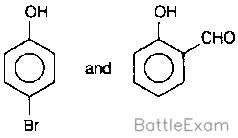
Identify the major products A and B respectively in the following reactions of phenol.
Phenol on reaction with Br2 in CS2/273K undergoes an electrophilic substitution reaction by Br+(electrophile) in aprotic solvent CS2 to give 4-bromophenol as the major product. Phenol on reaction withCHCl3,NaOH followed by hydrolysis gives Phenol on reaction with CHCl3,Na salicylaldehyde as a major product. It is Reimer-Tiemann reaction. It is also an electrophilic substitution reaction of phenol by dichlorocarbene CCl2 (electrophilic).
Q40JEE Main 2021MCQ4MPractical Organic Chemistry
Given below are two statements: Statement I A mixture of chloroform and aniline can be separated by simple distillation. Statement II When separating aniline from a mixture of aniline and water by steam distillation aniline boils below its boiling point. In the light of the above statements, choose the most appropriate answer from the options given below.
Statement I is true, i.e. a mixture of chloroform and aniline can be separated by simple distillation. Boiling points of chloroform (334K) and aniline (457 K) differ largely. So, on boiling the/mixture, vapours of CHCl3 are formed first which is then condensed to pure liquid CHCl3. Whereas, the vapours of aniline will form later and liquid aniline can be collected separately. Statement II is also true, i.e. aniline and water can be separated by steam distillation technique. Aniline is steam volatile but immiscible with water. So, a mixture of aniline and water will boil close to but below 373K. After distillation, the mixture of aniline (bottom layer) and water (top layer) can be separated by separating funnel. So, both statements I and II are true (option-d).
Q41JEE Main 2021MCQ4MHydrocarbons
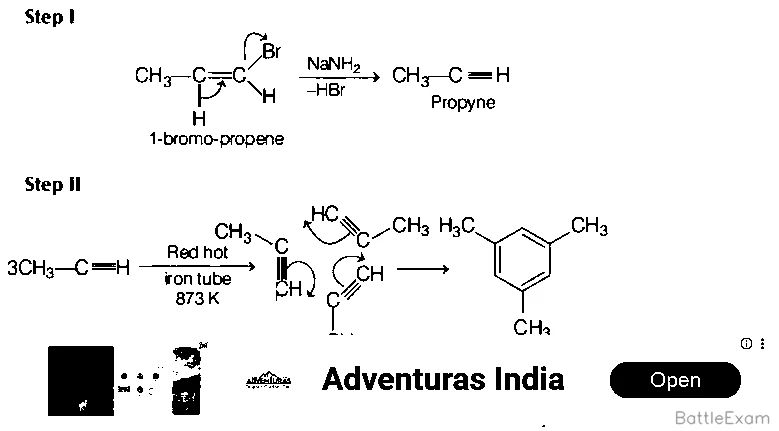
For the given reaction {\text{H}{\text{C}}_{|}_{CH_3}= {CHBr}{ \to }_{(ii) \text{Red} \text{hot} \text{iron} \text{tube} \text{iron}, 873 {K}}^{(i) {\text{NaNH}}_{2}}(\text{A})_{\text{Major} \text{product}}
When 1-bromo-prop-1-ene reacts with NaNH2 (a strong base), β-elimination or dehydrobromination, (−HBr) takes place to give propyne in next step. When propyne is passed through red hot iron tube, cyclic trimerisation (aromatisation also) occurs to produce mesitylene (A) as major product.
Q42JEE Main 2021MCQ4MRedox Reactions
On treating a compound with warm dil. H2SO4, gas X is evolved, which turns K2Cr2O7 paper acidified with dil. H2SO4 to a green compound Y.X and Y respectively are
Gas, X tums acidified dichromate (K2Cr2O7) green that means it is a reducing agent. Cr (VI) from compound K22Cr2O7 on reduction changes its colour from orange to green which is the colour of Cr (III) compound Y. SO2 can show both reducing and oxidising properties whereas SO3 cannot show reducing property because of highest group number 16, oxidation state (+6) of sulphur in SO3. So, X is SO2. As, X reacts with K2Cr2O7 in dil. H2SO4 medium, the green coloured Cr (III) compound, Y must be Cr (III) sulphate or Cr2(SO4)3. So, Y is Cr2(SO4)3. The overall reactions can be shown as : (\text{Compound})_{\text{Water} \text{soluble} {SO}_{3}^{-}\text{salt}} {\to }^{\;\text{ Dil. }\;}_{H_2SO_4} {{SO}_{2}}_{(\text{X})}(g) {\to }_{\text{dil}. H_2SO_4}^{ {K}_{2} {Cr}_{2} {O}_{7}} {Cr}_{2}{( {SO}_{4})}_{3}_{(\text{Y})}_{\text{Green}} (i) {SO}_{3}^{2-}+ {H}_{2} {SO}_{4} \longrightarrow \;{ {SO}}_{2}_{(X)} ↑+ {H}_{2} {O}+ {SO}_{4}^{2-} (ii) {{K}_{2} {{Cr}_{2}}^{+6} {O}_{7}}_{(\text{Orange})}+ {{SO}_{2}}^{+4} + {H}_{2} {SO}_{4} \longrightarrow {{Cr}_{2}}^{+3} ( {SO}_{4})_{3}_{(\text{Y})}_{(\text{Green})}+ {K}_{2} {{SO}_{4}}^{+6} + {H}_{2} {O}
Statement (b) is false whereas all other statements are true. There are two methods for estimation of nitrogen in an organic compound which are Duma's method and Kjeldahl's method. So, the statement in option (b) is false.
Q44JEE Main 2021MCQ4MBiomolecules
Which of the following vitamin is helpful in delaying the blood clotting ?
Deficiency of vitamin K increases blood clotting time. So, vitamin K is helpful in blood clotting. It is a fat-soluble vitamin. Vitamin C is used to prevent and treat scurvy. It is a water soluble vitamin. Vitamin B are also water soluble and play significant roles in cell metabolism and synthesis of RBC. Vitamin E is a fat-soluble vitamin. Deficiency of it may cause increased fragility of RBCs, nerve problems and mascular weakness. Vitamin E is a fat-soluble anti-oxidant which protects cell membranes.
Q45JEE Main 2021MCQ4MAldehydes, Ketones and Carboxylic Acids
A(C4H3Cl2)→373K Hydrolysis B(C4H8O)B reacts with hydroxyl amine but does not give Tollen's test. Identify A and B.
Compound B(C4H8O) reacts with hydroxylamine (NH2OH). So, compound B is an aldehyde or a ketone. Again, B does not give Tollen's test which indicates that B is a ketone but not an aldehyde. So, B is {{CH}_{3}- {C}^{||}^{\text{O}}- {CH}_{2} {CH}_{3}}_{2-\text{butan}-\text{one}}( {C}_{4} {H}_{8} {O}) Compound A(C4H8Cl2) is a dihalide which undergoes hot hydrolysis (H2O/373K) to give B, a ketone. So, A is a non-terminal geminal or gem dichloride and A is { {CH}_{3}- {C}_{|}_{Cl}^{|}^{Cl}- {CH}_{2} {CH}_{3}}_{ ( {C}_{4} {H}_{8} {Cl}_{2}) }_{ 2,2 -\text{dichlorobutane}} The reaction can be computed as,
Q46JEE Main 2021MCQ4MElectrochemistry
Compound A used as a strong oxidising agent is amphoteric in nature. It is the part of lead storage batteries. Compound A is
In the set of four lead compounds Pb (II) compounds are PbO and PbSO4.PbO2 is a Pb (IV) compound whereas Pb3O4 is a mixed oxide of Pb (II) and Pb (IV) i.e. 2PbO⋅PbO2. Pb is a member of group 14 and it shows +2 and +4 oxidation states. But due to inert pair effect, Pb2+ is more stable than Pb4+.So,Pb (IV) compounds are strong oxidising agents as Pb4+ gets easily reduced to more stable Pb2+. Pb+4+2e−⟶Pb2+,ΔC∘<0 (spontaneous) So, PbO2 or Pb3O4 can be the compound A. But out of these two compounds only PbO2 is used in lead storage batteries where a grid of lead packed with PbO2 acts as cathode and also it is amphoteric in nature. It reacts with both acids and alkali. (i) PbO2+2HCl⟶PbCl2+Cl2+H2O Here, PbO2 acts as a basic oxide as well as an oxidising agent. (ii) PbO2+2NaOH⟶Na2PbO2+H2O Here, PbO2 acts as an acidic oxide. So, the compound A is PbO2 (option-a).
Q47JEE Main 2021MCQ4Md and f Block Elements
Which one of the following lanthanoids does not form MO2 ? [ M is lanthanoid metal]
In oxides, MO2 ( M is lanthanoid metal) only four lanthanoids exhibit +4 oxidation state. These lanthanoids are praseodymium (Pr,Z=59), neodymium (Nd,Z=60) terbium (Tb,Z=65) dysprosium (Dy,Z=66) So, Yb (ytterbium) option (d) does not form MO2 type of oxide. Note The common and predominant oxidation state of lanthanoids is +3. Consequently M4+ compounds are strong oxidising agents which changes to the common +3 state. Similarly, lanthanoid compounds of +2 state have a tendency to show reducing property as they get changed to +3 state easily.
Q48JEE Main 2021MCQ4MAlcohols, Phenols and Ethers
Given below are two statements: Statement I o-nitrophenol is steam volatile due to intramolecular hydrogen bonding. Statement II o-nitrophenol has high melting due to hydrogen bonding. In the light of the above statements, choose themost appropriate answer from the options given below.
Statement I is true. Because of closer proximity (1,2-positions) of −OH and −NO2 groups, o-nitrophenol shows intramolecular hydrogen bonding.So, o-nitrophenol exists in monomeric state and becomes steam volatile. Statement II is false, because, due to the presence of intramolecular hydrogen bonding, boiling point and melting point of o-nitrophenol will be lower. Note p-nitrophenol is the positional isomer of o-nitrophenol. p-nitrophenol shows intermolecular hydrogen bonding and so, it has higher boiling point, melting point and water solubility.
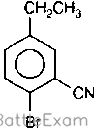
When 3 ethyl benzonitrile undergoes photochemical reaction (UV) with bromine (1 equivalent), we get a monobrominated product 1 bromo −1 ( 3 - cyanophenyl) ethane (A) as the major product.The reaction follows benzylic free radical substitution mechanism which has a 2∘ benzylic free radical intermediate (stable due to resonance with the benzene ring). (i) Initiation step In this step radicals are generated via homolytic fission of covalent bond.(ii) Propagation step 3-methyl benzonitrile reacts with bromine radical to give 1 -bromo-1-(3-cyanophenyl) ethane along with H∗.(iii) Termination step H∙ and Br∙ reacts to form HBr. H∙+Br∗⟶HBr
Q50JEE Main 2021MCQ4MAmines
An amine on reaction with benzene sulphonyl chloride produces a compound insoluble in alkaline solution. This amine can be prepared by ammonolysis of ethyl chloride. The correct structure of amine is
The amine on reaction with benzene sulphonyl chloride (Heisenberg reagent) produces a compound insoluble in alkali. It indicates the amine is a 2∘ amine. i.e. all options are possible except option (b) which is a 1∘ amine (CH3CH2NH2). As this 2∘ amine can be prepared by ammonolysis of ethyl chloride, the 2∘-amine should have at least one ethyl (C2H5) group. (a) Ph−NH−CH2CH2CH3 does not have ethyl group. (c) CH3CH2CH2−NH−CH3 does not have ethyl group. (d) CH3CH2CH2−NH−CH2CH3 has one ethyl group. So, option (d) is the correct answer. Preparation CH3CH2CH2−NH−CH2CH3 by ammonolysisof CH3CH2Cl
Q51JEE Main 2021NAT4MChemical Thermodynamics
For a chemical reaction, A+B⇌C+D(Δ1H∘=80kJmol−1) the entropy change ΔlS∘ depends on the temperature T (in K) as ΔrS∘=2T(JK−1mol−1). Minimum temperature at which it will become spontaneous is ............ K.
For the reaction, A+B⇌C+DΔG∘=ΔH∘−TΔS∘ The reaction will be spontaneous when, ΔG∘<0, i.e. ∣TΔS∘∣>∣ΔH∘∣[ Given,ΔH∘=80kJmol−1;ΔS∘=2TJmol−1K−1]⇒T>∣ΔS∘∣∣ΔH∘∣⇒T>2TJmol−1K−180×1000Jmol−1T2>4×10⁴K⇒T>200K So, the minimum temperature (T) at which the reaction will be spontaneous is 200K.
Q52JEE Main 2021NAT4MSome Basic Concepts of Chemistry
The number of significant figures in 50000.020×10−3 is ............
Non-zero digits are always significant. Any zeros between two significant digits are significant. ∴ Zero's between 5 and 2 are all significant. (Number of significant figures =7 )
Q53JEE Main 2021NAT4MChemical Kinetics
An exothermic reaction X→Y has an activation energy 30kJmol−1. If energy change ΔE during the reaction is −20kJmol−1 then the activation energy for the reverse reaction in kJ is ............
X⟶Y, it is an exothermic reaction whose ΔE or ΔH=−20kJmol−1Given, activation energy of the forward reaction (X→Y), Eaf=30kJmol−1 Activation energy of the backward or reverse reaction (Y→X), Eab can be calculated as, ΔH=Eaf−Eab⇒Eab=Eaf−ΔH=30−(−20)=50kJmol−1
Q54JEE Main 2021NAT4MElectrochemistry
Consider the following reaction, MnO4−+8H++5e−⟶Mn2++4H2O, E∘=1.51V. The quantity of electricity required in Faraday to reduce five moles of MnO4−is ............. .
In the reduction half-cell, MnO4−+8H++5e−⟶Mn2++4H1mol5F5mol25F As one mole of MnO4−required 5F of charge, 5 moles of MnO4−will require charge, Q=5×5 Faraday =25 Faraday
Q55JEE Main 2021NAT4MStates of Matter
A certain gas obeys p(Vm−b)=RT. The value of (∂p∂Z)T is RTxb. The value of x is ............ ( Z= compressibility factor)
For 1 mole of a real gas, the van der Waals' equation is, (p+Vm2a)(Vm−b)=RT At very high pressure, the equation becomes, p(Vm−b)=RT⇒pVm=RT+pb⇒RTpVm=1+RTpb⇒Z=1+RTpb[∵Z=RTpVm= compressibility ]∴(δpδZ)T=0+RTb=RTb=RTxb⇒x=1
Q56JEE Main 2021NAT4MChemical Equilibrium
A homogeneous ideal gaseous reaction AB2(g)⇌A(g)+2B(g) is carried out in a 25L flask at 27∘C. The initial amount of AB2 was 1 mole and the equilibrium pressure was 1.9atm. The value of Kp is x×10−2. The value of x is ............ .
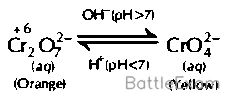
In basic medium dichromate ion (Cr2O72−) changes in chromate ion (CrO42−). Oxidation state of Cr in CrO42− is +6. ⇒CrO42−=x+4(−2)=−2 or x=+6 Dichromate and chromate equilibrium depends on pH of the medium as
Q58JEE Main 2021NAT4MSolutions
224mL of SO2(g) at 298K and 1 atm is passed through 100mL of 0.1MNaOH solution. The non-volatile solute produced is dissolved in 36g of water. The lowering of vapour pressure of solution (assuming the solution is dilute), (p(H2O)=24mm of Hg ) is x×10−2mm of Hg, the value of x is .......... .
Number of moles of SO2 passed n1=RTpV=0.082×2981×(224×10−3)=9.16×10⁻³mol=0.00916mol Number of moles of NaOH in the solution, n2=100100×0.1=1×10⁻²mol=0.01molHere, NaOH is the limiting reagent as it will leave (0.00916−0.005) mole of SO2 after the reaction. So, number of moles of Na2SO3 (solute) produced in the solution, n2′=21×0.01=0.005mol It is added into 36g of water to observe the colligative property, Relative Lowering of Vapour Pressure (RLVP). No. of moles of solute (Na2SO3)=0.005mol=n2′ No. of moles of solvent (H2O)=36/18=2mol=n1′ For Na2SO3 van't Hoff factor, i=3, as Na2SO3⟶2Na++SO32−[α=1, strong electrolyte ]i=[1+α(n−1)]=[1+1×(3−1)]=3 The RLVP equation is p∘Δp=xsolute ′×i=n1′+n2′n2′×i Lowering of VP (of the solution) =n1′+n2′n2′×i×p∘=2+0.0050.005×3×24mm of Hg=0.1795∼eq0.18mm of Hg=18×10−2mm of Hg=x×10−2mm of Hg⇒x=18
Q59JEE Main 2021NAT4MStates of Matter
3.12g of oxygen is adsorbed on 1.2g of platinum metal. The volume of oxygen adsorbed per gram of the adsorbent at 1atm and 300K in L is ............ [R=0.0821L atm K−1mol−1]
Number of moles (n) of O2 adsorbed on 1.2g of Pt=323.12mol Volume (V) of O2 adsorbed on 1.2g of PtV=pnRT=1323.12×0.082×300=2.398L{[R=0.082 {\text{L}} {\text{atm}} {\text{mol}}^{-1} {K}^{-1}, p=1 {\text{atm}}, T=300 {K}]\}\Rightarrow Volumeof{O}_{2}adsorbedpergramofadsorbent( {Pt})∈=;\frac{2.398}{1.2}=1.998 {L} ∼eq 2 {L}$
Q60JEE Main 2021NAT4MCoordination Compounds
Number of bridging CO ligands in [Mn2(CO)10] is ............ .
[Mn2(CO)10] is a polynuclear metal carbonyl compound. It is decarboxyldimanganese (0) which is made up of two square pyramidal Mn(CO)5 units joined by a Mn-Mn bond. The structure of [Mn2(CO)10] isHere, no CO ligand is a bridging ligand. So, number of bridging CO ligands in [Mn2(CO)10] is 0 (zero).
Mathematics30 questions
Q61JEE Main 2021MCQ4MVector Algebra
If a and b are perpendicular, then a×(a×(a×(a×b))) is equal to
a×[a×{a×(a×b)}]=a×(a×[(a⋅b)a−(a⋅a)b])[Using,a×(b×c)=(a⋅cb−(a⋅b)c]\;=a \times \[a × ((a ⋅ b) a-|a|^{2} b)]$;;=a \times $[(a × (a ⋅ b) a)-|a|^{2}(a × b)]$;;=a \times $[0-|a|^{2}(a × b)]$;;=-|a|^{2}[a \times (a \times b)];;=-|a|^{2}[(a \cdot b) a-(a \cdot a) b];;=-(a \cdot b) a|a|^{2}+|a|^{4} b;;=0+|a|^{4} b;;=|a|^{4} b;$
Q62JEE Main 2021MCQ4MProbability
A fair coin is tossed a fixed number of times. If the probability of getting 7 heads is equal to probability of getting 9 heads, then the probability of getting 2 heads is
Let the coin is tossed ' n ' times. Also, let x denote number of times head occurs. According to the question, P(X=7)=P(X=9) Using formula P(X=r)=nCtptqn−r where, p= probability of getting head in tossing a coin =1/2 and q=1−p=1−1/2=1/2∴P(X=7)=P(X=9)⇒nC7(21)7(21)n−7=nC9(21)9(21)n−9⇒nC7(21)n=nC9(21)n⇒nC7=nC9⇒n=7+9=16[∵nCr=nCq only when n=r+q]∴P(X=2)=16C2(21)2(21)14P(X=2)=2!14!16!(21)16=216×15(21)16=21623×15=21315
Q63JEE Main 2021MCQ4MMatrices and Determinants
Let A be a symmetric matrix of order 2 with integer entries. If the sum of the diagonal elements of A2 is 1 , then the possible number of such matrices is
Let A be the matrix as follows, A=[abbc], since A is symmetric matrix. Now, A2=[abbc][abbc]=[a2+b2ab+bcab+bcb2+c2] Given that, diagonal entries of A2 is 1. i.e. a2+b2+b2+c2=1 or a2+2b2+c2=1 Case 1. a=0 Then, 2b2+c2=1 (a) c=0 gives, b2=21 or b=±21∴a=0,b=1/2,c=0 (2 matrices) a=0,b=−1/2,c=0 (b) b=0, gives c2=1 or c=±1∴a=0,b=0,c=1 and a=0,b=0,c=−1 (2 matrices) Case 2. b=0, then a2+c2=1 (a) a=0, then c=±1a=0,b=0,c=1 and a=0,b=0,c=−1 This is repeated case. (b) c=0, then a=±1a=1,b=0,c=0 and a=−1,b=0,c=0 Again 2 matrices. Thus, only acceptable matrices are as follows A=[0001],[000−1],[1000],[−1000] Then possible number of such matrices are 4 .
Q64JEE Main 2021MCQ4MSequences and Series
In an increasing geometric series, the sum of the second and the sixth term is 225 and the product of the third and fifth term is 25 . Then, the sum of 4 th, 6 th and 8 th terms is equal to
Let the first term of geometric series be ' a ' and common ratio be ' r′. Then, nth term of given series is given as Tn=arn−1 Now, given that sum of second and sixth term is 225. i.e. T2+T6=225⇒ar+ar5=225=225 . . . (i) Also, given that product of third and fifth term is 25 . i.e. (T3)(T5)=25⇒(ar2)(ar4)=25⇒a2r6=25 . . . (ii) Squaring Eq. (i), we get a2r2(1+r4)2=(225)2 . . . (iii) Divide Eq. (iii) by Eq. (ii), a2r6a2r2(1+r4)2=4(25)(25)2⇒r4(1+r4)2=425⇒4(1+r4)2=25r4⇒4(1+r8+2r4)=25r4⇒4r8−17r4+4=0⇒4r8−16r4−r4+4=0⇒4r4(r4−4)−1(r4+(−4))=0⇒(r4−4)(4r4−1)=0 We have to find sum of 4 th, 6 th and 8 th term, i.e. T4+T6+T8=ar3+ar5+ar7=ar(r2+r4+r6)=ar3(1+r2+r4). . . (iv) Using Eq. (ii), t (ar3)2=25⇒ar3=5 Also, we take r4=4 because given series is increasing and r2=2. ∴T4+T6+T8=5(1+2+4)=5(7)=35
Q65JEE Main 2021MCQ4MDefinite Integrals
The value of sumn=1100intnnex−[x]dx, where [x] is the greatest integer ≤x, is
Let ' x ' be any real number, then x=[x]+{x}, where [x] is integer part of x and {x} is fractional part of x. Then, x−[x]={x}, Also period of {x}=1 Now, sumn=1100intn−1nex−[x]dx=sumn=1100intn−1ne[x]dx [Difference between upper and lower limit is 1 unit] =int01e[x]dx+int12e{x⟩dx+...+int99100e[x]dx=ex]01+e(x−1)]12+...+e(x−99)]99100=(e−1)+(e−1)+...+(e−1)=100(e−1)
Q66JEE Main 2021MCQ4MCircles
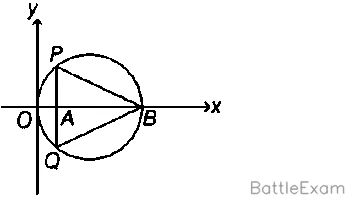
In the circle given below, let OA=1 unit, OB=13 unit and PQ⊥OB. Then, the area of the triangle PQB (in square units) is
Given, OA=1 unit, OB=13 unit Since, OB is diameter of circle. Then, radius(r)=13/2=6.5 unitsDraw a line joining points P and C, where C is the centre of the given circle. Then, PC= radius of circle =6.5 units OC= radius of circle =6.5 units Now, AC=OC−OA=6.5−1=5.5 unit Then, using Pythagoras theorem, (PA)2=(PC)2−(AC)2=(6.5)2−(5.5)2=(6.5−5.5)(6.5+5.5)=(1)(12)=12∴PA=12 Then, PQ=2PA=212 Hence, area of △PQB=21× Base ×( Height )=21×(PQ)×(AB)=21×(PQ)×(OB−OA)=21×(212)×(13−1)=1212=243 sq units
Q67JEE Main 2021MCQ4MSequences and Series
The sum of the infinite series 1+32+327+3312+3417+3522+... is equal to
Given, S=1+32+327+3312+... Let, S1=32+327+3312+... ... (i) Multiply 1/3 in series Eq. (i), 3S1=322+337+3412+...(ii) Subtract Eq. (ii) from Eq. (i), we get S1−3S1=32+325+335+...⇒32S1=32+[325+335+...]\;\; =\;\frac{2}{3}+\[;\frac{5 / 3^{2}}{1-1 / 3}]$[ \because ;\frac{5}{3^{2}}+;\frac{5}{3^{3}}+. . . ;\text{ is a geometric series };;;\text{ with }; r=1 / 3, ;\text{ \sum upto infinity of this series is };=;\frac{a}{1-r}^{'};; =;\frac{2}{3}+[;\frac{5}{6}]=;\frac{9}{6}=;\frac{3}{2}\Rightarrow ;; S_{1} ;; =;\frac{3}{2} \times ;\frac{3}{2}=;\frac{9}{4}S ;; =1+S_{1}=1+;\frac{9}{4}=;\frac{13}{4}$
Q68JEE Main 2021MCQ4MLimits, Continuity and Differentiability
The value of limh→02{3h(3cosh−sinh)3sin(6π+h)−cos(6π+h)} is
Using Binomial expansion, its (r+1) th term be, Tr+1=10Ct(tx1/5)10−r{t(1−x)1/10}r=10Cr(t)t(t)10−r(x1/5)10−t(1−x)r/10=10Cr(t)10−2r(x)510−r(1−x)r/10 If this term is independent of ' t′, then we havel 0−2r=0 gives, r=5∴T6=10C5(x)1(1−x)1/2∴T6=10C5(x)1(1−x)1/2 Let f(x)=x(1−x)1/2, to obtain its maximum value, we have to differentiate it and equate it to 0 . i.e. f′(x)=0⇒21−xx(−1)+1−x=0⇒−x+2(1−x)=0⇒−3x+2=0⇒x=32 and f^{' '}(\;\frac{2}{3}) < 0 (Maximum value) Thus, greatest term will be T6=10C5(32)(1−32)1/2=10C5332=(5!)2(33)10!⋅2
Q70JEE Main 2021MCQ4MDifferential Equations
The rate of growth of bacteria in a culture is proportional to the number of bacteria present and the bacteria count is 1000 at initial time t=0. The number of bacteria is increased by 20% in 2h. If the population of bacteria is 2000 after loge(6/5)kh, then (loge2k)2 is equal to
Let x be the number of bacteria at any time t. Given that, dtdx∝x(∵ Rate of growth =dtdx)⇒dtdx=λx⇒xdx=λdt After integrating it, we get logx=λt+C . . . (i) =0,x=1000 which gives log1000=0+C⇒C=log1000 Given, when t=0,x=log1000logx−log1000=λt or log(1000x)=λt . . . (ii) Given that in 2h, number of bacteria increased by 20% i.e. when t=2h,x=1200 Put, t=2 and x=1200 in Eq. (ii), log(10001200)=2λ gives, λ=21log(56) Again, from Eq. (ii), log(1000x)=21log(56) or 1000x=e2tlog(56). . . (iii) Given, x=2000 at t=k/loge(6/5), put in Eq. (iii), 10002000=e2klog(56)/log(56)2=ek/2orlog2=k/2k/log2=2∴(k/loge2)2=(2)2=4
Q71JEE Main 2021MCQ4MThree Dimensional Geometry
If (1,5,35),(7,5,5),(1,λ,7) and (2λ,1,2) are coplanar, then the sum of all possible values of λ is
Let P(1,5,35),Q(7,5,5),R(1,λ,7),S(2λ,1,2) Given P,Q,R,S are coplanar. Then, PQ, PR, PS lie on the same plane. PQ=(7−1)i^+(5−5)j^+(5−35)k^=6i^−30k^PR=(1−1)i^+(λ−5)j^+(7−35)k^=(λ−5)j^−28k^PS=(2λ−1)i^+(1−5)j^+(2−35)k^=(2λ−1)i^−4j^−33k^∵ PQ,PR and PS lie on same plane, then 602λ−10λ−5−4−30−28−33=0 Expand along first row, 6[−33(λ−5)−112]+30[(2λ−1)(λ−5)]=0⇒6(−33λ+53)+30(2λ2−11λ+5)=0⇒60λ2−528λ+468=0⇒10λ2−88λ+78=0⇒5λ2−44λ+39=0 . . . (i) Possible value of λ are roots of Eq. (i). Then, sum of all possible values of λ= Sum of roots of Eq. (i) =5−(−44)=544[∵ax2+bx++c=0, sum of roots =−b/a}
Q72JEE Main 2021MCQ4MInverse Trigonometric Functions
If asin−1(x)=bcos−1x=ctan−1y,0<x<1, then the value of cos(a+bπc) is
asin−1x=bcos−1x=ctan−1y Take first two terms of Eq. (i) asin−1x=bcos−1x⇒asin−1x=bcos−1x=a+bsin−1x+cos−1x⇒asin−1x=bcos−1x=a+bπ/2[∵sin−1x+cos−1x=2π]⇒asin−x=bcos−1x=a+bπ/2=ctan−1y Using last two terms, ctan−1y=a+bπ/2⇒tan−1y=2(a+b)πc⇒2tan−1y=(a+b)πc⇒cos−1(1+y21−y2)=a+bπc[∵2tan−1y=cos−1(1+y21−y2)]⇒1+y21−y2=cos(a+bπc)∴cos(a+bπc)=1+y21−y2
Q73JEE Main 2021MCQ4MPermutations and Combinations
The number of seven digit integers with sum of the digits equal to 10 and formed by using the digits 1,2 and 3 only is
To form a seven digit number with sum of digits 10 , all the digits can't be 1,2 or 3. Hence, seven digit number must have the following cases, Case 1. Using 1, 1, 1, 1, 1,2,3 Possible seven digit numbers will be =5!7!=7×6=42 Case 2. Using 2, 2, 2, 1, 1, 1, 1 Possible numbers will be =3!4!7!=3×27×6×5=35 No more cases will be formed. Hence, total number of seven digit numbers possible =42+35=77
Q74JEE Main 2021MCQ4MLimits, Continuity and Differentiability
Let f be any function defined on R and let it satisfy the condition ∣f(x)−f(y)∣≤∣(x−y)2∣,∀(x,y)∈R If f(0)=1, then
Given, ∣f(x)−f(y)∣≤∣x−y∣2⇒∣x−y∣∣f(x)−f(y)∣≤∣x−y∣ Now, taking the limit, limx→y∣x−yf(x)−f(y)∣≤limx→y∣x−y∣⇒∣f′(y)∣≤0 $[using the definition of f′(y) ]$ ⇒f′(y)=0 [since, modulus value can never be less than 0 ] On integrating it, we get f(y)=c (constant) Given, f(0)=1 gives C=1∴f(y)=1∀y∈R From given options, f(x)>0∀x∈R is satisfied only. Hence, answer will be option (d).
Q75JEE Main 2021MCQ4MApplication of Derivatives
The maximum slope of the curve y=21x4−5x3+18x2−19x occurs at the point
Given, curve is y=21x4−5x3+18x2−19x . . . (i) First, find the slope of given curve i.e. dy/dx, Differentiate Eq. (i), dxdy=21(4x3)−5(3x2)+18(2x)−19=2x3−15x2+36x−19 Now, let f(x)=2x3−15x2+36x−19 is slope of the curve and find its maximum value as follows, f′(x)=2(3x2)−15(2x)+36=6x2−30x+36 Equate f′(x)=0 and solve for ' x′ ', 6x2−30x+36=0⇒x2−5x+6=0⇒x2−3x−2x+6=0⇒(x−3)(x−2)=0⇒x=2 and 3\;\text{ Now, }\; f^{' '}(x) \;\; =\;\frac{d}{d x}(6 x^{2}-30 x+36)=12x−30\;\text{ Then, }\; f^{' '}(2) \;\; =12(2)-30=24-30=−6<0\;\text{ and }\; f^{' '}(3)= \;\; 12(3)-30=6 > 0 \because f^{' '}(2) < 0 , this implies 2′ is point of maxima. ∴ At x=2, slope will be maximum. Since, at x=2, slope will be maximum, then y-coordinate will be, y=21(2)4−5(2)3+18(2)2−19(2)=8−40+72−38=72−70=2∴ Maximum slope occurs at point (2,2).
Q76JEE Main 2021MCQ4MStraight Lines and Pair of Straight Lines
The intersection of three lines x−y=0, x+2y=3 and 2x+y=6 is a
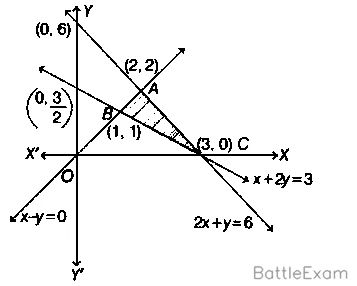
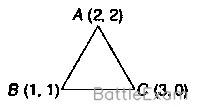
Given lines, x−y=0,x+2y=3,2x+y=6The only triangle which include all three lines is △ABC. Now, AB=(2−1)2+(2−1)2=2AC=(2−3)2+(2−0)2=5BC=(3−1)2+(0−1)2=5⇒AC=BC (two sides are equal) ⇒△ABC is isosceles triangle.
Q77JEE Main 2021MCQ4MThree Dimensional Geometry
Consider the three planes P1:3x+15y+21z=9, P2:x−3y−z=5 and P3:2x+10y+14z=5 Then, which one of the following is true?
Given, P1⇒3x+15y+21z=9P2⇒x−3y−z=5P3⇒2x+10y+14z=5 Consider plane P1, it can be written as 3x+15y+21z=9 or x+5y+7z=3 Again, consider plane P3, it can be written as, 2x+10y+14z=5 or x+5y+7z=5/2 Hence, P1 and P3 are parallel.
Q78JEE Main 2021MCQ4MMatrices and Determinants
The value of (a+1)(a+2)(a+2)(a+3)(a+3)(a+4)a+2a+3a+4111 is
Let I=int−π/2π1+3xcos2xdx... (i) Using the property, intabf(x)dx=intabf(a+b−x)dxI=int−π/2π/21+3π/2−π/2cos2(π/2−π/2=int−π/2π/21+3−xcos2xdx[∵cos(−x)=cosx]I=int−π/2π/2(1+3x)3xcos2xdx. . . (ii) Adding Eqs. (i) and (ii), 2I=int−π/2π/21+3xcos2xdx+int−π/2π/21+3x3xcos2xdx=int−π/2π/21+3x(1+3x)cos2xdx=int−π/2π/2cos2xdx=int−π/2π/221+cos2xdx=21[x+2sin2x]−π/2π/2=21[π]⇒2I=π/2⇒I=4π
Q80JEE Main 2021MCQ4MSets and Relations
Let R={(P,Q)∣,P and Q are at the same distance from the origin be a relation, then the equivalence class of (1,−1) is the set
Let P(a,b) and Q(c,d) are any two points. Given, OP=OQ i.e. a2+b2=c2+d2 Squaring on both sides, a2+b2=c2+d2 . . . (i) R={((a,b),(c,d)):a2+b2=c2+d2}R(x,y),S(1,−1),OR=OS This gives OR=x2+y2 and OS=2⇒x2+y2=2⇒x2+y2=2( Squaring on both sides )∴S={(x,y):x2+y2=2}
Q81JEE Main 2021NAT4MDifferential Equations
The difference between degree and order of a differential equation that represents the family of curves given by y2=a(x+2a), a>0 is ......... .
Given, y2=a[x+2a],a>0 ...(i) Differentiating both sides w.r.t. ' x ', 2ydxdy=a[1+0]=a . . . (ii) Use Eq. (ii) in Eq. (i) to eliminate the constant ' a '. y2=2ydxdy(x+2ydxdy)y2−2xydxdy=22⋅yy⋅dxdydxdy Squaring on both sides, y4+4x2y2(dxdy)2−4xy3dxdy=8y3(dxdy)3 Thus, degree of above differential equation is 3 and its order is 1 . Difference between degree and order =3−1=2
Q82JEE Main 2021NAT4MTrigonometric Ratios and Identities
The number of integral values of k for which the equation 3sinx+4cosx=k+1 has a solution, k∈R is ......... .
Given, 3sinx+4cosx=k+1. . . (i) Multiply and divide LHS of Eq. (i) by 32+42=5 i.e. 5(53sinx+54cosx)=k+1⇒5(cosαsinx+sinαcosx)=k+1 [Let cosα=3/5 then sinα=1−(3/5)2=54]⇒5sin(x+α)=k+1[Usesin(a+b)=sinacosb+cosasinb]⇒sin(x+α)=5k+1 Let x+α=θ Then, sinθ=5k+1∵−1≤sinθ≤1⇒−1≤5k+1≤1⇒−5≤k+1≤5⇒−6≤k≤4∴ Possible integral values of k are −6,−5,−4,−3,−2,−1,0,1,2, 3 and 4. i.e. Total 11 integral values of k are possible for which Eq. (i) has solution.
Q83JEE Main 2021NAT4MLogarithms
The number of solutions of the equation log4(x−1)=log2(x−3) is .......... .
log4(x−1)=log2(x−3) (given) ⇒log22(x−1)=log2(x−3) Using property of logarithm, logbca=C1logba⇒21log2(x−1)=log2(x−3)⇒log2(x−1)=2log2(x−3)⇒log2(x−1)=log2(x−3)2 On comparing, x−1=(x−3)2 or x−1=x2+9−6x⇒x2−7x+10=0⇒x2−5x−2x+10=0⇒(x−5)(x−2)=0⇒x=2,5x=2 (rejected) as x>3∴x=5 is only solution i.e. number of solution is 1 .
Q84JEE Main 2021NAT4MComplex Numbers
The sum of 162 th power of the roots of the equation x3−2x2+2x−1=0 is
Given, x3−2x2+2x−1=0 i.e. (x3−1)−(2x2−2x)=0⇒(x−1)(x2+x+1)−2x(x−1)=0⇒(x−1)(x2+x+1−2x)=0⇒(x−1)(x2−x+1)=0∴x=1 and x=2−(−1)±1−4=21±3i Then, sum of 162th power of the roots =(1)162+(−ω)162+(−ω2)162=1+ω162+ω324=1+(ω3)54+(ω3)108=1+(1)54+(1)108[∵ω3=1]=1+1+1=3
Q85JEE Main 2021NAT4MBinomial Theorem
Let m,n∈N and gcd(2,n)=1. If 30(table30;0)+29(table30;1)+...+2(table30;28)+1(table30;29)=n⋅2m, then n+m is .......... (Here, (tablen;k)=nCk)
Given, 30⋅30C0+29⋅30C1+...+2⋅30C28+30C29=n⋅2m This can be written as, sumr=029(30−r)30Cr=n⋅2m or sumt=030(30−r)⋅30Cr=n⋅2m⇒sumr=03030⋅30Cr−sumr=030r⋅30Cr=n⋅2m⇒30sumr=03030Cr−sumr=030r⋅30Cr=n⋅2m Using combination properties, 30⋅(2)30−30⋅(2)29=n⋅2m⇒30⋅(2)29(2−1)=n⋅2m⇒2.15⋅(2)29=n⋅2m⇒15⋅(2)30=n⋅2m Comparing both sides, n=15 and m=30⇒n+m=15+30=45
Q86JEE Main 2021NAT4MDifferential Equations
If y=y(x) is the solution of the equation esinycosydxdy+esinycosx=cosx,y(0)=0, then 1+y(6π)+23y(3π)+21y(4π) is .......... .
Given esinycosydxdy+esinycosx=cosx . . . (i) Let esiny=t, then esiny⋅cosy⋅dxdy=dx′dt Putting in Eq. (i), cosx ... (ii) (Linear form) Then, IF =e∫cosxdx=esinx Solution of differential Eq. (ii) is, t⋅IF=∫cosx⋅IFdx+Ct⋅esinx=∫cosx⋅esinxdx+C=eu i.e. let sinx=u then cosxdx=du⇒t⋅esinx=∫eudu+C=eu+C Put u=sinx and t=esiny⇒esiny⋅esinx=esinx+C Given, y(0)=0, this gives C=0⇒esiny⋅esinx=esinx⇒esiny+sinx=esinx⇒siny+sinx=sinx⇒siny=0⇒y=0∴y(π/6)=y(π/3)=y(π/4)=0 Hence, 1+y(6π)+23y(3π)+21y(4π)=1+0+0+0=1
Q87JEE Main 2021NAT4MThree Dimensional Geometry
Let (λ,2,1) be a point on the plane which passes through the point (4,−2,2). If the plane is perpendicular to the line joining the points (−2,−21,29) and (−1,−16,23), then (11λ)2−114λ−4 is ......... .
Given (λ,2,1) be point on the plane which passes through (4,−2,2) and plane is perpendicular to line joining P and Q. Given, AB is perpendicular to PQ i.e., AB⋅PQ=0 Now, AB=(4−λ)i^+(−2−2)j^+(2−k^=(4−λ)i^−4j^+k^PQ=(−1+2)i^+(−16+21)j^+(23−29)k^=i^+5j^−6k^=(4−λ)i^−4j^+k^PQ=(−1+2)i^+(−16+21)j^+(23−29)k^=i^+5j^−6k^ Hence, AB⋅PQ=0⇒(4−λ)(1)+(−4)(5)+(1)(−6)=0⇒4−λ−20−6=0⇒λ=−22 Then, (11λ)2−(114λ)−4=(11−22)2−(114×(−22))−4=4−(−8)−4=8
Q88JEE Main 2021NAT4MArea Under The Curves
The area bounded by the lines y=∣∣x−1∣−2∣ is ..........
Given, y=∣∣x−1∣−2∣ Required area is area of △PQR. Area =21×( Base )×( Height )=21×(PR)×(AQ)=21×4×2=4 Since, only one curve is given, here assume the area bounded by X-axis. Then, the area will be 4 sq unit.
Q89JEE Main 2021NAT4MDefinite Integrals
The value of the integral int0π∣sin2x∣dx is ......... .
Let I=int0π∣sin2x∣dx=2int0π/2∣sin2x∣dx[∵sin2x is periodic function ]=2int0π/2sin2xdx[sin2x is positive in range (0,π/2)]=2[2−cos2x]0π/2=−[cosπ−cos0]=−(−1−1)=2I=2
Q90JEE Main 2021NAT4MTrigonometric Ratios and Identities
If 3(cos2x)=(3−1)cosx+1, the number of solutions of the given equation when x∈[0,2π] is ......... .
Given, 3cos2x=(3−1)cosx+1,x∈[0,π/2] Let cosx=t, then 3t2=(3−1)t+1⇒3t2−3t+t−1=0⇒(3t2−3t)+(t−1)=0⇒3t(t−1)+1(t−1)=0⇒(t−1)(3t+1)=0 This gives t=1 and t=3−1 Put, t=cosx, then cosx=1 and cosx=3−1cosx=−1/3 is rejected as x∈[0,π/2]cosx=−1/3 is rejected as x∈[0,π∴cosx=1 Since, x∈[0,2π], then cosx=cos0 This gives x=0 is only solution. Therefore, number of solution when x∈[0,π/2] is 1 .