Given below are two statements: one is labelled as Assertion A and the other is labelled as Reason R. Assertion (A) When a rod lying freely is heated, no thermal stress is developed in it. Reason (R) On heating, the length of the rod increases. In the light of the above statements, choose the correct answer from the options given below
Thermal stress is defined as the stress, experienced by any rod on heating between two fixed rigid supports. On heating, the size of the rod increases but, if the two ends are free, rod will not experience any stress. i.e, there is no thermal stress will be produced in it. Hence, option (a) is the correct.
Q2JEE Main 2021MCQ4MWaves
A student is performing the experiment of resonance column. The diameter of the column tube is 6cm. The frequency of the tuning fork is 504Hz. Speed of the sound at the given temperature is 336m/s. The zero of the meter scale coincides with the top end of the resonance column tube. The reading of the water level in the column when the first resonance occurs is
Given, diameter of the column tube, d=6cm=6×10⁻²m Frequency of tuning fork, f=504Hz Speed of sound at given temperature, v=336ms−1 As, this is a closed organ pipe. Let L be the length of tube and λ be the wavelength, thenandL+e=λ/4=v/4f(∵λ=fv)e=0.6×d/2=106×26×10−2=0.018⇒L+e=4fv=4×504336⇒L=2016336−0.018=0.1667−0.018=0.1487m=14.87cm∼eq14.8cm
Q3JEE Main 2021MCQ4MGravitation
Two satellites A and B of masses 200kg and 400kg are revolving around the Earth at height of 600km and 1600km, respectively. If TA and TB are the time periods of A and B respectively, then the value of TB−TA is(Given, radius of Earth =6400km, mass of Earth =6×1024kg )
Given, MA=200kg,MB=400kg,HA=600km,HB=1600km and RA=RE+HA=6400+600=7000kmRB=RE+HB=6400+1600=8000km Let TA,TB,ωA,ωB,RA and RB be the time period, angular frequencies and radii of satellites A and B, respectively. Force on satellite A,FA=mAωA2RA=RA2GMmA⇒ωA2=RA3GM but, ωA=TA2π∴(TA2π)2=RA3GM⇒TA=GM4π2RA3 Similarly, TB=GM4π2RB3∴TB−TA=GM4π2(RB3−RA3)=GM2π[(8×10³)3−(7×10³)3]=GM2π×109(88−77)=2π×109/6.67×10−11×6×1024(4.107)=2π/4×1014×109(4.107)=π×102×4.107=12.9×102s=1.33×103s
Q4JEE Main 2021MCQ4MAlternating Current
The angular frequency of alternating current in an L-C-R circuit is 100rad/s. The components connected are shown in the figure. Find the value of inductance of the coil and capacity of condenser.
Given, angular frequency, ω=100rads−1R=60Ω,VR=15V,R′=40Ω,VR′=VL=20VVC=10VVR′=VL=20VBy using Ohm's law, V=IR⇒I=V/RI=15/60=1/4A . . . (i) and I1=VR′/R′=20/40=1/2A. . . (ii) As, XC=IVC=1/410=40Ω and XC=ωC1⇒C=XC(1)1=40×1001=0.25×10⁻³F=0.25mF=250μF By using KCL\inloop2, (ii) I2=I−I1=1/4−1/2=−1/4AXL=∣I2∣VL=1/420=80Ω⇒ωL=80L=ω80=10080=0.8H
Q5JEE Main 2021MCQ4MMagnetic Effects of Current and Magnetism
A proton, a deuteron and an α-particle are moving with same momentum in a uniform magnetic field. The ratio of magnetic forces acting on them is ......... and their speed is ......... in the ratio.
Let Fp,Fd and Fα be the forces and vp,vd and vα be the velocities of proton, deuteron and α−particle, respectively. Since, F=Bqv On dividing and multiplying F by m, we get F=Bqvmm⇒F=Bmqp(∵p=mv)⇒F∝q/m(∵p and B are same) ∴Fp:Fd:Fα=m+q:2m+q:4m+2q=1:1/2:1/2=2:1:1 and =Bqv⇒∝F/q∴vp:vd:vα=qpFp:qdFd:qαFα=q2x:qx:2qx=2:1:1/2=4:2:1
Q6JEE Main 2021MCQ4MSemiconductor Electronics
Given, below are two statements Statement I A speech signal of 2kHz is used to modulate a carrier signal of 1MHz. The bandwidth requirement for the signal is 4kHz. Statement II The side band frequencies are 1002kHz and 998kHz. In the light of the above statements, choose the correct answer from the options given below
Given, frequency of modulated signal, fm=2kHz=2×10³Hz Frequency of carrier signal, fc=1MHz=1×10⁶Hz=1000kHz Then, bandwidth =2fm=4kHz and side band frequency =fc±fm=(1000±2)kHz=1002kHz and 998kHz Hence, option (c) is the correct.
Q7JEE Main 2021MCQ4MOscillations
If the time period of a 2m long simple pendulum is 2s, the acceleration due to gravity at the place, where pendulum is executing SHM is
Given, length of simple pendulum, I=2m Time period, T=2s Let geff be the acceleration due to gravity. ∴ Time period, T=2π1/geff ⇒geff =4π2T21=4π2⋅42=2π2ms−2
Q8JEE Main 2021MCQ4MUnits and Measurements
The pitch of the screw gauge is 1mm and there are 100 divisions on the circular scale. When nothing is put in between the jaws, the zero of the circular scale lies 8 divisions below the reference line. When a wire is placed between the jaws, the first linear scale division is clearly visible while 72 nd division on circular scale coincides with the reference line. The radius of the wire is
Given, pitch of screw gauge, P=1mm Number of division, n=100∴ Least count (LC)=nP=1/100=0.01mm As, zero of circular division lies 8 divisions below. ∴ Zero error =8×LC=8×0.01=0.08mm Since, 1st linear scale division coinside with 72nd circular scale division. ∴Radius(r)=2[P+(72×LQ− Zero error ]=[1+(72×0.01)−0.08]/2=(1.72−0.08)/2=1.64/2=0.82mm
Q9JEE Main 2021MCQ4MSemiconductor Electronics
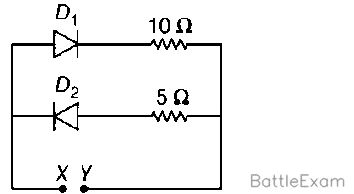
A 5V battery is connected across the points X and Y. Assume D1 and D2 to be normal silicon diodes. Find the current supplied by the battery, if the positive terminal of the battery is connected to point X.
Given, supply voltage, V=5V The circuit diagram, when positive terminal of the battery is connected to X is as shown belowLet I current is coming from battery. ∴D1 will act as closed circuit as forward biased and D2 will act as open circuit as reverse biased. Now, by using Kirchhoff's voltage law, 5−VD1−10I=0⇒5−0.7−10I=0(∵VD1=0.7V)⇒4.3=101⇒I=0.43A
Q10JEE Main 2021MCQ4MDual Nature of Matter and Radiation
An α-particle and a proton are accelerated from rest by a potential difference of 200V. After this, their de-Broglie wavelengths are λα and λp, respectively. The ratio λαλp is
Given, Cp=7/2R,CV=5/2R Since, change in internal energy (dU)=nCVdT Heat change (dQ)=nCpdT Work done (dW)=nRdT∴dU:dQ:dW=nCVdT:nCpdT:nRdT=CV:Cp:R=25R:27R:R=5R:7R:2R=5:7:2
Q12JEE Main 2021MCQ4MMotion in a Straight Line
An engine of a train moving with uniform acceleration, passes the signal-post with velocity u and the last compartment with velocity v. The velocity with which middle point of the train passes the signal post is
Given, initial speed of engine =u Speed of engine last compartment =v Let the length of train be I and the speed of mid-point of train be v′. Using third equation of motion, v2=u2+2as⇒v′2=u2+2al/2⇒v′2−u2=al . . . (i) Also, v2−u2=2al⇒a=2lv2−u2 Substituting the value of a in Eq. (i), we get v′2−u2=2lv2−u2⋅l=2v2−u2⇒v′=2v2−u2+u2=2v2+u2
Q13JEE Main 2021MCQ4MUnits and Measurements
Match List-I with List-II List-I List-II A. h (Planck's constant) 1. [MLT−1] B. E (kinetic energy) 2[ML2T−1] C. V (electric potential) 3. [ML2T−2] D. P (linear momentum) 4. [ML2I−1T−3]Choose the correct answer from the options given below.
The dimensional formulae of given terms are Planck's constant (h)=[ML2T−1] Kinetic energy (E)=[ML2T−2] Electric potential (V)=[ML2−11T−3] Linear momentum (p)=[MLT−1] So, the correct match is A→2,B→3,C→4,D→1.
Q14JEE Main 2021MCQ4MMagnetic Effects of Current and Magnetism
Magnetic fields at two points on the axis of a circular coil at a distance of 0.05m and 0.2m from the centre are in the ratio 8:1. The radius of coil is
Given, d1=0.05m,d2=0.2m and B1:B2=8:1 Let radius of coil be r. As we know that, magnetic field at a point on axis of a coil, B=2μ0⋅(d12+r2)3/2Ir2∴B2B1=(d12+r2)3/2⋅r2r2⋅(d22+r2)3/2=(d12+r2)3/2(d22+r2)3/218=(d12+r2d22+r2)3/2⇒123=(d12+r2d22+r2)3/214=d12+r2d22+r2⇒4d12+4r2=d22+r2⇒4(0.05)2+4r2=(0.2)2+r2⇒3r2=0.03⇒r=0.1m
Q15JEE Main 2021MCQ4MGravitation
A solid sphere of radius R gravitationally attracts a particle placed at 3R from its centre with a force F1. Now, a spherical cavity of radius (2R) is made in the sphere (as shown in figure) and the force becomes F2. The value of F1:F2 is
Given, radius of sphere =R Distance of particle from centre of Earth =3R Force between sphere and particle =F1 Radius of cavity =R/2 Let mass of sphere =M Mass of sphere with cavity =M′ Mass of particle =m Now, M′=ρ⋅34π(2R)3=8M By using concept of gravitational force, F1=(3R)2GMm=9R2GMm . . . (i) and Fcavity =(AB)2GM′m=25×8R2(2=254GMm . . . (ii) ∴F2=F1−Fcavity =9R2GMm−25×84R2GMm=R2GMm(91−501)=50×941R2GMm∵F2F1=4150
Q16JEE Main 2021MCQ4MAtoms and Nuclei
Two radioactive substances X and Y originally have N1 and N2 nuclei, respectively. Half-life of X is half of the half-life of Y. After three half-lives of Y, number of nuclei of both are equal. The ratio N2N1 will be equal to
Given, initial amount of X and Y be N1 and N2. Let half-life of X be tx and y be ty. According to question, tx=2ty=t⇒tx=t and ty=2t After 3 half-lives of Y, 3ty=6t As we know that, N=N0e−λt where, N is the number of nuclei left undecayed. and t1/2=λ0.693λ=t1/20.693λ1=t0.693 and λ2=2t0.693 Since, after 3 half-lives of Y number of nuclei of both become equal. ∴∴N1e−λ16t=N2e−λ26t⇒N1/N2=e6t(−λ2+λ1)⇒N1/N2=e6t(t0.693−2t0.693)=e0.693(t6t−2t6t)=e0.693×3=7.9∼eq8N2N1=18
Q17JEE Main 2021MCQ4MMotion in a Plane
In an octagon ABCDEFGH of equal side, what is the sum of AB+AC+AD+AE+AF+AG+AH if, AO=2i^+3j^−4k^?
Given, AO=2i^+3j^−4k^By using triangle law, Similarly, AC=AO+OBAD=AO+OCAE=AO+OEAF=AO+OFAG=AO+OGAH=AO+OH Now, adding all vectors AB+AC+AD+AE+AF+AG+AH=7AO+(OB+OC+OD+OE+OF+OG+OH) . . . (i) By using cyclic vector, OA+OB+OC+OD+OE+OF+OG+OH=0⇒OB+OC+OD+OE+OF+OG+OH=0−OA=0+AO Substituting in Eq. (i), we get AB+AC+AD+AE+AF+AG+AH=7AO+AO=8AO=8(2i^+3j^−4k^)=16i^+24j^−32k^
Q18JEE Main 2021MCQ4MGravitation
Given below are two statements: one is labelled as Assertion A and the other is labelled as Reason R. Assertion A The escape velocities of planet A and B are same. But A and B are of unequal mass. Reason R The product of their mass and radius must be same, M1R1=M2R2 In the light of the above statements, choose the most appropriate answer from the options given below.
Let vA,vB,MA,MB and RA,RB be the escape velocities, masses and radii of planet A and B, respectively. As we know that, v=2gR=R22GM⋅R=R2GM where, G is the gravitational constant. ⇒v∝RM Since, vA=vB∵RAMA=RBMB⇒MARB=MBRA or M1R2=M2R1 Hence, option (b) is the correct.
Q19JEE Main 2021MCQ4MElectromagnetic Induction
The current (i) at time t=0 and t=∞ respectively for the given circuit is
As we know that at time t=0, inductor acts as open circuit. Then, the circuit becomes Therefore, Req=(5+1)+(5+4)(5+1)(5+4)=6+96×9=1554=518 By using Ohm's law, V=IReqI=18E×5=185E[∵V=E] At t=∞, inductor will act as short circuit. It is shown belowTherefore, Req =5+55×5+1+41×4=1025+54=25+54=1033Ω and I=1033E=3310E
Q20JEE Main 2021MCQ4MWave Optics
Two coherent light sources having intensity in the ratio 2x produce an interference pattern. The ratio Imax+IminImax−Imin will be
Given, I2I1=2x⇒I1=2I2x As we know, and Imin=(I1−I2)2∴Imax+IminImax−Imin=2I1I2/l1+I2 (using dividendo rule) =22I2x⋅I2/2I2x+I2=2x+122x
Q21JEE Main 2021NAT4MAlternating Current
A transmitting station releases waves of wavelength 960m. A capacitor of 2.56μF is used in the resonant circuit. The self-inductance of coil necessary for resonance is ......... ×10−8H.
Given, wavelength of transmission signal, λ=960m Capacitance, C=2.56μF=2.56×10⁻⁶F As we know resonance frequency, f=2πLC1 Also, frequency (f)= wavelength (λ) speed (v)∴λv=2πLC1⇒LC=v×2πλ On squaring both sides, we get ⇒LC=v2×4π2λ2⇒L=v2×4π2×Cλ2⇒L=(3×10⁸)2×4π2×2.56×10−6(960)2∴L=10×10−8H
Q22JEE Main 2021NAT4MElectrostatics
The electric field in a region is given E=(53E0i^+54E0j^)CN. The ratio of flux of reported field through the rectangular surface of area 0.2m2 (parallel to YZ-plane) to that of the surface of area 0.3m2 (parallel to XZ - plane) is a:b, where a=.......... [Here i^,j^ and k^ are unit vectors along X,Y and Z-axes, respectively]
Given, {E}=\;\frac{3 E_{0}}{5} { {i}^{∧}+\;\frac{4}{5} E_{0} { {j}^{∧}, A1=0.2m2i^ and A2=0.3m2j^ Let φ1 and φ2 be the flux linked with area A1 and A2, respectively. As we know that, φ=∮E⋅dS=E⋅A⇒φ1=(3/5E0i^+4/5E0j^)⋅0.2i^=3/5E0×0.2 and similarly, φ2=4/5E0×0.3 Now, φ2φ1=4/5E0×0.33/5E0×0.2=1.20.6=21∴a=1
Q23JEE Main 2021NAT4MThermodynamics
In a certain thermodynamical process, the pressure of a gas depends on its volume as kV3. The work done when the temperature changes from 100∘C to 300∘C will be ........... nR, where n denotes number of moles of a gas.
Given, pressure (p)∝kV3T1=100∘C,T2=300∘CΔT=T2−T1=300−100=200∘C⇒ By using ideal gas equation, pV=nRTkV3⋅V=nRT⇒kV4=nRT On differentiating both sides w.r.t temperature, we get 4kV3dTdV=nR⇒4kV3dV=nRdT⇒kV3dV=nRdT/4⇒pdV=nRdT/4 As, work done (W)=pdV=nRdT/4=4nRΔT=4nR×200=50nR
Q24JEE Main 2021NAT4MCircular Motion
A small bob tied at one end of a thin string of length 1m is describing a vertical circle, so that the maximum and minimum tension in the string are in the ratio 5:1. The velocity of the bob at the highest position is ......... m/s. (Take, g=10m/s2 )
Given, length of string, l=1mTmax and Tmin be the tension in string and v1 and v2 be the velocities of bob at bottom and top in vertical circle.Tmax=mg+mv12/l and Tmin=mv22/l−mg∵TminTmax=mv22/l−mgmg+mv12/l=15⇒mg+mv12/l=5mv22/l−5mg Here, v1=v22+4gl⇒mg+lm(v22+4gl)=l5mv22−5mg⇒g+lv22+4gl=l5v22−5g⇒6gl=5v22−v22−4gl⇒10gl=4v22⇒v2=410gl=410×10×1=25=5m/s
Q25JEE Main 2021NAT4MCurrent Electricity
In the given circuit of potentiometer, the potential difference E across AB (10 m length) is larger than E1 and E2 as well. For key K1 (closed), the jockey is adjusted to touch the wire at point J1, so that there is no deflection in the galvanometer. Now, the first battery (E1) is replaced by second battery (E2) for working by making K1 open and K2 closed. The galvanometer gives then null deflection at J2. The value of E2E1 is b′a, where a= .......... .
Given, length of AB=10m=1000cm Length of one arm=101000=100cm For no deflection, In first case, l1=3×100+80=380cm In 2 nd case, I2=7×100+60=760cm As we know that in balanced potentiometer, ⇒ba=760380=21∴a=1
Q26JEE Main 2021NAT4MRay Optics and Optical Instruments
The same size images are formed by a convex lens when the object is placed at 20cm or at 10cm from the lens. The focal length of convex lens is ........... cm.
Let v be the position of image, h be the height of image and ho be the height of object. Given, hi=ho Since, magnification, m=hi/ho=hi/h . . . (i) By using lens formula, 1/f=1/v−1/u⇒1/v=1/f+1/uv=u+ffum=uv=f+uf Now, from Eq. (i), m can be ±1. For, m=+1=−10+ff . . . (ii) For m=−1=−20+ff . . . (iii) On dividing Eq. (iii) by Eq. (ii), we get −1=−20+f−10+f⇒20−f=−10+f⇒30=2f⇒f=15cm
Q27JEE Main 2021NAT4MElectrostatic Potential and Capacitance
512 identical drops of mercury are charged to a potential of 2V each. The drops are joined to form a single drop. The potential of this drop is.
Given, number of mercury drops, n=512 Voltage of each drop, V=2V Let r,R be the radius of drop small and combined spherical drop, respectively. Now, when all drops are joined into single drop, volume remains constant, i.e. 512×34πr3=34πR3∵V=rkq=2. . . (i) ∴Vnet =RkQ where, Q be the charge of bigger sphere. ⇒Vnet =8rk×512q . . . (ii) On dividing Eq. (ii) by Eq. (i), we get Vnet /V=8r×kqk×512q×r=8512Vnet =2×8512=128V
Q28JEE Main 2021NAT4MElectromagnetic Induction
A coil of inductance 2H having negligible resistance is connected to a source of supply whose voltage is given by V=3tV (where, t is in second). If the voltage is applied when t=0, then the energy stored in the coil after 4s is ........... J.
Given, inductance of coil, L=2H Supply voltage, V=3tV Let E be the energy stored in the coil. Since, emf V=L⋅dtdl3t=Ldtdl⇒3tdt=Ldl3t=Ldtdl⇒3tdt=Ldl On integrating both sides, we get 32t2=LI At t=4s, At t=4s,23×42=LI⇒23×L16=IL24=I. . . (i) As, E=1/2LI2E=1/2LL2242 [From Eq. (i)] =21L242=2×2242∴=144J
Q29JEE Main 2021NAT4MThermodynamics
A monoatomic gas of mass 4.0u is kept in an insulated container. Container is moving with velocity 30m/s. If container is suddenly stopped, then change in temperature of the gas (R= gas constant ) is 3Rx. Value of x is ........ .
Given, atomic mass of monoatomic gas, m=4u Velocity of container, u=30ms−1 Final velocity of container, v=0ms−1 Let ΔT be the change in temperature and ΔU be the internal energy change. Therefore, ΔKE=ΔU=(1/2)m(v2−u2)=nCvΔTΔT=21n⋅3/2Rm(v2−u2)⇒(∵Cv=23R)\;\; \;\frac{1}{2} \times m\[v^{2}-u^{2}]$=n \cdot ;\frac{3}{2} \cdot R \Delta T;\text{ Now, }; ;\frac{1}{2} \times 4|0^{2}-30^{2}|=1 \times ;\frac{3}{2} R \Delta T\Delta T=;\frac{4 \times 900}{3 R}=;\frac{x}{3 R};; x=3600$
Q30JEE Main 2021NAT4MProperties of Matter
The potential energy (U) of a diatomic molecule is a function dependent on r (interatomic distance) as U=r10α−r5β−3 where, α and β are positive constants. The equilibrium distance between two atoms will be (β2α)ba, where a=.........
Given, potential energy, U=r10α−r5β−3 As we know for equilibrium, differentiation of potential energy with respect to distance (drdu)=0⇒drd(r10α−r5β−3)=0⇒drd(αr−10−betar−5−3)=0−10αr−11+5βr−6−0=0⇒10αr−11=5βr−6⇒2αr−11=βr−6⇒β2α=r−11r−6=r5⇒r=(β2α)1/5⇒a=1⇒drd(r10α−r5β−3)=0⇒drd(αr−10−βr−5−3)=0⇒−10αr−11+5βr−6−0=0⇒10αr−11=5βr−6⇒2αr−11=betar−6⇒β2α=r−11r−6=r5⇒r=(β2α)1/5⇒a=1
Chemistry30 questions
Q31JEE Main 2021MCQ4MStructure of Atom
The plots of radial distribution functions for various orbitals of hydrogen atom against ' r ' are given below.The correct plot for 3s-orbital is
The correct plot for 3s-orbital isFor 3s, value of I=0 value of n=3 Number of peak =n−I=3−0=3 In graph D, three peaks are present, so this is the correct plot for 3s-orbital.
Q32JEE Main 2021MCQ4MChemical Bonding and Molecular Structure
According to molecular orbital theory, the species among the following that does not exist is
According to Molecular Orbital Theory (MOT), electronic configuration and their bond order of given options are as follows - O22−=σ1s2,σ∗1s2,σ2s2,σ∗2s2,σ2pz2,π2px2,π2py2,π∗2px2,π∗2py2 [No. of bonding electrons Bond order =r=2− No. of antibonding electrons] =210−8=22=1 - He2−=σ1s2,σ∗1s2,σ2s1 Bond order =23−2=21=0.5 - Be2=σ1s2,σ∗1s2,σ2s2,σ∗2s2 Bond order =24−4=0 - He2+=σ1s2,σ∗1s1 Bond order =22−1=21=0.5 If bond order of chemical species is zero then that chemical species does not exist. Therefore, Be2 does not exist.
Q33JEE Main 2021MCQ4MIonic Equilibrium
The solubility of AgCN in a buffer solution of pH=3 is x. The value of x is...... . [Assume : No cyano complex is formed; Ksp(AgCN)=2.2×10⁻¹⁶ and Ka(HCN)=6.2×10⁻¹⁰]
Ellingham diagram is the graphical representation of ΔG vs T. For the formation of oxides of elements similar diagrams can also be constructed for sulphides and halides. Such diagrams can help us in pridicting the feasibility of thermal reduction of an ore.
Q36JEE Main 2021MCQ4MRedox Reactions
Which of the following equation depicts the oxidising nature of H2O2 ?
Oxidation involves increase in oxidation number and reduction involves decrease in oxidation number. 2I−+2H++H2O12⟶I12+2H+12O2−2 In this reaction, H2O2 oxidises I−to I2 and itself gets reduced to H2O, so the reaction depicts oxidising nature of H2O2. While in other reactions H2O2 does not oxidise KlO4,I2 and Cl2.
Q37JEE Main 2021MCQ4MChemical Bonding and Molecular Structure
Statement (c) is correct, whereas all other statements are incorrect. Correct statements are as follows - Both B-H-B bridge bond having same bond length. - B-H-B bond angle is 90∘. - BH3 is electron deficient species and therefore act as Lewis acid.
Q38JEE Main 2021MCQ4Md and f Block Elements
Given below are two statements: Statement ICeO2 can be used for oxidation of aldehydes and ketones. Statement II Aqueous solution of EuSO 4 is a strong reducing agent. In the light of the above statements, choose the correct answer from the options given below.
Both statement I and statement II are true. The +3 oxidation state of lanthanide is most stable and therefore lanthanide in +4 oxidation state has strong tendency to gain electrons and converted into +3 and therefore act as strong oxidising agent, e.g. Ce4+. ∴CeO2 is used to oxidised alcohol, aldehyde and ketones. Lanthanides in +2 oxidation state has strong tendency to loss electron and converted into +3 oxidation state e.g. Eu+2. ∴ EuSO 4 acts as strong reducing agent.
Q39JEE Main 2021MCQ4MStructure of Atom
In which of the following pairs, the outer most electronic configuration will be the same?
(a) V2+−[Ar]3d3;Cr+−[Ar]3d5 (b) Cr+−[Ar]3d5;Mn2+−[Ar]3d5 (c) Ni2+−[Ar]3d8;Cu+−[Ar]3d10 (d) Fe2+−[Ar]3d6;Co+−[Ar]3d74s1 Thus, in option (b), both ions have same outer most electronic configuration.
Q40JEE Main 2021MCQ4MCoordination Compounds
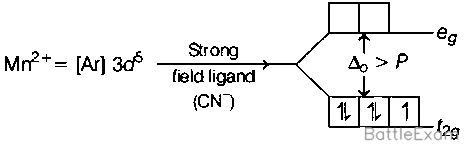
The hybridisation and magnetic nature of [Mn(CN)6]4− and [Fe(CN)6]3−, respectively are
[Mn(CN)6]4− In this complex, oxidation state of Mn is +2Hybridisation- d2sp3 Magnetic nature-Paramagnetic [Fe(CN)6]−3Hybridisation- d2sp3 Magnetic nature-Paramagnetic
Q41JEE Main 2021MCQ4Mp Block Elements
Given below are two statements: Statement I An allotrope of oxygen is an important intermediate in the formation of reducing smog. Statement II Gases such as oxides of nitrogen and sulphur present in troposphere contribute to the formation of photochemical smog. In the light of the above statements, choose the correct answer from the options given below.
Reducing smog is a mixture of smoke, fog and sulphur dioxide. Therefore, statement I is false. Tropospheric pollutants such as nitrogen oxide and sulphur oxide contribute to the formation of photochemical smog. So, statement II is true.
Q42JEE Main 2021MCQ4MOrganic Chemistry - Some Basic Principles
Complete combustion of 1.80g of an oxygen containing compound (CxHyOz) gave 2.64g of CO2 and 1.08g of H2O. The percentage of oxygen in the organic compound is
CxHyOz1.8g+O2⟶CO22.64g+H2O1.08gnC=CO (Moles) 2=44 (Molecular mass) 2.64 (Given mass) =0.06nH=2×nH2O=181.08×2=0.12 Weight of oxygen in CxHyOz=1.80−12×442.64−181.08×2=1.80−0.72−0.12=0.96g% of oxygen by weight =1.800.96×100=53.33%
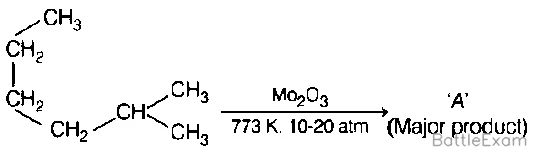
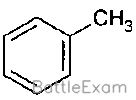
Oxides of molybdenum, vanadium and chromium, i.e. Mo2O3,V2O5 and Cr2O3 work as catalyst. When they are operated under certain temperature and pressure with n-heptane then they form toluene which is aromatic compound. Mo2O3 behave as aromatising agent.
Ist reaction is Markownikoff's addition of HCl on double bond while 2 nd reaction is halide substitution by Finkelstein reaction in which chlorine get displaced by iodine.
Q45JEE Main 2021MCQ4MAldehydes, Ketones and Carboxylic Acids
The major product of the following chemical reaction is {\text{CH}}_{3} {\text{CH}}_{2} {\text{CN}}{ \to }^{(ii) {\text{SOCl}}_{2}}^{(i) {H}_{3} {O}^{+}, \Delta }_{(iii) {Pd} / {\text{BaSO}}_{4}, {H}_{2}}?
Since, CrO3⋅H2SO4 behave as strong oxidising agent and it converts alcohol directly to carboxylic acid. Thus, reaction (b) will not form acetaldehyde.
Q47JEE Main 2021MCQ4MAldehydes, Ketones and Carboxylic Acids
Compound(s) which will liberate carbon dioxide with sodium bicarbonate solution is/are
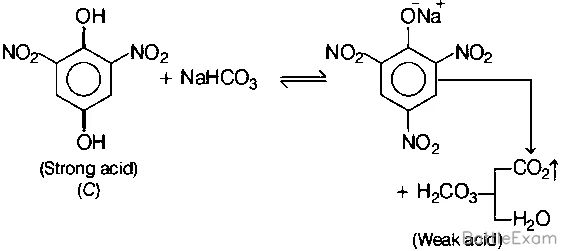
The reactions of given compound with sodium bicarbonate solution are as followsAs H2CO3 is weak acid it dissociate to liberate CO2 gas and H2O.Equilibrium favours forward direction and CO2 is liberated. In the above two reactions, H2CO3 is comparatively weak acid.Equilibrium favours backward direction and CO2 is not liberated. Thus, only B and C will liberate carbon dioxide with sodium bicarbonate solution.
Q48JEE Main 2021MCQ4MAmines
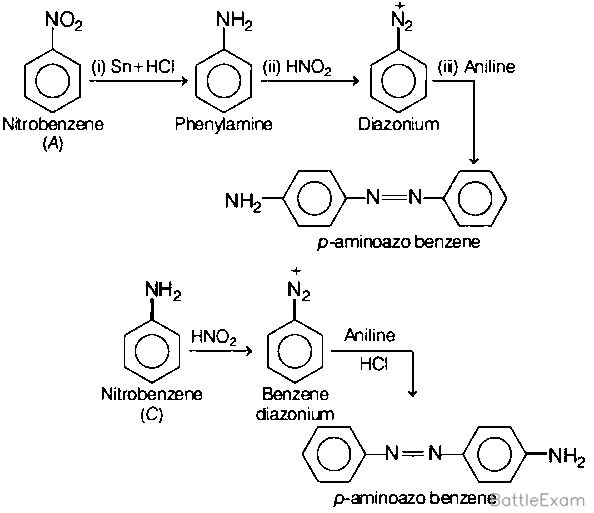
Which of the following reaction(s) will not give p-aminoazobenzene?
Nitrobenzene in presence of NaBH4,NaOH and aniline will not give p-amino azobenzene.In case of (A) and (C), coupling reaction takes place as the medium is quite acidic follows
Only statement (d) is correct whereas other statements are incorrect. The correct statements are as follows Buna- N is a synthetic polymer. Buna- S is an elastomer. Buna- S is polymerised by addition polymerisation method, which needs radical initiator for chain propagation step. Nascent oxygen can be used as an radical initiator.Neoprene is a synthetic rubber not an addition copolymer.
Q50JEE Main 2021MCQ4MBiomolecules
Which of the glycosidic linkage between galactose and glucose is present in lactose?
Glycosidic linkage is a type of covalent bond that joins carbohydrate molecules to another group. In lactose, glycosidic linkage is formed between C-1 of galactose and C−4, glycosidic of glucose.
Q51JEE Main 2021NAT4MIonic Equilibrium
0.4g mixture of NaOH,Na2CO3 and some inert impurities was first titrated with 10NHCl using phenolphthalein as an indicator, 17.5mL of HCl was required at the end point. After this methyl orange was added and titrated. 1.5mL of same HCl was required for the next end point. The weight percentage of Na2CO3 in the mixture is .............. (Rounded off to the nearest integer).
As given, NaOH and Na2CO3 is titrated with N/10HCl. For NaOH, Equivalents of NaOH= Equivalents of HCl Equivalents of HCl= Normality × Volume (L)=0.1×100017.5 Equivalent of HCl=1.75×10⁻³ Equivalents of NaOH=1.75×10⁻³ Weight of NaOH= Equivalent of NaOH× equivalent weight of =40×1.75×10−3=0.07gNaOH Now, weight % of NaOH=0.40.07×100=470=17.5% Similarly for Na2CO3, Equivalent of HCl= Equivalent of Na2CO3 Equivalent of Na2CO3=0.1×10001.5=0.15×10⁻³ Weight of Na2CO3= Equivalent of Na2CO3× equivalent weight of Na2CO3=0.15×10−3×106=15.9×10⁻³g Weight % of Na2CO3=0.415.9×10−3×100=0.039×100=3.9%∼eq4%
Q52JEE Main 2021NAT4MStates of Matter
A car tyre is filled with nitrogen gas at 35 psi at 27∘C. It will burst if pressure exceeds 40 psi. The temperature in ∘C at which the car tyre will burst is ........ (Rounded-off to the nearest integer).
p1=35ψ,T1=27∘C=300Kp2=40ψ,T2= ? According to Charle's law, p∝Tp1p2=T1T2⇒3540=300T2T2=35300×40=342.85K=69.7∘CT2∼eq70∘C Hence, answer is 70 .
Q53JEE Main 2021NAT4MChemical Thermodynamics
The reaction of cyanamide, NH2CN(s) with oxygen was run in a bomb calorimeter and ΔU was found to be −742.24kJmol−1. The magnitude of ΔH298 for the reaction NH2CN(s)+23O2(g)⟶N2(g)+O2(g)+H2O(l) is ............. kJ (Rounded off to the nearest integer). $[Assume ideal gases and R=8.314Jmol−1K−1 ]$
ΔU=−742.24kJmol−1Δng= [Number of gaseous molecules of products - Number of gaseous molecules of reactants] NH2CN(s)+23O2(g)⟶N2(g)+O2(g)+H2O(l)Δng=2−23=21ΔH=ΔU+ΔngRT=−742.24+21×10008.314×298=−741kJ/mol Hence, answer is 741 .
Q54JEE Main 2021NAT4MSolutions
1 molal aqueous solution of an electrolyte A2B3 is 60% ionised. The boiling point of the solution at 1atm is ........... K (Rounded off to the nearest integer). $[Given, Kb for (H2O)=0.52Kkgmol−1 ]$
In basic medium CrO42− oxidises S2O32− to form SO42− and itself changes into Cr(OH)4−. The volume of 0.154MCrO42− required to react with 40mL of 0.25MS2O32− is ........... mL (Rounded off to the nearest integer).
Given, Molarity of CrO42−(M1)=0.154M Molarity of S2O32−(M2)=0.25M Volume of S2O32−(V2)=40mL Volume of CrO42−(V1)= ? CrO4+S2O3⟶SO42−+Cr(OH)4+6 Gram equivalent of CrO42−= Gram equivalent of S2O32−N1V1=N2V2 Normality = Molarity ×n factor n for Cr=6−3=3n for S⇒S2O32−⟶2SO42−+8e−=80.154×3×V1=0.25×40×8V1=173mL
Q56JEE Main 2021NAT4MChemical Kinetics
For the reaction, aA+bB→cC+dD, the plot of logkvsT1 is given belowThe temperature at which the rate constant of the reaction is 10−4s−1 is ......... K (Rounded off to the nearest integer). $[Given : The rate constant of the reaction is 10−5s−1 at 500K ]$
According to Arrhenius equation, logK=logA−2.303RTEa Given, Slope =2.303REa=10,000K1=10−5,K2=10−4T1=500Klog10[K2K1]=2.303REa[T11−T21]\log \[;\frac{10^{-4}}{10^{-5}}]$ ;; =10000[;\frac{1}{500}-;\frac{1}{T_{2}}]\log 10 ;; =10000[;\frac{1}{500}-;\frac{1}{T_{2}}]T_{2} ;; =526.31 ∼eq 526 {K}$
Q57JEE Main 2021NAT4MChemical Thermodynamics
The ionisation enthalpy of Na+formation from Na(g) is 495.8kJmol−1, while the electron gain enthalpy of Br is −325.0kJmol−1. Given, the lattice enthalpy of NaBr is −728.4kJmol−1. The energy for the formation of NaBr ionic solid is (−)............×10−1kJmol−1.
Na(g)⟶IE1Na+(g)[IE1=495.8kJmol−1]Br(g)→gainenthalpy Electron (EG)Br−(g)[Gain enthalpy =−325kJmol−1]Na++Br−→energy Lattice (LENaBr(s)[ Lattice energy =−728.4kJmol−1]ΔHFormation =IE1+ Gain enthalpy + Lattice energy ΔH=495.8+(−325)+(−728.4)=−557.6kJ/mol=−5576×10−1kJ
Q58JEE Main 2021MCQ4Mp Block Elements
Among the following, the number of halide(s) which is/are inert to hydrolysis is
(1) BCl3+3H2O⟶H3BO3+3HCl (2) SiCl4+4H2O⟶SiO4H4+4HCl(3)PCl5+H2O⟶POCl3+2HCl (4) Due to steric crowding by six F-atoms, SF6 is inert towards hydrolysis.
Q59JEE Main 2021NAT4MAldehydes, Ketones and Carboxylic Acids
Consider the following chemical reaction. CH≡CH→(2)CO,HCl,AlCl3 (1) Red hot Fe tube, 873K Product The number of sp2 hybridised carbon atom(s) present in the product is .............
The reaction take place as follows Every carbon atom found in benzaldehyde (6 carbon in benzene ring +1 in aldehyde group), forms three bonds with neighbouring atoms-(one double bond + two single bond). Therefore, in benzaldehyde total number of sp2′C′ are 7 .
Q60JEE Main 2021NAT4MPractical Organic Chemistry
Using the provided information in the following paper chromatogram. The calculated Rf value of A×10−1
The retention factor (Rf) value can be used to identify the components of a mixture (solutes). Rf= Distance travelled by solvent front Distance travelled by solute On chromatogram, distance travelled by compound is 2cm. Distance travelled by solvent =5cm∴Rf=52=4×10⁻¹
Mathematics30 questions
Q61JEE Main 2021MCQ4MProbability
When a missile is fired from a ship, the probability that it is intercepted is 31 and the probability that the missile hits the target, given that it is not intercepted, is 43. If three missiles are fired independently from the ship, then the probability that all three hit the target, is
Probability of missile to get intercepted =31∴ Probability of missile to not get intercepted =1−31=32 Probability of missile to hit the target =43∴ Probability of three missiles to hit the target =(32×43)×(32×43)×(32×43)=81
Q62JEE Main 2021MCQ4MSequences and Series
If 0<θ,φ<2π,x=sumn=0∞cos2nθ,y=sumn=0∞sin2nφ and z=sumn=0∞cos2nθ⋅sin2nφ, then
Given, x=sumn=0∞cos2nθy=sumn=0∞sin2nφz=sumn=0∞cos2nθ⋅sin2nφ⇒x=1+cos2θ+cos4θ+...∞x=1−cos2θ1. . . (i) 1−cos2θ=x1⇒cos2θ=1−x1⇒y=1+sin2φ+sin4φ+...∞∴y=1−sin2φ1 . . . (ii) 1−sin2φ=y1⇒sin2φ=1−y1⇒z=1+cos2θ⋅sin2φ+cos4θsin4φ+...∞∴z=1−cos2θsin2φ1 . . . (iii) From Eqs. (i), (ii) and (iii), we get z=1−(1−x1)(1−y1)1∵cos2θ=1−x1∵sin2φ=1−y1z=xy−(x−1)(y−1)xyz=xy−xy+x+y−1xy⇒xz+yz−z=xy⇒xy+z=(x+y)z
Q63JEE Main 2021MCQ4MFunctions
Let f,g:N→N, such that f(n+1)=f(n)+f(1)∀n∈N and g be any arbitrary function. Which of the following statements is not true?
Given, f(n+1)=f(n)+f(1),∀n∈N⇒f(n+1)−f(n)=f(1) It is an AP with common difference =f(1) Also, general term =Tn=f(1)+(n−1)f(1)=nf(1)⇒f(n)=nf(1) Clearly, f(n) is one-one. For fog to be one-one, g must be one-one. For f to be onto, f(n) should take all the values of natural numbers. As, f(x) is increasing, f(1)=1⇒f(n)=n If g is many-one, then fog is many one. So, if g is onto, then fog is onto.
Q64JEE Main 2021MCQ4MThree Dimensional Geometry
The equation of the line through the point (0,1,2) and perpendicular to the line 2x−1=3y+1=−2z−1 is
Given, line ⇒2x−1=3y+1=−2z−1=λ (let) Any point on this line is B(2λ+1,3λ−1,−2λ+1) and direction ratios of this line =(2,3,−2)=d1 Let given point be A(0,1,2). Then direction ratio of AB=(2λ+1,3λ−2,−2λ−1)=d2∵ Both lines are perpendicular to each other. ∴d1⋅d2=02(2λ+1)+3(3λ−2)−2(−2λ−1)=0⇒4λ+2+9λ−6+4λ+2=0⇒17λ=2λλ=2/17∴ Direction ratio of required line d2=(21,−28,−21)=(3,−4,−3)=(−3,4,3) This line passes through A(0,1,2). ∴ Required equation of line ⇒−3x−0=4y−1=3z−2
Q65JEE Main 2021MCQ4MThree Dimensional Geometry
Let α be the angle between the lines whose direction cosines satisfy the equations I+m−n=0 and I2+m2−n2=0. Then, the value of sin4α+cos4α is
Given, l+m−n=0. . . (i) and I2+m2−n2=0... (ii) On squaring Eq. (i), we get (l+m)2=n2⇒l2+m2+2lm=n2 . . . (iii) From Eqs. (ii) and (iii), I2+m2−n2=0I2+m2+2lm=n2−n2−2lm=−n2−−−−⇒2lm=0⇒Im=0⇒I=0 or m=0 Case I When I = 0 ⇒0+m−n=0⇒m=n and I2+m2+n2=1⇒m2+m2=1[∵n=m and l=0]⇒m2=21m=±21=n∴(I,m,n)=(0,21,21) or (0,2−1,2−1) Case II When m=0 then, l+m−n=0⇒I=n and l2+m2+n2=1[∵n=I and m=0]⇒I2+0+I2=1I=±21[∵n=l and m=0]⇒∴(I,m,n)=(21,0,21) or (2−1,0,2−1)⇒a=(0,21,21) and b=(21,0,21) Then cosα=∣a∣∣b∣a⋅b=21∴sinα=±23 Now, cos4α+sin4α=161+169=1610=85
Q66JEE Main 2021MCQ4MIndefinite Integrals
The value of the integral ∫sinθsin\2θ(sin6θ+sin4θ+sin2θ)2sin4θ+3sin2θ+6/1−cos2thetadθ is (where, c is a constant of integration)
Given, int_{-1}^{1} x^{2} e^{[x^{3}]\} d x,where[t]isgreatestintegerfunction.\because ;; $[x^{3}]$=0 ∀ x in(0,1)and[x^{3}]=-1 ∀ x in(-1,0)So,int_{-1}^{1} x^{2} e^{[x^{3}]$} d x=int_{-1}^{0} x^{2} e^{-1} d x+int_{0}^{1} x^{2} e^{0} d x;; =;\frac{1}{e} int_{-1}^{0} x^{2} d x+int_{0}^{1} x^{2} d x=;\frac{1}{e} \times $[;\frac{x^{3}}{3}]{-1}^{0}+$[;\frac{x^{3}}{3}]{0}^{1};; =;\frac{1}{e} \times [0+;\frac{1}{3}]+[;\frac{1}{3}]=;\frac{1}{3 e}+;\frac{1}{3}=(;\frac{1+e}{3 e})$
Q68JEE Main 2021MCQ4MTrigonometric Ratios and Identities
A man is observing, from the top of a tower, a boat speeding towards the tower from a certain point A, with uniform speed. At that point, angle of depression of the boat with the man's eye is 30∘ (ignore man's height). After sailing for 20s, towards the base of the tower (which is at the level of water), the boat has reached a point B, where the angle of depression is 45∘. Then, the time taken (in seconds) by the boat from B to reach the base of the tower is
lnΔPQB,tan45∘=BQPQ1=BQPQPQ=BQ=h( let )In △PAQ,tan30∘=AQPQ⇒31=x+hh⇒x+h=3h⇒x=(3−1)h∵ Speed = Time Distance ∴ Speed from A to B=20AB=20x Also, distance from B to Q=h∴ Time taken to reach Q from B= Speed BQ=x/20h=xh×20[∵x=(3−1)h]=(3−1)hh×20=(3−1)(3+1)(3+1)×20=2(3+1)×20=10(3+1)
Q69JEE Main 2021MCQ4MParabola
A tangent is drawn to the parabola y2=6x, which is perpendicular to the line 2x+y=1. Which of the following points does not lie on it?
Given, parabola ⇒y2=6x⇒y2=4(23)x and given, line ⇒2x+y=1.∵ Equation of any tangent to the parabola having slope m is y=mx+3/2m Slope of line 2x+y=1 is m1=−2∵ Tangent is perpendicular to this line, ∴ Slope of tangent =m2=−m1=21∴ Equation of tangent will be y=21x+23×2y=2x+3 or2y=x+6 orx−2y+6=0 Clearly, on putting the coordinates of point (5,4), the equation of tangent is not satisfied. ∴ Point (5,4) does not lie on this tangent.
Q70JEE Main 2021MCQ4MTrigonometric Ratios and Identities
All possible values of θ∈[0,2π] for which sin2θ+tan2θ>0 lie in
sin2θ+tan2θ>0⇒sin2θ+cos2θsin2θ>0⇒sin2θ(1+cos2θ1)>0⇒sin2θ(cos2θcos2θ+1)>0⇒tan2θ(2cos2θ)>0cos2θ=0⇒1−2sin2θ=0sinθ=±21 Now, tan2θ(1+cos2θ)>0⇒tan2θ>0 as 1+cos2θ>0⇒2θ∈(0,2π)∪(π,23π)∪(2π,25π)∪(3π,27π)∴θ∈(0,4π)∪(2π,43π)∪(π,45π)∪(23π,47π) Since, sinθ=±21]
Q71JEE Main 2021MCQ4MComplex Numbers
Let the lines (2−i)z=(2+i)z and (2+i)z+(i−2)z−4i=0, (here i2=−1 ) be normal to a circle C. If the line iz+z+1+i=0 is tangent to this circle C, then its radius is
Given, (2−i)z=(2+i)z Let z=x+iy, then z=x−iy⇒(2−i)(x+iy)=(2+i)(x−iy)⇒2x−ix+2iy+y=2x+ix−2iy+y⇒2ix−4iy=0∴ Equation of line L1⇒x−2y=0. . . (i) Also, (2+i)z+(i−2)z−4i=0⇒(2+i)(x+iy)+(i−2)(x−iy)−4i=0⇒2x+ix+2iy−y+ix−2x+y+2iy−4i=0⇒2ix+4iy−4i=0∴ Equation of line L2⇒x+2y−2=0. . . (ii) From Eqs. (i) and (ii), 4y=2 or y=1/2 and x=1 Hence, centre =(1,1/2) Equation of third line L3⇒iz+z+1+i=0⇒i(x+iy)+(x−iy)+1+i=0⇒ix−y+x−iy+1+i=0⇒(x−y+1)+i(x−y+1)=0∴ Radius = Distance of point (1,1/2) to the line x−y+1=0∴r=∣1−21+1∣/12+12=223
Q72JEE Main 2021MCQ4MStraight Lines and Pair of Straight Lines
The image of the point (3,5) in the line x−y+1=0, lies on
Image of P(3,5) on the line x−y+1=0 is 1x−3=−1y−5=2−2(3−5+1)⇒1x−3=−1y−5=1⇒1x−3=1 and −1y−5=1x=4,y=4∴ Required image is at (4,4). Clearly, this point lies on (x−2)2+(y−4)2=4 as (4,4) satisfies this equation.
Q73JEE Main 2021MCQ4MEllipse
If the curves, ax2+by2=1 and cx2+dy2=1, intersect each other at an angle of 90∘, then which of the following relations is true?
Given, curves ax2+by2=1 and cx2+dy2=1∵ax2+by2=1 On differentiating both sides w.r.t. x, we get a2x+b2y⋅dxdy=0dxdy=ay−bx. . . (i) Also, cx2+dy2=1 On differentiating both sides w.r.t. x, we get c2x+d2y⋅dxdy=0dxdy=cy−dx∵ Both the curves intersect each other at 90∘. ∴ Tangents at point of intersection must be perpendicular to each other. ∴ Product of slope of tangents =−1ay−bx×cy−dx=−1 [from Eqs. (i) and (ii)] ⇒bdx2=−acy2 ... (iii) Also, on subtracting the equation of given curves, we get (ax2+by2−1)−(cx2+dy2−1)=0⇒x2(a1−c1)+y2(b1−d1)=0 or x2(a1−c1)=−y2(b1−d1) ... (iv) Dividing Eq. (iii) by Eq. (iv), (a1−c1)bd=(b1−d1)ac⇒c−abd×ac=d−bac×bd⇒c−a=d−b or c−d=a−b or a−b=c−d
Q74JEE Main 2021MCQ4MLimits, Continuity and Differentiability
Given, limit form is 1∞. L=elimn→(n1+21+31+...+n1) Let S=1+(21+31)+(41+51+61+71)+... Clearly, S<1+(21+21)+(41+41+41+41)+...+⏟(2n1+...+2n1)2n\timesS<1+1+1+1+...+1S<n+1∴L=en→−(2n+1−1n+1)⇒L=e0∴L=1L=1
Q75JEE Main 2021MCQ4MProbability
The coefficients a,b and c of the quadratic equation, ax2+bx+c=0 are obtained by throwing a dice three times. The probability that this equation has equal roots is
Given, ax2+bx+c=0 According to the question, a,b,c∈{1,2,3,4,5,6}∴n(S)=6×6×6=216 For equal roots D=0⇒b2−4ac=0⇒b2=4ac⇒ac=4b2b=2,ac=1⇒(a=1,c=1)b=4,ac=4⇒(a=1,c=4) or (a=4,c=1)(a=2,c=2)b=6,ac=9⇒(a=3,c=3)
Q76JEE Main 2021MCQ4MPermutations and Combinations
The total number of positive integral solutions (x,y,z), such that xyz=24 is
Given, xyz=24⇒xyz=23⋅31 Let x=2a1⋅3b1y=2a2⋅3b2z=2a3⋅3b3 where, a1,a2,a3∈{0,1,2,3}b1,b2,b3∈{0,1} Case Ia1+a2+a3=3∴ Non-negative solution =3+3−1C3−1=5C2=10 Case II b1+b2+b3=1∴ Non-negative solution =1+3−1C3−1=3C2=3∴ Total solutions =10×3=30
Q77JEE Main 2021MCQ4MQuadratic Equation and Inequalities
The integer ' k ', for which the inequality x2−2(3k−1)x+8k2−7>0 is valid for every x in R, is
If a curve passes through the origin and the slope of the tangent to it at any point (x,y) is x−2x2−4x+y+8, then this curve also passes through the point
Given, slope =x−2x2−4x+y+8⇒dxdy=x−2x2−4x+y+8=(x−2)(x−2)2+(y+4)=(x−2)+x−2y+4 Let (x−2)=t⇒dx=dt and (y+4)=u⇒dy=du∴dxdy=dtdu Now, dxdy=(x−2)+(x−2)(y+4)⇒dtdu=t+tu⇒dtdu−tu=t Here, integrating factor (IF) =1/t⇒u⋅(t1)=∫t(t1)dt⇒u/t=t+c⇒(x−2)(y+4)=(x−2)+c∵ It passes through origin [i.e. (0,0) ], then ∴−24=−2+c⇒−2+2=c⇒c=0 Hence, (x−2)(y+4)=(x−2)+0⇒y+4=(x−2)2 Clearly, this curve passes through (5,5) as it satisfies the equation.
Given, f(x)=x3−ax2+bx+4,x∈[1,2] Here, f(1)=f(2)⇒1−a+b−4=8−4a+2b−4⇒3a−b=7 . . . (i) Also, f′(x)=3x2−2ax+b According to the question, f′(34)=0⇒3×(34)2−2a(34)+b=0⇒−8a+3b=−16 . . . (ii) From Eqs. (i) and (ii), a=5,b=8(a,b)=(5,8)∴(a,b)=(5,8)
Q81JEE Main 2021NAT4MApplication of Derivatives
Let f(x) be a polynomial of degree 6 in x , in which the coefficient of x6 is unity and it has extrema at x=−1 and x=1 . If limx→0x3f(x)=1 , then 5f(2) is equal to ................
f(x)=x6+ax5+bx4+cx3+dx2+ex+f As, limx→0x3f(x)=1 non-zero finite So, d=e=f=0 and f(x)=x3(x3+ax2+bx+c) Hence, limx→0x3f(x)=c=1 Now, as f(x)=x6+ax5+bx4+x3 and f′(x)=0 at x=1 and x=−1 i.e. f′(x)=6x5+5ax4+4bx3+3x2 Now, f′(1)=0⇒6+5a+4b+3=0⇒5a+4b=−9 . . . (i) and f′(−1)=0⇒−6+5a−4b+3=0⇒5a−4b=3 . . . (ii) From Eqs. (i) and (ii), a=−3/5 and b=−3/2∴f(x)=x6−53x5−23x4+x3∴5f(2)=5[26−53(2)5−23(2)4+(2)3]=5[64−53×32−23×16+8]=320−96−120+40=144
Q82JEE Main 2021NAT4MLimits, Continuity and Differentiability
The number of points at which the function f(x)=∣2x+1∣−3x+2∣+x2+x−2∣,x∈R is not differentiable, is ........... .
Given, f(x)=∣2x+1∣−3∣x+2∣+∣x2+x−2∣=∣2x+1∣−3∣x+2∣+∣x+2∣×∣x−1∣ Here, critical points are x=2−1,−2,1∴f(x)=⎩⎨⎧x2+2x+3x<−2−x2−6x−5−2<x<2−1−x2−2x−32−1<x<1x2−7x>1 Now, f′(x)=⎩⎨⎧2x+2x<−2−2x−6−2<x<2−1−2x−22−1<x<12xx>1 Now, f′(x) at 1,−2 and −1/2 are For x=1, f′(x)=2x=2×1=2 and −2x−2=−(2×1)−2=−4f′(x)=2x= and −2x−2=−(2 both are not equal. ∴ Non-differentiable at x=1 Similarly, for x=−2,f′(x)=2x+2=2×(−2)+2=−2 and −2x−6=−2×(−2)−6=−2 both are equal. ∴ Differentiable at x=−2 and for x=−1/2,f′(x)=−2x−6=−2×(2−1)−6=−5 and −2x−2=−2×(2−1)−2=−1 both are not equal. ∴ Non-differentiable at x=−1/2∴ The number of points at which f(x) is non-differentiable is 2 .
Q83JEE Main 2021NAT4MArea Under The Curves
The graph of sine and cosine functions, intersect each other at a number of points and between two consecutive points of intersection, the two graphs enclose the same area A. Then A4 is equal to ......... .
Required area of shaded region A=intπ/45π/4{sinx−cosx)dx=[−cosx−sinx]π/45π/4=−[(cos45π+sin45π)−(cos4π+sin4π)]=−[(−21−21)−(21+21)]∴A=24=22⇒A4=(22)4=64
Q84JEE Main 2021NAT4MSequences and Series
Let A1,A2,A3,........ be squares, such that for each n≥1, the length of the side of An equals the length of diagonal of An+1. If the length of A1 is 12cm, then the smallest value of n for which area of An is less than one, is ......... .
According to the question, length of side of A1 square is 12cm.∵ Side lengths are in GP. (Side of nth square i.e. An ) ∴Tn=(2)n−112∴ Area =( Side )2=((2)n−112)2=2n−1144 According to the question, the area of An square <12n−1144<1⇒2n−1>144 Here, the smallest possible value of n is 9.
Q85JEE Main 2021NAT4MMatrices and Determinants
Let A=xyzyzxzxy, where x,y and z are real numbers, such that x+y+z>0 and xyz=2. If A2=I3, then the value of x3+y3+z3 is ........... .
A=02θ)tan(2θ)−tan(0and (I2+A)(I2−A)−1=[ab−ba]⇒∣(I2+A)(I2−A)−1∣=a2+b2⇒a2+b2=∣I2−A∣∣I2+A∣ . . . (i) Now, I2+A=[1001]+02θ)tan(2θ)−tan(0=12θ)tan(2θ)−tan(1 Similarly, I 2−A=12θ)−tan(2θ)tan(1 Here, ∣I2+A∣=∣I2−A∣=(1+tan2(2θ))⇒∣I2−A∣∣I2+A∣=1 . . . (ii) From Eqs. (i) and (ii), a2+b2=1 Now, 13(a2+b2)=13×1=13
Q87JEE Main 2021NAT4MPermutations and Combinations
The total number of numbers, lying between 100 and 1000 that can be formed with the digits 1,2,3,4,5, if the repetition of digits is not allowed and numbers are divisible by either 3 or 5 , is ........... .
Given, digits ={1,2,3,4,5} Numbers divisible by 3 (sum of digits divisible by 3 ).Case I When sum is 12→3,4,5→3!=6 Case II When sum is 9→2,3,4→3!=6 Case III When sum is 9→1,3,5→3!=6 Case IV When sum is 6→1,2,3→3!=6 So, total numbers divisible by 3=6×4=24 Numbers divisible by 5 (ending with 5) So, total numbers divisible by 5=12 Numbers divisible by 15 , are 145,415,345,435 i.e. total 4 numbers are divisible by both 3 and 5. i.e. divisible by 15 . Hence, the required numbers which are divisible by 3 or 5 =24+12−4=32
Q88JEE Main 2021NAT4MVector Algebra
Let a=i^+2j^−k^,b=i^−j^ and c=i^−j^−k^ be three given vectors. If r is a vector such that r×a=c×a and r⋅b=0, then r⋅a is equal to ......... .
Given equations, kx+y+2z=13x−y−2z=2−2x−2y−4z=3 For infinitely many solutions, Δ=Δx=Δy=Δz=0 Here, Δy=k3−21232−2−4=0⇒k(−8+6)−1(−12−4)+2(9+4)=0⇒−2k+16+26=0⇒2k=42∴k=21
Q90JEE Main 2021NAT4MHyperbola
The locus of the point of intersection of the lines (3)kx+ky−43=0 and 3x−y−4(3)k=0 is a conic, whose eccentricity is ............ .
Given, lines are 3kx+ky−43=0. . . (i) 3x−y−43k=0... (ii) Multiply Eq. (ii) ×k and then adding Eqs. (i) and (ii), 3kx+ky−43=0(23x)k=43+43k23kx−ky−43k2=0∴x=23k43(1+k2)=2(k+k1) Subtracting Eq. (i) from Eq. (ii), 3kx+ky−43=03kx−ky−43k2=02ky=43−43k2−++y=2k43(1+k2)=23(k+k1) We have, x=2(k+k1) and y=23(k1−k)2x=(k+k1). . . (iii) 23y=(k1−k) . . . (iv) Squaring and subtracting Eq. (iii) from Eq. (iv), 4x2−12y2=(k2+k21+2)−(k21+k2−2)4x2−12y2=4 or 16x2−48y2=1 Clearly, this is a hyperbola. ∴e2=1+a2b2=1+1648=1+3e2=4e=4=2 ( ∵ e is positive)